
OK, that’s a big question. Let’s narrow it. In your writing or whenever you are making a point, are you a dog with a bone? Or are you a cat swishing its tail, just cooling it?
I ask because I was faced with the question recently as my new book’s concluding chapter brought some criticism from one of my best, most trusted critics. Tony Gentry was my student, my tutee as we called them in History and Literature, many, many years ago. We got close back then. I helped him shape his senior thesis on Whitman and D.H Lawrence. I thought some doses of red beans and rice and Dr. John might help. (It helped enough that he graduated cum laude from one of the university’s most prestigious majors and inspired him to move to New Orleans to get some more beans and more of the good Dr.). He conducted a musician interview series on local radio and went on to write several YA bios of jazz stars like Dizzy and athletes like Jesse Owens. He’s written three novels including The Night Doctor of Richmond and his latest, Covenant City.
Back then, Tony served as a sounding board as I shaped my dissertation on Literature and the Rhetoric of Spontaneity, one of those broad undertakings everyone warns you not to attempt.
I did. I was arrogant and I felt I was onto something, the power of the claim of spontaneity to persuade. I was right: Trump’s perilous rhetoric of spontaneity has proven my idea valid not just for the ivory tower but for the ever-widening halls of injustice.
But what about the dog with a bone, or a cat swishing its tail, you’re wondering.
Glad you asked.
Tony’s take on my book’s conclusion threw me. He was looking for a dog delivering a bone:
Quick read of the conclusion, not seeing how it serves as a traditional conclusion to your book, as it introduces a bunch of new stuff, instead of reviewing and summarizing the chapters that have gone before…. I’d be looking for a rousing wrap-up that threads themes of each chapter together and neatly restates your thesis that popular improvisation, as engendered in American black culture, and fostered by emerging technologies, has taken over the world. Not much of that in this draft, right?
That he’s looking for a “traditional” conclusion is a tell: he wants “a rousing wrap-up.”
We teach our students the 5-paragraph essay that begins, a dog digging for a bone, this is what I’m going to tell you. Three paragraphs develop and demonstrate the argument: tell, tell, tell, barks the dog, bone in mouth, tail wagging. Then, delivering the bone to master, the ta-da, the QED: this is what I did. Chew on that! Aren’t I a good doggie?
It should be noted that young journalists are also taught to do that same dog with a bone approach: tell 'em what you're gonna tell 'em, tell it, tell 'em what you told 'em.
The dog is a utilitarian beast. He’s got purpose, the greatest good for the greatest number, with master at its head. Indeed, master especially. A dog with a bone? Nothing is more exclusively on task. No one bothers less to smell the roses.
In writing, the audience is master, I’ll give Tony that. They have a right to have their expectations met.
Or do they? For cat, not so much.
Cat is not one for purpose. And, masters? Who needs them? Masters—or mistresses—aren’t even on cats’ radar screens, unless perchance they’ve failed to put out the tuna kibbles.
Cats hang out. They live in the present moment. They leap here and there just for the fun of it, toppling things as they go. Wait, maybe that’s what masters and mistresses are for, picking up afterwards, or bearing witness to their charismatic acrobatics. Hence all those Instagram and YouTube cat videos.
So, you may wonder, where did this metaphor for essay finales come from?
Many years ago, giving my quest for bones a rest for a moment, I found myself reflecting on the kind of essay I liked to read, and write. Though not myself a cat person, I decided my essays seemed most like that simplest of line drawings of a cat. You remember: two circles, the smaller on top; a tail swooping to the right. No eyes, mouth or whiskers, just that most abstract kind of cat—even though there’s nothing abstract about a cat. They are all here, now: presence itself. No quest, no hero’s journey, no overt purpose.
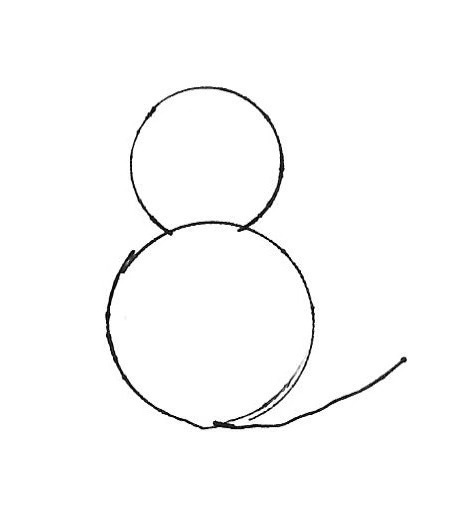
That in my mind’s eye the tail—my essay’s conclusion—swooped to the right was my only concession to purpose. It didn’t swoop left which felt like it pointed backwards—like the 5-paragraph essay we once learned and later taught, and then decided we could do without. It didn’t point to where we’d been but to where we’re going—and were going all along.
The swooping tail does sum up the essay. The cat uses its tail for balance. The essay’s tail end says, you wondering where all this was tending? Well, here it is.
No, the essay doesn’t deliver a bone. Just the balance of the essay delivered at a new level of abstraction or meaning. Not just the what that’s been explored, but the so what? What the understory is. What it all means to you and me and to our humanity.
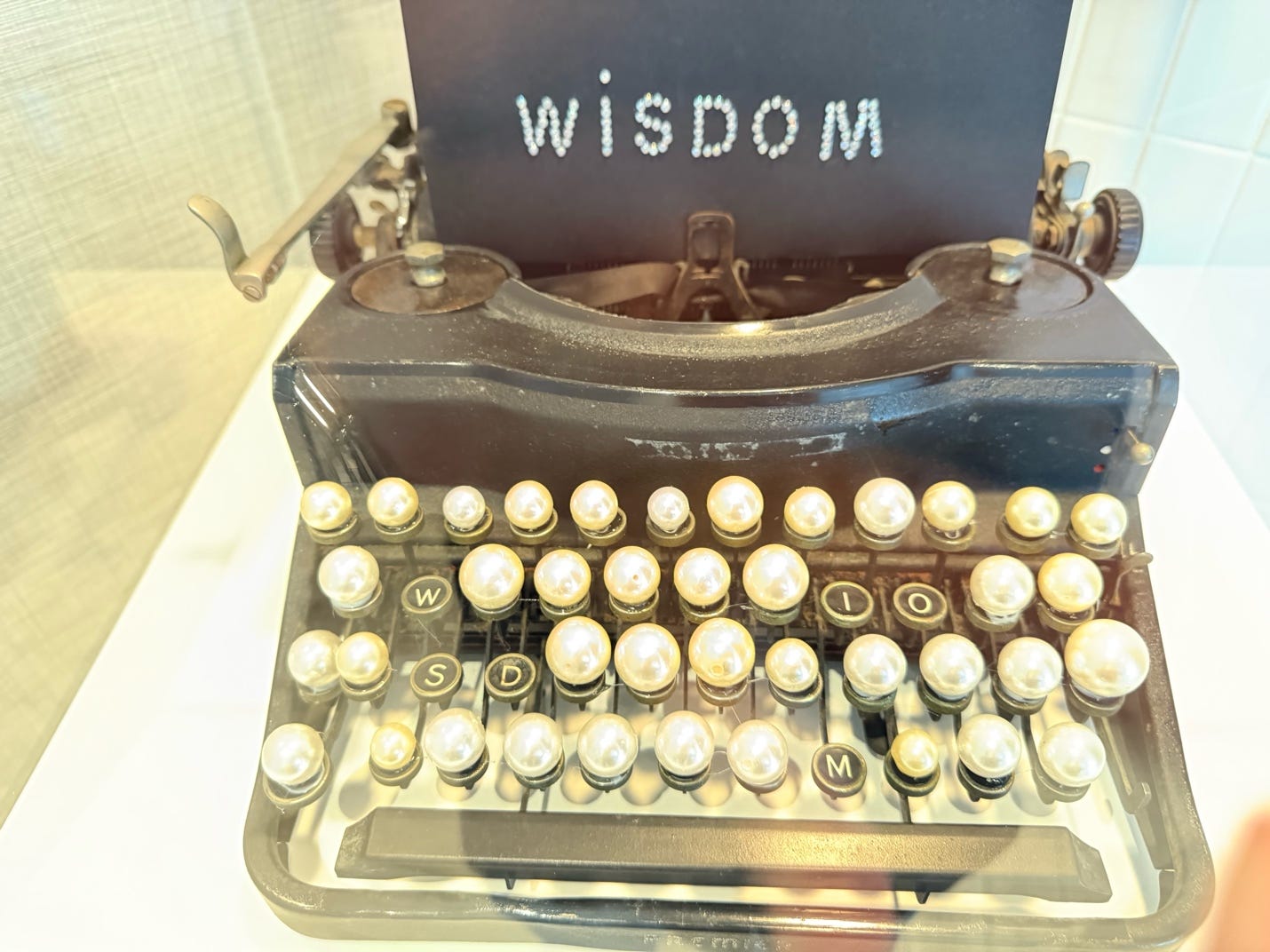
How is this essay’s tail wagging? Well, synchronistically, a metaphor came to my rescue to try to explain it. This art installation in the JFK Delta Lounge hit me as I was mulling over the difference between dogs-with-their-bones and cats-with-their-balancing-tails. W-I-S-D-O-M it reads on an old typewriter, most of its keys covered with glistening pearl beads. WISDOM: that was the bone we dug up presented in bright sequins on black paper. Ta-Da!
That’s if your essay is a dog, wishing to please its master, the audience. You go straight to the payoff: W-I-S-D-O-M.
But seen from another angle, the W-I-S-D-O-M was there all along. The pearls? Those were the other keys—QWERTY—that had just as much value as those six to which we give such weight. Those 6 letters weren’t our only goal. The other twenty had value too. They too were pretty and fun. The going was part of the goal. The essay was not just a dog with a message to deliver, but a cat, enjoying the journey all the while. W-I-S-D-O-M might be worth some tail wagging, but pearlescent keys are mighty pretty in getting there. Why worry just about the bone when finding it and bringing it home is part of the fun. Improv is about presence. Shouldn’t a book about presence display presence too, a purring, tail-wagging cat, not a dog on a mission.
What is my cat and what is the tail my book is wagging, or attempting to use for balance? Well, that’s for me to know, and to work on a better presentation of. Only then will I present it to the world, hoping it will pass Tony’s sniff test, and give you—and him—both pleasure and wisdom.
So, let me know. Are you a dog with a bone or a cat swishing its tail?
The new book is coming: The Age of Improv: How Improvisation Transformed Global Popular Culture.
No posts
Comments
Nothing yet. Say the first thing.
Sign in to join the conversation.