
(Rampersand's Giant Warm Intro returns to SouthStart. Since 2019, GWI has facilitated 1,200+ curated meetings and supported $10M+ in tracked capital raised. Taryn Pieterse speaks at Midday on Wednesday in the Cellar. See you there →)
Legendary VC investor John Doerr said, “We need teams of missionaries, not teams of mercenaries”, back in 2000.
It’s a great soundbite. But does it still hold true a quarter of a century later, in a world where AI can compress years of domain learning into months, where iteration cycles are measured in days, and where a sharp operator with no personal axe to grind can outship a true believer who fell in love with their first solution?
I talk to hundreds of founders a year and the pattern that actually predicts outcomes isn’t motivation type. It’s the quality of focus on solving a painful problem, tied with elite execution.
The mercenary founder who spots a large, underserved market and bets on out-executing the field? Dangerous. We’re watching exactly this play out with Sascha Krecinic and Dheer Gupta at SkipUp — serial startup operators who identified a genuine execution gap in AI scheduling and are moving at a pace that matters.
The missionary founder who has lived the problem from the inside, can’t stop thinking about it, and is building the thing they wished existed? Also dangerous. We see this every day in Jevon Le Roux, Tracy Godtschalk and Tahir Rauf at Keeyu — retail operators who spent years inside e-commerce, firefighting the chaos their platform now proactively prevents.
Different fuel sources. Both compounding.
Whatever the motivation, it must translate into relentless focus, deep customer listening, and rapid iteration. We’ve seen missionaries fail because their conviction made them rigid — too loyal to the original thesis to hear what the market was actually telling them. We’ve seen mercenaries flame out because, without genuine belief in the problem, the inevitable hard stretch feels like a signal to move on rather than grind through.
Perhaps you need both.
NextView Ventures’ Rob Go put it well:
“One of the most successful founders I’ve had the opportunity to collaborate with is arguably a missionary who was trained as a mercenary early in their professional career, so has found a way to be the best of both.”
With AI, the pace is unforgiving. Remaining focused, staying close to the customer, being disciplined enough to act on what you hear — and knowing what to ignore — is the real discipline.
The question I ask when we meet a founder isn’t: why are you building this? It’s: do you understand this problem at a level no one can easily replicate? Are you closer to the customer’s pain than anyone else? And are you building a team that can ship, learn, and ship again?
The motivation is the backstory. Focus and execution is the weapon.
If you’re building in AI — driven by mission, market, or a mix of both — we’d love to hear from you.
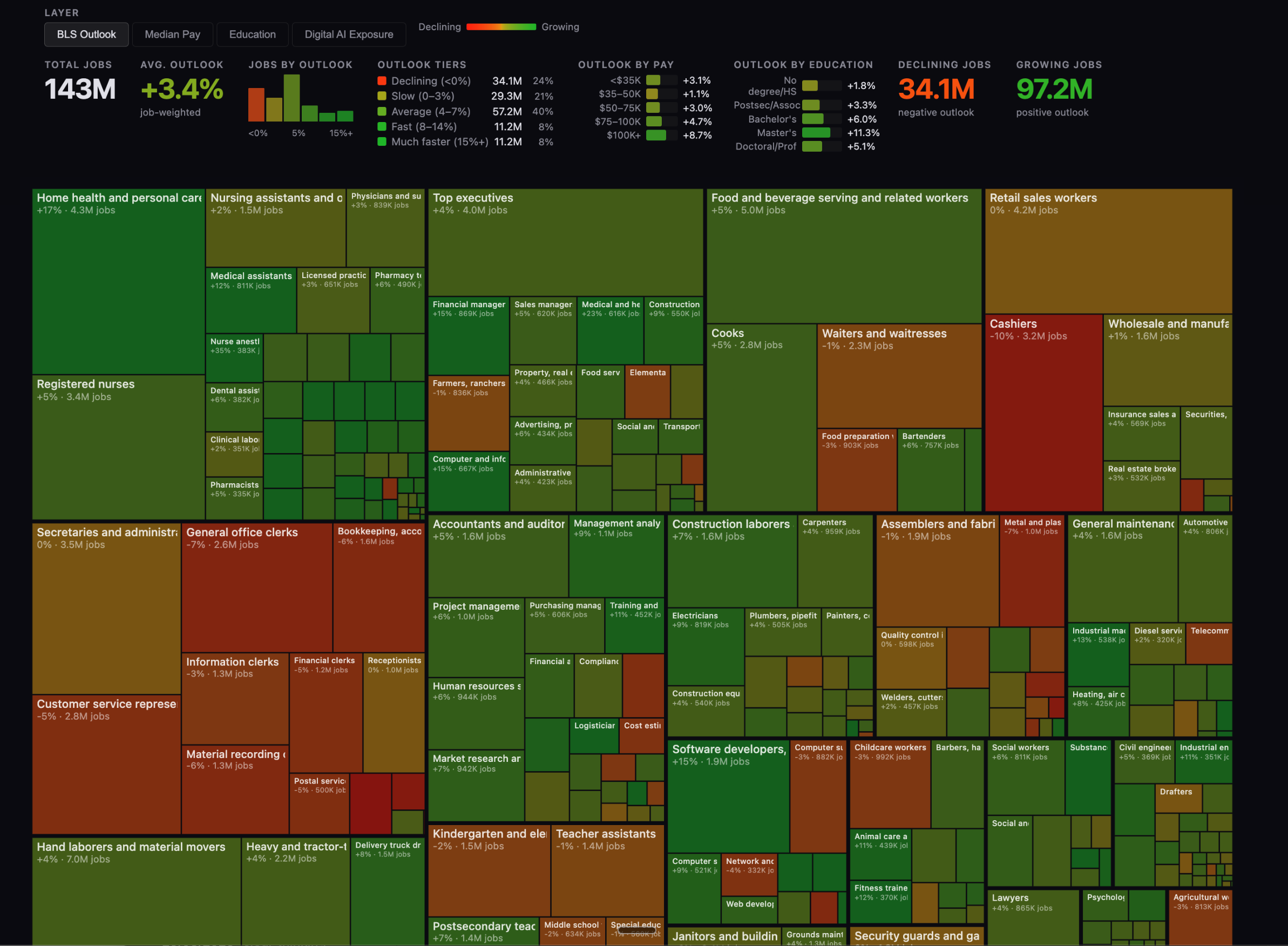
Karpathy Maps AI Exposure Across Every Job in America
What happened: Andrej Karpathy scraped all 342 occupations from the US Bureau of Labor Statistics, scored each one’s AI exposure on a 0–10 scale using an LLM, and published the results as an interactive treemap.
The average AI exposure score across the entire US economy is 5.3 out of 10. Software developers score 8–9. Medical transcriptionists hit a perfect 10. Roofers sit at 0–1. The pattern is blunt: if your entire job happens on a screen, you’re exposed.
Takeaway: This isn’t a think-piece — it’s a queryable dataset. Founders building vertical AI should use it to identify which occupations are most exposed but least served. The gap between “high AI exposure” and “tools actually built for that role” is where the opportunity lives.
Source: GitHub repo | Interactive visualisation
Karpathy’s /autoresearch Lets an LLM Improve Shopify’s Liquid by 53% in a Day
What happened: Andrej Karpathy released autoresearch, a minimal repo that sets an AI agent loose on a codebase in an autonomous loop — iterating on training code, accumulating git commits, and optimising without human involvement.
Then Shopify CEO Tobi Lütke ran it on Liquid, the templating language he invented and has personally refined for 20 years. The result: 53% faster combined parse and render time, 61% fewer object allocations — in less than a day, for a few hundred dollars in tokens.
“Tobi hired the best people in the world and paid them millions of dollars to improve Liquid performance. He invented Liquid and worked on it for the last 20 years. An LLM improved it by 53% in less than a day.” — Sebastian Szturo
Why this matters: This isn’t AI writing boilerplate code. This is AI autonomously optimising a mature, expert-tuned codebase and finding improvements that world-class engineers missed. Anything you can measure and loop on is now a candidate for autonomous optimisation.
Source: GitHub repo | Tobi Lütke’s results | Sebastian Szturo’s commentary
Australian Man Designs Custom mRNA Cancer Vaccine for His Dog Using ChatGPT and AlphaFold
What happened: An Australian tech worker with zero biology background paid $3,000 to sequence his rescue dog’s tumour DNA, fed the results to ChatGPT and AlphaFold, identified mutated proteins, matched them to drug targets, and designed a custom mRNA cancer vaccine from scratch. A genomics professor described himself as “gobsmacked.” After three months of ethics approval, the dog received her first injection. The tumour halved. Her coat grew glossy again.
“If we can do this for a dog, why aren’t we rolling this out to humans?” — the reviewing genomics professor
Why this matters: This is the most visceral example yet of AI collapsing the expertise barrier in life sciences. One person with a chatbot and $3,000 outperformed what traditionally requires a pharmaceutical discovery team, months of lab work, and millions in funding. The red tape took longer than the science.
Takeaway: The bottleneck in biotech is shifting from discovery to regulation. Founders in health and biotech should watch this space — the tools to design personalised therapies are becoming accessible faster than the regulatory frameworks can adapt.

Yann LeCun's AMI Labs Raises $1.03 Billion in Europe's Largest-Ever Seed Round
What happened: AMI Labs, the Paris-based AI company co-founded by Turing Award winner Yann LeCun after departing Meta, raised $1.03 billion in a seed round at a $3.5 billion pre-money valuation — the largest seed round ever for a European startup. The round was co-led by Cathay Innovation, Greycroft, Hiro Capital, HV Capital, and Bezos Expeditions, with participation from Nvidia, Samsung, Toyota Ventures, and Temasek.
AMI — pronounced like the French word for “friend” — is building world models using LeCun’s Joint Embedding Predictive Architecture (JEPA), an alternative to generative AI that focuses on learning abstract representations of how the physical world works rather than generating pixel-perfect predictions.
Why this matters: LeCun has been the most prominent critic of the large language model paradigm, arguing LLMs are fundamentally limited in their ability to reason about the physical world. AMI is a $1 billion bet that he’s right. JEPA is designed to enable AI systems that learn from unlabelled video and sensory data the way humans do — efficiently, from observation. The target applications are autonomous driving, robotics, and real-world physical environments where current AI struggles.
The Technical Founder’s Guide to Pilots and POCs
Mark LaRosa at Amplify Partners wrote the definitive guide to running your first pilots — drawing on 15+ years of enterprise sales and dozens of portfolio companies including Hex and WarpStream. The core argument: before you have product-market fit, feedback is worth more than revenue or signups. Frictionless signups mean frictionless exits.
The framework:
Your pilot’s #1 goal is to learn something — not to close a deal. Does your product add value? Is your ICP right? Are the use cases what you imagined?
Pick a brutally specific ICP — not “developers at enterprise companies” but “backend engineering team leads at US companies with $50M–$1B in revenue.” If your target list is 15,000 companies, you’re not specific enough. Aim for 200–300.
Your pitch should sell outcomes, not product — think movie trailer, not movie. If the customer isn’t excited about the promised land, no amount of technical detail will save you.
Pilots should be free — charging adds procurement friction and gives people reasons to say no. Your design partner pays with their time. If they won’t stay engaged without money on the line, the problem isn’t painful enough.
Scope ruthlessly, agree on success criteria up front — 2–3 months max. Build small wins into every week. If a pilot drags past 6 months, you have a scoping problem.
Garry Tan Open-Sources His Claude Code Setup: 10K Lines and 100 PRs Per Week
Y Combinator CEO Garry Tan released gstack, the exact Claude Code configuration he used to average 10,000 lines of code and 100 pull requests per week over the past 50 days. It’s a set of eight opinionated workflow skills that turn Claude Code from a generic assistant into a team of specialists — all as slash commands.
The standout is /browse, a 200ms browser skill built on Bun and Playwright that Tan says outperforms Chrome MCP by 20x with no context bloat, letting you test any app fast.
Key skills include:
/plan-ceo-review— Rethink the problem. Find the 10-star product hiding inside the request./plan-eng-review— Lock in architecture, data flow, edge cases, and tests./ship— Sync main, run tests, resolve reviews, push, open PR./browse— Give the agent eyes. Full QA pass in 60 seconds.
Takeaway: The head of YC is personally shipping 100 PRs a week with AI tooling. This isn’t delegation — it’s a new mode of building where the CEO is also the engineering team. Clone the repo and try it this weekend.
Travis Kalanick’s Atoms: Seven Years of Stealth, Three Industries, One Manifesto
Travis Kalanick spent eight years building what everyone thought was a ghost kitchen company. That was the cover story. Today he renamed City Storage Systems to Atoms and revealed what he was actually doing: building a robotics company across food, mining, and autonomous transport.
The food play: Lab37’s Bowl Builder robot assembles 200 meals per hour with zero human hands. Otter processes 18% of all US food delivery orders — that was the data layer. Thousands of employees across hundreds of locations in 110 cities, operating in stealth so deep that employees couldn’t list the company name on LinkedIn.
The mining play: Pronto, Anthony Levandowski’s autonomous vehicle startup for industrial sites, is being acquired. The last time Kalanick and Levandowski worked together, Uber poached Levandowski from Google’s self-driving programme, Waymo sued for trade secret theft, Levandowski went to prison, got pardoned by Trump, and Uber settled for $245 million. Now they’re reuniting.
The transport play: The Information reported that Uber is providing major backing for Kalanick’s self-driving venture. The same board that sent him a resignation letter in 2017 now needs his help. Uber sold its autonomous driving unit to Aurora in 2020. Waymo is scaling robotaxis. Tesla is pushing Cybercab. Uber just missed earnings for the first time in seven quarters.
Kalanick’s manifesto is worth reading in full. His framework for “Digitizing the Physical World” has three steps: understand the current state, predict the future state, control the future state. On the humanoid robot debate, he’s blunt: specialised robots beat humanoids for industrial tasks. “I watched the humanoid half-marathon and couldn’t help but think how much better it would be if they just had wheels.”

Guillermo Rauch@rauchg
1 hour of TravisCore to build and accelerate to
1:32 AM · Mar 15, 2026 · 385K Views
94 Replies · 372 Reposts · 3.8K Likes
A design canvas built on HTML/CSS — which means your designs export as real code with nothing lost in translation. Paper connects directly to Claude Code and other AI agents via MCP, letting them read your canvas, pull real data from APIs, and generate responsive variants while you focus on the creative decisions. The team calls it “anti-slop” design: agents handle the boilerplate (responsive layouts, style variations, consistency checks), humans make the calls that matter. If you’re a technical founder who’s been using Figma under protest, this is the tool you’ve been waiting for.
WA Innovation Booster Grants Launch for 2026
What happened: The Western Australian government has opened applications for its 2026 Innovation Booster Grants, committing $5 million to support early-stage startups in the state.
Why this matters: Western Australia remains one of the most underfunded startup ecosystems relative to its economic weight. The state generates enormous wealth through mining and resources but has historically funnelled very little of that into technology ventures. This grant programme is a step toward changing that — and for founders building in mining tech, energy, or resources-adjacent sectors, WA offers something Sydney and Melbourne don’t: direct proximity to the industries being disrupted.
Innovation Bay’s VC at Sea Hits 97% Attendance — And Rampersand Was on Board
What happened: Innovation Bay hosted VC at Sea, putting 120+ venture capitalists on a yacht in Sydney. The result: 97% attendance from RSVPs — a number Ryan Burns, Innovation Bay’s Head of Venture Capital, says he’s never seen in four years of running events in Australia. Rampersand’s Andrew Poesaste was among the workshop table leaders, alongside Karen Chan, Jason Serda, Lisa Fedorenko, Kate Bennett Eriksson, Alastair Hick, and others — running interactive sessions with founders and investors.
Takeaway: The ANZ VC community is small enough that the right event can put you in a room with half the decision-makers in the ecosystem. Innovation Bay’s next major event is Venture Down Under on the Gold Coast in August — worth marking the calendar.
PredictHQ Partners with Expedia Group to Power Sports Tourism Demand Forecasting.
PredictHQ has become Expedia Group’s first deeply integrated demand intelligence partner, embedding its verified event signals and predictive forecasts directly into Partner Central — the platform Expedia’s lodging partners use to manage rates, inventory, and performance.
The partnership launched ahead of this year’s Big Soccer Tournament, with joint forecasts projecting total traveller spend across North America’s host cities to exceed $8.1 billion USD between June and August 2026, nearly $750 million higher than last year. Accommodation spend alone is projected to surge 86%, with international arrivals driving four-digit demand increases in key cities.
“Major global events create highly concentrated and fast-moving demand patterns that traditional forecasting models lack the real-world context to detect. By partnering with Expedia Group, we are embedding this trusted, explainable context directly into decision-making.” — Campbell Brown, CEO, PredictHQ
Takeaway: This is PredictHQ moving from data provider to embedded infrastructure inside one of the world’s largest travel platforms. When your intelligence layer is wired directly into how partners set prices and allocate inventory, you’re no longer a nice-to-have — you’re part of the operating system.
Cuttable Launches Inaugural Coffee Club
Cuttable is kicking off its first Coffee Club next week at Niccolo Melbourne, a relaxed morning networking event over free coffee, designed to bring together familiar faces and new connections in the industry. It’s the kind of low-friction, high-value community building that turns customers into advocates.

Takeaway: If you’re in Melbourne and work in the signage, print, or visual communications space, this is worth showing up to. Details on Cuttable’s LinkedIn.
mx51 Expands Partnership with FrabPOS AU
mx51 is deepening its collaboration with FrabPOS AU, a cloud-based point-of-sale provider for retail and hospitality. The partnership integrates mx51’s payment processing infrastructure with FrabPOS’s merchant tools — streamlining operations and improving checkout experiences for businesses across Australia.
Takeaway: mx51 continues to quietly expand its footprint as the payments infrastructure layer behind an increasing number of POS providers. Each new integration compounds the network effect.
Senior Software Developer at Restoke
Location & type: Port Melbourne, Victoria, full-time
What they do: Restoke uses AI to streamline operations for hospitality businesses — from recipe costing to supplier management.
What you’ll do: Build and ship core product features as a senior engineer on a fast-moving team transforming how hospitality runs behind the scenes.
Finance Manager at Cake Equity
Location & type: Gold Coast, Australia, full-time
What they do: Cake Equity simplifies equity management for startups — cap tables, equity incentives, and compliance in one platform.
What you’ll do: Own financial operations, compliance, and strategic planning at a company that helps other startups get equity right.
Location & type: Canberra, Australia, full-time
What they do: Goterra is revolutionising waste management through insect-based technology, converting organic waste into sustainable resources.
What you’ll do: Work hands-on with Goterra’s biological systems — maintaining and optimising the processes that turn waste into valuable by-products.
Do you have a job you’d like us to promote? Add it to Hatch and share the link with us.
See all jobs across the Rampersand Portfolio.
Taryn will be in Adelaide 17 - 20th March. Please reach out.
📍 ADELAIDE - Mar 17–19, 2026
Australia’s premier startup and innovation conference returns to Adelaide. Chanie Hyde, Taryn Pieterse, and Rod Hamilton will be there — and we’re bringing GWI for the first time since 2023.
📍 SYDNEY - Apr 30, 2026
Sydney’s flagship startup event. Andrew Poesaste will be attending.
Thanks for being part of the Rampersand Community! You can stay updated with even more news and info on our LinkedIn and X/Twitter pages.
No posts
Comments
Nothing yet. Say the first thing.
Sign in to join the conversation.