
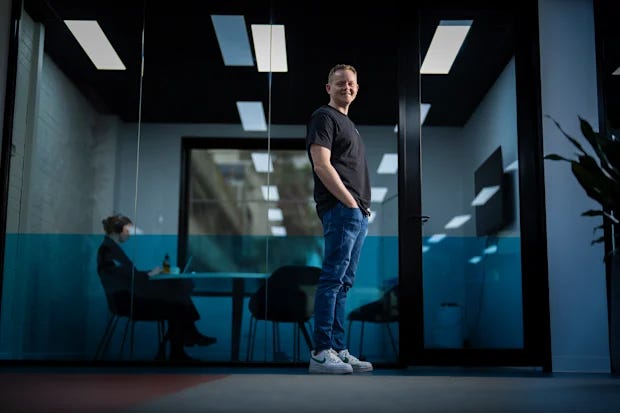
(Sam Kroonenburg, founder of Cuttable, whose AI-powered ad platform just hit a $100M valuation. Rampersand backed Cuttable from inception and doubled down in this round)
Two weeks ago, a panel chaired by Tesla chair Robyn Denholm handed down a report called Ambitious Australia. If you’re a founder or investor in the Australian ecosystem, it’s the most significant policy proposal in years. The window between the report landing and the government deciding how much of it to actually implement is short.
For as long as I’ve been working with Australian founders, I’ve heard the same frustration in slightly different forms. The R&D Tax Incentive is too complex. The ESVCLP is too restrictive. There are too many programs, spread too thin, run by too many agencies, with too much paperwork and too little actual support at the sharp end of company building. Too many founders are spending tens of thousands on R&D tax consultants just to access incentives that were designed to help them.
Ambitious Australia proposes to fix this. A premium startup stream for the R&D Tax Incentive that would simplify access, avoid the need for consultants, and improve cash flow through quarterly payment, keeping precious dollars in the hands of teams actually driving innovation. The package moves away from more than 150 fragmented programs towards a more coordinated system focused on six national priorities and up to 18 National Strategic Initiatives, spanning proof-of-concept schemes, pre-accelerators, accelerators and incubators. For investors, it broadens the definition of wholesale investor, expands eligibility and recognises SAFE notes within the Early-Stage Innovation Company framework, and lifts the cap on fund size for the ESVCLP.
We think Ambitious Australia is exactly right. Every ambitious Australian founder has had the conversation: move to San Francisco, or stay and build from here. Right now, too many of the best ones are leaving. Not because the talent or the ideas are better elsewhere, but because the system here makes it harder than it needs to be. These recommendations won’t remove every disadvantage overnight, but if they’re implemented as a package, they could meaningfully change the calculus for the next generation of founders deciding where to build.
The Government now has to respond.
The first signals to watch for are in the 2026–27 Budget, specifically whether a National Innovation Council is established with genuine authority, and whether R&D Tax Incentive reform achieves real simplification rather than just relabelling. For founders and investors: now is the time to make noise. If you believe in this ecosystem, say so loudly.
Have thoughts on Ambitious Australia or how it could impact your company? I'd love to hear from you.
Anthropic’s Unreleased “Claude Mythos” Model Leaks via Unsecured Database
What happened: Security researchers found 3,000 unpublished assets in a publicly accessible Anthropic database, including internal docs describing Claude Mythos a model Anthropic confirmed is real and describes as “a step change” above Opus. Internal docs warn it is “currently far ahead of any other AI model in cyber capabilities.”
Why this matters: If Mythos is genuinely a tier above anything on the market, we could be looking at the first $2K or even $20K/month AI model — premium, differentiated pricing for capabilities that justify it. The cybersecurity angle (a model that can exploit vulnerabilities faster than defenders can patch them) adds a layer the industry hasn’t priced in yet.
Takeaway: The era of commodity AI pricing may be shorter than people think. If the capability gap is real, Anthropic has room to charge dramatically more — and customers building on frontier capabilities will pay it.
Intercom Ships Apex: A Custom Model That Beats GPT-5.4 at Customer Service
What happened: Intercom’s 60-person AI group trained Apex 1.0 on billions of proprietary customer service interactions. It now powers 100% of English-language Fin conversations, resolving issues at a higher rate than any frontier model — one customer saw resolution jump from 68% to 75% overnight. It’s also faster, cheaper, and hallucinates less.
CEO Eoghan McCabe’s thesis: the age of vertical models has arrived. Cursor’s Composer 2 is the same pattern in coding. Karpathy calls it “speciation” — smaller models with the cognitive core, specialised for specific niches, outperforming general-purpose models at the jobs that matter.
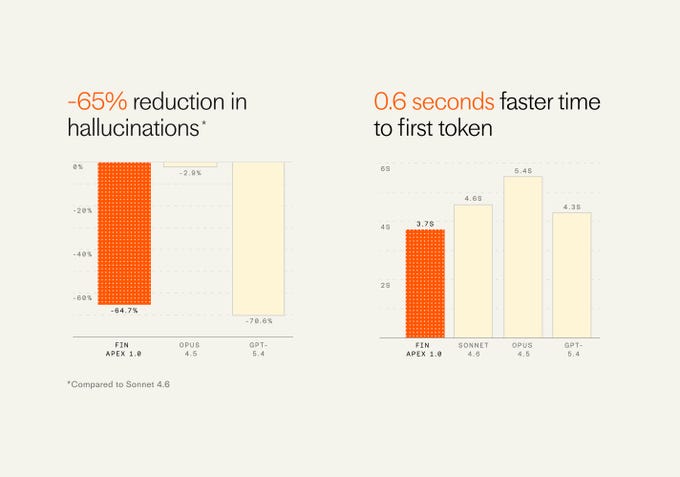
“The frontier labs still have the very best models, but the open-weight models are not that far behind. Where we think the frontier will move next is to post-training.” — Eoghan McCabe, CEO, Intercom
Takeaway: The battle between foundational and vertical models is heating up. Is it worth the investment to train your own? Intercom says yes — but they had 60 AI engineers and billions of interaction data points to train on. The real question for most founders: at what scale does building your own model beat renting someone else’s?
Google’s TurboQuant Cuts KV Cache Memory by 6x With No Accuracy Loss
What happened: Google Research introduced TurboQuant, a quantisation method that compresses the KV cache to 3 bits per value with no accuracy loss — cutting memory use by 6x and delivering up to 8x faster attention on H100 GPUs. No retraining required. Benchmarked on Gemma, Mistral, and Llama-3.1. Peer-reviewed work to be presented at ICLR 2026.
Why this matters: If capable models can run on dramatically smaller hardware, what happens to the trillion-dollar data centre buildout? Breakthroughs like TurboQuant chip away at the assumption that AI scaling requires ever-larger clusters. More throughput from the same GPUs, capable models on edge devices, lower serving costs — the infrastructure thesis may need updating.
Takeaway: Every efficiency gain at the inference layer is a quiet vote against the “build more data centres” narrative. Watch this space.
Pretext: Text Layout 500x Faster Than the DOM
What happened: Cheng Lou (React, ReasonML, Midjourney’s frontend) released Pretext — a TypeScript library that measures and lays out text 500x faster than the browser DOM, trained against real rendering in Safari, Chrome, and Firefox. Demos show hundreds of thousands of text boxes at 120fps. Engineers from Vercel, Figma, and shadcn have cosigned.
Takeaway: Front-end development is about to change thanks to AI. When you can lay out text at 120fps without CSS or DOM measurement, the entire constraint model for building interfaces shifts — and AI-generated UIs become dramatically more viable.
Precision GTM: $15,000 in Billboards, One Target Customer, One Oil Field Contract
Solugen founder Gaurab Chakrabarti spent $15,000 on billboards targeting a single person: the guy controlling all the chemical spend at a saltwater disposal company in Texas. They mapped his commute and bought every billboard between his house and the oil field. When they finally called, he said “I see your billboards everywhere.” That landed their first oil field contract.
At the time, their entire operation was a $10,000 reactor built from PVC pipes from Home Depot, turning corn sugar into industrial chemicals. People keep trying to throw it away. It still works. That leaking PVC reactor started a multibillion-dollar company. YC recently visited their Houston plant — the original reactor is still on the floor next to the Bioforge.
Takeaway: The best early-stage GTM isn’t scalable — it’s unforgettable. Map one decision-maker’s commute, buy every billboard on the route, and call them when they think you’re everywhere. Do things that don’t scale, and do them with conviction.
What 20+ Enterprise AI Leaders Are Actually Buying Right Now
Box CEO Aaron Levie sat down with 20+ enterprise AI and IT leaders and shared what’s actually happening on the ground. The short version: agents are the big thing, coding is still the dominant use case, and every other category of knowledge work is starting to follow. The conversations have shifted from chatbots to agents, and from pilots to production.
What founders should pay attention to:
Agentic workflows are hitting every part of the org — back office, client-facing, sales, onboarding. The focus is on delivering better for customers and speeding up high-ROI workflows, not pure cost cutting.
Data governance is the blocker — years of data fragmentation that wasn’t a problem before is now the barrier to agent adoption. Getting data into a spot that agents can securely operate on remains a huge task.
Identity is the emerging problem — should an agent have access to everything you have? Enterprises are asking how to manage dozens of agents with partitioned access levels.
Token budgets are becoming OpEx — companies are figuring out how to budget for tokens across use cases and teams. This will likely move out of IT budgets and into operating expenses.
Interoperability, not platforms — every enterprise is deploying multiple AI systems. There won’t be a single platform to rule them all. Agent interoperability will be one of the biggest drivers of the AI stack.
Takeaway: If you’re a founder wondering where to point your enterprise AI product, this is the map. The biggest unsolved problems — data governance, agent identity, token budgeting, interoperability — are all open territory. Enterprises know they need agents. They don’t yet know how to manage them.
Google Parks $20 Billion Australian Investment Over Tax Fears
What happened: Google has paused a planned $20 billion investment in Australia amid concerns that the $5.5 trillion company may face higher local tax obligations. The move signals growing tension between Big Tech’s infrastructure ambitions and governments increasingly willing to extract more from companies operating in their markets.
Takeaway: Australia wants to be an AI hub but also wants Big Tech to pay more tax. At some point, those two goals collide. Founders building infrastructure-dependent products should watch how this plays out — downstream effects on cloud pricing, data centre availability, and the broader investment signal for the Australian tech ecosystem.
Sierra Opens Sydney Office — Bret Taylor Brings AI Customer Experience Down Under
What happened: Sierra, the AI customer experience company co-founded by former Salesforce CEO Bret Taylor and ex-Google executive Clay Bavor, is opening an office in Sydney.
Why this matters: Sierra is one of the fastest-growing enterprise AI companies globally, and Sydney is now on their map alongside the world’s major business capitals. For ANZ founders building in customer experience, this is both validation (the market is real) and a competitive signal (a very well-capitalised player just landed in your backyard).
Cuttable Hits $100M Valuation — Rampersand and Square Peg Double Down
Cuttable, the AI-powered ad creation platform founded by Sam Kroonenburg (who sold A Cloud Guru to Pluralsight for $2B in 2021), has closed a major funding round at a $100M valuation — up from $44.5M last year. Airtree Ventures and Glitch Capital joined the register, while Square Peg Capital and Rampersand returned to increase their stakes.
Over 220 brands now use Cuttable — primarily e-commerce operations like Appliances Online and Brooks Running — to generate multiple ad variations that social platforms’ algorithms test and optimise automatically. Kroonenburg said the platform was fully redesigned to be AI-driven last year, removing human creatives from the loop entirely.
“All advertising now is digital — Meta, Google and TikTok have eaten the world of advertising.” — Sam Kroonenburg
Takeaway: A Rampersand portfolio company more than doubling its valuation in 12 months. Cuttable is proving that AI-native ad creation at scale is a category, not a feature.
Parachute Hits the Road — Brisbane Demo Leaves Legal AI Experts Impressed
Parachute founder Ryan Zahrai took the product on the road in Brisbane, and legal AI consultant Daniel Kavan called it “one of the best demos I’ve ever seen.” What set it apart: Zahrai invited audience members — practising legal experts — to suggest tricky, nuanced questions live, then showed Parachute delivering solid responses in real time. No scripted demos, no safe questions. Melbourne is coming up on 23rd of April.
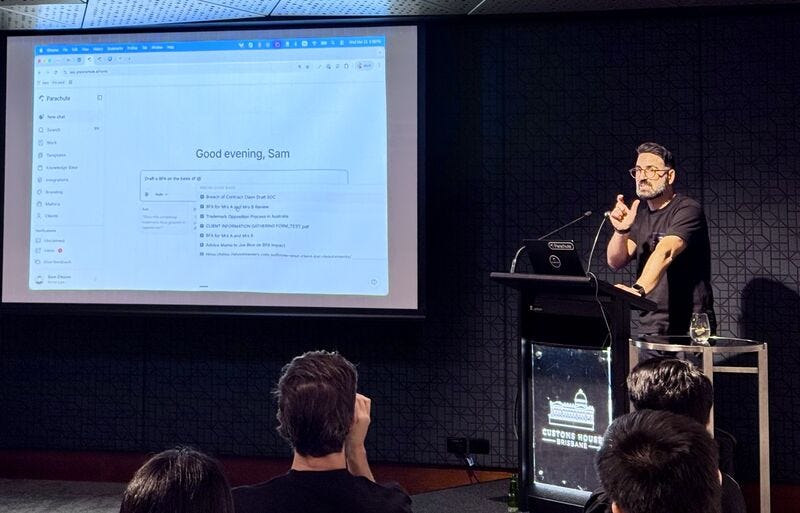
(Co Founder and CEO Ryan Zahrai demos the legal AI platform live at Customs House, Brisbane — inviting practising lawyers to stress-test it with their hardest questions. Try Parachute →)
Takeaway: The best way to build credibility with domain experts is to let them stress-test your product in public. Parachute is building trust in Australian legal AI one live demo at a time.
Marketing Manager (Social & Content) at Cor
Location & type: Melbourne, Australia, hybrid, full-time
What they do: Cor builds Obi, a voice AI agent that onboards and activates software users over video calls — solving the adoption gap that ships when software builds faster than users can learn.
What you’ll do: Own social and content execution from day one as one of the first 10 employees. No playbook, no approval chains — you work directly with the CEO and ship fast.
Multiple Roles at Cuttable — Sales, Marketing, Engineering & More
Location & type: Melbourne + New York, full-time
What they do: Cuttable uses AI to create and optimise ad variations at scale for e-commerce brands — fresh off a $100M valuation round.
What you’ll do: Roles open across sales, marketing, customer success, engineering, and product. Email hello@cuttable.com.
Finance Manager at Cake Equity
Location & type: Gold Coast, Australia, full-time
What they do: Cake Equity simplifies equity management for startups — cap tables, equity incentives, and compliance in one platform.
What you’ll do: Own financial operations, compliance, and strategic planning in a collaborative, tech-first environment.
Do you have a job you’d like us to promote? Add it to Hatch and share the link with us.
See all jobs across the Rampersand Portfolio.
Andrew will be in Melbourne 23–24 April. Reach out to grab a coffee.
📍 MELBOURNE — Apr 23, 2026
Rampersand portfolio company Parachute is hosting an invite-only evening at The George on Collins for SME law firm principals, professional services operators, and migration agencies. Founder Ryan Zahrai and the founding team will share what’s actually working in AI for SME firms, how modern practices are building margin without burning out teams, and give an early look at the Parachute platform. Drinks, canapés, real conversation. Capacity is capped.
📍 SYDNEY — Apr 30, 2026
Blackbird’s annual festival of creativity, technology, and ambition returns to Carriageworks. Not a business conference — a cultural celebration where founders, operators, and creatives gather to stretch the edge of what feels possible. Andrew Poesaste will be attending.
Thanks for being part of the Rampersand Community! You can stay updated with even more news and info on our LinkedIn and X/Twitter pages.
No posts
Comments
Nothing yet. Say the first thing.
Sign in to join the conversation.