
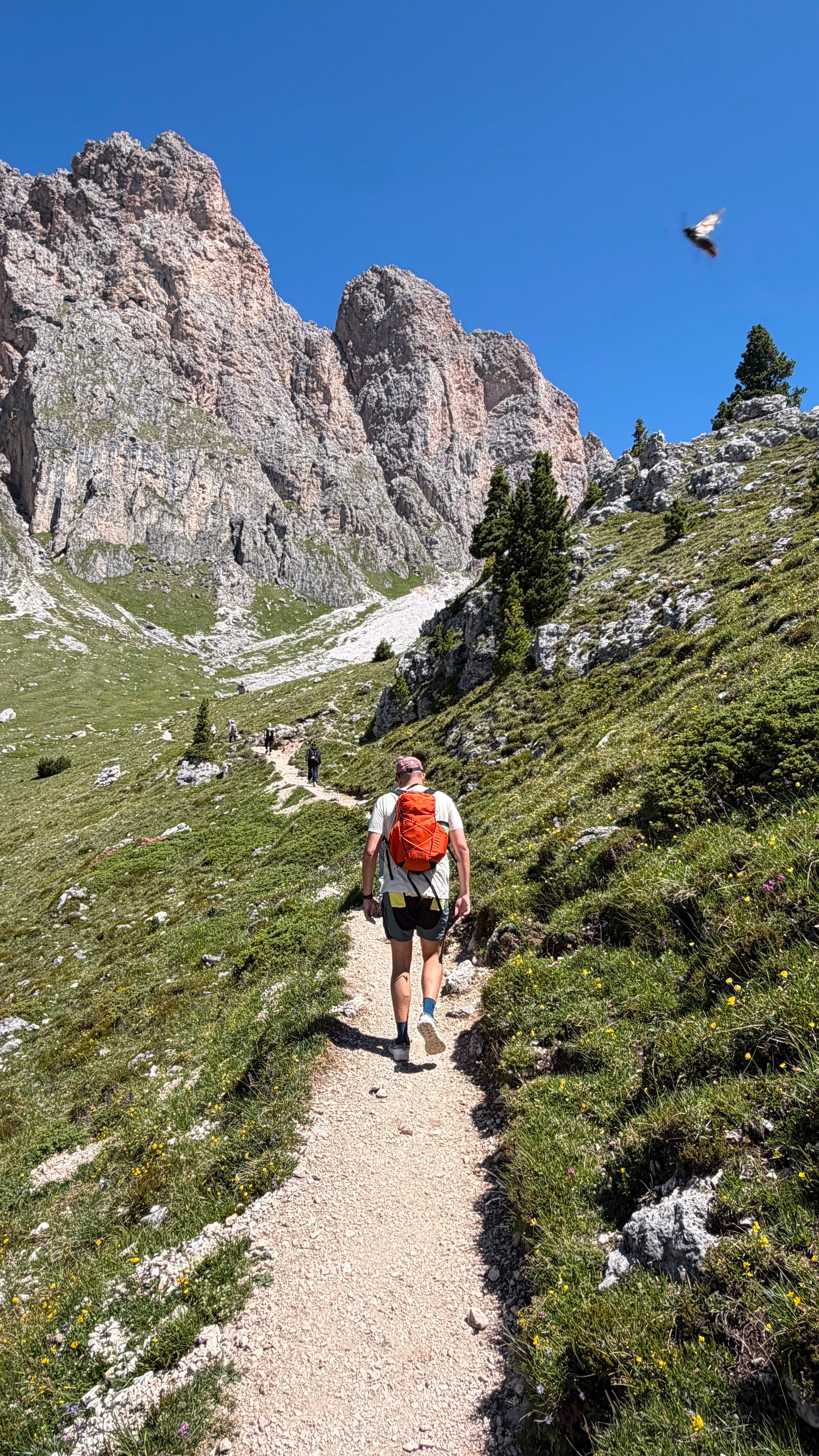
(Andrew taking the scenic route through the Dolomites this month. A week away from the AI chatter, and some of the clearest thinking happens where the reception ends. Great to get away; even better to come back)
When I was growing up, the big debate was forestry. We cut down our natural resources, sold the pulp for a pittance, then bought back paper and finished goods at a premium. That instinct never left us. We sell iron ore cheap and buy back the cars. We export lithium and import the batteries. Hand over the raw material, let someone else capture the value, then pay to bring it home. It has made us prosperous. It has also made us a supplier in other people’s supply chains.
It has made us a taker, not a maker.
In the AI universe we have to decide whether that continues, and the stakes are higher than any mineral. The raw material this time is compute and data. The value-added product is intelligence itself, sold to the world by the token, along with the applications built on top of it.
Right now the loudest AI story in the country is a digging story: tens of billions in foreign commitments to build data centres on Australian soil. That investment is genuinely welcome, and the Prime Minister was right last week to elevate AI to a national priority and set out how we intend to manage it. But we should be clear-eyed that much of the boom follows the old pattern. We provide the land and the power, they train and own the models, and we buy the intelligence back. That is iron ore with better marketing.
Here is the good news, the really good news. This time we do not have to choose digging, because we already have people building the value-added product at home.
The depth is already there
Look across the ecosystem and the evidence is everywhere. Founders training models on home soil. Teams shipping AI products that beat global names. Researchers doing frontier work from Melbourne and Sydney labs. The talent is here and the ambition is here. What it does not get is the attention, or the backing, it deserves.
We have Australian companies training large language models from scratch on their own infrastructure, no hyperscaler holding the keys, going after the hard, structured problems the global giants still fumble. Maincode, in Melbourne, is doing exactly that with its Matilda model. We have world-class proprietary models coming out of healthcare, trained on data earned through partnership rather than scraped, already helping clinicians catch disease earlier; Harrison.ai is a standout. We have design and creative AI so good that our own companies built foundation models rather than settle for off-the-shelf, from Canva’s proprietary design model to Leonardo.ai, the homegrown image generator Canva thought worth acquiring. And we have PredictHQ, which has built demand intelligence on trillions of proprietary data points, relied on by bluechips from Uber and Amazon to Walgreens and Expedia.
And at the application layer, where Australia has always punched above its weight, our founders are beating the best in the world. Cuttable has marched into the US with its AI advertising and is growing at pace. Lorikeet is winning global recognition. Relevance AI is building an entire AI agent workforce. Keeyu, Restoke and others are not far behind. These are not thin wrappers on someone else’s technology. They own their data, their workflows and their customers.
No one of these companies is the point. The point is the pattern. Talent everywhere, vision in no short supply, and capital arriving too, from a maturing local venture base to individual backers willing to fund national-scale ambition out of pure conviction. The ingredients are on the bench. We just have to decide to cook.
The choice in front of us
Other countries have already made theirs. The UK stood up a £500m sovereign fund to back its own model-builders, under a banner that should sound familiar: an AI maker, not an AI taker. We could achieve the same with a fraction of the money, because our builders have shown they go further on less. Melbourne’s Heidi Health is the proof: its AI scribe now sits in 2.7 million consults a week across 190 countries, built on barely US$100m of total funding, a fraction of what its US rivals have raised. Imagine what our builders would do with real government procurement, patient local capital, and an ecosystem that actually knows their names.
Last week’s national framework was a genuine step forward and the ambition behind it is welcome. The next step is to match our enthusiasm for hosting AI with equal enthusiasm for building it. A framework that celebrates and backs Australian model-makers, not just Australian data centres, is how we keep the value here.
This is the optimistic case, and it is the true one. We are not late. We are early, and we are good.
Over to you
Who are the Australian AI builders we should be shouting about? If you are training a model, shipping a serious AI product, or keeping capability onshore, we want to feature you. And if you are a founder weighing where to aim your next decade, tell me what would make you build deeper into the stack.
Let’s elevate the thinkers and the doers. Let’s not sell this one cheap and buy it back at a premium. For once, let’s add the value ourselves. Reach out.
What happened: On 16 July, Beijing’s Moonshot AI launched Kimi K3, a 2.8-trillion-parameter model with a one-million-token context window and native vision, with full open weights due 27 July. Independent testing from Artificial Analysis places it at 57 on its Intelligence Index, level with Claude Opus 4.8 and behind only Claude Fable 5 and GPT-5.6 Sol, the best-scoring open-weight model on the board.
The pricing is the real signal. K3 lists at $3 per million input tokens and $15 per million output, the same rate card as Sonnet-tier closed models. Moonshot is charging mid-tier Western prices because the measured intelligence justifies it, which ends the era where “open weight” was shorthand for “the cheap tier”. Six labs now score above 50 on the index; in early June it was two.
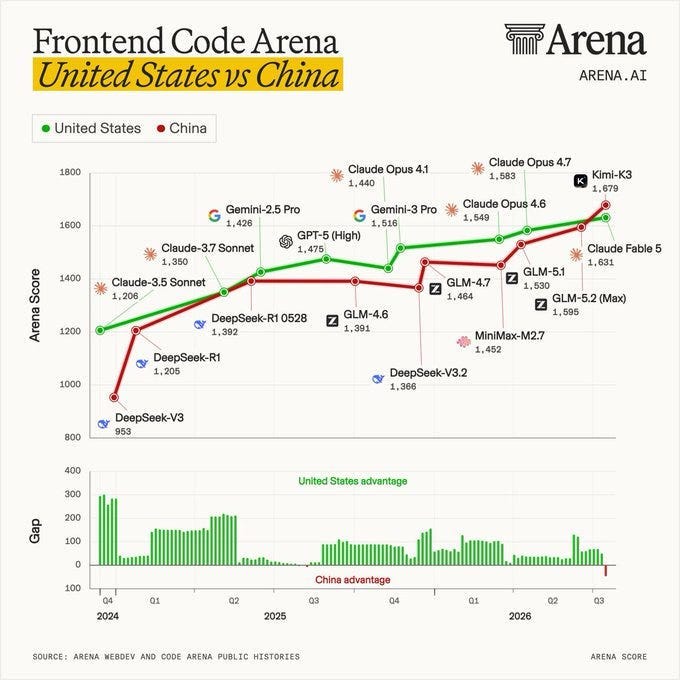
Takeaway: The question has moved from “which model is smartest” to “which model wins this lane at this price”. If you route production traffic, eval per task rather than committing to one model, the price-for-capability spread is now wide enough to matter to your margin.
What happened: Revel Pharmaceuticals, with Calico and the University of Colorado, published work in Nature Communications on an engineered enzyme, CMLase, that removes CML, the most abundant advanced glycation end-product that builds up in tissue over a lifetime and stiffens arteries. On donated human tissue it cleared more than 70% of the damage from elderly arterial samples and over 55% from skin, bringing them below the levels seen in tissue from people in their early thirties. The enzyme was built by screening tens of thousands of protein structures and then running directed evolution across hundreds of millions of variants.
The significance is the direction of travel. Since the 1980s this damage was treated as permanent, with every existing approach only able to slow new damage from forming. Nothing removed what was already there.
Takeaway: The caveats are real: this was tissue in a dish, there is no functional data yet, delivering a large enzyme into living tissue is unsolved, and trials are years away. But it is a marker of what directed-evolution plus enzyme engineering pipelines can now attempt, a space worth watching.
From our own Product Counsel: Venture Partner Rod Hamilton distils a session where Kath Cashion (Fresho) and Nick Cust (Cake Equity) worked through live pricing decisions. The tension every AI company is navigating: sellers want pricing tied to value and protected margin; buyers want spend they can predict and defend to a CFO. The data says nobody has solved it. Hybrid pricing jumped from 25% to 37% of B2B software companies in a year, three in four changed pricing in the last twelve months, and when we asked Anthropic directly how startups should price AI features, they were honest: they don’t quite know either.
Two lines worth keeping. Pricing isn’t downstream from product, it bends the product. And the best pricing unit isn’t the one customers say they prefer, it’s the one that tracks the value they get and still feels fair at renewal.
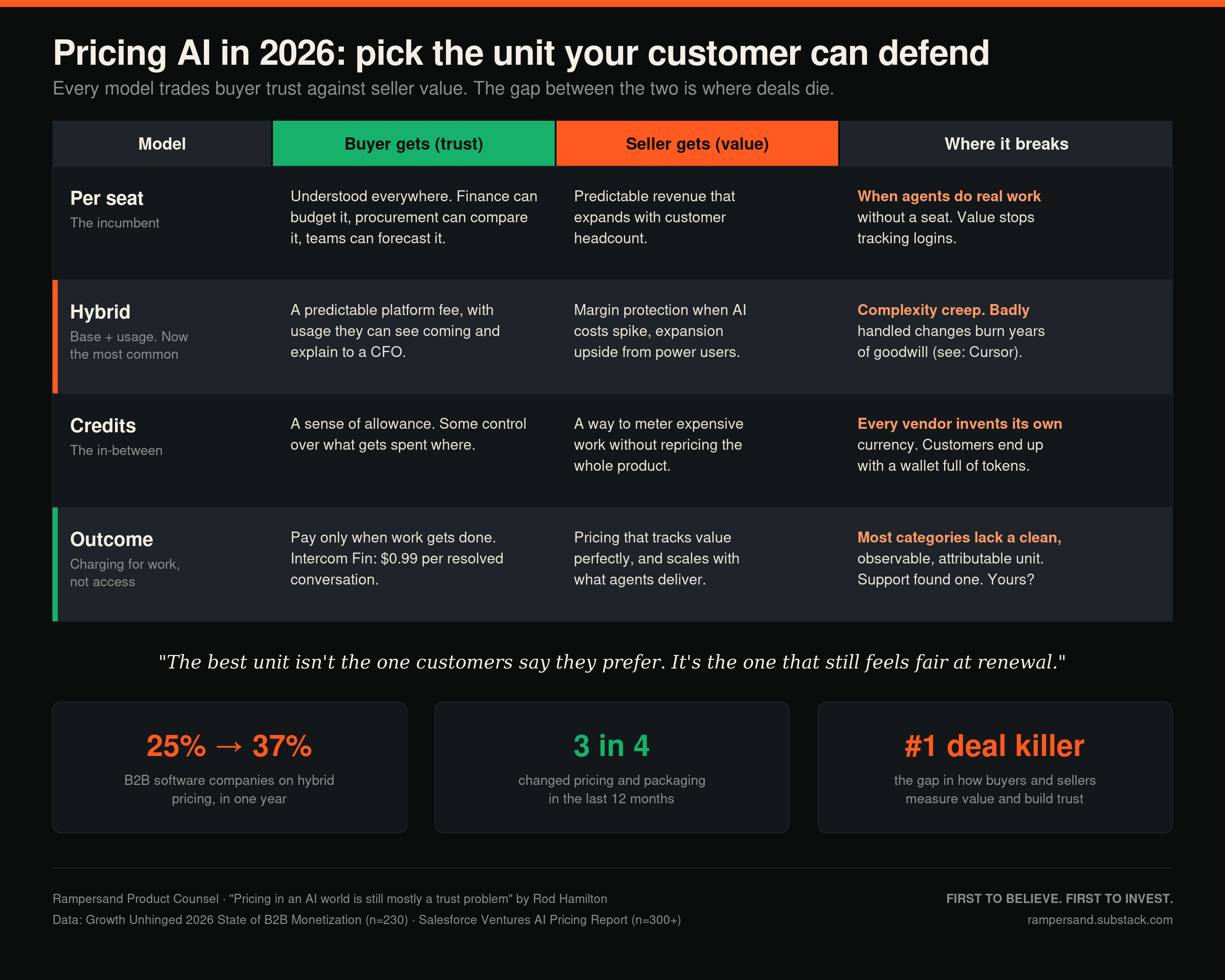
Takeaway: Expect messy hybrids, not one migration from seats to outcomes. Price the workflow or the outcome, not the token, and make sure your pricing model implies the roadmap you actually want.
NFX has published a rebuilt go-to-market playbook for the AI era, arguing the old motion (hire reps, generate leads, run a funnel) is being rewired now that products can demonstrate value before a human ever gets on a call. The through-line: distribution is shifting from human-gated to product-gated, and the founders winning are the ones designing the buying experience around it rather than bolting AI onto a legacy sales org.
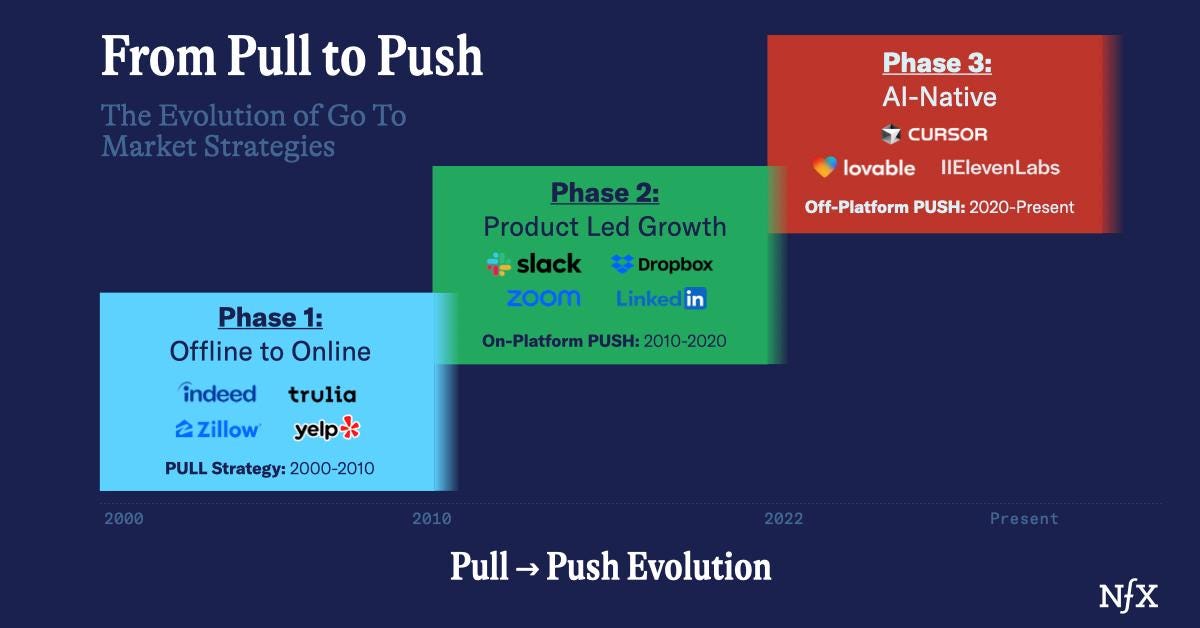
Takeaway: Map your GTM to where the buyer actually forms conviction. If your product can prove value pre-sales, your first hire may be a growth engineer, not another AE.
Lightspeed’s Nakul Mandan lays out the trap in scaling from $1M to $10M ARR. Founders reach for “hire a lot of AEs”, but hiring and ramping reps takes months and it is only half the problem. The half they miss is pipeline: $9M of net-new ARR needs roughly $27–36M of qualified pipe, and a team that went 0 to $1M on founder-led selling has probably only ever seen about $3M of it. Building the machine to generate that pipe predictably is the steep climb, not closing capacity.
Takeaway: Before you scale the closing team, build the pipe-generation engine to feed it. This is why the fastest-growing companies lean on land-and-expand, it lightens the pipe-gen load.

justine@justinemach_
an idiot in motion goes further than a genius at rest
7:28 PM · Jul 9, 2026 · 1.65M Views
690 Replies · 9.66K Reposts · 53.9K Likes
Anthropic has linked a potential US$15bn Australian investment, up to 1.4GW of data-centre capacity to train Claude, to the country resolving copyright uncertainty, with CEO Dario Amodei pressing Treasurer Jim Chalmers for legal certainty. It puts a concrete number on what regulatory clarity could unlock, and a concrete cost on continued ambiguity.
Sharon AI CEO James Manning takes the other side, arguing Australia can attract data-centre billions without changing copyright law and pointing to Microsoft’s existing $25bn commitment as proof the capital comes regardless. His Nasdaq-listed neocloud is planning an ASX float this year. Read together with the Anthropic story, it is the clearest framing yet of the split in how the industry thinks Australia should compete for compute.
PredictHQ spent the first half of the year forecasting a record demand surge around the 2026 FIFA World Cup, projecting roughly US$8.1bn in North American traveller spend across June to August through its Expedia Group partnership. The tournament delivered: it broke the all-time attendance record on 25 June and the group stage alone drew 4.64 million fans at 99.7% seat fill. The demand intelligence that flagged the surge months out is exactly what lets hotels and OTAs price for it before it arrives rather than after.
Matrak co-founder and CEO Shane Hodgkins joined The Profitable Estimator to argue that construction’s biggest shift over the next decade is not AI itself, it is the professionals who learn to work alongside it. The case: AI amplifies expertise rather than replacing it, and the people who combine deep knowledge of drawings, scope, contracts and procurement with AI tooling will outperform those who resist it, across estimators, QSs, engineers, PMs and site teams alike.
Quantum Brilliance was singled out in a 10 July industry feature as the most commercially advanced company globally working with nitrogen-vacancy diamond quantum technology, citing its deployed systems at supercomputing facilities and its quantum-grade diamond foundry. Third-party validation of a hard-tech thesis that has been years in the building.
Location & type: Australia, remote, full-time
What they do: mx51 is payments infrastructure that lets banks and acquirers offer merchant services at scale.
What you’ll do: Own and grow the partner relationships that put mx51’s platform in front of more merchants.
Verified live on mx51’s Greenhouse board, tagged “New”.
Location & type: Auckland, New Zealand, hybrid, full-time
What they do: PredictHQ builds demand intelligence, verified event signals and predictive forecasts that businesses plan around.
What you’ll do: Own product delivery, turning demand-data capability into features customers can act on.
Verified live on PredictHQ’s careers site.
Location & type: Melbourne, VIC, part-time
What they do: Restoke is an AI platform that automates hospitality operations, from recipe costing and inventory to supplier orders.
What you’ll do: Get new venues live on the platform and set operators up to succeed from day one.
Do you have a job you’d like us to promote? Add it to Hatch and share the link with us.
See all jobs across the Rampersand Portfolio.
Andrew will be in Sydney on 29–30 July taking founder meetings. Reach out for a coffee.
Rod Hamilton and Phil Jacob will be running Product Counsel in Sydney on 29 July.
📍 SYDNEY · Thu 30 July 2026
Early-stage founders from South-West and Western Sydney pitch for a share of $40k. A grassroots night for spotting under-the-radar talent.
📍 GOLD COAST — Aug 4–6, 2026
Oceania’s premier VC gathering brings 100+ General Partners from Australia, New Zealand, Singapore, the US and UK to the Sheraton Mirage. Rampersand’s Andrew Poesaste will be there all three days. Building something? Come find him.
Thanks for being part of the Rampersand Community! You can stay updated with even more news and info on our LinkedIn and X/Twitter pages.
First to believe. First to invest.
No posts
Comments
Nothing yet. Say the first thing.
Sign in to join the conversation.