
I went into this month’s Product Counsel expecting a conversation about AI pricing.
I left thinking the more important conversation is still about trust.
AI changes the economics of software. It introduces variable cost where SaaS teams used to enjoy mostly fixed cost. It creates power users whose usage can unexpectedly blow up your margins. It also gives customers a new expectation that software shouldn’t just store work, organise work, or report on work, but actually do the work.
That should change pricing, and it already is.
But what came through in our session was more grounded than the market narrative. Founders and product leaders aren’t sitting around waiting for a perfect pricing model to emerge. They’re trying to keep customers confident while the product, the cost base, and the buying conversation are all moving.
This month, Kath Cashion from Fresho and Nick Cust from Cake led a Product Counsel session on pricing in an AI world. Both are working through pricing decisions in live businesses. Different markets, different products, different customers. But the same core tension kept appearing.
Sellers want pricing to reflect value. Tied to the outcome the buyer is getting, moves up as the product gets stronger, and captures enough margin to fund the next leap when AI costs increase.
Buyers want pricing they can trust. Predictable spend, fits the annual budget, and can be easily explained to the CFO when challenged.
This gap is where most of the hard work is.
The outside data matches what we heard in the room.
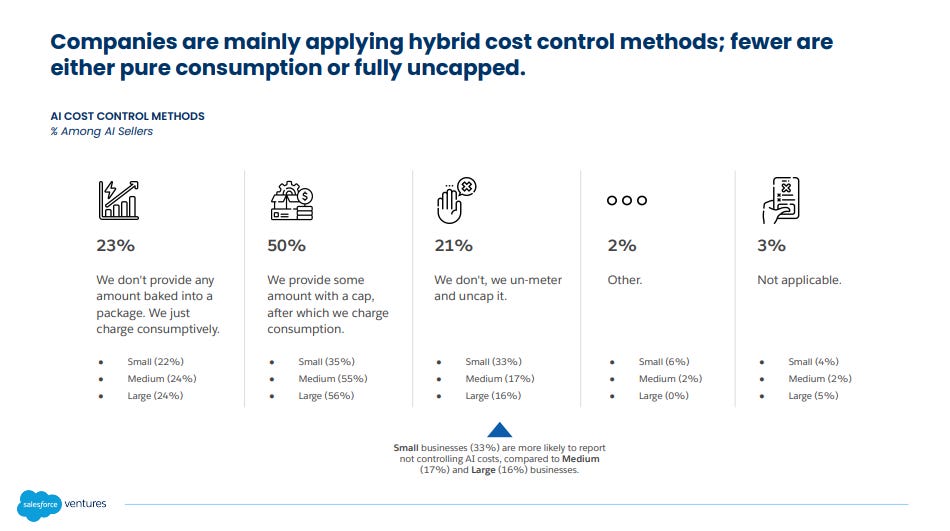
Salesforce Ventures recently surveyed more than 300 startup and enterprise executives for its AI Pricing Report. Most sellers plan to change pricing in the next 12–18 months. Most believe they’re underpricing but are hesitant to charge more. And the number one thing killing AI deals is the gap in how buyers and sellers measure value and build trust around it.
Growth Unhinged’s 2026 State of B2B Monetization report tells a similar story. In a survey of 230 B2B software and AI companies, hybrid pricing was the most common model, used by 37 percent of respondents. That was up from 25 percent in the prior year among the same participant set. Three in four software companies changed pricing and packaging in the last year.
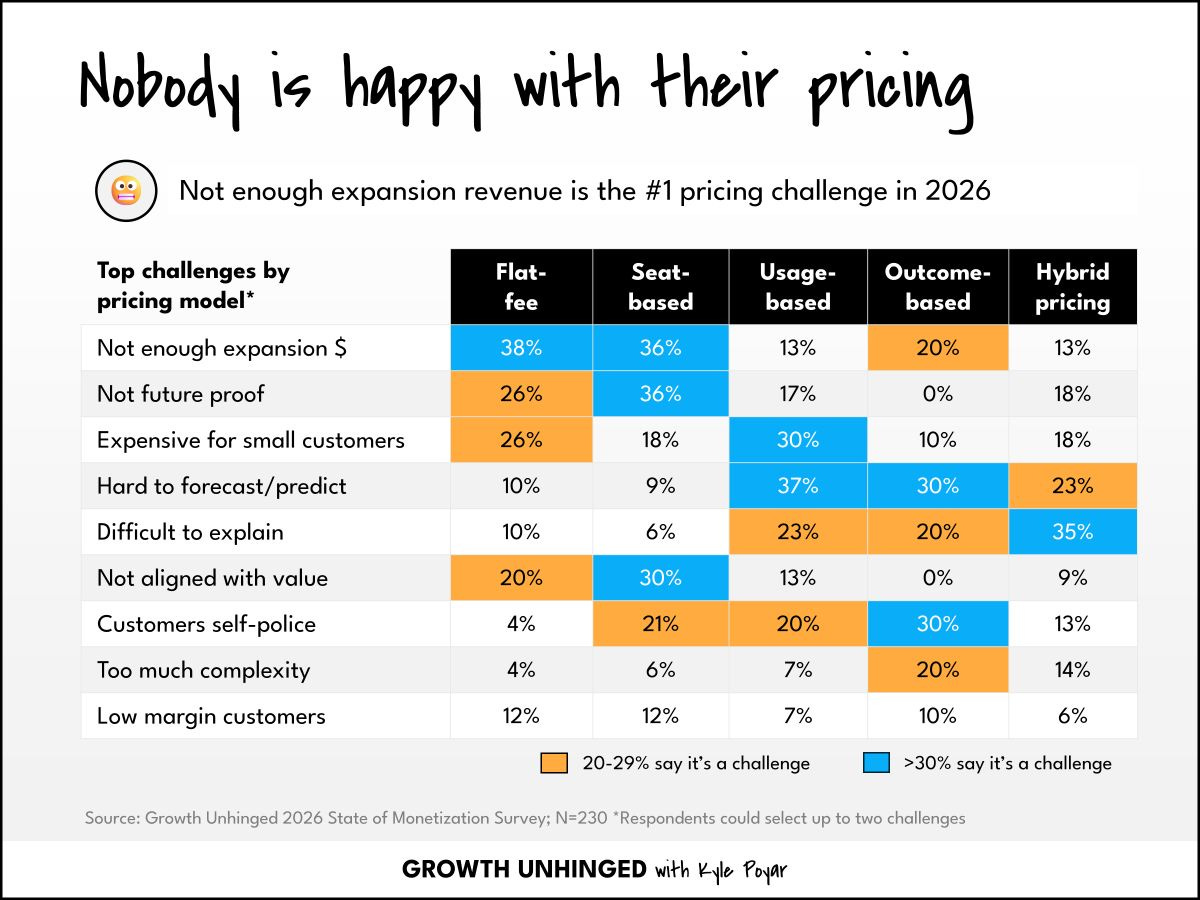
Annual price tweaks have always been routine in SaaS — slight bumps that are largely hidden inside “per-seat pricing” or as a result of new tiers or modules. The shift right now is the depth of the change. A jump from 25 to 37 percent on hybrid models shows the underlying pricing model is changing.
That kind of change used to happen in slow, high-stakes moments. Big pricing and packaging projects, often with external consultants, painful customer testing, a sales enablement deck and the allure that you’re not going to touch this again for a couple of years.
Why? Pricing model changes pull leaders from across the business off whatever else they’re doing. Engineering, sales, finance, product. Endless debate about modules, buyers, competitors, modelling, and often just to come up with a “good enough” answer that nobody quite loves. Then everyone goes back to their day jobs.
Repricing rarely feels like the “hair on fire problem”. You can always just sell better, ship faster, or make the product more compelling. Pricing can wait.
Now pricing models are starting to behave more like product. Shipped, watched, adjusted, sometimes pulled back. All more frequently than SaaS used to allow.
Growth Unhinged and PricingSaaS tracked more than 1,800 pricing and packaging changes across 500 SaaS and AI companies in 2025. Metronome’s pricing index (drawn from 50+ AI pricing models) says single-track pricing models are becoming the minority in AI. McKinsey’s view is more measured, but points in the same direction: per-user pricing won’t disappear, but software companies will need some form of consumption component as AI capabilities scale.
When we hosted Anthropic at a Product Counsel Live event in Melbourne last month, we asked them directly how startups should price their AI features. They were honest: they don’t quite know either.
So if you feel like pricing is unsettled, you’re not behind. You’re just in the same fog as all of us.
Fresho is a leading Australian B2B software platform for the wholesale fresh-food industry. It digitises the ordering and operations between wholesale suppliers (fruit & veg, meat, seafood, dairy) and their hospitality/retail customers (restaurants, cafés, grocers).
Fresho has historically priced around order volume, which makes sense for a fresh food ordering platform. The customer value isn’t seats. In fact, part of the value is helping customers grow without adding more people.
One of the traps in pricing is copying the unit that is easiest to administer rather than the unit that reflects how the customer experiences value.
For Fresho, new products and modules are putting pressure on the old model. Their AI order co-pilot has been live for around 12 months, turning messy order inputs into electronic orders. Their newer Messaging and Insights module brings WhatsApp, email, SMS, and operational data together so customers can communicate with buyers more intelligently.
The commercial question isn’t just “what should this cost?” It’s “what are we promising customers this will become?”
If a team sells a bundled module, the product roadmap tends to become a bundled roadmap. If a team sells volume tiers, it needs usage visibility, alerts, and throttling. If customers are buying early off a prototype, the pricing promise becomes a product promise.
Pricing isn’t downstream from product. It bends the product.
Kath’s story wasn’t about if they’d picked the right number, it was about how much the pricing decision was forcing clarity on packaging, customer expectations, and proving value as the product was adopted.
If your pricing model would force the wrong roadmap, it isn’t just a pricing problem.
Cake Equity is an Australian equity-management platform - essentially cap table and share/option management software for startups and private companies. They came at the topic from a different direction.
The company had a hybrid pricing model with a fixed plan and per-head components. From a detailed customer survey, Nick learned that the most important things were predictability and transparency, but customers weren’t huge fans of seat based pricing.
The revenue data told a different story.
A meaningful share of expansion was coming from headcount growth. Customers might not love per-head pricing in the abstract, but it held up. Headcount genuinely tracked the value they were getting: as teams grew, more people held equity, and managing that equity is exactly what the product does. Paying more made sense. It was transparent. It mapped to a number they already had to justify internally. Not because per-head was the unit they liked, but because it matched how the product earned its keep.
The best pricing unit isn’t always the one customers say they prefer. It’s the one that tracks the value they’re getting, the one that still feels fair when they’re renewing or being asked to pay more.
That logic has limits. Per-head holds where headcount tracks usage. It strains in domains where AI agents do real work without a corresponding seat. The “AI agents don’t need seats” critique has teeth, but it’s not universal. It’s domain-specific.
Nick also shared something I keep hearing across AI discussions: customers are becoming more open to AI, but trust is also domain-specific.
In Cake’s world, cap tables and equity are high-consequence systems. Customers aren’t asking for an agent that autonomously changes the cap table. They’re more comfortable with agents that alert, draft, explain, or open up controlled access through MCP endpoints.
The pricing implications follow. If the product is being trusted as infrastructure, predictability and control are part of the value. If AI is doing autonomous work with measurable outcomes, usage or outcome pricing may make more sense. If the AI is improving a workflow but not replacing labour, it may be better as an add-on or premium capability inside a broader package.
The pricing model follows the trust model.
A lot of AI pricing commentary collapses into one argument: seats are dead, usage is the future.
I don’t think we’re there yet.
Seats are under pressure, especially where value no longer scales with how many people log in. But seats still have one enormous advantage: buyers understand them. Finance teams can budget them. Procurement can compare them. And teams can forecast them.
That’s why hybrid pricing keeps coming up: headcount plus usage, platform plus credits.
A base platform fee or seat model gives the buyer predictability. A usage layer gives the seller margin protection and expansion upside. Credits can sit between the two, giving customers some sense of allowance while giving vendors a way to meter expensive work.
I’m wondering if credits will become their own headache though. If every vendor invents their own credit system, customers will end up with a wallet full of various currencies which might work for a while but I suspect it won’t be the end state.
Bessemer frames the deeper shift as moving from charging for access to charging for work. That gets closer to what customers actually care about. If agents resolve support tickets, drafts documents, or completes workflows, the value is no longer access, it’s work getting done.
Customer support is one area where this appears to be working well. Intercom Fin charges $0.99 per resolved conversation. Zendesk has shifted to resolution pricing. Decagon prices on resolved interactions. These work because “a ticket resolved without escalation” is a clean, observable, attributable outcome. The category found its unit.
Most categories won’t be that clean. That’s why I suspect the next few years won’t be one big migration from seats to outcomes. It’ll be a period of messy hybrids.
Seats plus credits. Platform fees plus overages. Included usage plus premium caps. Annual contracts with quarterly options. Human-in-the-loop workflows with add-on automation. Outcome language in the sales story, but predictable buying models in the contract.
That may look inelegant.
But it’s easy for buyers to understand, and rarely gives them a sharp surprise when usage spikes.
Some questions I would take back into any pricing discussion:
What unit does the customer already understand?
If the customer can’t explain why they’re paying more, the model will create friction even if it’s economically correct.
Where do the top users break your margin?
AI makes usage uneven. Growth Unhinged points out that the top power users can drive a very large share of token consumption. You need to know where that happens before it becomes a gross margin surprise.
What are customers actually afraid of?
Sometimes it’s price. Often it’s opacity, loss of control, privacy, reliability, or a bill they can’t forecast.
What product promise does the pricing model create?
Bundling, tiers, early access pricing, and usage caps all imply a roadmap. Make sure it’s the roadmap you want.
Can you change pricing without breaking trust?
Pricing agility is becoming an advantage. But only if the customer experience around pricing, billing, limits, alerts, and renewal is clear. Cursor’s mid-2025 pricing migration is the cautionary tale here. A credit overhaul handled badly enough to burn through years of goodwill with their most loyal users in a matter of weeks.
Are you pricing the model, the workflow, or the outcome?
Tokens are a cost unit. They aren’t automatically a customer value unit. The closer your pricing gets to customer value, the more credible it becomes. The closer it gets to raw cost, the more it risks feeling like a tax.
The lesson isn’t that every SaaS company needs to rip out its pricing model and replace it with usage, credits, or outcomes. That would be too neat.
The better lesson is that pricing needs to get closer to the product conversation.
Not as a spreadsheet at the end. Not as a one-off annual project. Pricing is becoming part of the product system: what you expose, what you meter, what you bundle, what you cap, what you promise, and what customers can trust.
The companies that do this well won’t be the ones with the cleverest pricing page.
They’ll be the ones that know what their customers value, know what their product costs to deliver, and build enough trust that customers are willing to grow with them as both keep changing.
That’s less exciting than “AI has killed SaaS pricing”.
Huge thanks to Kath Cashion and Nick Cust for sharing the work behind the work, and to the Product Counsel members who made the conversation what it was.
More of this, please.
No posts
Comments
Nothing yet. Say the first thing.
Sign in to join the conversation.