
Perhaps the first surprise of Kesar Singh Chibbar’s account of Guru Nanak Dev Ji is that out of the 153 verses, it takes until verse 120, almost 80% of the way through, for the birth of Guru Nanak Dev Ji.
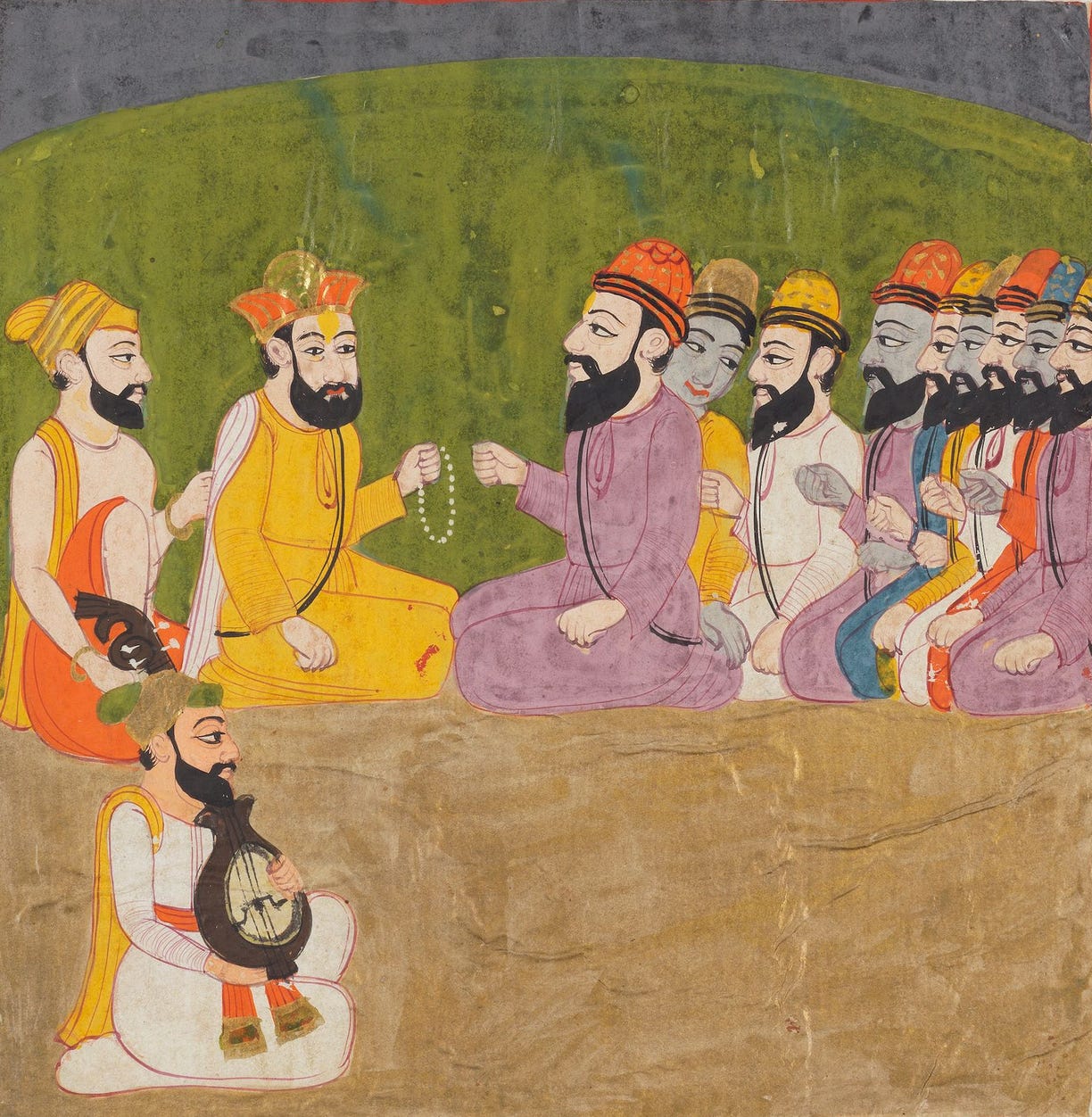
In the previous verses, Chibbar takes the reader through worlds beyond worlds, cosmic eggs suspended from immortal trees, the Sun dynasty, Ram and his sons Lav and Kush, the rise and fall of the Bedi and Sodhi lineages and an ancient promise that has been fulfilled through the ten Gurus.
This is very much an affront to how a modern biography normally begins.
Guru Nanak Dev Ji is often introduced as a religious founder, a social reformer, a poet, a mystic or a teacher who challenged caste, empty ritual and blind religious belief. Chibbar does not reject any of this but he begins on a completely different scale.
Chibbar is clearly showing that before Guru Nanak Dev Ji becomes a historical person, he is a cosmic presence. Before Chibbar deals with the teachings of Guru Nanak Dev Ji, Chibbar places his authority within a mythological history stretching from the creation of the universe to the emergence of Sikh sovereignty.
This may not read as historically rich in respect of the details surrounding the life of Guru Nanak Dev Ji but it does provide us a brilliant insight into how those in the 18th century remembered Guru Nanak Dev Ji.
The Bansavalinama Dasan Patshahian Ka is usually dated to 1769 and Chibbar informs us himself in the text, that he is writing in a dharamsala in Jammu, as a result of being asked to discuss a line from Jap Ji Sahib by his son.
The line in question was:
ਧਰਤੀ ਹੋਰੁ ਪਰੈ ਹੋਰੁ ਹੋਰੁ
Dhartee Hor Parai Hor Hor.
“There are worlds beyond worlds.”
Jap Ji Sahib – Pauri 16
What makes the author and this account of particular interest is the connection Chibbar’s family has to the households of the later Gurus.
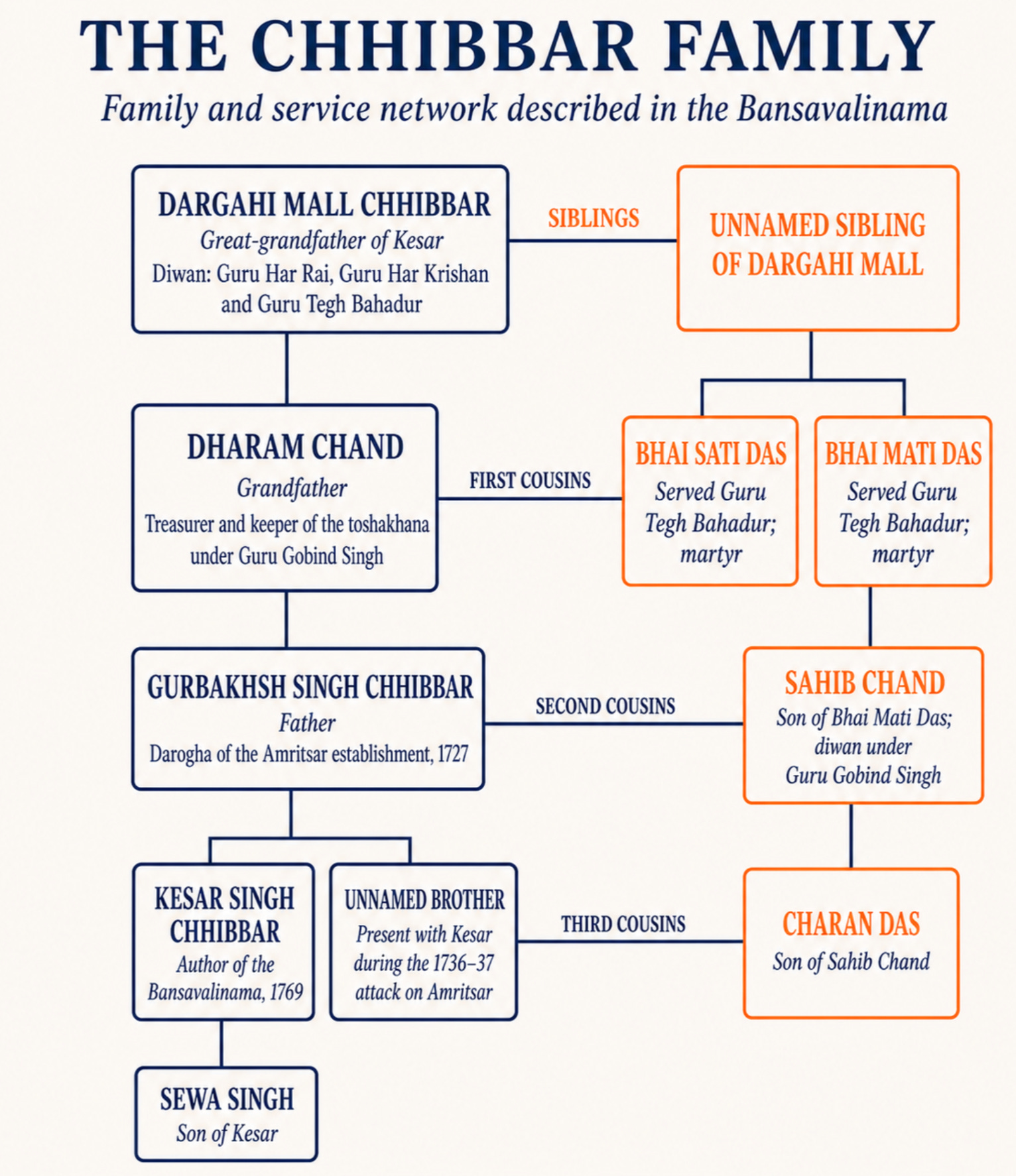
In his account, Chibbar informs us that his great-grandfather Dargah Mall served as diwan (a senior civil administrator often in charge of supervising revenue, expenditure, correspondence, officials and everyday operations of the court) to Guru Har Rai and Guru Har Krishan and was confirmed in that office by Guru Tegh Bahadur Sahib Ji.
Dargah Mall’s son Dharam Chand, Chibbar’s grandfather, was subsequently entrusted with Guru Gobind Singh’s treasury and toshakhana.
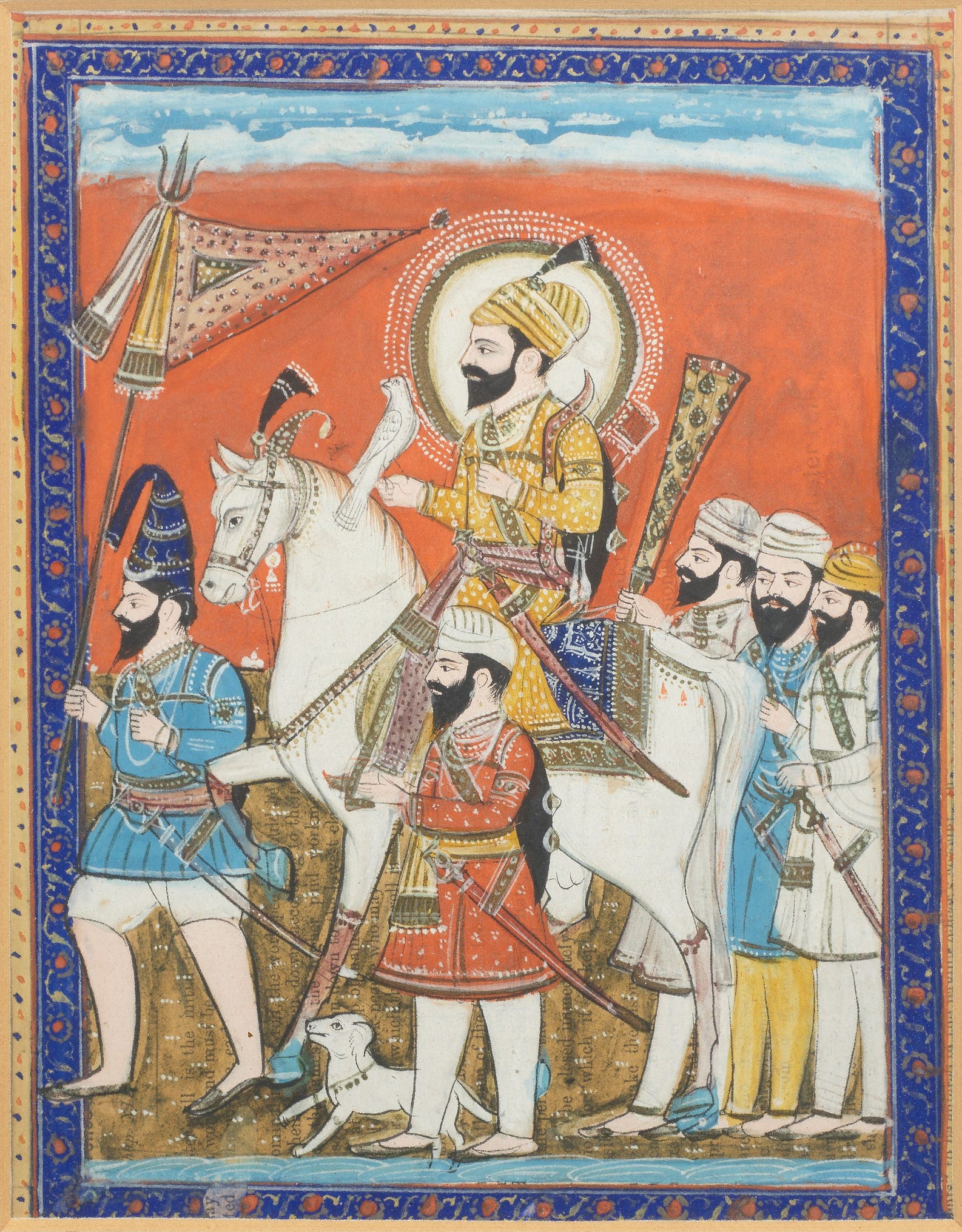
Chibbar’s father, Gurbaksh Singh, continued the family’s administrative work, first carrying out business for the Guru’s household and later, in 1727, serving as darogha (a superintendent or operational overseer) of Amritsar, with the responsibility for its treasury, offerings and associated departments.
The wider family included Bhai Sati Das and Bhai Mati Das, described as Dargah Mall’s nephews, as well as Mati Das’s son and a diwan under Guru Gobind Singh Ji.
Kesar Singh Chibbar grew up within the institutional world that survived the passing of the last living Guru. He says that he attended the Delhi darbar maintained by Mata Sundari and Mata Sahib Devi, where he encountered senior figures connected to the Gurus’ household, including Guru Gobind Singh’s maternal uncle, Kirpal Singh, as well as Bhai Mani Singh, Tara Singh and Koer Singh Chandra.
Chibbar places himself, as a young child, at the 1727 gathering in Amritsar where Kirpal Singh re-organised the darbar’s finances and appointed four administrators. One of them was Chibbar’s father, Gurbaksh Singh, who became darogha.
Bhai Mani Singh subsequently joined this circle and is praised by Chibbar as a Sikh of the Guru without any equal.
These relationships placed Chibbar close to the people, records and administrative traditions that connected the Guru’s household and court with the post-living Guru institutions of Delhi and Amritsar. This quite clearly gave Chibbar access to an important body of family and institutional memory.
Chibbar’s family were not simply attendants in the Gurus’ domestic households. They belonged to a hereditary class of literate court administrators responsible for finance, records, correspondence and the practical operation of the Gurus’ establishment.
The text therefore should be viewed as a layered record of how one informed but highly situated Sikh writer understood the past. those layers include historical events, family traditions, scripture, philosophy, Puranic cosmology, Chibbar’s own Brahmin background and far more.
J.S. Grewal in History, Literature and Identity: Four Centuries of Sikh Tradition, on page 227, states that there are, “two opposing evaluations of Kesar Singh Chibbar’s Bansavalinama Dasan Patshahian Ka: one based on extreme scepticism and the other bordering on credulity. None of these could be regarded as a balanced view.”
In verses 39-50, Chibbar moves from the infinity of creation to the identity of Guru Nanak Dev Ji.
In these verses, history, philosophy, identity and more all come together. For instance, Chibbar describes countless universes, each a fruit hanging from immeasurable trees. Each fruit believes itself complete and the only universe because its inhabitants cannot see the scale beyond it. It is this boundless Being manifested throughout these innumerable worlds that Guru Nanak is identified with.
Chibbar writes, “The mindless human thinks him [Guru Nanak] merely human.”
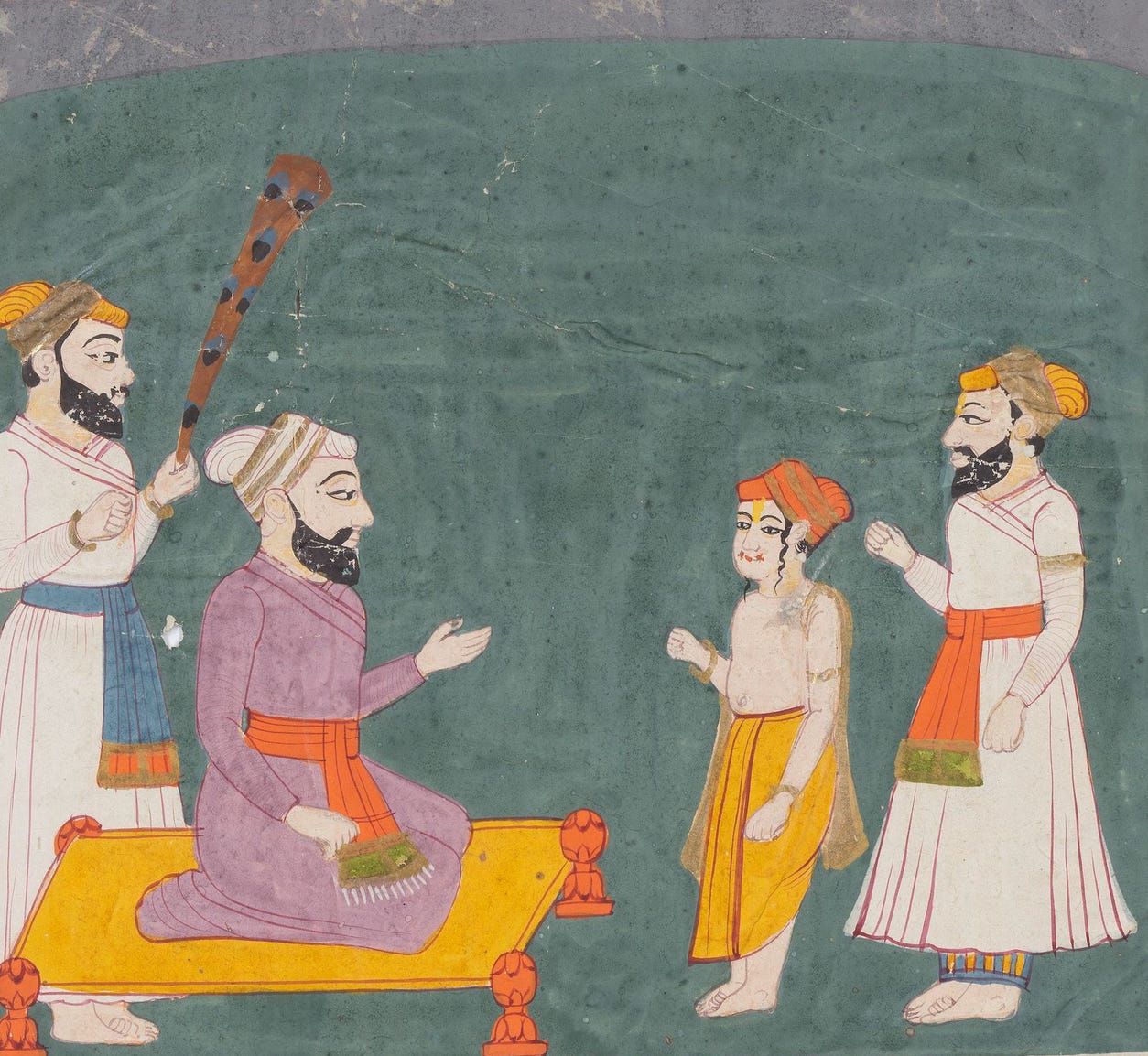
Chibbar continues to state that the ten Gurus are not presented as ten related teachers, they are instead ten forms of Guru Nanak. Each Guru maybe physically different but they all carry the same one divine light. The divine light that was manifest via Guru Nanak Dev Ji is the physical manifestation of the boundless Being.
This continuity is not simply Chibbar’s invention. The Ramkali ki Vaar of Satta and Balwand describes Guru Nanak Dev Ji appointing Lehna, who would become Guru Angad Dev Ji, during his own lifetime and states that the Divine Light remained the same even though the body changed.
However, Chibbar' develops this principle further, through the language of Avatar, cosmic manifestation and Puranic genealogy. That specific language tell us how Chibbar explained the Gurus’ oneness, not necessarily how every Sikh in the 18th century understood their history.
Modern accounts often preserve this very idea, “one light in ten forms’ as a doctrinal sentence without the enormous cosmological architecture Chibbar builds around it. A cosmological architecture that, should be noted, Chibbar does not invent but inherits from the Bachittar Natak commonly associated with Guru Gobind Singh Ji.
Close to a third of the chapter is dedicated to connecting the Bedis and Sodhis with the lineages of Lav and Kush, the sons of Ram.
This is obviously not to be read literally yet on the other hand, read only as evidence of Chibbar’s Brahmin bias, it becomes too easy to dismiss and frankly, far too simplistic. Furthermore, dismissing it is further complicated by the genealogy appearing in Bachittar Natak.
The Bansavalinama is a genealogical work that often appear in Rajasthani literary traditions where it is a feature to trace a ruler back to the Sun or Moon dynasty. The genealogy itself justified authority and the right to rule.
Chibbar utilises that political form and replaces the regional chief with the Gurus. The Bedis descend from Kush and the Sodhis from Lav, with the transfer of authority between their lineages a fulfilment of an ancient promise.
An interesting point to note is that Chibbar is emphasising a genealogy for Sikh sovereignty at a moment in history where Sikh forces were actively displacing Afghan and Mughal authority across vast swathes of Punjab.
The mythological genealogy is telling Chibbar’s readers that Sikh authority did not appear accidentally in the 18th century but belonged to a sacred history whose promise began long prior to the birth of Guru Nanak Dev Ji.
Modern biographies usually remove this material in search of the verifiable, historical Guru Nanak. However, removing it conceals the work that this genealogy performed for 18th century Sikhs attempting to explain sovereignty, succession and the philosophical framework to understand the ten Gurus.
The historical details are rather ordinary in comparison.
Guru Nanak Dev Ji’s father appears as Kalyan Das, rather than Mehta Kalu. Kalyan Das’s younger brother is named Lal Chand. Chibbar describes the family’s movement towards Talwandi and presents both as competent keepers of accounts.
Kalyan Das goes on to recieve the work of a patwari, a village revenue official. In this context of flourishing trade and the family’s standard rising, is when Guru Nanak Dev Ji is born.
Chibbar continues to relay how Guru Nanak marries Mata Sulakhani, has two sons, returns home between his journeys and eventually settles at Kartarpur beside the river Ravi, where he takes up farming. None of this is presented as a retreat from or an affront to spiritual life.
In fact the contrast between Guru Nanak Dev Ji and his eldest son is revealing. Sri Chand adopts the dress and celibacy of a yogi, while Guru Nanak establishes a household and a community shaped by work. Nevertheless, family ties did not determine who took up the mantle of Guruship.
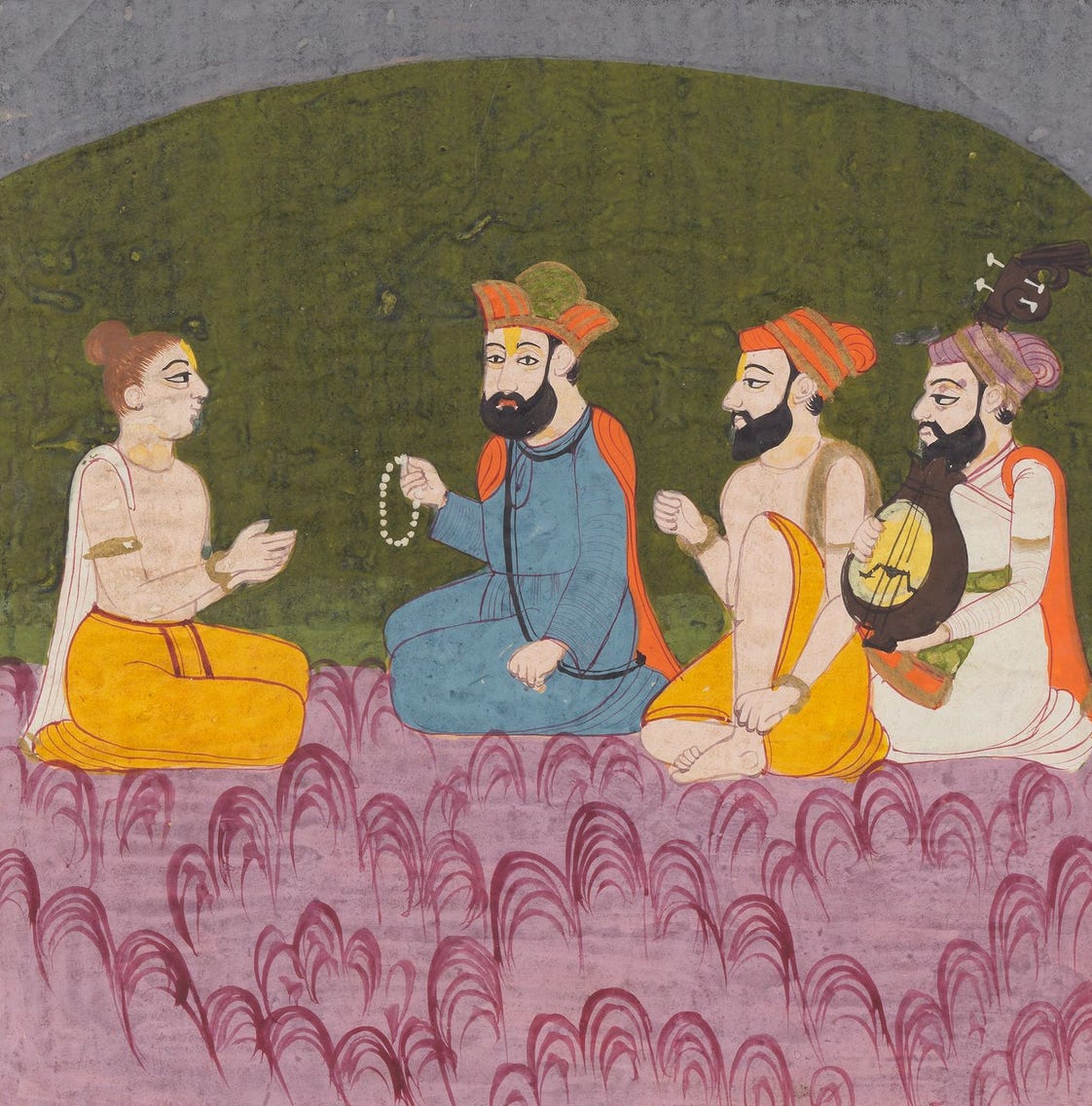
In many ways this view of Guru Nanak agrees with a significant shift in recent scholarship where the older academic portrait of Guru Nanak primarily as a mystic is being challenged. Early sources such as Bansavalinama show Guru Nanak Dev Ji creating a community, establishing institutions and planning for that community’s survival.
Guru Nanak chooses Lehna, later known as Guru Angad, rather than either of his sons. In Chibbar’s telling, marriage, fatherhood and labour are compatible with spiritual authority, an authority not inherited by birth.
Chibbar’s account begins when Guru Nanak gives his coat, or godara, to Lehna and declares him Guru Angad. Many more modern retellings pave over the uncomfortable process Chibbar outlines.
Sri Chand, Lakshmi Das and the wider family object. Their speech contains a caste insult directed towards Lehna and they question what has happened to their honour and inheritance. In response, Guru Nanak Dev Ji does not deny their place in the family lineage and informs them the world will know of them, their descendants and speaks of the horses and hawks given to them as insignia of authority. However, the Guruship was a burden given to Lehna.
Chibbar states that following the passing of Guru Nanak Dev Ji, the family attempts to recover the godara. However, Dharam Chand cannot lift it and neither can Lakshmi Das as the garment becomes as heavy as an elephant. It is only Angad, who after bowing to it, can raise and wear it.
The similarities between this and the swayamvara motif are rather striking. In the Mahabharta the assembled kings cannot string the bow and it is Arjuna, the outsider who at that moment is disguised as a brahmin, who wins Draupadi’s hand.
The structure is strikingly similar, an object of impossible weight, a public test and a legitimacy that lineage and claim alone cannot provide.
One way to view Chibbar’s addition to the motif, is that Angad succeeds not through extreme strength but through submission, which inverts the trial whilst borrowing its shape. On the other hand, Lehna is able to lift a goat that becomes as heavy as an elephant, illustrating that the burden of Guruship, heavy as an elephant for others, is a weightless burden for Lehna.
The use of the motif is something requiring further reading on my part.
More importantly for Chibbar, the story supplies divine confirmation. Although the conflict surrounding it is just as important, for spiritual succession does not erase kinship, property, honour or your own progeny.
Chibbar places the death of Mardana at Khurma during the travels, or Udasis. Mardana passes away after becoming ill and asking Guru Nanak not to bury him but to have his body consumed by fire.
This can often be read rather simply as a story of a Muslim disciple ‘transcending’ Muslim practice. That interpretation is rather neat and views Chibbar’s ritual assumptions as the voice of Mardana himself.
As with many facts presented in early Sikh literature, there are various theories and disagreements. The Bala Janamsakhi describes a cremation, while an account attributed to the Mani Singh tradition has Guru Nanak place Mardana’s body in the river Ravi.
Chibbar’s version is not unique proof of what happened and it along with many other texts belong to a contested history of how later communities remembered Maradana’s identity, discipleship and funeral.
Modern accounts often turn Mardana into an emblem of ‘Hindu-Muslim’ or ‘Sikh-Muslim’ harmony. Chibbar’s narrative asks who has the authority over the body of a disciple and whether inherited religious identity remains after a lifetime with the Guru.
Chibbar’s account of Guru Nanak Dev Ji’s own passing differs sharply from the more familiar Janamsakhi stories.
There is no quarrel between religious communities or followers over the body. There is no sheet lifted to reveal flowers that are then divided for burial and cremation.
Instead, Chibbar describes cremation, thirteen days of mourning, recitation from the Garud Puran, a Brahm Bhoj and gifts to Brahmins. The pyre miraculously leaves no ash.
It is tempting to view this as verified history. However, these verses cannot establish that Guru Nanak’s funeral occurred exactly as described. Yet what they can establish is that this ritual account was acceptable enough to be included in a Sikh genealogy in the late 18th century.
This distinction matters simply because the archive preserves a Sikh past less doctrinally uniform than later summaries might suggest. It’s contradictions should be examined and questioned rather than hidden or automatically accepted.
Chibbar’s omissions are just as revealing.
Unlike the Janamsakhi literature, there is no extended account of Sacha Sauda, the rejection of the janeu, Bhai Lalo and Malik Bhago, Haridwar, Mecca, Baghdad, Babur’s invasion or the encounter with the Siddhas. Even the travels are compressed into a few lines.
The famous declaration ‘there is no Hindu, there is no Muslim,’ does not appear after the three days in the Bein but Chibbar does state that Guru Nanak Dev Ji returned carrying divine instruction.
These absences do not prove that Chibbar rejected or had never heard of those stories. It indicates that Chibbar was not trying to write the kind of life and story assembled in the Janamsakhi literature. Literature which overwhelmingly shapes modern popular narratives of Guru Nanak Dev Ji.
The Bansavalinama does not recover an uncontaminated ‘historical Guru Nanak.’ No 18th century source could do that on its own.
Yet what it helps to restore is the range of ways that Guru Nanak could be understood before modern biography settled around a familiar sequence of episodes.
I’ve always found Sikh history fascinating and over the years I’ve been working on studying the Janamsakhi literature. What is interesting to see at the moment is that a mapping of 150 sakhis across 12 versions of Guru Nanak’s life finds only 6 episodes appearing in 9 of them, 22 episodes appear in 7 of them, while only 46 episodes occur in only 1.
Even within these sources, there is no single, stable biography reproduced from generation to generation. There is a compact shared spine that covers birth, schooling, Sultanpur, the encounter with the qazi, Mount Sumeru, the return home, Pak Pattan, succession and death. However, this is surrounded by a far larger and varied field of stories.
Those differences show that each tradition made different choices about what Guru Nanak’s life was meant to reveal.
The Miharban tradition, an apostate tradition, expanded the theological conversations and sacred geography of Guru Nanak Dev Ji.
The Bala traditions developed a more anecdotal life, while B40 combined elements associated with both the Puratan and Bala streams.
Macauliffe and Bhai Vir Singh later worked as synthesists, selecting and arranging material from these inherited narratives into lives that helped shape modern understanding.
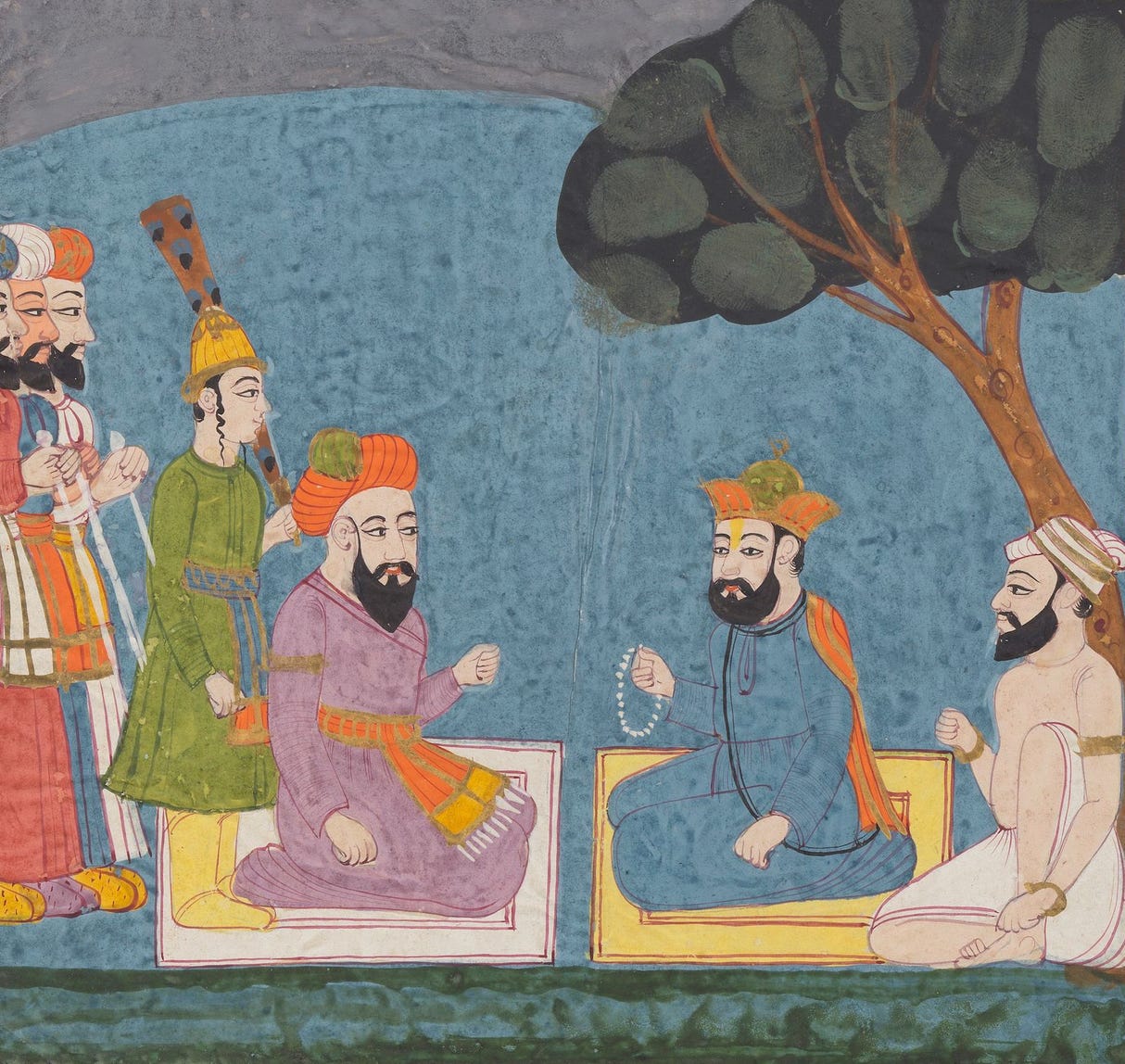
Chibbar therefore matters not because he supplies every story now considered essential but because his selection reveals a different answer to the question of who Guru Nanak Dev Ji was.
Chibbar’s Guru Nanak is cosmic without ceasing to be a farmer. Guru Nanak belongs to a household without allowing Guruship to become hereditary property. Guru Nanak stands within an Indic genealogical and mythological world while inaugurating an authority that far surpasses wordly authority. Guru Nanak is the First Sovereign and also the single light Chibbar sees moving through all ten Sovereigns.
Modern accounts often focus on what Guru Nanak Dev Ji did, Chibbar asks what kind of authority could pass through ten bodies, survive disputes over inheritance and become the foundation of a people who will actualise their own sovereignty.
This is why Guru Nanak Dev Ji’s birth can wait until verse 120.
No posts
Comments
Nothing yet. Say the first thing.
Sign in to join the conversation.