
Contents
A rumour in the hills
The chronicler and his sources
Sent by the Guru
The furnace of Gurdas Nangal
“As you did, so you receive”
The ninth body
The man who would not die
What the first memory tells us
In 1769, in the town of Jammu, an elderly chronicler named Kesar Singh Chhibbar wrote down something extraordinary about Banda Singh Bahadur, the man the Mughal empire had publicly executed in Delhi 53 years earlier.
Banda, he recorded, had not died at all. He had given his head in Delhi, taken up “a body just like it,” and returned to the hill kingdom of Kullu. He had lived 22 years in Suket Mandi. He was chiranjeet, one who does not die: “Now, wherever he is, that chiranjeet remains; whatever body he wishes, he puts on and sheds.”
Chhibbar devotes an entire chapter to Banda, 67 verses, and places it directly after his account of Guru Gobind Singh Ji, before the Gurus’ widows, before the state of the Panth itself. The position is part of the argument. What the chapter contains is stranger, more conflicted and, I think, more historically revealing than the Banda of modern memory.
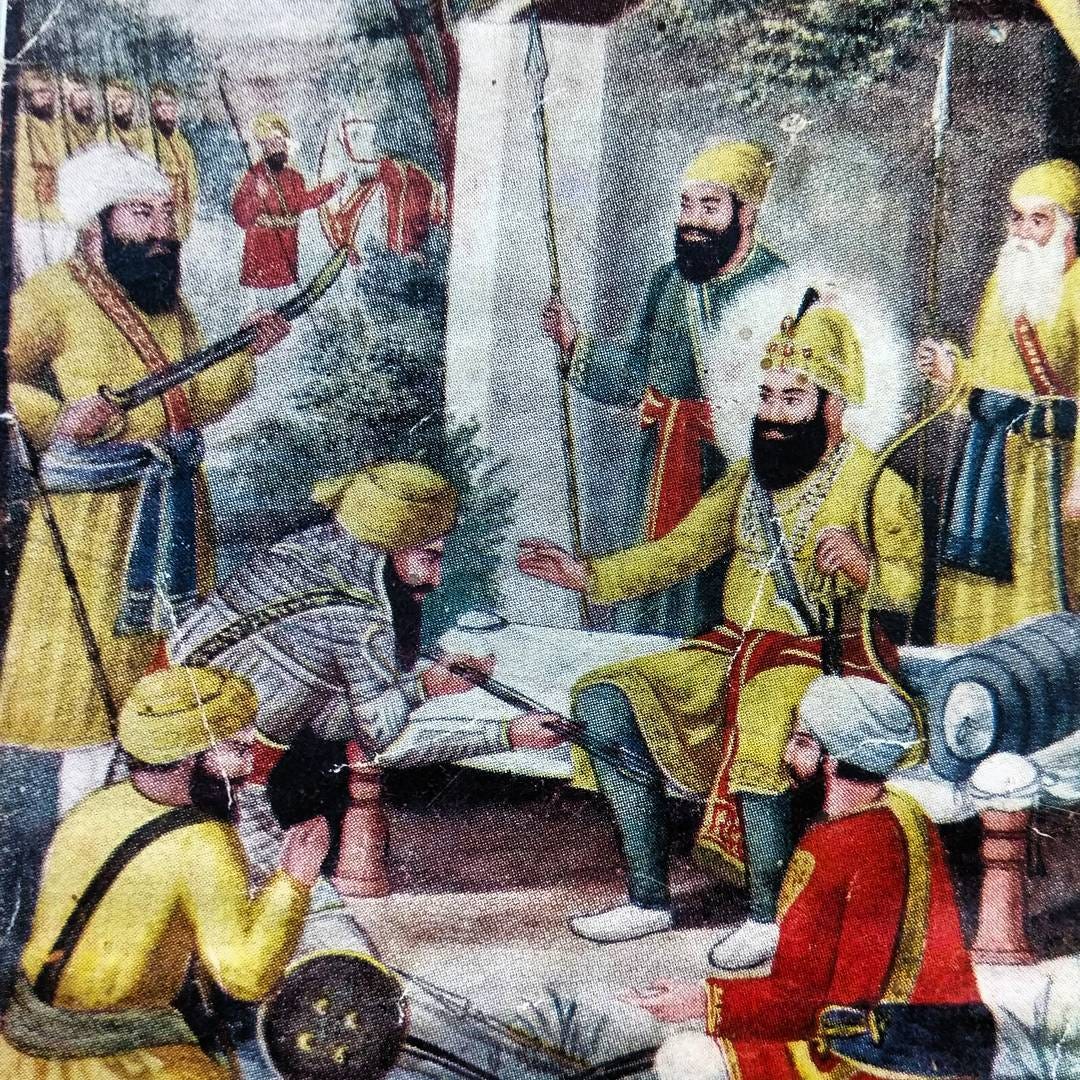
Kesar Singh Chhibbar was not a neutral observer, which is precisely what makes him valuable. He was the grandson of Dharam Chand, treasurer to Guru Gobind Singh Ji, from a Brahmin family that had served the Gurus’ household for generations and was closely associated with the family of Bhai Mani Singh.
He spent his childhood at the Delhi darbar of Mata Sundari Ji and Mata Sahib Devi Ji, the community that formed around the Guru’s widows after 1708. He grew up among people who had known Banda’s contemporaries, in the very city where Banda was executed, within a decade or two of the execution.
He tells us his method himself: “Whatever of Banda Sahib’s haqiqat I could hear, Singh Kesar ‘Chhibbar,’ grandson of Dharam Chand, has spoken and recounted.”
This is oral tradition, gathered by a man with better access to it than almost anyone alive, and set down in 1769, decades before the accounts most popular histories rely on.
The first thing to understand about Chhibbar’s Banda is that his legitimacy is never in question. In the twelfth chapter, counting the martyrdoms inflicted on the Guru’s house, Chhibbar writes simply: “Banda, sent by the Guru, came.”
The mission itself, vengeance on Wazir Khan of Sirhind for the murder of the younger Sahibzade, is treated as genuinely commanded by Guru Gobind Singh Ji. In the fourteenth chapter Chhibbar goes further: the one who came “in the form of a Vaid Bairagi” tore down the tombs and burned the graves, and this was “the tamasha of that Complete Being,” the Master’s wish working itself out.
Chhibbar’s position is carefully drawn: Banda is the Guru’s instrument, sent and validated but he is not the Guru.
Chhibbar’s account of the end is vivid and, in its outline, matches the Persian sources. The siege of the fortification at Gurdas Nangal in 1715: “Inside there was no grain, no fodder, no wood. Suffering and starving, the horses were given up... Gurdas Nangal became a furnace.” Then the arrest, which the printed edition’s editor dates to 7 December 1715, where 740 Sikhs were taken to Delhi and martyred.
Chhibbar states: “No one could have captured him; had he wished, he could have departed. But knowing [the appointed hour], he surrendered himself.” Here Chhibbar seems to be reading the martyrdom through hukam. Banda submits not to Mughal power but to the divine ordinance itself. He allowed himself to be taken, Chhibbar explains, “because he had consumed the governance of the realm past its appointed time.” The failure is real, but it is folded into a larger frame in which nothing happened to Banda; it happened through him.
Interestingly, Chhibbar also preserves the community’s memory of how the surrender was actually achieved. In his telling the besiegers swore safe conduct to draw the starving garrison out, then broke their word the moment they had them: “With oaths and promises they took them out of Gurdaspur, and then released them slain.” The only release the Sikhs received was death. Where the Persian chroniclers describe a spent garrison giving itself up, Chhibbar remembers a sworn oath deliberately broken.
The execution scene Chhibbar gives us is a dialogue. The emperor Farrukhsiyar questions Banda about his miracles, and Banda answers in terms consistent with almost all pre-colonial Sikh literature, indicative of the epistemological context it spoke from.
“As one has done, so has one received. As you do, so shall you also receive.” Then: “Banda Sahib gave his head and kept his dharma.”
For Chhibbar this is not merely a brave death, it is the hinge of a moral argument that runs through the whole book. The Turks’ slaughter of a hundred thousand Sikhs became the sin that destroyed their own rule.
“The Turks too struck away their own root.” Farrukhsiyar himself was killed by the Sayyid brothers, “an evil death, the same men who had removed Banda Ji’s body,” and the Sikhs, “who gave their heads but did not lose their sidak,” received the rule of Punjab in their turn.
Chhibbar, writing in 1769, with the misl sardars ascendant around him, was very aware of the entire arc: persecution, patience, retribution, sovereignty, all working as a completed karmic proof. The eyewitness English accounts of 1716 marvelled at the composure of the Sikh prisoners going to execution. Chhibbar’s chronicle arguably explains, from inside, where that composure came from.
Then there is the verse that gave this whole piece its title. In chapter 12, Chhibbar counts the cost borne by the Guru’s house, starting with Guru Arjan, killed at Lahore without cause, Guru Tegh Bahadur, imprisoned and beheaded, the four Sahibzade and Mata Gujri dead in captivity.
“Eight bodies of the Guru’s house the Turks killed,” he writes, and then: “the ninth body, Banda, killed with thousands of Sikhs.”
Chhibbar, a man writing a genealogy, concerned with who is inside the sacred lineage and who is not, enrolls Banda Singh Bahadur among the Guru’s own dead. Banda is counted as a body of the Guru’s house, in the same list as the Sahibzade. I know of no stronger statement of where the first generation of Sikh memory placed him. But the same closeness cuts the other way: it shows how easily Banda could be mistaken for a Guru himself, a confusion, and a concern, that even contemporary Rajasthani documents share.
Yet at the same time Chhibbar also condemns Banda. Chhibbar the Brahmin is scandalised by Banda’s army of the so-called low-born, by his punishment of Brahmin and Khatri families, by his departures from what Chhibbar considered orthodox conduct, and he says so.
What is more fascinating is that he holds both positions at once, without embarrassment, just as he holds his own Brahmanical supremacy alongside the radical egalitarianism of the Sri Guru Granth Sahib Ji.
For Chhibbar, Banda is the Guru’s instrument: his conduct is in parts deplorable, yet he is counted a martyr of the Guru’s own household, and he serves as a warning. Modern retellings want a verdict, hero or heretic, and trim the story to fit. The earliest account refuses to, preserving the complexity of Banda himself and of an 18th century Sikh community still grappling with how best to understand him.
Which brings us back to Chhibbar’s survival claim, contradicted by every contemporary record, Mughal and European alike, but important in a different way. Banda Singh Bahadur died in Delhi in June 1716, and the manner of that death is among the most terrible and best-attested episodes of the century.
The legend is historically incorrect, but it is not a mistake. It is what communities do with their revolutionaries. The executed leader who secretly lives, in the hills, across the border, waiting, is one of the oldest shapes grief and defiance take, and here we can see the rumour taking shape within fifty years of the event, recorded by a man who tells us he is writing down “whatever I could hear.”
This also means that somewhere between Delhi and Jammu, between 1716 and 1769, the community that had watched Banda die had begun to say that he had not. Chhibbar adds minute detail to support the reality of the rumour: “nine and a half years Banda exercised rule.”
So how does the earliest inside account understand Banda Singh Bahadur? As sent, and therefore legitimate. As sovereign, though not Guru, the count of his years kept like that of a king. As culpable in conduct, by the standards of a Brahmin chronicler whose standards the Gurus’ own scripture undermined. As a martyr of the Guru’s house, counted by Chhibbar as the ninth body in his list of Sikh martyrdoms and as undying, in the way that communities refuse to surrender the people who refused to surrender.
None of this is the tidy Banda Singh Bahadur of the modern day.
In my opinion this is a better story, it is the Banda of the people who were closest to the events, still arguing about him, still grieving him and still counting his years in the hills. When you read it you will understand why I keep saying that this chronicle’s biases are not obstacles to the history. In places like this, they are the history.
No posts
Comments
Nothing yet. Say the first thing.
Sign in to join the conversation.