
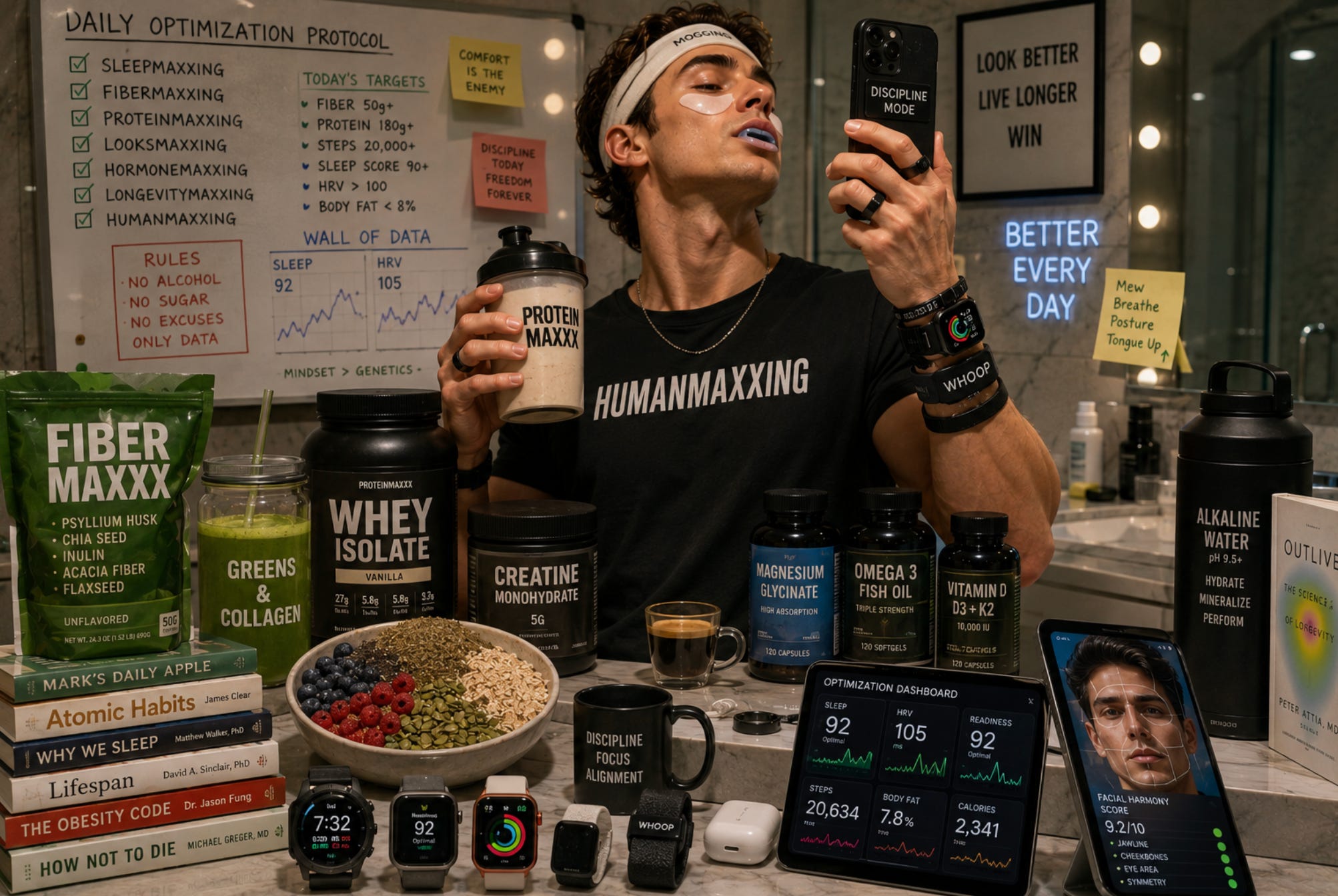
A patient came in a few months ago and read me his numbers off his phone. Forty grams of fiber. A hundred and fifty grams of protein. His daily protocol included cold plunge in the morning, mouth taping at bed and a magnesium stack for sleep. He was regularly tracking his VO2 max, HRV and body composition.
Then he asked what else he should be doing.
He wasn’t sick. He wasn’t struggling. But admittedly, he was obsessed with optimizing, and he couldn’t find the place where it stops.
There’s a word for what he was doing. Maxxing.
Spend ten minutes on social media and you’ll meet a dozen versions of it. Sleepmaxxing. Fibermaxxing. Proteinmaxxing. A biotech investor is now promoting humanmaxxing, which drops the pretense that this was ever about one nutrient.
Some of this looks harmless. Some of it might even be good.
Fibermaxxing is the one I should love. Fiber is the thing most of us are genuinely short on, and it isn’t close. More than 9 in 10 Americans miss the recommended intake. We average 17 grams a day against a target of 25 to 38. So when Google reported this summer that fiber searches had hit an all-time high and fibermaxxing was up 115% in ninety days, I was glad. It’s only search data, but at least the internet got interested in something that would actually help.
But I’ve seen the fallout of people doing it the maxxing way. Going from fifteen grams of fiber to fifty grams a day in a week, because if some is good then more must be better. The problem is your gut needs two to four weeks to adapt to a change like that, and it will tell you so. I’ve seen people bloated and cramping and miserable, convinced they are allergic to beans, or asking me what was wrong with them, when nothing was wrong with them. They went too fast at the right thing.
Proteinmaxxing bothers me more, because we were never short on protein to begin with. It’s on every label now, protein cereal and protein water and protein cookies, processed food with a health halo stamped on the front. Doritos launched a protein chip this year. There are real exceptions, older adults working to hold onto muscle, anyone losing weight fast on a GLP-1. The guy buying protein Doritos is not one of them. What I keep getting stuck on is the verb, maxxing.
Maxxing assumes there is a ceiling and you are not at it. It assumes more is the direction, always. And once you accept that frame you’ve signed up for a game with no finish, because there is no shortage of variable at which a maxxer says good, that’s enough.
The appeal makes sense to me. It feels like control. If I hit the numbers and close my rings, I win the day. But what if the number of rings and goalposts keeps increasing?
My patient with perpetual optimization had never once asked himself where it ends.
I’m not anti-data. Data is useful.
I wear a ring and watch tracking my health metrics. Some mornings I look at my sleep score and question why I wear these, as they can often be demoralizing. With a performative number in the red zone, I am being told by my device that I should expect to feel awful today. But I’ve stopped letting it tell me how my day is going to go, and that’s the only reason it’s still on my finger.
I used to be the biggest critic of tracking my food intake. I thought, why would anyone want to do that, it’s so onerous. Then a coach had me do it for a month and I understood. Short periods of tracking build awareness. Awareness of portion sizes, awareness of calorie density, awareness of mindless snacking.
So this isn’t about whether we should be collecting data. We are collecting the data, and increasingly, we’ll be collecting more and more. It’s about the moment a number stops being information and becomes a verdict.
The suffix, by the way, came from looksmaxxing, which started on online forums about a decade ago. The theory there was that your jaw and your bone structure decided your worth, and that with enough effort you could maximize your way into being aesthetic. It moved to TikTok in the early 2020s, the suffix came along with it, and now you can “maxx” anything.
Most people saying fibermaxxing have no idea that’s the lineage. I think it explains a lot about how the whole thing feels. Somewhere underneath the fiber counts and the sleep scores is the same idea: that you are not enough yet, and the number is how you find out.
I see what that does to people in my medical practice. They’re afraid to take their blood pressure because they’re afraid to see the number. They don’t want to get on the scale. Because when the number isn’t where they think it should be, they don’t think “useful information.” They feel bad. It feels shameful. It feels like they failed.
Am I passing or failing? Am I doing this right?
That question is heavy to carry around every day. And it has almost nothing to do with being healthy.
James Clear says this better than I can, in Atomic Habits. You have to standardize before you optimize, meaning a habit must be established before it can be improved. Put simply: Master the habit of showing up first. Optimize later.
Fitness trackers and apps are very good at helping you optimize. Genuinely good. The problem is most people have never standardized.
Optimization is built for someone who already moves most days, already sleeps at a regular hour, already eats in a way that works for them. For that person, shaving a few points off a number is fun. They earned the right to play that game.
But if you’re still building the thing in the first place, optimization is just overwhelm. It’s forty numbers on a dashboard when what you needed was permission to take a walk.
A patient told me once that a dietician had told her to walk ten minutes after every meal. Good advice. She never did it once.
She isn’t lazy. It landed as one more chore, and I remember thinking, I have a maximum number of chores I can do in my life. So does she. So do you.
Dr. Michelle Segar at the University of Michigan has spent about thirty years on this exact question. What she found is that all of us carry a meaning for movement, and it’s either a chore or a gift. When it’s a chore, it’s the first thing to go the week things get hard. Her framework for changing that includes permission, which is the step almost everyone skips. Michelle was recently on The Health Feast, linked below.
Every time I visit my parents they want to take me for falafel from this one place. They know I like it. And I do like it. I also don’t love how it makes me feel afterward.
I get it anyway. I eat it with them. Because it makes them happy to think it’s making me happy.
No app scores that correctly. If I were to track this refined carb heavy and fried meal, it would read as a red day. But it’s one of the best things I do for myself all year.
Health is not our only value. And the food we eat is not the only component to health. I have to remind people of that constantly, because a scoreboard never accounts for it.
The other thing a scoreboard does is make everything all or nothing. I can’t get to the gym, so I guess I’m not working out. I didn’t meal prep, so I guess it’s DoorDash. And when it’s all or nothing, it almost always becomes nothing.
It can be all or something. It’s very rarely all. Why does it have to be all?
The healthiest people I know aren’t maxxing anything. They eat mostly real food. They move. They sleep. In my experience, when someone stops chasing a certain number and starts paying attention to how they actually feel, the numbers usually takes care of itself. The rings close. They just weren’t the point.
So here’s what I’d try this week.
If you track something and it has started to feel like a test, turn that one thing off for seven days. Not the things your doctor asked you to watch, your blood pressure, your glucose. And if you’re working with someone on a history of disordered eating, this one isn’t for you, because your team gave you that structure for a reason.
And if you don’t track anything at all, which is most people I know, then it’s simpler. Take the one healthy thing you keep meaning to do and shrink it until it stops feeling like a chore. Five minutes. One walk. Something you’d actually look forward to.
Do it for a month. Then, ask yourself something no app can answer.
Do I feel better than I did a month ago?
You don’t need a score to answer that one.
Live well and RAK ON,
Dr. Rak 👊🏽
P.S.: 👊🏽 Join Our RAK On Tribe Community!
We are making sure you are not alone in your health journey. Join For Free →
The RAK On Tribe brings together like-minded individuals committed to wellness rooted in Roots, Awareness, and Kindness. For just $11/month (or save 25% with an annual membership), you’ll get:
Monthly breathwork sessions to reset your nervous system
Strength training guidance twice monthly
Evidence-based plant-forward cooking classes
Growing resource library of practical tools
Supportive community to celebrate your wins and navigate challenges
First month free (and no credit card required)!
Comments
Nothing yet. Say the first thing.
Sign in to join the conversation.