
The worst bugs don’t crash loudly. They just go quiet — like the server that charged your card, told the kitchen, and then died before it could tell the driver.
A pizza delivery app. Friday night rush. Order #49201: card charged, kitchen notified, driver dispatch in progress — and then a memory spike takes the Kubernetes pod down mid-task.
The customer’s app shows “preparing your order.” Forever.
No error. No alert. Just silence.
This is one of the most insidious failure modes in distributed systems: the ghost task — work that started, never finished, and left no trace for anyone else to pick up.
Before I talk solutions, I need to talk about how engineers think about distributed systems — because most of us are trained on single-machine thinking, and that intuition actively misleads us here.
On one machine: if a process dies, the OS knows. Other processes can detect it. You get a clean signal.
In a distributed system: there is no global observer. No omniscient god-process watching from above. Each node only knows about itself. When a server goes silent, it doesn’t broadcast a goodbye — it just… stops. The rest of the cluster has to infer the death from absence.
This requires a fundamental mental model shift:
Assume any node can die at any point between any two lines of code. Design for that.
Not “handle errors.” Not “add retries.” Design for mid-operation death as a normal operating condition, not an edge case.
The ghost task problem shows up anywhere work is distributed across multiple machines:
Ride-sharing apps: A server assigns a driver mid-trip, then crashes. The rider is stranded, the driver is waiting, and no other server knows the assignment was in progress.
Payment processing: A service deducted funds and was mid-way through updating an order record when the pod was evicted during a deployment.
ML inference pipelines: A GPU worker picked up a batch job, started processing, and the node was spot-terminated by the cloud provider mid-inference.
Email senders: A marketing platform was building and sending a campaign email — halfway through the recipient list — when the container crashed.
In all cases: work started, nobody finished it, nobody else knows to pick it up.
The industry answer to this problem is called the lease-with-heartbeat pattern. It’s used by Kubernetes node health, etcd leader election, Apache ZooKeeper, and virtually every serious distributed coordination system.
The idea is disarmingly simple:
If you’re alive, keep saying so. If you go quiet, you’re dead.
Here’s how it works in practice:
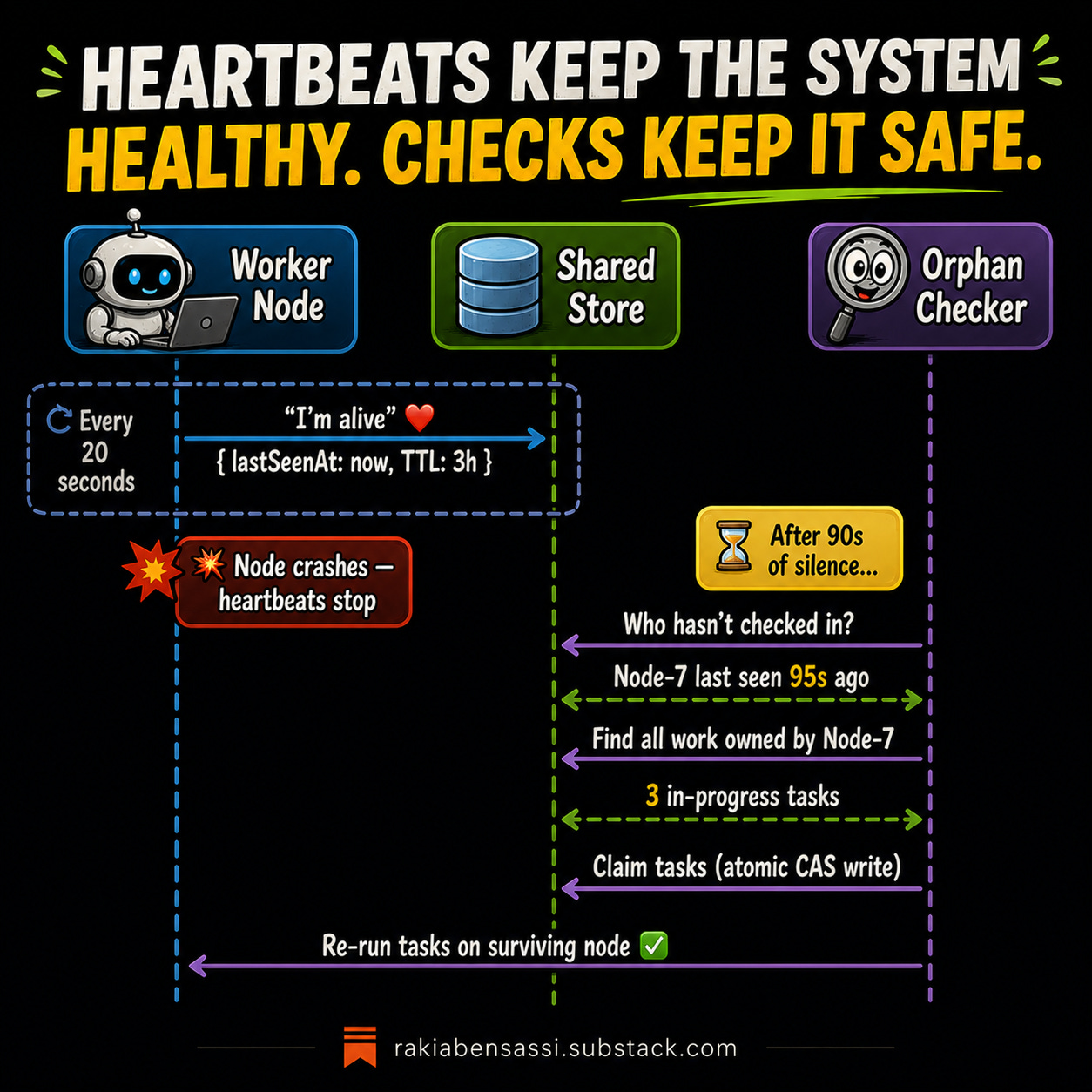
Each worker writes a tiny “I’m alive” document to a shared store every N seconds. A background checker periodically scans for workers that have
gone quiet. When it finds one, it reclaims that worker’s in-progress tasks and re-runs them on a healthy node.
The key insight: write heartbeats at the worker level, not the task level.
If you have 1,000 concurrent tasks, touching each task document every 20 seconds = 1,000 writes/minute.
If you have 20 workers, touching each worker document = 20 writes/minute.
The load scales with your fleet size, not your workload size.
The tricky part isn’t detecting dead workers — it’s safely picking up their work without two healthy workers both grabbing the same task. The answer:
Comments
Nothing yet. Say the first thing.
Sign in to join the conversation.