
Welcome to this week’s issue of RAISINI.
Every week, i write about building a life on your own terms - through music, entrepreneurship, investing, health and brand-building. This isn’t theory. It’s what I’ve lived. Let’s keep going.
If you want access to private chats, live events, workshops, and more, consider becoming a paid or founding member.
For thousands of years, human beings have created gods, spirits, rituals, sacred stories, and systems of belief. This pattern appears so consistently across civilizations that it raises a deeper question than whether any particular religion is true. Why do human beings repeatedly arrive at the sacred at all?
This essay explores how the idea of God evolved alongside human consciousness, why religion emerged in every corner of the world, and how belief helped humanity confront uncertainty, mortality, morality, meaning, and the challenge of building civilization itself.
Chapters
Before God, There Was Fear
Before God, The World Was Alive
The World Was Once Full Of Gods
The Evolution Of God
God Solved The Problem Of Death
The Invention Of The Soul
God Made Large Civilizations Possible
The Axial Age
The Invention Of Morality
Religion Was Humanity’s Operating System
From Many Gods To One God
God As The Human Mirror
Why Science Didn’t Kill God
What Replaced God?
The Return Of The Sacred
The Most Powerful Idea Humans Ever Created
Human beings disagree about almost everything. They speak different languages, live under different political systems, inherit different traditions, and develop radically different explanations for the world around them. Yet across history, one pattern appears with remarkable consistency. Wherever human beings form civilizations, they eventually create some version of the sacred.
The details change. Some societies worship ancestors. Others worship spirits, nature, many gods, one God, or abstract cosmic principles. The names, stories, rituals, and doctrines vary enormously. The underlying pattern does not. Civilizations separated by geography, culture, and thousands of years repeatedly arrive at ideas involving invisible forces, sacred obligations, life beyond death, moral order, and realities that extend beyond immediate experience.
This raises a question that is far more interesting than whether a particular religion is true. Why does the sacred emerge so reliably wherever human beings gather, organize, and build societies? If religion were merely a failed attempt at science, it would be difficult to explain its persistence across nearly every period of human history. The endurance of religious thought suggests that it was solving problems far deeper than explaining storms, eclipses, or disease.
To understand the invention of God, we must first understand the conditions that produced it. Human beings are uniquely aware of uncertainty, mortality, suffering, and the limits of their own knowledge. They require explanations, but they also require meaning, trust, cooperation, identity, and ways of confronting realities that cannot be fully controlled.
This essay explores why the idea of God emerged repeatedly across civilizations, what human needs it addressed, and what the persistence of the sacred reveals about human nature itself.
Imagine standing alone on an open plain more than ten thousand years ago. There are no cities, no books, no scientific instruments, no accumulated body of knowledge explaining the world around you. The sky darkens unexpectedly. Wind moves through the landscape. Thunder rolls across the horizon. Then a flash of light tears through the darkness and strikes a nearby tree. For a moment the night becomes day. The air shakes. The tree burns. Then silence returns.
Today we know what happened. We can describe lightning through physics, explain storms through meteorology, and measure atmospheric conditions with remarkable precision. Early humans possessed none of these explanations. Yet they experienced the same storms, witnessed the same lightning, and felt the same fear. Faced with events that appeared powerful, unpredictable, and beyond control, they confronted a question that would shape the future of human civilization:
Why?
That question sits beneath much of human history. Before philosophy, before science, before organized religion, human beings were trying to understand the forces acting upon their lives. Storms arrived without warning. Eclipses darkened the sky. Disease spread through communities. Crops failed. Animals disappeared. Children died. Droughts arrived. Winters lasted longer than expected. Every day exposed human beings to realities they could experience directly but could not explain. The world presented itself as a collection of mysteries long before it became a collection of facts.
From a modern perspective it is tempting to imagine that ancient humans simply lacked information. While true in one sense, that explanation is incomplete. The deeper reality is that the human mind does not tolerate unexplained events particularly well. Human beings are pattern-seeking creatures. We naturally search for causes, relationships, and explanations because understanding the environment improves survival. A rustling bush might contain nothing. It might also contain a predator. In evolutionary terms, assuming agency where none exists is often less costly than ignoring agency when it is present. Over time, human cognition became extraordinarily sensitive to detecting intention, purpose, and hidden causes.
This tendency helped our ancestors survive. It also shaped how they interpreted the world. When the river flooded unexpectedly, it was natural to wonder whether something had caused it. When disease spread through a village, people searched for reasons. When lightning struck a tree, the event felt too significant to be random. Human beings instinctively seek explanations in terms they understand best. And the thing humans understand most naturally is agency. We live among people. We interpret intentions. We negotiate relationships. We predict behavior. Long before humans understood natural forces, they understood other minds.
As a result, the world often appeared alive. Rivers seemed capable of generosity and destruction. Storms appeared angry. Forests felt inhabited. Mountains possessed presence. Animals carried symbolic significance. The boundary between the human world and the natural world was not as sharply defined as it is today. Reality felt populated by forces that behaved less like mechanisms and more like personalities. The environment was experienced not merely as matter but as intention.
Dreams likely intensified this perception. A person could watch a loved one die, bury the body, and still encounter that same individual in dreams. The dead appeared, spoke, warned, guided, and remained psychologically present long after physical death. To a modern mind this may seem unsurprising. To an early human, it raised profound questions. If the dead continue appearing, where have they gone? What part of them remains? Did something leave the body when life ended? Across many cultures, ideas about spirits, ancestors, and unseen worlds emerged long before formal religious systems. Human experience itself seemed to suggest that reality extended beyond what could be observed directly.
None of this occurred because ancient people were unintelligent. In many respects they were responding rationally to the information available to them. They were attempting to build explanations from observation, experience, memory, and intuition. The difference was that they lived inside a world where causes remained hidden and uncertainty dominated daily life. Their challenge was not a lack of curiosity. It was a lack of explanatory tools.
The important point is that religion did not emerge from certainty. It emerged from uncertainty. Before there were temples, scriptures, priests, doctrines, or formal gods, there were human beings trying to understand a world that felt unpredictable, dangerous, and mysterious. Fear was not the only force involved, but it was an important one. Fear focuses attention. Fear demands explanation. Fear forces the mind to search for patterns that transform chaos into something understandable.
The invention of God did not begin with theology. It began with a deeper human tendency: the search for agency behind events, meaning behind experiences, and order behind uncertainty. Long before humanity imagined a single God, it first learned to see intention in a world that seemed very much alive.
The earliest forms of religion did not begin with temples, scriptures, moral commandments, or even gods in the way most people understand them today. Before humanity imagined divine beings ruling the heavens, many cultures inhabited a world that already felt populated by invisible presences. Rivers, forests, mountains, animals, storms, ancestors, and even particular locations appeared to possess a kind of agency. The world was not experienced as a collection of objects. It was experienced as a community of forces, intentions, and relationships.
Anthropologist Edward Tylor, one of the earliest scholars of religion, used the term animism to describe this tendency. Animism is often misunderstood as a primitive belief that everything literally possesses a spirit. A more useful interpretation is that early humans perceived the world as fundamentally alive. Agency seemed present everywhere. A mountain was not merely a geological structure. A river was not merely flowing water. Certain places appeared powerful. Certain animals appeared significant. Certain events seemed intentional rather than accidental. The distinction between living and non-living, human and non-human, natural and supernatural was far less rigid than it would later become.
To modern readers this can initially appear irrational. Yet when viewed through the lens of human psychology, animism begins to make more sense. Human beings evolved as social creatures whose survival depended upon detecting intentions in the environment. A rustling sound in the bushes could indicate wind. It could also indicate a predator. Across evolutionary time, the cost of assuming agency where none existed was often lower than the cost of failing to detect a genuine threat. As a result, the human mind became exceptionally sensitive to signs of intention, purpose, and hidden actors.
Modern cognitive scientists sometimes describe this tendency through what is known as agency detection theory. The basic observation is straightforward. Human beings naturally infer agents behind events long before they possess complete evidence. We search for causes. We look for motives. We assume that significant events happen for reasons. This tendency remains visible today. People speak about luck, fate, destiny, signs, and coincidences. We often struggle to accept randomness, especially when events feel emotionally important. The impulse is deeply human and far older than organized religion.
For early humans, this psychological tendency operated within a world filled with uncertainty. Survival depended on understanding environments that could not be explained scientifically. Weather changed unexpectedly. Animals migrated. Floods destroyed settlements. Disease appeared without warning. The world behaved in ways that seemed purposeful even when its mechanisms remained invisible. Under such conditions it was natural to interpret reality through agency rather than through impersonal forces. Invisible intentions became easier to imagine than invisible systems.
Dreams likely played an important role in reinforcing this worldview. Throughout history, dreams have blurred the boundary between the visible and invisible worlds. A hunter might dream of a deceased parent offering advice. A mother might dream of a child who had died years earlier. Ancestors appeared, spoke, warned, and guided. To modern observers these experiences can be interpreted psychologically. To people without such frameworks, dreams raised profound questions about the nature of existence itself. If the dead continue appearing, perhaps they continue existing. If they continue existing, perhaps they remain connected to the living. Across cultures, ancestor traditions emerged not simply because people feared death, but because human experience seemed to suggest that relationships survived beyond physical disappearance.
This same logic extended into the natural world. Certain animals acquired sacred status because they appeared unusually powerful, intelligent, dangerous, or mysterious. Wolves, bears, snakes, eagles, ravens, and countless other creatures became symbols of forces larger than themselves. Sacred animals were not always worshipped. More often they were treated as intermediaries between the visible world and something beyond it. The animal embodied qualities that humans respected, feared, or struggled to understand. Through symbolism, humans transformed nature into a language capable of expressing deeper truths about survival and existence.
Landscapes often acquired similar significance. Across civilizations, particular mountains, forests, rivers, caves, and deserts became sacred spaces. This pattern appears repeatedly throughout history and across geography. Certain places felt different. They inspired awe, fear, reverence, or mystery. Modern people may visit a cathedral and feel something difficult to articulate. Early humans often experienced that same feeling in nature itself. Before sacred architecture existed, sacred landscapes performed a similar function. They connected individuals to realities larger than themselves.
The important point is that these beliefs were not random inventions detached from human experience. They emerged from recurring features of consciousness. Human beings naturally seek patterns. We naturally search for causes. We naturally detect agency. We naturally struggle to separate visible reality from the meanings we attach to it. Animism represents one of the earliest attempts to organize those tendencies into a coherent understanding of the world.
Long before humanity imagined powerful gods governing the cosmos, it first imagined a universe filled with presence. Spirits inhabited forests. Ancestors remained nearby. Animals carried meaning. Landscapes possessed significance. Invisible intentions appeared to exist behind visible events. Religion did not begin with a supreme deity descending from the heavens. It began with a world that felt alive.
The gods would come later. First came the conviction that reality itself contained far more than what the eye could see.
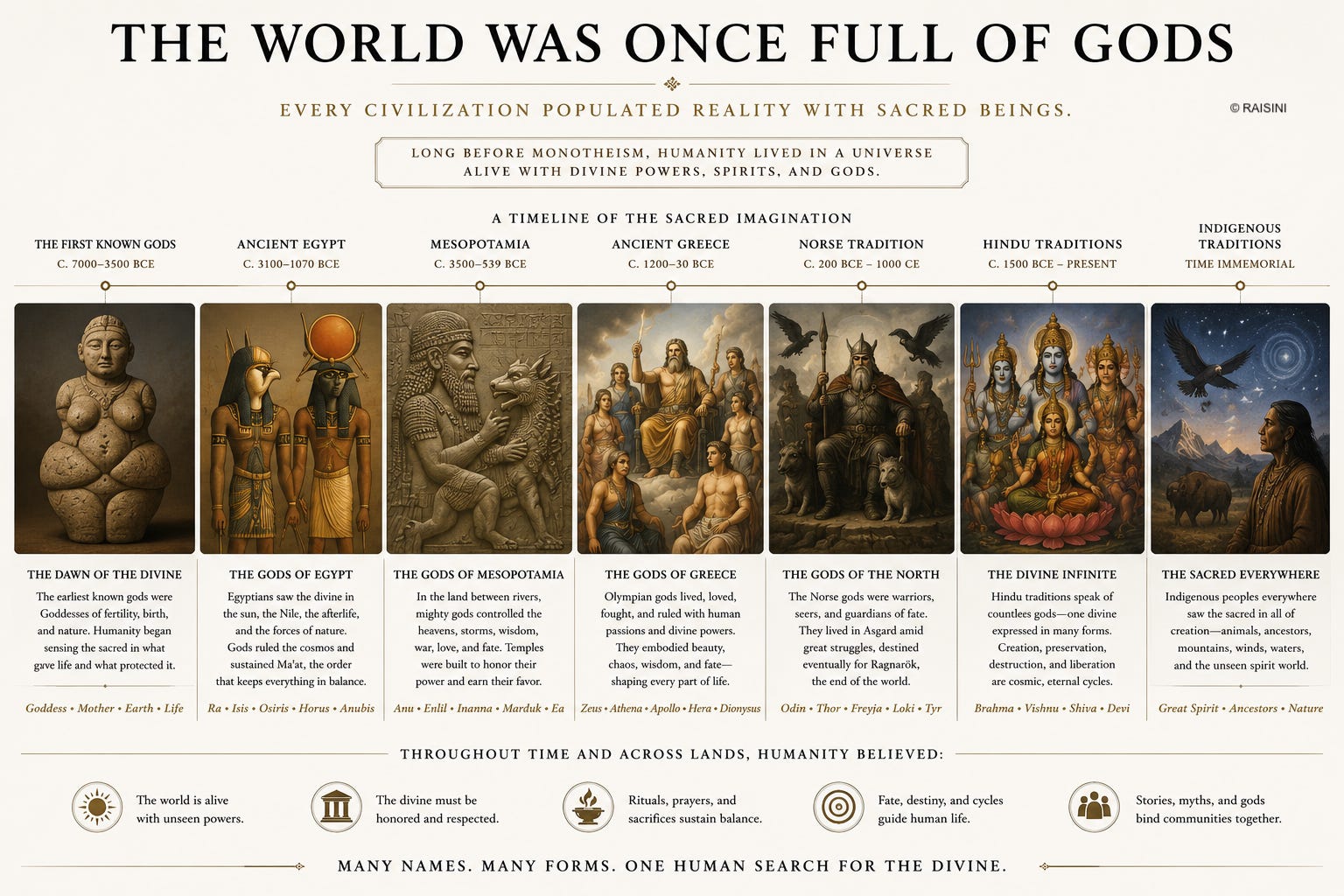
If we could travel backward through most of human history, one of the first things we would notice is not the presence of religion, but the sheer number of gods. The modern world often thinks about religion through the lens of monotheism, where a single divine authority governs reality. Historically, that is the exception rather than the starting point. For most civilizations, the world was populated by countless supernatural beings. Gods governed rivers, storms, harvests, fertility, war, death, wisdom, the sea, the sun, the moon, and the changing seasons. Humanity did not begin with one God. Humanity began with thousands.
This development followed naturally from the animistic worldview explored in the previous section. Once a world filled with invisible intentions is accepted, it becomes increasingly difficult to separate natural forces from personalities. Human beings understand persons more easily than systems. We understand desire, anger, generosity, revenge, loyalty, and fear because these are experiences we encounter daily. We do not naturally think in terms of atmospheric pressure systems, tectonic activity, genetics, or ecological complexity. Long before humans could explain how the world worked mechanically, they explained it socially. The universe became understandable by imagining it as a collection of personalities interacting with one another.
This is why so many gods appear strikingly human despite possessing supernatural abilities. The gods of ancient civilizations often loved, hated, competed, punished, rewarded, desired status, sought recognition, protected allies, and fought rivals. They behaved less like abstract principles and more like amplified versions of humanity itself. The structure makes psychological sense. If a storm is caused by a personality rather than an impersonal process, the storm becomes easier to understand. It may still be dangerous, but it becomes interpretable. Human beings can negotiate with personalities. We can offer sacrifices, perform rituals, seek forgiveness, ask for protection, and establish relationships. A force becomes less frightening when it can be imagined as an actor with motives.
Across civilizations this pattern appears repeatedly. The Egyptians associated divine forces with the Nile, the sun, death, kingship, fertility, and cosmic order. The Greeks populated reality with gods responsible for the sea, wisdom, war, love, hunting, thunder, and countless other domains. Norse traditions imagined gods connected to storms, battle, fate, and the harsh realities of northern life. Mesopotamian civilizations developed complex pantheons reflecting the uncertainties of agriculture, flooding rivers, political power, and survival. Hindu traditions evolved an extraordinarily rich universe of deities representing creation, destruction, preservation, knowledge, prosperity, devotion, and cosmic order. Indigenous traditions throughout the world often integrated ancestors, animals, landscapes, and natural forces into sacred systems that connected everyday life with larger realities.
What is remarkable is not that these systems differed. What is remarkable is how often they arrived at similar structures despite developing independently. Human societies repeatedly transformed the unknown into personalities. They assigned agency to forces that mattered most to survival. Wherever uncertainty existed, gods appeared nearby. The specific names changed. The underlying cognitive process remained surprisingly consistent.
This reveals something important about how human beings make sense of reality. We often assume that understanding begins with objective observation followed by rational explanation. In practice, humans frequently understand complex realities by first translating them into familiar forms. A child understands animals before understanding biology. People understand leaders before understanding institutions. We understand stories before we understand systems. Throughout much of history, gods performed a similar function. They translated the overwhelming complexity of existence into narratives that human minds could comprehend.
The role of nature worship also becomes clearer through this lens. Many ancient cultures did not separate humanity from nature in the way modern societies often do. Rivers determined survival. Rain determined harvests. Seasons determined food supplies. Oceans determined trade. Forests provided shelter and danger simultaneously. Human life was deeply embedded within natural processes. It therefore made sense that the most powerful forces in existence appeared worthy of reverence. Nature was not merely observed. It was encountered as something capable of shaping destiny.
This helps explain why sacred animals appear across cultures as well. Eagles, snakes, wolves, ravens, bears, cattle, and countless other animals acquired symbolic and spiritual significance because they represented qualities humans admired, feared, or depended upon. Animals were not viewed simply as biological organisms. They became carriers of meaning. Through them, people interpreted courage, intelligence, danger, fertility, transformation, endurance, and power. Once again, the human tendency to transform abstract realities into understandable symbols appears at work.
It is tempting to view these religious systems as failed attempts at science. That interpretation misses something important. The primary function of early gods was not merely explanatory. They were psychological. They helped transform uncertainty into something manageable. They converted unpredictable events into relationships. They provided narratives where only mystery existed before. The question was not simply why lightning strikes. The deeper question was how human beings could live emotionally within a world they did not fully understand.
The world once contained thousands of gods because the world contained thousands of uncertainties. Every force that influenced human survival invited explanation. Every mystery encouraged imagination. Every unexplained event created space for agency. The gods emerged not because ancient people lacked intelligence, but because human beings naturally interpret reality through the language of intention, personality, and relationship.
Before humanity learned to describe the world through systems, laws, and mechanisms, it described the world through characters. The universe became a story long before it became a science. In many ways, the gods were the first protagonists.
If a person from the modern world could travel backwards through history, one of the most surprising discoveries would be that the idea of God was not fixed. It evolved. The God imagined by a modern monotheist would have been almost unrecognizable to many early humans. Before God became creator, judge, lawgiver, and source of reality itself, the sacred existed in very different forms. The evolution of God is therefore not simply a religious story. It is also a story about the evolution of human consciousness and civilization.
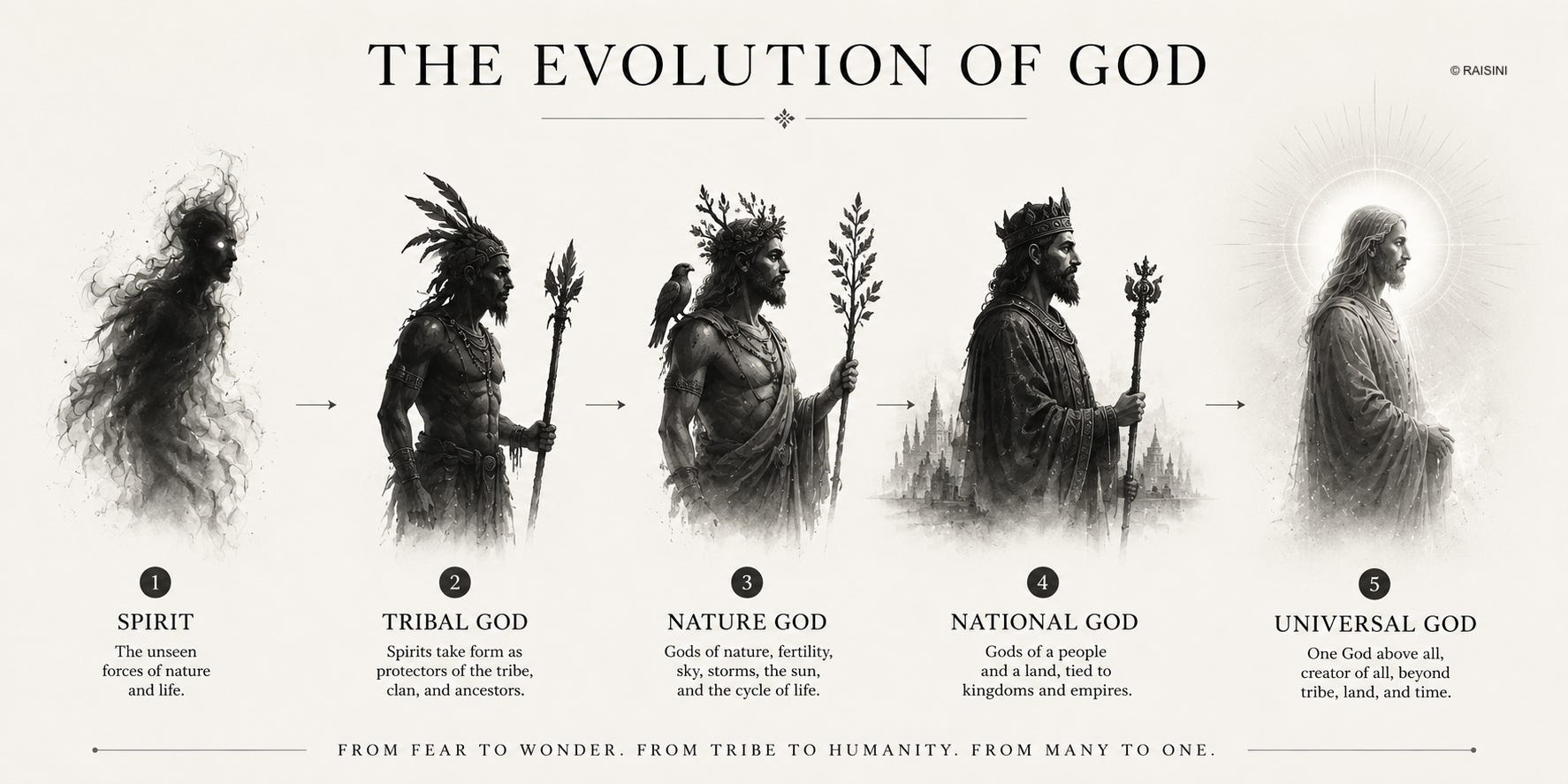
Stage 1 - Spirits
The earliest sacred world was not populated by gods as most people understand them today. It was populated by spirits. Early humans lived in environments that appeared alive with invisible presence. Rivers seemed to possess intention, mountains carried significance, forests felt inhabited, and animals appeared connected to forces beyond ordinary understanding. The distinction between natural and supernatural had not yet emerged because reality itself was experienced as animated. Human beings did not see themselves living in a mechanical universe governed by impersonal laws. They experienced the world as a place filled with agency.
Part of this tendency emerged from the way the human brain evolved. Survival often depended upon detecting threats quickly, which encouraged humans to assume agency even when evidence was incomplete. Over time, this produced a worldview in which unseen intentions seemed to exist behind visible events. The sacred therefore began not with organized religion, but with the belief that invisible forces were woven throughout reality itself.
Stage 2 - Tribal Gods
As human communities became more settled, spiritual forces gradually became attached to specific places and peoples. Villages developed their own sacred protectors, tribes maintained their own ancestral powers, and landscapes became connected to particular stories and rituals. A river belonged to one community, a mountain to another, and the divine became increasingly tied to geography, ancestry, and identity.
This development reflected the scale of human life at the time. Most people lived within relatively small communities and rarely traveled far from where they were born. Their world was local, and their gods were local as well. Divine authority extended only as far as the community that recognized it. The sacred was no longer simply an invisible presence throughout nature. It became connected to particular groups and places, reinforcing social identity and collective belonging.
Stage 3 - Nature Gods
As civilizations grew larger and more complex, their gods became more specialized. Agriculture, trade, warfare, kingship, fertility, weather, and death each introduced different forms of uncertainty into human life. Rather than assigning all of these forces to a single divine power, many civilizations developed pantheons in which different gods governed different domains of existence.
Ancient Egypt, Greece, Mesopotamia, and the Norse world all produced elaborate systems of specialized deities. Some gods oversaw war, others protected harvests, while others governed wisdom, storms, oceans, fertility, or the underworld. This specialization reflected the increasing complexity of civilization itself. Human beings were beginning to organize society into distinct functions, and their religious systems mirrored that organization.
The popularity of specialized gods also reveals something important about human psychology. People generally understand personalities more easily than abstract systems. A storm is difficult to understand as an impersonal natural process, but it becomes easier to reason about when imagined as the action of a storm god. By transforming uncertainty into personalities, ancient civilizations created stories that helped make a complex world more understandable.
Stage 4 - National Gods
As tribes became kingdoms and kingdoms became empires, local and specialized gods faced a new challenge. A deity associated with one village or one river could not easily unite large populations spread across vast territories. As political structures expanded, religious structures expanded alongside them.
Gods increasingly became associated with entire peoples rather than individual communities. Kingdoms viewed themselves as existing under divine protection, and rulers often linked their authority to sacred legitimacy. Religious identity became a tool for creating cohesion among populations large enough that most members would never know one another personally. The sacred no longer belonged only to a place. It belonged to a nation, a dynasty, or an empire.
This shift illustrates an important pattern throughout history. As human societies grew larger, the scale of the divine grew larger as well. Religion evolved alongside political organization, helping create unity across increasingly complex social structures.
Stage 5 - Universal God
The final transformation was the most significant. Some religious traditions gradually moved beyond the idea of gods attached to particular places, peoples, or domains and began imagining a single source behind all existence. Instead of separate gods governing different aspects of reality, the divine became unified.
This universal God was not merely the protector of one tribe or one nation. God became creator of the universe, source of morality, foundation of law, and ultimate explanation for reality itself. Divine authority extended everywhere because existence itself extended everywhere. The sacred was no longer geographic, political, or specialized. It became universal.
This development reflected a broader shift occurring within civilization. As societies became more interconnected, human beings increasingly thought in universal categories. Laws expanded beyond local customs, moral principles extended beyond tribal boundaries, and religious ideas followed the same trajectory. The concept of a universal God emerged alongside humanity’s growing ability to think beyond immediate geography and kinship.
The evolution from spirits to a universal God did not occur identically across every civilization, nor did every tradition follow the same path. Many religious systems remained polytheistic, while others developed entirely different understandings of the sacred. Yet the broader pattern remains striking. As human societies became larger, more interconnected, and more abstract, their conceptions of the divine became larger, more interconnected, and more abstract as well.
The evolution of God therefore reveals something about humanity itself. Religious ideas did not develop independently of civilization. They evolved alongside it. The sacred grew as human consciousness grew. What began as spirits inhabiting forests and rivers gradually expanded into the idea of a universal reality standing behind all existence. In that sense, the history of God is also a history of how human beings learned to think on increasingly larger scales.
Of all the mysteries human beings encountered, none proved more consequential than death. Storms could be survived. Droughts eventually ended. Diseases sometimes passed. Death was different. Every human society eventually discovered the same uncomfortable reality: everyone dies. Parents die. Children die. Friends die. Leaders die. Entire generations disappear. Unlike other problems, death could not be negotiated with, outrun, or fully understood. It represented a permanent interruption to every human story. If religion was attempting to solve the deepest problems of existence, it was inevitable that mortality would become one of its central concerns.
Death presents a challenge that extends beyond physical survival. Human beings are unusual in their ability to anticipate the future. We do not simply experience death when it arrives. We know it is coming. We understand that those we love will eventually disappear, and we understand that we will as well. This awareness creates a psychological burden that few other species appear to carry. The problem is not merely that death exists. The problem is that consciousness allows us to imagine it long before it arrives.
Throughout history, religions developed remarkably different answers to this problem, yet most shared a common structural feature. They refused to treat death as a complete ending. Instead, they transformed it into a transition. The details varied enormously. Some traditions envisioned an afterlife. Others emphasized ancestor continuity. Some proposed reincarnation. Others taught resurrection, judgment, salvation, liberation, or spiritual transformation. Despite these differences, the underlying function remained surprisingly consistent. Religion rarely eliminated death. It redefined what death meant.
Ancestor traditions provide one of the earliest examples of this pattern. Across cultures, the dead often remained active participants in the lives of the living. Ancestors were consulted, honored, remembered, and respected. They continued to occupy an important place within the social structure even after physical death. This solved a profound psychological problem. Death removed individuals from immediate experience, but it did not remove them from meaning. Relationships continued through memory, ritual, and belief. The dead remained part of the community.
Many religious systems expanded this principle further by introducing explicit models of life beyond death. Ancient Egyptian civilization invested enormous energy into preparing individuals for existence after physical life. Tombs, burial practices, sacred texts, and rituals reflected a conviction that death represented passage rather than disappearance. Similar patterns emerged elsewhere. Concepts of heaven, resurrection, judgment, and salvation offered different pathways toward continuity. Hindu traditions developed sophisticated ideas surrounding reincarnation, while Buddhist traditions explored liberation from cycles of rebirth altogether. The specifics differed, but the central concern remained recognizable. Human beings were searching for ways to understand mortality without reducing existence to a brief and ultimately meaningless interruption between birth and death.
What makes these ideas significant is not whether they are true or false. That question belongs to theology and personal belief. The more relevant question for this essay is why such ideas emerged so consistently. The answer becomes clearer when we consider what death threatens psychologically. Mortality does not merely end biological life. It challenges identity, continuity, purpose, and meaning. If every relationship ends permanently, if every achievement eventually disappears, and if every life concludes in absolute extinction, then human beings must confront questions that are emotionally difficult to resolve. Religion provided frameworks capable of absorbing those questions.
This is one reason why religious systems often connect death to judgment and morality. Death alone creates uncertainty. Judgment transforms uncertainty into structure. Actions matter because consequences extend beyond life itself. Virtue matters because existence continues. Justice matters because ultimate accountability exists somewhere beyond immediate experience. Many religious traditions recognized a reality that remains visible today: people struggle to accept a universe where suffering appears random and moral outcomes seem incomplete. Judgment, salvation, karma, and related concepts offered ways of reconciling human expectations of fairness with the realities of life.
The connection between mortality and meaning also helps explain why religious ideas became so emotionally resilient. Scientific explanations can describe how biological death occurs. They are less equipped to answer what death means. Human beings do not live entirely through facts. We also live through interpretation. Two individuals can experience the same event while assigning radically different meanings to it. Religion operates primarily within this second domain. It organizes interpretation. It provides narratives capable of transforming loss into continuity, suffering into purpose, and death into transition.
This observation connects directly to a theme explored in Fear of Mortality. Much of human behavior can be understood as a response to the awareness of death. People build families, create institutions, pursue achievements, preserve legacies, and search for meaning partly because they know time is limited. Religion emerged as one of the earliest and most comprehensive systems for addressing this reality. It offered explanations for where we come from, guidance for how we should live, and answers about what happens when life ends. Whether those answers are accepted is ultimately secondary to understanding why they became so widespread.
The enduring influence of religion suggests that its relationship with mortality runs deeper than doctrine. Human beings required a way to continue living despite the knowledge that life ends. Religion provided one solution. It transformed death from an absolute conclusion into part of a larger story. The story differed across civilizations, but the psychological function remained remarkably similar.
Religion did not remove death. Nothing could. What it accomplished was perhaps more important. It made mortality psychologically survivable. By placing death inside a framework of continuity, meaning, and transcendence, religion allowed human beings to face one of existence’s most difficult realities without being overwhelmed by it.
Before human beings could imagine heaven, hell, resurrection, reincarnation, salvation, or divine judgment, they first had to imagine that something inside a person could survive the body. This may have been one of the most important conceptual leaps in religious history. God was not necessarily humanity’s first great religious invention. The soul may have come earlier, because without some surviving inner essence, most later religious ideas about death could not exist. Before there could be an afterlife, there had to be something capable of entering it.
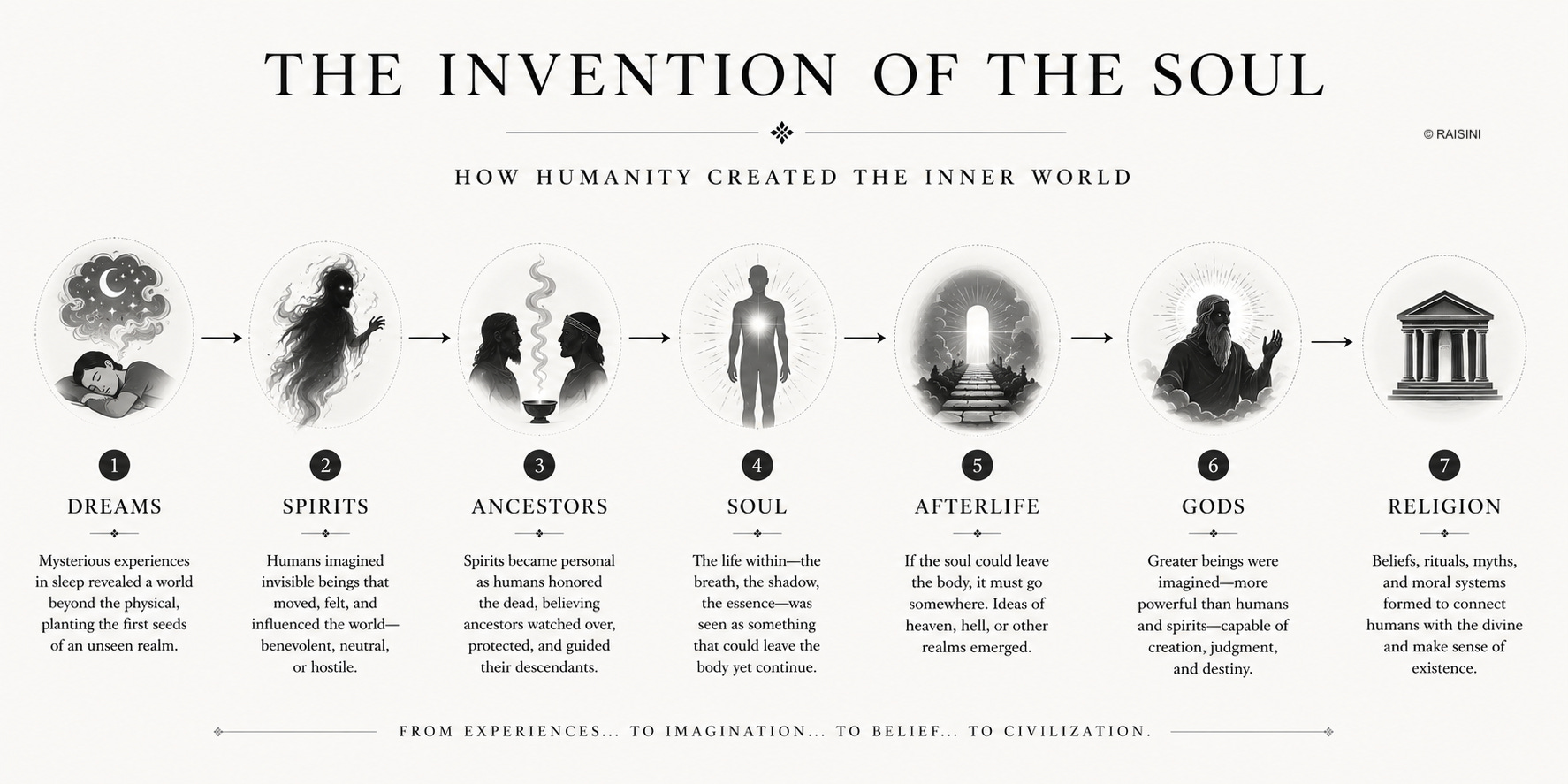
The earliest foundation for this idea may have emerged from dreams. Human beings could watch someone die, bury the body, mourn the loss, and then encounter that same person again during sleep. The dead could speak in dreams, give warnings, appear restored, or continue behaving as though they had not disappeared at all. To a modern mind, dreams can be explained through memory, emotion, and the activity of the brain. To earlier humans, without those frameworks, the experience would have suggested something far more mysterious. If a person could be dead in the physical world but still appear in the inner world, then perhaps the person was not entirely gone.
From dreams, the idea of spirits became psychologically natural. Human beings began imagining that an invisible presence could exist apart from the visible body. This did not require formal doctrine. It required only repeated experiences that seemed to separate the person from the flesh. Breath, shadow, voice, memory, dreams, and personality all suggested that human life contained something more subtle than physical matter. Death, in this framework, was not simply the stopping of the body. It was the departure of whatever had animated it.
Ancestor traditions developed from this intuition. The dead were not treated merely as memories but as continuing presences within the life of the community. They could be honored, consulted, feared, appeased, or remembered through ritual. This transformed death from disappearance into relationship. The ancestor remained connected to the living, and the living remained responsible to the dead. Across many societies, this belief helped create continuity between generations, allowing families and communities to imagine themselves as part of a longer chain rather than isolated lives ending in silence.
Over time, this surviving presence became more defined. What began as dreams and ancestral spirits gradually became the concept of the soul: an inner essence that carried identity beyond the body. The soul solved several problems at once. It explained why the dead could appear in dreams. It explained why the body seemed empty after death. It preserved personal identity beyond physical destruction. It also created the foundation for moral consequence after death, because if the soul continued, then human actions could matter beyond a single lifetime.
This progression is crucial to the larger story of religion. Dreams suggested invisible continuation. Spirits gave that continuation presence. Ancestors gave it social meaning. The soul gave it identity. Once the soul existed, the afterlife became imaginable. Once the afterlife became imaginable, gods could become judges, guides, saviors, or guardians of the dead. In this sense, the invention of the soul created the bridge between mortality and religion. It allowed human beings to transform death from a biological ending into a spiritual passage, and it gave later religious systems one of their most powerful foundations.
Modern people often think about religion primarily as a matter of personal belief. We imagine faith as something that exists within individuals: private convictions about the nature of reality, morality, or life after death. Historically, however, religion performed a much larger function. Long before it became a personal identity, religion operated as social infrastructure. It helped solve one of the most difficult problems any civilization must overcome: how to create trust among large numbers of people who do not know one another.
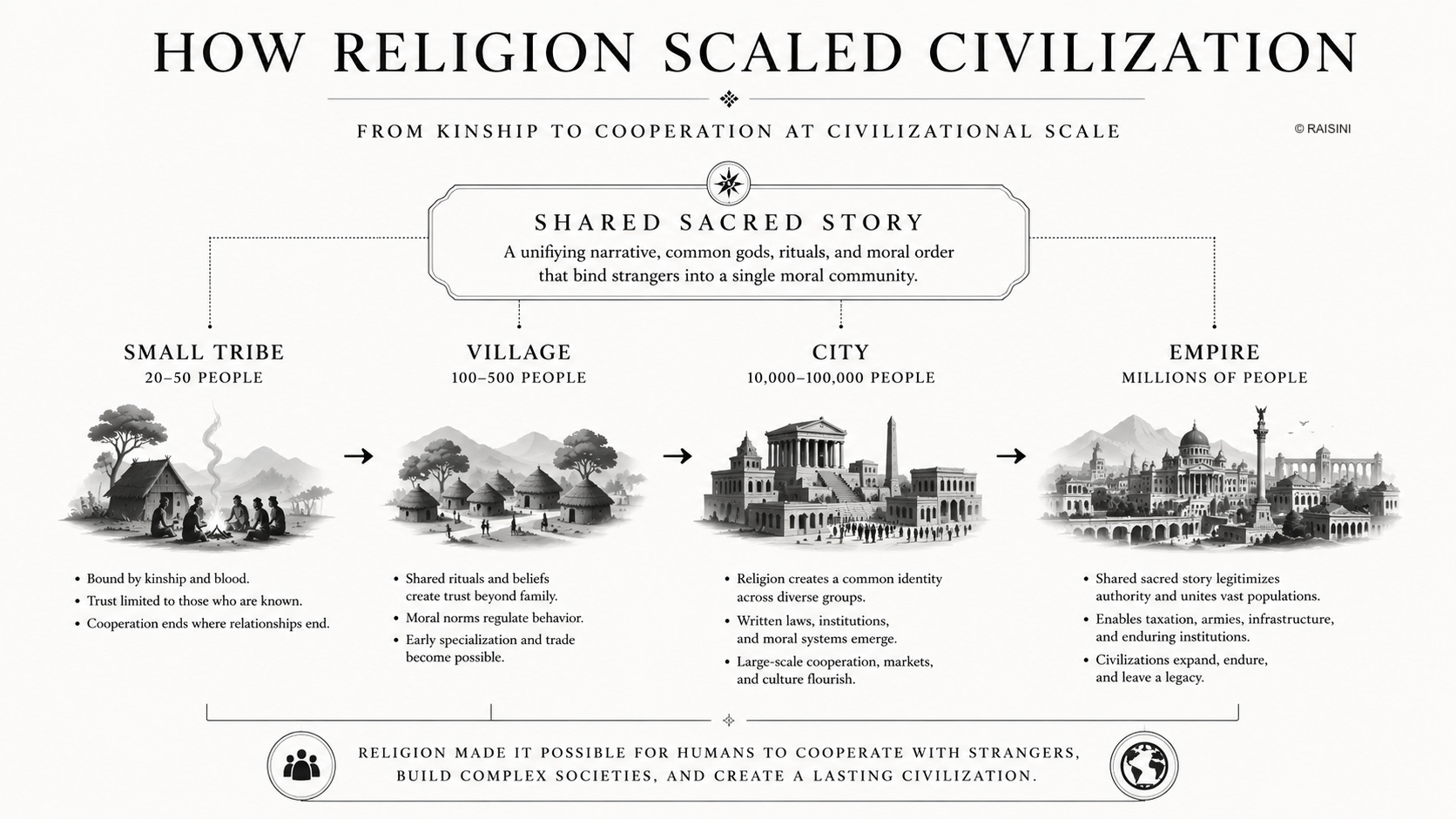
For most of human history, this problem barely existed. Human beings lived in relatively small groups where cooperation emerged naturally through familiarity. In a hunter-gatherer band of thirty, fifty, or one hundred individuals, people knew each other directly. Reputation traveled quickly. Acts of generosity were remembered. Acts of selfishness were noticed. Trust did not require elaborate institutions because social relationships provided constant feedback. Cooperation emerged from repeated interaction rather than abstract systems.
This arrangement works surprisingly well at small scales. Human beings evolved in environments where most social interactions occurred among relatives, friends, allies, and familiar faces. Under such conditions, trust is relatively straightforward. If someone repeatedly violates expectations, the consequences are immediate. They lose status, support, access to resources, or membership within the group itself. Social order is maintained through visibility. Everyone knows who everyone is.
The challenge emerges when societies begin to grow. Agriculture allowed populations to expand beyond the size of small tribes. Villages became towns. Towns became cities. Cities became kingdoms and empires. Suddenly human beings found themselves surrounded by strangers. A merchant might trade with someone from another region. A traveler might pass through unfamiliar settlements. Political authorities might govern thousands or even millions of people they would never meet. The mechanisms that sustained trust within small groups became increasingly insufficient.
This created a new civilizational problem. How do strangers cooperate at scale?
The answer is more difficult than it first appears. Modern societies rely on contracts, legal systems, police forces, financial institutions, and bureaucratic structures. Most ancient societies possessed far fewer of these mechanisms. Yet they still managed to organize large populations, maintain trade networks, coordinate collective projects, and preserve social order across vast territories. Religion played a crucial role in making this possible.
Shared religious beliefs created a common framework through which people could interpret one another’s behavior. If two strangers believed in the same gods, respected the same rituals, feared the same punishments, and accepted the same moral obligations, cooperation became easier. The relationship was no longer based entirely on personal familiarity. It became anchored in a shared sacred order. Religion provided a system of expectations that extended beyond direct relationships.
This idea appears throughout history. Ancient kingdoms often united populations through common religious practices. Sacred festivals synchronized collective identity. Rituals reinforced belonging. Religious symbols created a sense of participation in something larger than the individual. People who would never meet one another could still feel connected through shared myths, sacred stories, and moral obligations. Religion transformed large populations into moral communities.
Historian Yuval Noah Harari touches on a related idea in Sapiens when discussing humanity’s ability to cooperate through shared imagined realities. Nations, laws, money, corporations, and religions all depend upon collective belief. Their power emerges not from physical existence alone but from shared agreement. Religion represented one of the earliest and most successful examples of this phenomenon. It created narratives capable of coordinating behavior among large groups of unrelated individuals.
The relationship between religion and cooperation becomes even more interesting when we consider what researchers sometimes call the “Big Gods” theory. The basic observation is that as societies became larger and more complex, many religious systems began emphasizing moralizing gods—deities who cared not only about rituals and sacrifices but also about human behavior. These gods observed, judged, rewarded, and punished. They monitored honesty, loyalty, fairness, and obedience. In effect, they introduced a form of moral surveillance extending beyond human observation.
The significance of this development should not be underestimated. In a small tribe, wrongdoing can often be detected directly. In a large society, many actions occur beyond immediate observation. A person can cheat, steal, deceive, or exploit others without being caught. This creates incentives that threaten cooperation. Religious systems responded by introducing a powerful idea: even if other people do not see your actions, someone else does.
A society that believes someone is always watching behaves differently from one that believes nobody is watching.
Whether that observer is understood as God, the gods, ancestors, spirits, karma, or divine judgment matters less than the underlying mechanism. The belief itself influences behavior. It encourages self-regulation. It extends accountability beyond immediate social consequences. Individuals begin monitoring themselves because they perceive themselves as being monitored by a larger moral order.
This does not mean religion created morality from nothing. Human beings possessed moral instincts long before organized religion emerged. Cooperation, fairness, reciprocity, loyalty, and empathy all have deep evolutionary roots. What religion accomplished was different. It scaled morality. It transformed local expectations into broader social systems capable of operating across large populations.
Seen through this lens, religion begins to look less like a collection of supernatural claims and more like a civilizational technology. It created shared identities, reinforced cooperation, stabilized expectations, and helped coordinate behavior among strangers. This does not explain every aspect of religion, nor does it reduce faith to social utility. It simply highlights a function that often receives less attention than theology itself.
The growth of civilization required mechanisms capable of extending trust beyond direct relationships. Religion became one of the earliest and most effective solutions. Shared sacred stories allowed millions of people to cooperate without knowing one another personally. Moralizing gods extended accountability beyond immediate observation. Rituals created collective identity. Belief systems generated social cohesion.
Religion did not merely help individuals understand the world. It helped societies organize themselves within it. In that sense, religion did far more than explain reality. It helped build civilization itself.
Between roughly 800 BCE and 200 BCE, a remarkable transformation occurred across several civilizations. Historians often refer to this period as the Axial Age because it appears to mark a turning point in the development of human thought. Within a relatively short historical window, Confucius and Laozi emerged in China, Siddhartha Gautama appeared in India, Greek philosophers such as Socrates began questioning the foundations of ethics and knowledge, and prophets increasingly emphasized justice, righteousness, and moral responsibility. These individuals lived in different societies, spoke different languages, and were separated by vast distances, yet they were responding to surprisingly similar questions.
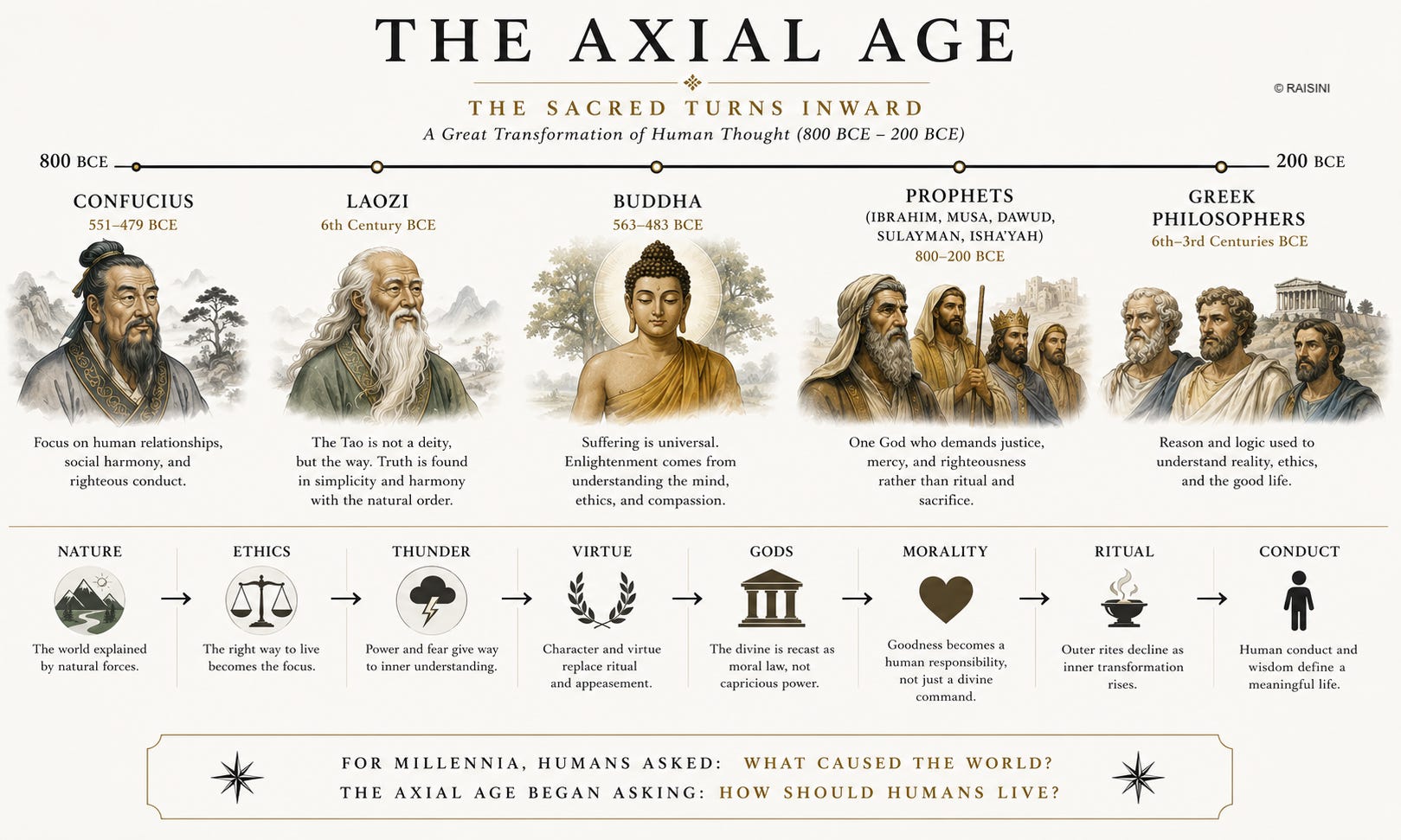
What makes this period significant is not merely the appearance of influential thinkers. The deeper significance lies in the nature of the questions they were asking. Earlier religious systems were often concerned with understanding the external world. Human beings wanted to know why storms occurred, why harvests failed, why floods appeared, why disease spread, and why death existed. Religious explanations helped transform uncertainty into something comprehensible. During the Axial Age, however, attention increasingly shifted away from the forces of nature and toward the conduct of human beings themselves. Questions concerning the structure of reality remained important, but they were increasingly accompanied by questions concerning virtue, justice, suffering, responsibility, wisdom, and the proper way to live.
This shift reflected broader changes taking place within civilization. Human societies were becoming larger, more urbanized, and more interconnected than ever before. Trade networks expanded, populations increased, and political systems became increasingly complex. As societies grew beyond small tribes and villages, maintaining social order required more than shared myths about nature. Large populations needed ethical frameworks capable of guiding behavior among strangers. The challenge was no longer simply understanding the world. The challenge was learning how to live together within increasingly sophisticated social systems.
The responses varied across civilizations, but they shared a common direction. Confucius focused on moral character, social harmony, duty, and proper conduct. Laozi emphasized balance, humility, and living in accordance with a deeper order underlying reality. The Buddha concentrated on suffering, attachment, self-awareness, and the cultivation of inner freedom. Greek philosophers increasingly explored virtue, reason, justice, and the foundations of ethical life. Prophets directed attention toward moral accountability, condemning corruption and emphasizing obligations toward both God and society. Although these traditions reached different conclusions, they all moved religious thought toward questions of human behavior and moral responsibility.
The consequences of this transformation were profound. Religion gradually became more than a system for explaining external events. It became a framework for evaluating human conduct. The sacred was increasingly associated with justice rather than merely power, wisdom rather than merely authority, and ethical responsibility rather than merely ritual obligation. Earlier gods often resembled amplified human rulers concerned with territory, sacrifice, fertility, or victory. During and after the Axial Age, religious traditions increasingly connected the divine to moral principles that applied to human life itself. The sacred became less concerned with controlling nature and more concerned with shaping character.
Many of the religious and philosophical traditions that emerged during this period continue influencing human civilization today because they addressed questions that remain permanent features of the human condition. Scientific knowledge can explain the mechanics of the universe, but it cannot fully answer how individuals should respond to suffering, exercise power, pursue justice, or live meaningful lives. The thinkers of the Axial Age confronted these questions directly, creating intellectual and moral frameworks that extended far beyond their own historical moment.
Seen from a broader perspective, the Axial Age represents the moment when religion expanded beyond explaining reality and began systematically examining the human condition itself. Civilization became increasingly introspective because the challenges facing civilization increasingly required introspection. As societies grew more complex, the sacred evolved alongside them, shifting its attention from the mysteries of nature toward the mysteries of human behavior. In many ways, this was the period in which religion became moral philosophy, and the consequences of that transformation continue shaping the modern world.
If religion helped human beings explain the world and cooperate within large societies, it eventually assumed another responsibility that would shape civilization for thousands of years: the organization of morality. This development is often misunderstood. Many people assume morality originated with religion, while others argue morality exists independently of it. Both positions miss a more interesting reality. Human beings possessed moral instincts long before organized religion emerged. Religion’s contribution was not the invention of morality itself. Its contribution was the transformation of morality into a durable social structure.
Even small groups require behavioral norms. Cooperation becomes impossible if individuals consistently steal, deceive, exploit, or betray one another. Long before temples, scriptures, or priesthoods existed, human communities depended upon trust, reciprocity, fairness, loyalty, and restraint. Hunter-gatherer societies punished selfishness, rewarded cooperation, and enforced social expectations because survival required collective effort. Morality did not suddenly appear with religion. It emerged naturally wherever human beings depended upon one another.
The challenge was scale. Moral expectations function differently in a group of fifty people than they do in a civilization of fifty million. Within small communities, behavior can be regulated through reputation and direct observation. People know who contributes and who takes advantage. Social approval and disapproval often provide sufficient enforcement. As societies expanded, these mechanisms became less effective. Large populations required more stable systems capable of transmitting moral expectations across generations, regions, and social classes.
Religion provided precisely that framework.
One of the most significant developments in religious history was the gradual transformation of moral behavior into sacred obligation. Actions were no longer evaluated solely through social consequences. They became connected to a larger moral order. Honesty, generosity, courage, loyalty, compassion, and self-restraint were no longer merely useful traits. They became virtues. Likewise, deceit, greed, betrayal, cruelty, and exploitation became more than socially undesirable behaviors. They became sins.
This distinction mattered because it altered how morality was understood. Social rules can be negotiated. Sacred rules are more difficult to challenge. A law may change with a ruler. A divine command carries a different kind of authority. By connecting moral expectations to sacred principles, religions created systems that could survive individual leaders, political instability, and changing social conditions. Morality became anchored to something perceived as larger than human preference.
The emergence of commandments illustrates this process clearly. Across civilizations, religious traditions developed explicit moral codes governing behavior. These codes varied in content and emphasis, yet they often addressed similar concerns: honesty, violence, family obligations, property, sexuality, justice, and social responsibility. What makes these systems significant is not simply that they established rules. Every society develops rules. The significance lies in how those rules were justified. They were not merely practical guidelines. They reflected a deeper moral structure believed to exist within reality itself.
This is where concepts such as duty, honor, and shame became especially important. Modern societies often emphasize individual rights and personal autonomy. Many historical societies were organized around obligations. People were expected to fulfill responsibilities toward family, community, ancestors, rulers, and gods. Honor reflected successful participation within this moral order. Shame reflected failure. Religious systems reinforced these expectations by embedding them within stories, rituals, traditions, and collective identities. Morality ceased to be simply a matter of behavior. It became part of who people understood themselves to be.
The concept of sin represents an especially powerful development in this process. Sin transformed morality from an external issue into an internal one. A person could violate moral principles even when no visible harm occurred. Intentions mattered. Thoughts mattered. Character mattered. The moral arena expanded beyond public actions and entered the private realm of conscience. This shift dramatically increased the depth and reach of moral systems. Individuals began evaluating themselves not only through the eyes of their communities but through the lens of a larger moral standard.
Importantly, this process did not occur because religious leaders sat down and invented morality from scratch. Rather, religion gradually organized and stabilized moral intuitions that already existed. Human beings naturally possess concerns about fairness, reciprocity, loyalty, care, and social order. Religious traditions collected these concerns, codified them, transmitted them across generations, and connected them to broader narratives about the nature of reality. In doing so, they transformed scattered moral instincts into coherent moral systems.
This explains why moral teachings often remain among the most enduring aspects of religious traditions. Even in increasingly secular societies, many moral assumptions continue to reflect frameworks shaped by centuries of religious influence. Ideas about responsibility, justice, compassion, dignity, forgiveness, and accountability often persist long after belief in specific doctrines declines. The institutional structures may change. The moral architecture frequently remains.
Viewed through this lens, religion appears less as the creator of morality and more as its organizer. It provided a mechanism for preserving, transmitting, and enforcing ethical norms across large populations and long periods of time. By connecting behavior to sacred meaning, religion transformed morality from a local social necessity into a civilizational framework.
God did not create human morality. Human beings already possessed moral instincts. What religion accomplished was something equally important. It transformed moral behavior into social structure. Virtue became institutionalized. Duty became sacred. Shame became moral enforcement. Honor became collective identity. Through religion, morality evolved from an informal feature of human cooperation into one of the central organizing principles of civilization.
Modern societies are accustomed to separating life into categories. Politics belongs in one institution, education in another, law in another, business somewhere else, and religion occupies its own distinct sphere. This division feels natural because it is familiar. Historically, however, it is remarkably unusual. For most of human history, religion was not one institution among many. It was the framework through which all other institutions were understood.
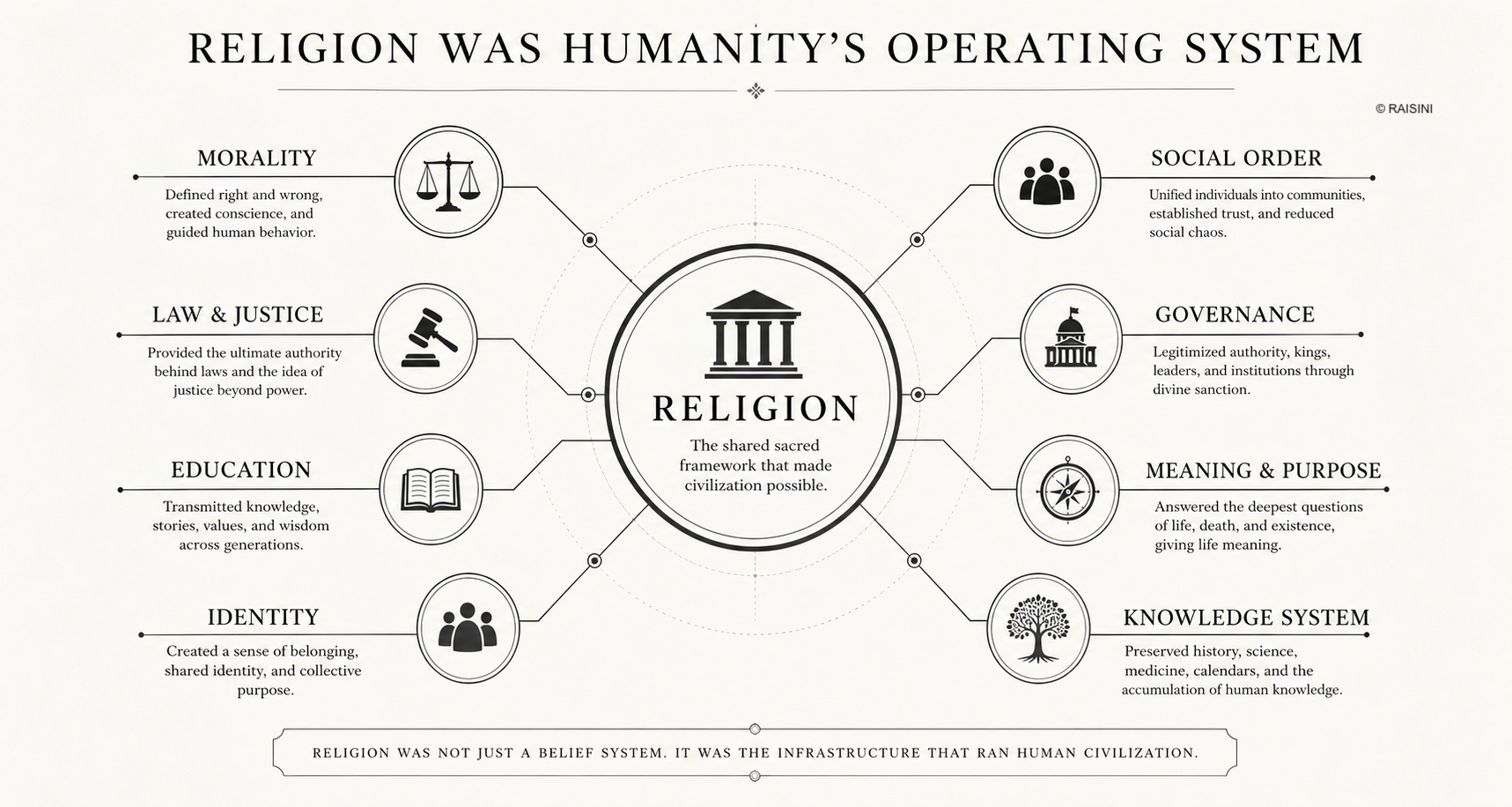
When modern people think about religion, they often imagine worship, prayer, sacred texts, or questions about the afterlife. While these were certainly important, they represented only part of religion’s historical role. In many civilizations, religion provided the intellectual architecture through which reality itself was interpreted. It explained where people came from, why society existed, who possessed authority, how individuals should behave, what happened after death, and what ultimately mattered. Religion was not a department of life. It was the operating system upon which life ran.
An operating system performs a largely invisible function. Most people using a computer focus on applications, documents, messages, or websites. Beneath all of them sits a system that organizes information, establishes rules, coordinates functions, and creates a coherent environment in which everything else can operate. Religion often played a similar role within civilization. It connected law, morality, education, governance, identity, family structures, and social expectations into a single worldview. People did not simply practice religion. They interpreted reality through it.
This role becomes easier to understand when we consider the practical challenges faced by early civilizations. Every society must answer a set of fundamental questions. Who should rule? What makes authority legitimate? How should disputes be resolved? What responsibilities do individuals owe one another? How should children be educated? What values deserve preservation? What happens when rules are violated? Modern societies answer these questions through a mixture of political systems, legal institutions, educational frameworks, and cultural norms. Historically, religion often answered all of them simultaneously.
Law provides a clear example. Today, many people think of law as separate from religion. For much of history, the distinction barely existed. Legal systems were frequently understood as extensions of divine order. Kings ruled through sacred legitimacy. Judges interpreted laws connected to religious principles. Social obligations were reinforced through religious authority. The power of law came not only from enforcement but from the belief that legal order reflected a deeper moral structure embedded within reality itself. To obey the law was often understood as participating in a sacred order rather than merely complying with a political system.
Education functioned similarly. Before modern school systems emerged, religious institutions often served as the primary custodians of knowledge. They preserved history, transmitted values, taught literacy, maintained traditions, and shaped collective memory. More importantly, they provided answers to questions modern education frequently avoids. What is the purpose of life? What responsibilities accompany existence? How should individuals relate to suffering, death, and uncertainty? Education was not simply about acquiring skills. It was about understanding one’s place within a larger cosmic story.
Religion also played a crucial role in governance. Political authority rarely existed independently of sacred authority. Pharaohs, emperors, kings, and rulers often justified their legitimacy through divine relationships. Sometimes rulers claimed divine ancestry. Sometimes they acted as representatives of sacred power. Sometimes they governed under laws believed to originate from a higher source. While the specific arrangements varied, the pattern remained remarkably consistent. Political order became more stable when connected to a sacred narrative larger than any individual ruler.
Identity was equally shaped by religion. Today many people derive identity from nationality, profession, ideology, ethnicity, or personal values. Historically, religious identity often served as the primary organizing principle. It answered the question of who belonged and who did not. It defined communities, established shared rituals, and created collective memory across generations. Religious festivals synchronized populations. Shared stories connected individuals to ancestors and descendants. The sacred provided continuity through time in ways few other institutions could match.
Meaning itself was perhaps religion’s most important contribution. Human beings do not merely need systems that organize behavior. They need systems that explain why behavior matters. A legal code can prohibit murder. A religious worldview can explain why human life possesses value. A government can establish obligations. Religion can place those obligations within a broader narrative about existence itself. Throughout history, religion supplied the stories through which people understood suffering, sacrifice, duty, purpose, and destiny. It transformed isolated events into parts of a larger framework.
This is why reducing religion to belief alone often obscures its historical significance. Beliefs were important, but beliefs existed within a much larger structure. Religion coordinated moral expectations, legitimized authority, organized knowledge, created identity, preserved traditions, and provided meaning. It functioned as a civilizational framework capable of integrating diverse aspects of human life into a coherent whole.
This observation also helps explain religion’s extraordinary durability. Institutions survive when they solve multiple problems simultaneously. Religion did not persist for thousands of years because it answered a single question particularly well. It persisted because it addressed many questions at once. It helped explain the world, organize society, transmit values, maintain order, confront mortality, and create collective identity. Few institutions in history have operated across so many dimensions simultaneously.
Seen through a modern lens, religion often appears as one voice competing among many. Historically, it occupied a very different position. It was the foundation upon which many other structures rested. Law, education, governance, morality, identity, and meaning were not separate systems interacting with religion. They were often expressions of the same underlying framework.
For most of history, religion functioned as civilization’s primary operating system. It provided the architecture through which societies understood reality, organized themselves, and transmitted meaning across generations. Long before modern institutions divided human life into separate domains, religion connected those domains into a single coherent structure. It was not merely something people believed. It was the framework through which they understood what belief itself meant.
Religion As Information Storage
One of the least appreciated functions of religion is that it served as a mechanism for preserving knowledge across generations. Modern societies possess schools, universities, libraries, archives, databases, cloud storage, and communication networks capable of transmitting information almost instantly. For most of human history, none of these systems existed. Civilization therefore faced a fundamental problem: how could important knowledge survive longer than the individuals who possessed it?
Religion became one of the solutions.
Sacred stories preserved collective memory. Rituals preserved social practices. Scriptures preserved laws, customs, genealogies, and moral expectations. Priests, monks, scribes, and religious institutions often became custodians of knowledge long before the emergence of modern educational systems. In many civilizations, the temple was not simply a place of worship. It was also a place of record keeping, learning, administration, and cultural preservation.
This function becomes easier to understand when viewed as a civilizational challenge rather than a religious one. Every society must find a way to transmit accumulated knowledge from one generation to the next. Agriculture, law, trade, morality, governance, and social organization all depend upon information surviving the deaths of the individuals who originally acquired it. Religion provided structures capable of preserving that information across centuries and, in some cases, millennia.
The durability of many religious traditions reflects this role. Sacred narratives were repeated, memorized, recited, written, copied, and taught continuously across generations. This allowed civilizations to preserve not only beliefs but also identity, history, values, and social norms. Long before modern institutions assumed these responsibilities, religion functioned as one of humanity’s most important systems for storing and transmitting collective knowledge.
Religion As Social Software
Religion also performed another function that is often overlooked. It helped coordinate human behavior at scale. Civilization depends upon physical infrastructure such as roads, buildings, armies, markets, and administrative systems, but physical infrastructure alone is not sufficient. Societies also require shared expectations about how people should behave toward one another. Without these expectations, cooperation becomes increasingly difficult.
Religion frequently supplied those expectations.
Shared beliefs created shared assumptions. Shared rituals reinforced collective identity. Shared moral frameworks established predictable patterns of behavior. Individuals who had never met could still cooperate because they understood the same stories, recognized the same symbols, and operated within the same moral universe. Religion therefore reduced one of civilization’s most significant challenges: the difficulty of coordinating large numbers of unrelated individuals.
This helps explain why religion became so deeply embedded within social structures. Its importance extended beyond personal belief. Religious systems provided common reference points through which people interpreted obligations, responsibilities, trust, authority, and belonging. These frameworks made social cooperation more stable because individuals could often predict how others were expected to behave.
Seen from this perspective, religion functioned as a form of social software running beneath civilization itself. The roads, cities, institutions, and political structures of a society represented visible infrastructure. Religion supplied many of the invisible assumptions that allowed those structures to operate. It helped transform populations into communities, strangers into participants, and social systems into functioning civilizations.
Taken together, these functions help explain why religion occupied such a central position throughout history. It was not merely a collection of beliefs about the divine. It preserved knowledge, transmitted identity, coordinated behavior, reinforced social order, and provided meaning. For much of human history, religion was not a department within civilization. It was one of the primary systems through which civilization itself operated.
For most of human history, the sacred world was crowded. Every river had its spirit. Every mountain possessed significance. Every city maintained its patron deity. Every tribe protected its own sacred traditions. The divine reflected the fragmented nature of human society itself. Small communities lived within local realities, and their gods often remained local as well. Yet over time, something remarkable happened. Across several major civilizations, religious systems gradually moved from many gods toward fewer gods, and in some cases toward a single universal God.
This transformation was not merely theological. It reflected deeper changes occurring within civilization itself.
The earliest religious systems emerged in small communities where life was organized around immediate relationships and local environments. A tribe required a tribal god because its world was tribal. A city required a city god because its identity was tied to a particular place. Divine authority mirrored social structure. Human beings organized reality through familiar categories, and the sacred world reflected those same boundaries. The gods of one group often possessed little relevance beyond that group’s territory.
As societies expanded, however, these local frameworks became increasingly difficult to maintain. Agriculture produced larger populations. Trade connected distant regions. Empires incorporated diverse peoples. Political authority extended beyond individual cities and tribes. Human beings found themselves participating in systems far larger than anything their ancestors had experienced. The scale of civilization was changing, and religious ideas began changing with it.
This is one reason empires frequently encouraged broader religious frameworks. Governing a single city differs significantly from governing hundreds of cities spread across vast territories. A local deity may unify a village. It struggles to unify an empire. Larger political systems required larger organizing principles. Just as political authority became more centralized, religious authority often became more universal.
The transition did not occur overnight, nor did it follow a single path. Many civilizations maintained complex pantheons for centuries. Yet beneath these differences, a broader pattern becomes visible. The sacred gradually moved toward abstraction. Instead of countless local forces governing isolated domains, religious thought increasingly emphasized larger principles capable of encompassing reality as a whole.
This development mirrors a broader tendency in human cognition. As knowledge expands, human beings often move from specific observations toward more general principles. Early societies encounter many separate events: storms, harvests, floods, seasons, births, and deaths. Later societies begin searching for underlying patterns connecting them. Religion evolved in a similar way. The divine gradually shifted from many specialized powers toward more universal sources of order.
The emergence of imperial religions accelerated this process. Large civilizations required frameworks capable of connecting diverse populations under shared systems of meaning. A universal empire naturally encouraged universal ideas. If political authority extends across many peoples, perhaps divine authority does as well. If law applies to everyone within an empire, perhaps morality does too. Religious concepts increasingly reflected these broader realities.
This helps explain why monotheism represents more than a reduction in the number of gods. It represents a profound shift in how reality is understood. In a polytheistic world, different forces possess different authorities. Storms belong to one god. Oceans belong to another. Fertility, war, wisdom, and death each occupy separate domains. Monotheism introduces a different structure entirely. Reality becomes unified beneath a single source. Nature, morality, history, and existence itself are connected through one overarching principle.
The significance of this shift extends beyond religion. It reflects the growing human capacity for abstraction. Universal law becomes possible when societies stop viewing justice as local custom and begin viewing it as a principle applicable to everyone. Universal morality emerges when ethical expectations extend beyond tribe and kinship. Universal gods often appear alongside universal claims about human behavior, responsibility, and order. The movement toward one God parallels the movement toward one law, one moral framework, and one conception of humanity.
This does not mean monotheism is inherently more advanced than polytheism. Such judgments are often shaped by contemporary assumptions. Both systems emerged in response to different social and historical conditions. The important observation is that religious ideas evolved alongside civilizations themselves. As human societies became larger, more interconnected, and more abstract, their conceptions of the divine frequently followed the same trajectory.
What began as spirits inhabiting forests eventually became gods governing cities. City gods became imperial gods. Imperial gods became universal gods. At each stage, the sacred expanded alongside the structures of human civilization. Religion was not evolving in isolation. It was adapting to the changing scale of human organization.
Seen through this lens, the rise of monotheism becomes easier to understand. The question is not simply why people stopped believing in many gods. The deeper question is why civilizations increasingly required religious ideas capable of transcending local identities and connecting larger populations. Universal societies encouraged universal laws. Universal laws encouraged universal morality. Universal morality encouraged universal gods.
As civilizations expanded, gods became increasingly universal and abstract. The divine grew larger because the human world itself was growing larger. The journey from many gods to one God was, in many ways, a reflection of humanity’s own movement from fragmented communities toward increasingly interconnected civilizations.
Up to this point, we have explored religion as an explanation of uncertainty, a response to mortality, a mechanism for cooperation, a framework for morality, and an operating system for civilization. Each of these perspectives helps explain why religious systems emerged and endured. Yet there is another possibility worth considering. What if religion was not only humanity’s attempt to understand the world? What if it was also humanity’s attempt to understand itself?
This idea appears in different forms throughout philosophy and psychology. Among its most influential advocates was Ludwig Feuerbach, who argued that human beings often project their own highest qualities onto God. According to this view, religion reveals less about the supernatural and more about the human imagination. When people describe God as perfectly just, infinitely loving, perfectly wise, or morally flawless, they may be expressing ideals that already exist within human consciousness. God becomes a reflection of what human beings admire, aspire to, and struggle to embody.
Whether one agrees with Feuerbach’s conclusion is ultimately secondary. What makes the idea valuable is the question it raises. Why do so many religious traditions attribute remarkably similar qualities to the divine? Across different cultures and historical periods, gods often evolve beyond their original roles as controllers of storms, harvests, or natural forces. They increasingly become associated with justice, wisdom, mercy, truth, compassion, order, and transcendence. These are not merely powers. They are values.
This development suggests that religion was addressing something deeper than fear alone. Fear can explain why humans sought protection from chaos. It cannot fully explain why they imagined perfection.
If religion emerged solely from anxiety, we might expect gods to remain little more than powerful supernatural rulers capable of controlling nature. Yet many religious traditions gradually elevated the divine into something more abstract. God became not merely stronger than humans, but better than humans. The divine represented an ideal standard against which human behavior could be measured. Justice was no longer whatever the strongest individual desired. Wisdom was no longer whatever benefited a particular tribe. The highest virtues became anchored in something imagined as permanent, universal, and beyond ordinary human limitations.
This is where the idea of God begins to resemble a mirror. Not a mirror reflecting human beings as they are, but a mirror reflecting what they believe they could become.
The psychologist Carl Jung approached this question from a different direction. Rather than treating religious symbols primarily as theological claims, Jung viewed them as expressions of deep psychological structures. Throughout history, similar themes appear repeatedly across cultures: wise fathers, divine mothers, sacrificial heroes, redeemers, judges, creators, destroyers, and protectors. Jung argued that these recurring patterns reveal something fundamental about human psychology. Religious images often externalize inner realities. They transform psychological experiences into stories, symbols, and sacred figures that people can understand and engage with.
Again, this perspective does not prove or disprove religious beliefs. That is not its purpose. Its value lies in helping explain why certain ideas appear repeatedly across civilizations. Human beings seem drawn toward similar ideals regardless of geography or culture. We admire wisdom because ignorance is costly. We admire justice because unfairness destabilizes societies. We admire compassion because life contains suffering. We admire courage because fear is unavoidable. Over time, these aspirations frequently become embodied within religious conceptions of the divine.
The same process can be observed in the evolution of moral religions. Earlier gods often possessed recognizably human flaws. They became jealous, vengeful, impulsive, and unpredictable. Later religious traditions increasingly emphasized divine perfection. God became morally complete in ways ordinary humans could never fully achieve. This shift mirrors a broader movement within civilization itself. As societies became more complex, they required higher standards of cooperation, trust, and ethical behavior. The divine gradually became a repository for the qualities civilizations most valued.
At the same time, God often absorbed humanity’s deepest fears. Fear of death. Fear of injustice. Fear of meaninglessness. Fear of abandonment. Fear of chaos. Religion provided narratives capable of confronting these anxieties while simultaneously presenting ideals capable of transcending them. Divine judgment addressed fears about justice. Salvation addressed fears about mortality. Divine love addressed fears about isolation. Sacred order addressed fears about chaos. The same structure that reflected humanity’s highest hopes also contained its deepest concerns.
This dual function may help explain religion’s extraordinary psychological power. Human beings are not motivated solely by fear, nor solely by aspiration. We move through life balancing both. We seek protection from what threatens us while reaching toward what inspires us. Religion often operated at the intersection of these forces. It provided explanations for suffering while offering visions of perfection. It acknowledged human limitations while pointing toward ideals that seemed to transcend them.
Viewed through this lens, the invention of God becomes more than an attempt to explain the external world. It becomes an attempt to organize the inner world as well. The divine serves as a symbolic container for humanity’s understanding of justice, wisdom, mercy, love, meaning, and purpose. Whether these qualities originate from God or are projected onto God remains a question beyond the scope of this essay. What matters here is the recurring pattern itself.
Across civilizations, God became a container for humanity’s highest ideals as well as its deepest fears. The sacred was not only a way of understanding reality. It was also a way of understanding what human beings hoped reality might ultimately become.
Few predictions in modern intellectual history appeared more reasonable than the prediction that religion would eventually disappear. As science advanced, many thinkers assumed that humanity’s need for God would steadily decline. Diseases once attributed to divine forces could be explained through biology. Storms could be understood through meteorology. Eclipses no longer required supernatural interpretation. The universe increasingly appeared governed by discoverable laws rather than mysterious interventions. It seemed only a matter of time before scientific knowledge replaced religious belief entirely.
In some respects, this prediction appeared correct. Scientific progress dramatically reduced the explanatory role religion had historically played. Questions that once required sacred narratives increasingly received empirical answers. The physical universe became more understandable, predictable, and measurable. The Scientific Revolution, the Enlightenment, Darwin’s theory of evolution, and subsequent advances in physics, chemistry, medicine, and astronomy transformed humanity’s understanding of reality. Large areas of uncertainty that had once been occupied by religion became occupied by science.
Yet something unexpected happened.
Religion weakened in some societies, but the deeper questions that had given rise to religion did not disappear. Human beings gained better explanations for how reality functions, but explanations alone did not resolve every problem consciousness encounters. Scientific knowledge could explain the mechanics of death, but it could not determine how individuals should respond to mortality. It could explain the biological processes associated with suffering, but it could not tell people whether suffering possesses meaning. It could describe the universe with extraordinary precision, yet remain largely silent on questions concerning purpose, value, morality, and significance.
This distinction is important because science and religion were never solving exactly the same problems. Religion certainly attempted to explain natural phenomena, and many of those explanations were eventually replaced by scientific understanding. However, religion also addressed a different category of questions. Human beings wanted to know how to live, how to organize society, how to confront death, how to endure suffering, how to establish moral obligations, and how to locate meaning within existence. Scientific progress reduced the need for certain explanations, but it did not eliminate the conditions that produced those deeper questions in the first place.
This helps explain why secularization unfolded unevenly across the world. In some societies, traditional religious participation declined significantly. In others, religion remained highly influential. Even within highly secular societies, interest in spirituality, meaning, self-transcendence, ritual, community, and moral identity often persisted. The decline of institutional religion did not necessarily produce the disappearance of the sacred. In many cases, it produced new forms through which similar needs continued expressing themselves.
Part of the reason is that human beings do not live entirely within the domain of facts. Facts are essential because they help us understand reality more accurately. Yet understanding reality and inhabiting reality are not identical experiences. Every person must still navigate questions concerning love, loss, responsibility, identity, purpose, mortality, belonging, and meaning. These questions arise not from ignorance but from consciousness itself. They emerge whenever human beings become aware of themselves, their limitations, and the finite nature of life.
The persistence of these questions suggests that religion’s historical durability cannot be explained solely by gaps in scientific knowledge. If religion existed only to explain lightning, disease, or eclipses, it would likely have disappeared once better explanations emerged. Instead, religion survived because it was addressing multiple dimensions of human existence simultaneously. It helped explain reality, but it also helped organize morality, reinforce social cohesion, confront mortality, preserve identity, and create meaning. Scientific progress could replace some of these functions more easily than others.
This does not mean science failed. On the contrary, science remains one of humanity’s most powerful methods for understanding reality. Nor does it mean religion necessarily retains the same role it once possessed. The relationship between science and religion is often presented as a competition in which one must eventually eliminate the other. History suggests a more complicated picture. Scientific knowledge transformed humanity’s understanding of the external world, while many of the internal questions that shaped religious thought remained remarkably persistent.
Seen from this perspective, the most surprising fact is not that science weakened some religious beliefs. The surprising fact is that the sacred survived at all. Human beings continued searching for meaning even after acquiring unprecedented knowledge. They continued forming rituals, communities, identities, and moral frameworks even as traditional religious authority weakened. The questions changed, the institutions changed, and the language changed, but the underlying search remained visible.
Scientific progress transformed humanity’s understanding of reality. It did not eliminate humanity’s need to understand its place within reality. That distinction may explain why science changed religion so profoundly without ultimately replacing the deeper human concerns that helped create it in the first place.
For much of the nineteenth and twentieth centuries, many intellectuals believed religion was entering its final chapter. Scientific progress was accelerating. Industrialization was transforming societies. Literacy was expanding. Traditional religious authority appeared to be weakening across many parts of the world. The assumption seemed reasonable: as human knowledge increased, religion would gradually decline until it became a minor historical artifact.
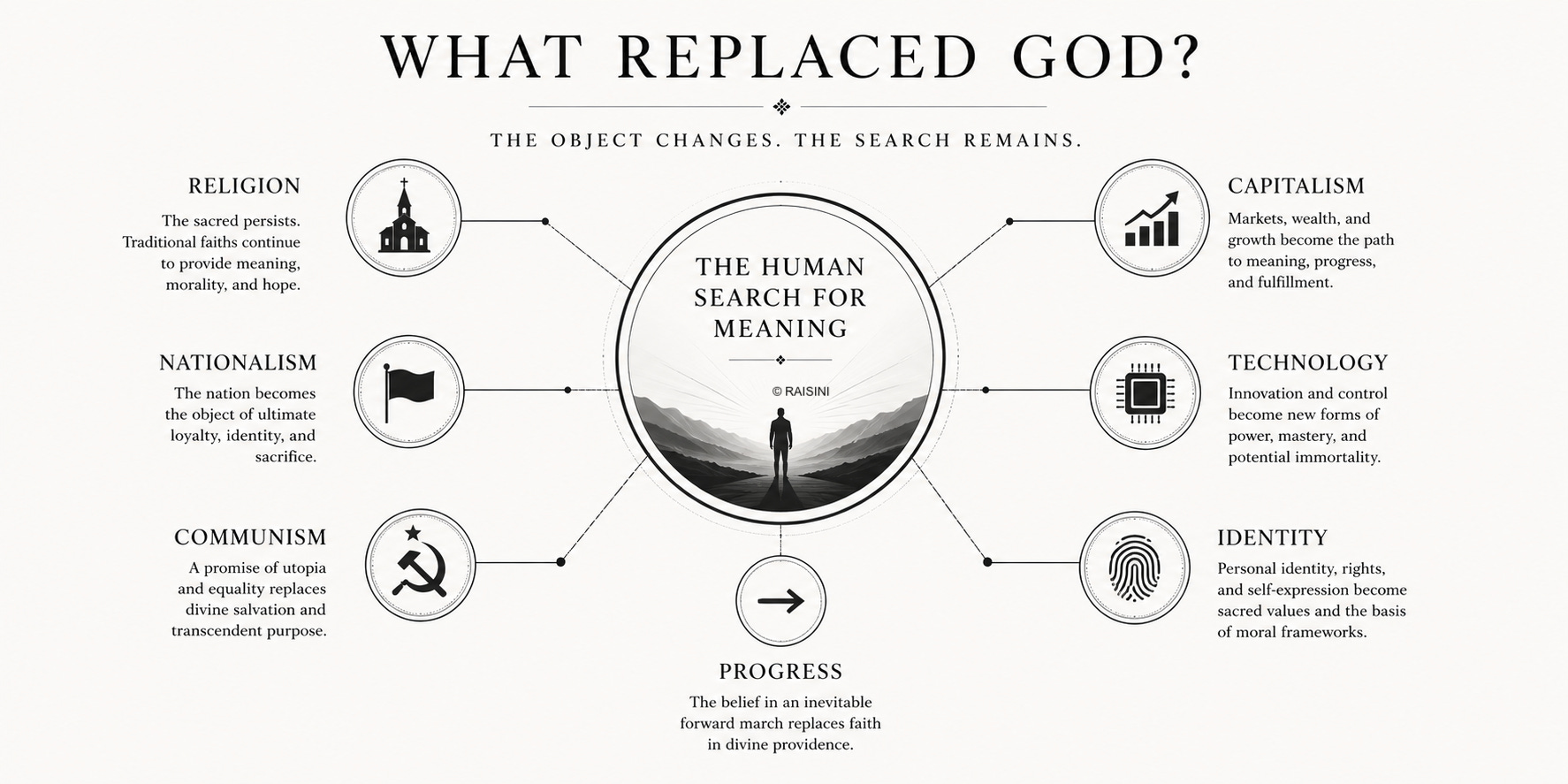
In some respects, that prediction appeared correct. Religious participation declined in many developed societies. Secular institutions assumed responsibilities once performed by religious organizations. Science became the dominant framework for explaining the physical world. Political authority became increasingly separated from religious authority. Yet something unexpected happened. While traditional religion weakened in some places, the deeper human needs religion had addressed did not disappear.
Human beings still sought meaning.
They still sought belonging.
They still sought moral certainty.
They still sought identities larger than themselves.
The questions remained even when some of the traditional answers lost influence.
This observation is important because it shifts the discussion away from religion itself and toward the underlying human condition. Throughout this essay, we have seen religion function as a response to uncertainty, mortality, cooperation, morality, and social organization. If these needs are deeply rooted within human psychology, then weakening religion does not automatically eliminate them. It simply creates space for alternative systems to emerge.
Nationalism offers one example. Throughout much of modern history, national identity assumed a role that often resembles functions previously performed by religion. Nations developed founding myths, sacred symbols, collective rituals, national holidays, monuments, heroes, martyrs, and narratives of destiny. Citizens were asked to sacrifice for causes larger than themselves. The nation became more than a political structure. It became a source of identity, belonging, and meaning. This does not make nationalism a religion. The comparison is structural rather than literal. The important observation is that both systems help answer the question of who people are and what larger community they belong to.
Political ideologies frequently perform similar functions. Communism, liberalism, nationalism, socialism, and various ideological movements often provide comprehensive explanations for how society works, what problems matter most, who is responsible for suffering, and what future should be pursued. They create moral frameworks that divide actions into right and wrong, progress and regression, virtue and vice. Once again, this does not mean political ideologies are religions. It means they often satisfy some of the same psychological and social needs that religions historically addressed.
The same pattern can be observed in humanity’s relationship with progress itself. Many modern societies place extraordinary faith in the idea that the future will be better than the past. Scientific advancement, economic growth, technological innovation, and increasing knowledge are often treated as forces moving civilization toward improvement. In many respects, this confidence is justified. Modern societies have achieved remarkable advances in health, education, communication, and living standards. Yet progress also functions as a narrative. It provides direction. It creates purpose. It reassures people that present sacrifices contribute to a larger story about the future.
Technology occupies an especially interesting position within this landscape. Historically, religion often provided answers to questions about human limitations. Technology increasingly offers practical solutions to many of those same limitations. Disease can be treated. Distance can be eliminated through communication networks. Information can be accessed instantly. Some modern thinkers even discuss extending life, enhancing intelligence, or overcoming biological constraints through technological development. While technology operates through fundamentally different mechanisms than religion, it can evoke similar hopes regarding transcendence, transformation, and the overcoming of human vulnerability.
Science deserves careful treatment here because it is often misunderstood in these discussions. Science is not a religion, nor should it be described as one. Science is a method for investigating reality through observation, experimentation, and evidence. Its strength lies precisely in its willingness to revise conclusions when new evidence emerges. However, many people relate to science not merely as a method but as a source of certainty, authority, and meaning. The distinction matters. Science explains how reality behaves. Human beings often continue searching for answers about what reality means.
Identity itself has also become increasingly important in modern societies. As traditional institutions weakened, many individuals began constructing meaning through personal, cultural, ideological, professional, or social identities. Identity provides belonging. It creates community. It offers narratives through which individuals understand themselves and their place in the world. Once again, the function resembles something religion historically provided, even when the content differs dramatically.
The broader pattern is difficult to ignore. Human beings appear remarkably consistent across history. The symbols change. The institutions change. The language changes. The underlying needs remain surprisingly stable. People seek frameworks capable of organizing reality, explaining suffering, creating belonging, establishing moral expectations, and connecting individual lives to larger purposes. Religion addressed these needs for much of human history. Modern societies increasingly address them through a wider range of institutions and ideas.
The twentieth century provided perhaps the strongest evidence for this pattern. Some of the most secular societies in history did not become free from collective belief. Instead, many redirected religious energy toward political ideologies, national identities, revolutionary movements, and visions of historical destiny. These movements often developed their own moral frameworks, sacred symbols, founding narratives, heroes, martyrs, and promises of a better future. The decline of traditional religion did not necessarily eliminate humanity’s attraction to transcendent causes. In many cases, it simply changed the objects toward which that attraction was directed.
This does not mean religion disappeared. Nor does it mean every modern belief system is secretly religious. Such conclusions would oversimplify a far more complex reality. The important observation is that human beings continue searching for many of the same psychological and social functions religion once supplied. The forms evolve while the needs persist.
Modern societies weakened traditional religion, particularly in parts of the world where scientific, political, and economic institutions assumed greater influence. Yet they did not eliminate humanity’s need for meaning, belonging, identity, and moral certainty. Those needs remain visible everywhere. They simply express themselves through different structures.
The question, then, is not whether religion disappeared.
The deeper question is whether the sacred ever truly left.
For more than two centuries, many thinkers believed modernity would gradually eliminate the need for religion. Scientific knowledge was expanding, political authority was becoming increasingly secular, and technological progress appeared capable of solving problems that earlier generations could only address through faith. As societies became wealthier, more educated, and more technologically sophisticated, it seemed reasonable to assume that sacred thinking would slowly fade into history.
Yet reality has unfolded differently.
While traditional religious participation has declined in some societies, sacred thinking itself has proven remarkably resilient. Human beings continue creating rituals. They continue forming tribes. They continue organizing around symbols. They continue searching for meaning, belonging, identity, and moral purpose. The forms have changed. The underlying patterns remain surprisingly familiar.
Part of the reason lies in the distinction between information and meaning. Modernity has become extraordinarily effective at producing information. We know more about the physical universe than any previous civilization. We can explain biological processes, understand planetary motion, map the human genome, and communicate instantly across the globe. These achievements are remarkable. Yet knowledge alone does not fully address the questions that have historically driven human beings toward the sacred. Understanding how the universe functions is not the same as understanding what role an individual life plays within it. Information explains mechanisms. Meaning organizes experience.
This distinction helps explain why rituals persist even within highly secular societies. Rituals serve functions that extend beyond religious belief. Graduation ceremonies, national commemorations, weddings, funerals, sporting traditions, annual holidays, and countless social practices all help individuals mark transitions, reinforce identity, and create continuity across time. Ritual transforms events into shared experiences. It reminds individuals that they belong to something larger than themselves. The sacred has always relied heavily upon ritual because human beings are not merely rational creatures. We are symbolic creatures as well.
Symbols remain equally powerful. Throughout history, religious traditions used symbols to represent ideas too large or complex to express directly. Modern societies continue doing the same. Flags, memorials, monuments, logos, uniforms, and cultural icons often carry significance far beyond their physical form. Their power does not emerge from material properties alone. It emerges from shared meaning. People defend symbols, rally around symbols, and sometimes sacrifice for symbols because symbols connect individuals to collective identities larger than themselves.
The persistence of tribes follows a similar pattern. Modernity promised a more individualistic world in which traditional group identities would gradually weaken. Yet human beings continue forming communities organized around beliefs, values, cultures, professions, ideologies, interests, and causes. The specific tribes change, but the underlying impulse remains. Belonging satisfies deep psychological needs. It provides orientation, support, recognition, and purpose. Religion historically supplied many of these functions. New forms of community continue supplying them today.
Identity plays an increasingly important role within this process. As traditional religious frameworks became less dominant in some societies, individuals gained greater freedom to define themselves. This development created many opportunities, but it also introduced new challenges. When inherited structures weaken, people often search more actively for sources of identity and meaning. Questions that were once answered collectively become personal responsibilities. Who am I? What do I belong to? What should I value? How should I live? These questions did not disappear with modernity. If anything, they became more visible.
The persistence of sacred thinking may ultimately reflect something fundamental about human consciousness itself. Human beings do not simply observe reality. We interpret it. We construct narratives. We attach significance to experiences. We transform events into stories and stories into identities. The sacred emerges wherever people collectively agree that certain things possess extraordinary meaning. Sometimes those things are religious. Sometimes they are cultural, political, national, moral, or personal. The specific object varies. The process remains recognizable.
This does not mean every strongly held belief is sacred, nor does it mean all communities function like religions. Such comparisons can easily become superficial. The deeper observation is that human beings appear naturally inclined toward meaning-making. We create frameworks that help us distinguish what matters from what does not. We establish symbols, rituals, communities, and narratives that connect individual lives to larger structures of significance. The sacred repeatedly emerges because these functions remain necessary regardless of historical period.
Modernity succeeded in many of its predictions. It transformed science, technology, medicine, economics, and political organization. What it did not eliminate was the human search for meaning. The need to belong, to participate in something larger than oneself, and to interpret life through shared narratives remains remarkably persistent.
The sacred continues returning because the conditions that produced it never fully disappeared. Mortality remains. Uncertainty remains. Identity remains. Community remains. Meaning remains.
Human beings appear unable to live entirely inside material reality. We continually construct symbolic worlds alongside the physical one. The names change, the institutions change, and the stories change, but the underlying impulse endures. The sacred returns because it addresses dimensions of human experience that facts alone cannot fully satisfy.
We began this essay with a simple observation. Human beings have created thousands of civilizations, spoken thousands of languages, and lived under radically different conditions across history. Yet despite these differences, one pattern appears with remarkable consistency. Wherever human beings gather, organize themselves, and attempt to make sense of existence, some form of the sacred eventually emerges.
This remains one of the most fascinating facts about our species.
The question is not whether different religions agree with one another. They often do not. The question is not whether every religious claim can be verified. Many cannot. The deeper question is why human beings repeatedly arrive at similar structures of belief despite being separated by geography, culture, language, and time. Why do civilizations continue producing gods, spirits, rituals, sacred stories, moral systems, and visions of realities beyond immediate experience?
Throughout this essay, we have explored several possible answers.
Religion helped explain a world that once appeared unpredictable and mysterious. Before scientific frameworks existed, sacred narratives transformed chaos into something understandable. Storms, eclipses, disease, famine, and natural disasters became part of larger stories through which human beings could interpret their experiences. Religion did not necessarily provide accurate explanations in a scientific sense, but it provided explanations that made reality psychologically navigable.
Religion also addressed mortality. Human beings are unusual not simply because they die, but because they know they will die. This awareness creates questions that extend beyond biology. What happens when life ends? Does anything remain? How should one live knowing time is limited? Religious traditions offered different answers, yet they shared a common function. They transformed death from an absolute ending into part of a larger narrative. Mortality became something that could be endured, interpreted, and psychologically integrated.
As societies grew larger, religion assumed additional responsibilities. Shared sacred stories helped strangers cooperate. Common moral frameworks stabilized behavior across populations. Religious institutions preserved knowledge, transmitted values, and reinforced collective identity. What began as an attempt to understand reality gradually became a mechanism for organizing civilization itself. Religion did not merely explain the world. It helped build the structures through which people lived within it.
Religion also provided meaning. This may be its most enduring contribution. Human beings do not live by information alone. Facts help us understand how reality functions. Meaning helps us understand how to live inside that reality. Religion connected suffering to purpose, responsibility to identity, and individual lives to larger narratives. It created frameworks capable of answering questions that extend beyond observation and measurement. Why are we here? What matters? How should we live? These questions have persisted across every era because they emerge naturally from consciousness itself.
Yet perhaps the most interesting insight is that religion appears to reveal something about human beings as much as it reveals something about gods. Across civilizations, sacred systems repeatedly incorporated ideals such as justice, wisdom, mercy, love, courage, truth, sacrifice, and transcendence. The divine often became a repository for humanity’s highest aspirations as well as its deepest fears. Whether these qualities originate from God or are projected onto God remains a matter of interpretation. What matters for our purposes is that the pattern appears again and again.
This brings us back to the question posed at the beginning of the essay.
Why did every civilization create the sacred?
No single answer is sufficient. Religion was not merely an explanation of nature. Nor was it merely a response to mortality, a tool of social organization, a moral framework, or a source of meaning. It was all of these simultaneously. Its extraordinary durability may stem from the fact that it addressed multiple dimensions of human existence at once. Few ideas in history have operated across so many levels simultaneously.
Importantly, this essay has not attempted to answer whether God is real. Nor has it attempted to determine whether any particular religion is true. Those are different questions requiring different methods of inquiry. A person’s conclusions about theology do not change the historical reality that the idea of God transformed human civilization on a scale almost unmatched by any other concept.
Whether God was discovered, revealed, invented, projected, or emerged naturally from human consciousness remains one of the great questions of human history. Different traditions and individuals will continue offering different answers. What is far less controversial is the impact the idea itself has had upon the world. It shaped civilizations, organized morality, influenced politics, inspired art, guided laws, comforted the dying, motivated sacrifice, and provided meaning to billions of lives across thousands of years.
Throughout this essay, we have treated God as a civilizational phenomenon rather than a theological claim. That distinction matters because the central question was never whether a particular religion is true. The question was why human beings repeatedly create sacred systems at all. Across continents, languages, empires, and thousands of years, civilizations developed remarkably similar ideas concerning transcendence, morality, meaning, invisible realities, and forces existing beyond immediate perception. The details differed, but the underlying patterns appeared again and again.
Whether God was discovered, revealed, invented, projected, or emerged naturally from human consciousness remains unresolved. Different traditions offer different answers, and history alone cannot settle the question. What history reveals with far greater certainty is that the search itself appears universal. Human beings repeatedly construct frameworks that help explain reality, confront mortality, organize society, endure suffering, and locate meaning within existence. The persistence of these patterns suggests that religion was responding to something deeper than ignorance, and perhaps something deeper than culture alone.
Perhaps the deeper mystery is not why human beings believed in God. Perhaps the deeper mystery is why civilizations separated by oceans, languages, and thousands of years kept arriving at the sacred again and again.
— Raisini
If you enjoyed this essay, please show your support by donating and help spread this story with a friend to help them find their purpose.
See you next week,
RAISINI
👉🏻 Connect on LinkedIn - LEONIDAS RAISINI
👉🏻 Listen to my music - RAISINI
👉🏻 Work with me - www.LeonidasRaisini.com
Founding Member
You can also become a founding member, where you will get a 15 Minutes consultation call with me, have access to super exclusive stories including access to my new Music before others, meet in person (if we are in the same city), invite to our events. All for $150 per year. [This is also a great option if you happen to have, say, an employer-sponsored reading or education budget.]
Copyright RAISINI 2026. Any illegal reproduction of this content will result in immediate legal action.
Comments
Nothing yet. Say the first thing.
Sign in to join the conversation.