
Welcome to this week’s issue of RAISINI.
Every week, i write about building a life on your own terms - through music, entrepreneurship, investing, health and brand-building. This isn’t theory. It’s what I’ve lived. Let’s keep going.
If you want access to private chats, live events, workshops, and more, consider becoming a paid or founding member.
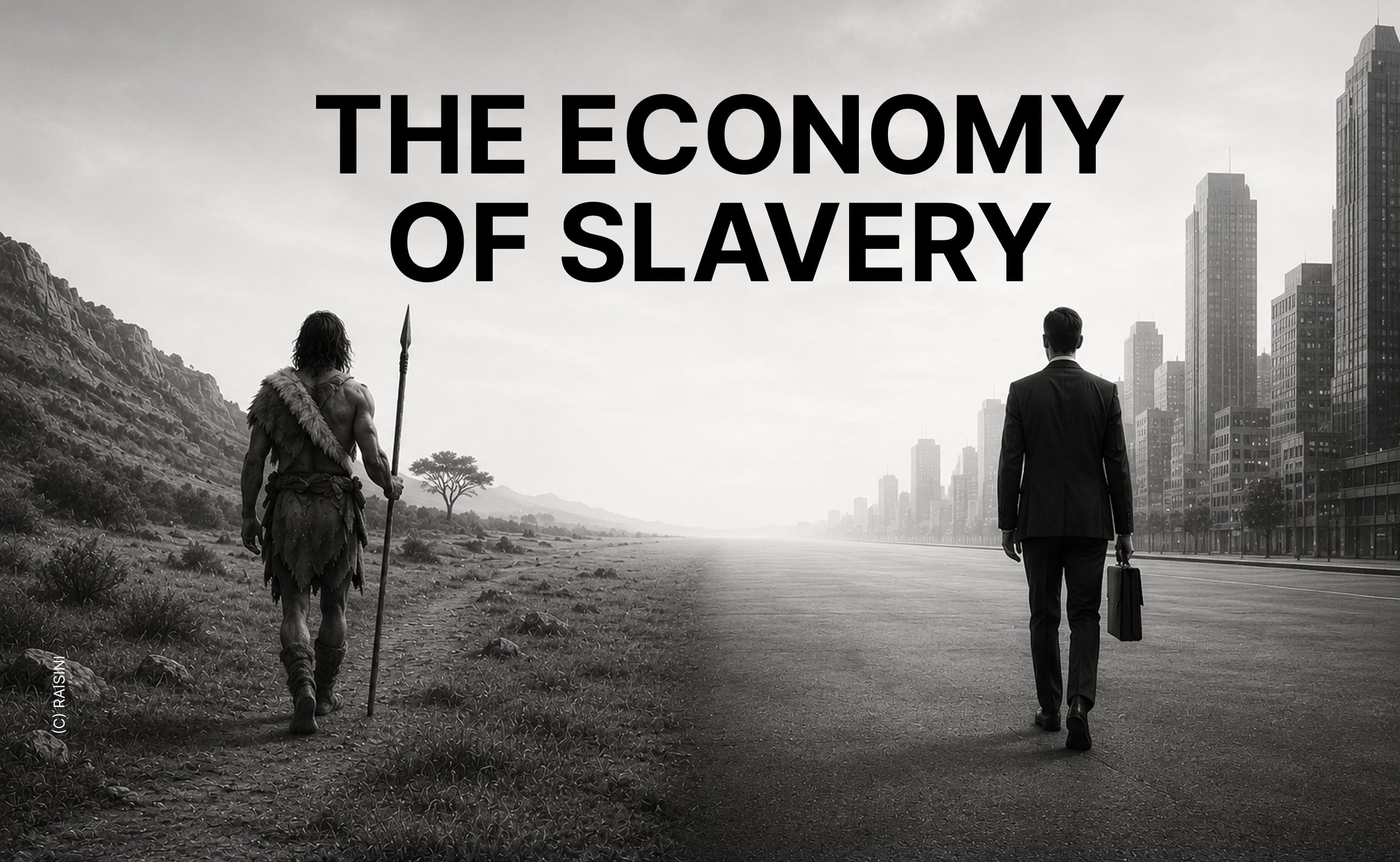
Modern civilization gave humanity unprecedented prosperity, safety, technology, and opportunity. Yet many people increasingly feel dependent on systems they do not control, institutions they cannot easily leave, and economic structures that mediate almost every aspect of survival. This essay explores how human beings moved from direct survival to systemic survival, why modern life often feels simultaneously free and restrictive, and whether the pursuit of stability gradually transformed autonomy into participation.
What You'll Discover
The Invisible Contract
From Direct Survival to Systemic Dependency
The Financialization of Existence
Ownership Became Access
The Birth of Permission
Institutions Teach Participation
The Illusion of Choice
Attention Became the New Labor
The Psychology of Dependency
What Humans Actually Want
The Real Question Is Not Freedom
Preview
This essay is written as an exploration of a tension that sits beneath modern life but is rarely examined directly.
Human beings today enjoy levels of comfort, safety, mobility, and technological capability that would have seemed unimaginable for most of history. Food can be delivered within minutes. Information is available instantly. Medical care can extend lives that would once have ended prematurely. Entire industries exist to remove inconvenience from daily life. By almost every measurable standard, modern civilization has solved problems that previous generations spent centuries trying to overcome.
Yet despite these achievements, many people carry a persistent feeling that something about the relationship between themselves and the world has changed. They work, earn, consume, and participate, yet often feel less in control of the conditions that sustain their lives. Access to food, shelter, transportation, education, healthcare, communication, and even opportunity increasingly depends on systems that are vast, complex, and largely outside individual control. Most people can navigate these systems, but very few understand them, and fewer still could function independently of them for long.
This creates a paradox. Modern humans are arguably freer than most humans who came before them, yet many experience their lives through a growing sense of dependency. The more civilization advanced, the further individuals moved from direct control over the mechanisms of their own survival. What was once immediate became institutional. What was once local became systemic. What was once owned increasingly became accessed.
This essay explores that transition. It is not an argument against civilization, markets, governments, or technology. It is an examination of the tradeoffs that accompany complex societies, and the question of what happens when participation becomes necessary, dependency becomes normal, and survival itself becomes increasingly mediated by systems few people can realistically leave.
Imagine a person loses their income unexpectedly. Not permanently, perhaps only for a few months. The immediate problem is not the loss of money itself. The problem is that money has become the mechanism through which access to almost everything else is maintained. Rent or mortgage payments begin approaching. Bills continue arriving. Food, transportation, communication, insurance, and healthcare remain available, but only so long as participation in the economic system continues. What initially appears to be a financial setback quickly reveals itself as something much larger. Modern life is built upon a network of dependencies, and the interruption of income exposes how many of those dependencies exist simultaneously.
This is not unusual. For most people, survival is no longer something accessed directly. It is accessed through institutions. Food is obtained through supply chains. Shelter is obtained through property systems. Healthcare is obtained through medical systems. Energy is obtained through infrastructure networks. Communication passes through digital platforms. Transportation depends upon regulatory, financial, and logistical systems operating continuously in the background. Most people rarely think about these structures because they function reliably enough to remain invisible. Like electricity flowing through a wall, their importance only becomes obvious when access is interrupted.
One of the defining achievements of civilization is that it removed much of the uncertainty that shaped earlier human existence. Food became more reliable. Violence became less common. Lifespans increased. Specialization allowed individuals to focus on narrow areas of expertise while relying on others for everything else. The result was extraordinary prosperity compared to most of human history. Yet every gain in specialization created a corresponding increase in dependency. The modern individual no longer survives because they personally understand agriculture, construction, energy production, medicine, and transportation. They survive because millions of people, institutions, and systems perform those functions on their behalf.
The consequence is a relationship with survival that feels fundamentally different from the one experienced by our ancestors. A hunter understood food directly. A farmer understood land directly. Even when life was physically harder, the connection between effort and survival was often visible. Modern survival is more abstract. Most people work in occupations that are several layers removed from the necessities that sustain life. Their labor is exchanged for income, income is exchanged for access, and access is exchanged for survival. The chain functions efficiently, but it also introduces distance between individuals and the conditions required for their own existence.
This is where the tension emerges. Modern humans are often described as free because they possess political rights, economic opportunities, and personal choices unavailable to most previous generations. There is truth in that observation. Yet freedom and dependency are not opposites. It is entirely possible to be legally free while remaining structurally dependent on systems you neither own nor control.
The question is not whether civilization improved human life. It clearly did.
The more interesting question is what humanity traded away in exchange for that improvement, and whether those tradeoffs altered the way people experience autonomy itself.
To understand how that trade occurred, and why so many people feel simultaneously liberated and dependent, we must begin much earlier, before institutions, before large-scale economies, and before survival became something mediated by systems. We must begin with how human beings originally interacted with the world that kept them alive.
Comments
Nothing yet. Say the first thing.
Sign in to join the conversation.