
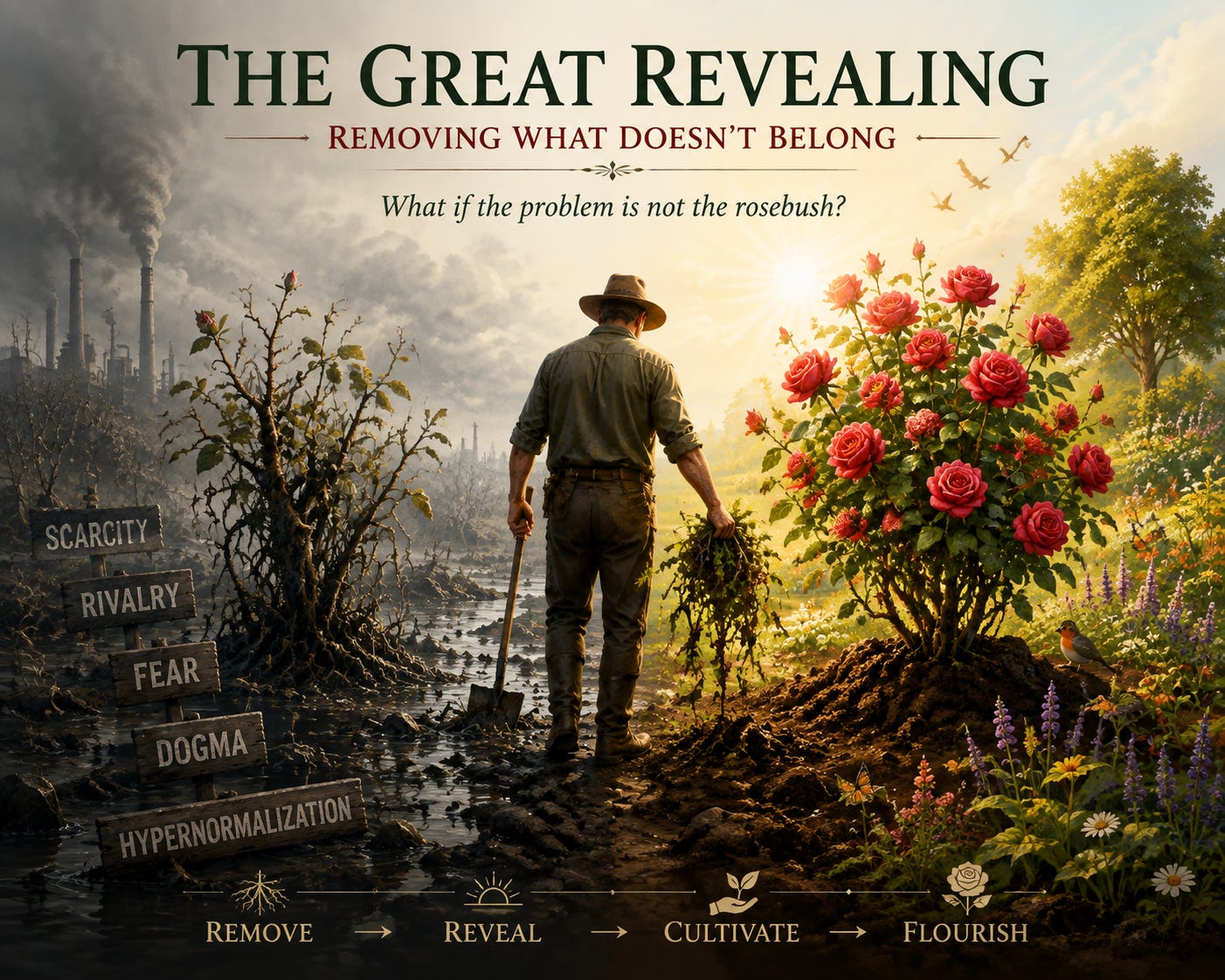
If you have ever watched a sculptor at work, you have witnessed something surprising.
They do not begin by creating.
They begin by removing.
With every careful strike of the chisel, they cut away what does not belong until the form hidden within the stone gradually reveals itself. Whether or not Michelangelo actually said he saw the angel in the marble and carved until he set it free is almost beside the point. The metaphor endures because it points toward something profound.
The sculptor does not manufacture the figure.
The sculptor reveals it.
A skilled gardener understands something similar.
A gardener cannot force a rosebush to bloom. She cannot command life into existence. She removes weeds, prunes diseased branches, enriches the soil, and cultivates the conditions under which the rose can become what it already carries within itself.
Perhaps some of humanity’s greatest transformations have always worked this way.
Not by inventing something entirely new.
But by removing what has prevented us from seeing what was already possible.
History occasionally offers moments when inherited assumptions begin to fracture—often through conflict and resistance—revealing new ways of understanding reality that were previously difficult to imagine.
More than five hundred years ago, Nicolaus Copernicus displaced Earth from the center of the cosmos—not by inventing a new universe, but by revealing that we had misunderstood the one we already inhabited.
The Copernican Revolution was not simply an astronomical discovery.
It was a humbling realization:
The world was not organized around the assumptions humanity had inherited.
Long before Copernicus, Plato imagined prisoners in a cave mistaking shadows on a wall for reality.
Centuries later, Thomas Kuhn showed how scientific paradigms persist—not because people are irrational, but because the assumptions underlying a worldview often remain invisible until reality itself begins presenting contradictions that can no longer be ignored.
Daniel Quinn extended this insight to civilization itself, arguing that humanity is governed by cultural stories so pervasive that we rarely recognize them as stories at all. We inherit these stories so deeply that they shape our understanding of what is natural, possible, and inevitable.
More recently, Yuval Noah Harari explored another dimension of this human capacity: our ability to create shared imagined realities that allow large groups of people to coordinate. Nations, money, laws, and institutions exist because humans collectively participate in stories that give them meaning and power.
Again and again, profound transformations begin with a deceptively simple act:
Question what everyone assumes cannot be questioned.
More than a century ago, Edward Bellamy offered another profound example through a simple parable.
He imagined humanity as a rosebush planted in a swamp.
Generation after generation of gardeners devoted themselves to making it bloom. They studied the bush, experimented with techniques, debated theories, and searched for explanations.
Some concluded the bush itself was defective.
Others believed it possessed some inherent flaw preventing it from flourishing.
A few even questioned whether it was truly a rosebush at all.
But a small number of gardeners wondered something different.
Perhaps the problem was not the rosebush.
Perhaps the problem was the bog.
When the rosebush was finally transplanted into healthier soil, the vermin and mildew disappeared, and the bush bloomed with extraordinary beauty.
The rose had not suddenly become something else.
The conditions had changed.
The question was never:
How do we fix the rosebush?
The deeper question was:
What if we have been diagnosing the wrong problem all along?
This question has stayed with me because it challenges one of our deepest assumptions.
We often believe that human beings are the problem.
People are selfish.
People are greedy.
People are naturally competitive.
People will always seek domination.
People cannot cooperate at scale.
Perhaps these statements describe some human behaviors.
But what if they describe the behaviors that emerge under particular conditions rather than the full range of human possibility?
A rosebush growing in poisoned soil tells us something about the rose.
But it also tells us something about the soil.
Human beings are no different.
When we create systems organized around scarcity, competition, insecurity, hierarchy, and rivalry, certain behaviors become adaptive.
Then we observe those behaviors and declare:
This is human nature.
But perhaps we are confusing adaptation with essence.
Perhaps we are studying the rosebush in the swamp and drawing conclusions about roses.
The difficulty is that we rarely notice the swamp.
We inherit assumptions so completely that they become invisible. We stop experiencing them as assumptions and begin experiencing them simply as reality.
This may be the deepest form of dogma.
Not merely believing something strongly.
But forgetting that what we believe is a belief.
Daniel Quinn described a profound civilizational pattern as The Great Forgetting.
Humanity has forgotten that many of the arrangements we now consider permanent features of existence are actually particular ways of organizing life that emerged under particular historical conditions.
To remember is not to return to the past.
It is to recover possibilities that have disappeared beneath habit.
It is not about romanticizing earlier human societies or pretending history was without hardship and conflict.
It is about remembering capacities that have always been part of us:
Belonging.
Reciprocity.
Stewardship.
Cooperation.
Relationship with place.
Participation in the community of life.
The challenge before us is not to recreate the past.
It is to integrate what humanity has forgotten with what humanity has learned.
To remember without regressing.
To evolve without severing ourselves from the living systems that sustain us.
I have come to think of this practice as The Great Revealing.
By revealing, I do not mean a final truth handed down from above.
Nor do I mean exposing hidden conspiracies.
I mean something quieter.
Something more demanding.
The patient practice of removing inherited assumptions until reality can speak more clearly.
The Great Revealing is not meant to compete with The Great Forgetting, The Great Turning, The Great Unraveling, The Great Work, The Great Simplification, or the many other attempts to name this extraordinary civilizational moment.
If anything, it is an invitation to listen to them together.
Perhaps the emergence of so many “Greats” is itself revealing.
Different thinkers, from different disciplines and perspectives, are sensing different dimensions of the same profound transition. Each is illuminating a part of a larger pattern that becomes visible only when we hold these perspectives in relationship.
Each illuminates something important.
One reminds us of what we have forgotten.
One calls us toward transformation.
One asks us to undertake the work.
One reveals the limits of our current trajectory.
One invites us to imagine another possibility.
What patterns become visible when we stop treating these perspectives as competing narratives and begin recognizing them as different windows onto the same unfolding reality?
Perhaps the deeper question is not:
Which vision is correct?
Perhaps the question is:
What are all of these perspectives revealing when held together?
If our greatest challenge is not simply a lack of information but our inability to notice the assumptions shaping what we perceive, then we need a different kind of listening.
I call this capacity hyperlistening.
Not listening harder.
Listening deeper.
The idea of hyperlistening emerges in contrast to what Adam Curtis, drawing from the work of Alexei Yurchak, described as hypernormalization: the condition in which people collectively accept a reality that may no longer reflect what is actually happening, because imagining alternatives has become increasingly difficult.
Hypernormalization is what happens when assumptions become so familiar that they disappear from view.
Hyperlistening is the practice of making them visible again.
It is listening beneath what has become normal.
It is noticing the gap between what we are told and what we experience.
It is hearing the contradictions between our values and the systems we create.
It is questioning whether something is truly inevitable—or simply familiar.
Hyperlistening asks:
Is this actually true?
Has this always been true?
What conditions created this belief?
What does this assumption bring forth in human beings?
What possibilities does it prevent us from imagining?
Hyperlistening is not about possessing secret knowledge.
It is about cultivating enough humility to recognize that our current understanding is incomplete.
It is the willingness to let reality correct us.
But revealing assumptions is only the beginning.
The goal is not simply to criticize the swamp.
The goal is to cultivate healthier soil.
This is where we must avoid another false choice.
Changing ourselves is not enough.
Changing systems is not enough.
We cannot simply transform individual consciousness while leaving destructive conditions intact.
Nor can we redesign institutions while ignoring the human capacities required to inhabit them differently.
The rose and the soil belong to one living system.
So do we.
A garden is not judged by the gardener’s theories, but by what it allows to flourish. Some conditions nourish life; others diminish it.
Our consciousness shapes our actions.
Our actions shape our relationships.
Our relationships shape our cultures.
Our cultures shape our systems.
And our systems continuously shape the conditions in which human beings develop.
The inner and outer worlds are not separate.
The individual and collective are not separate.
Being and doing are not separate.
Transformation emerges through relationship.
The gardener does not only tend the rose.
The gardener tends the conditions that allow the rose to flourish.
The Great Revealing begins with a simple practice.
Choose one thing you have been told is simply the way the world works.
Competition.
Scarcity.
Ownership.
Growth.
Success.
Human nature.
Power.
Progress.
Do not immediately reject it.
Do not immediately defend it.
Simply listen.
Ask:
Is this an enduring truth?
Or is it a response to particular conditions?
Ask:
What behaviors does this assumption reward?
What behaviors does it suppress?
What kind of world does it create?
Then return to Bellamy’s question:
What if the problem is not the rosebush?
And ask the gardener’s question:
What conditions would allow something more life-affirming to grow here?
The purpose of seeing clearly is not merely to recognize what no longer belongs. It is to cultivate the conditions for something more beautiful to emerge.
That question changes the quality of the search.
Because once we begin asking it, we stop looking only for better answers.
We begin cultivating better conditions.
Every generation inherits a garden it did not plant.
We can spend our lives arguing about whether the roses are worthy of saving.
We can blame the roses for failing to bloom.
Or we can ask a different question:
What kind of soil are we asking them to grow in?
That question is where The Great Revealing begins.
Not with certainty.
With attention.
Not with ideology.
With curiosity.
Not with the belief that humanity must become something completely different.
But with the possibility that healthier conditions may reveal capacities that have always been within us.
We cannot force the rose to bloom.
We cannot pull the flower open with our hands.
But we can become wiser gardeners.
We can remove what prevents life from flourishing.
We can cultivate the conditions for something more beautiful to emerge.
And perhaps that is the work before us now.
Not to impose the future.
Not to return to the past.
But to listen deeply enough to reality, remember what we have forgotten, and learn how to tend the garden together.
Because the rose was never the problem.
The question is whether we are ready to cultivate the soil. 🌹
The Great Revealing is part of a larger conversation shaped by many thinkers who have explored humanity’s relationship with itself, civilization, and the living Earth.
These thinkers are not presented as a single unified school of thought, but as different windows onto the same unfolding question:
What conditions allow life to flourish?
Readers interested in exploring these ideas further may wish to begin with:
Edward Bellamy — Looking Backward: 2000–1887
The source of the rosebush parable that inspired this essay: humanity’s flourishing depends not only on the nature of the rose, but on the conditions in which it grows.
Daniel Quinn — Ishmael and The Story of B
Explorations of civilization’s underlying stories, humanity’s relationship with the living world, and what we may have forgotten.
Thomas Kuhn — The Structure of Scientific Revolutions
An examination of how paradigms shape what societies recognize as knowledge and truth.
Yuval Noah Harari — Sapiens
An exploration of humanity’s capacity to create shared imagined realities that allow large-scale cooperation.
Joanna Macy — The Great Turning and related works
A framework for understanding the transition toward a life-sustaining civilization.
Thomas Berry — The Great Work
A vision of humanity’s role in creating a mutually enhancing relationship with Earth.
Nate Hagens — The Great Simplification
An examination of the ecological and energetic realities confronting industrial civilization.
Adam Curtis and Alexei Yurchak — HyperNormalisation
Explorations of how societies can normalize contradictions and lose the capacity to imagine alternatives.
No posts
Comments
Nothing yet. Say the first thing.
Sign in to join the conversation.