
A note on process: This essay grew out of my morning pages practice — a tool from Julia Cameron's The Artist's Way, the daily discipline of writing fast, without editing, following the stream wherever it goes. What you're reading is where that stream led.
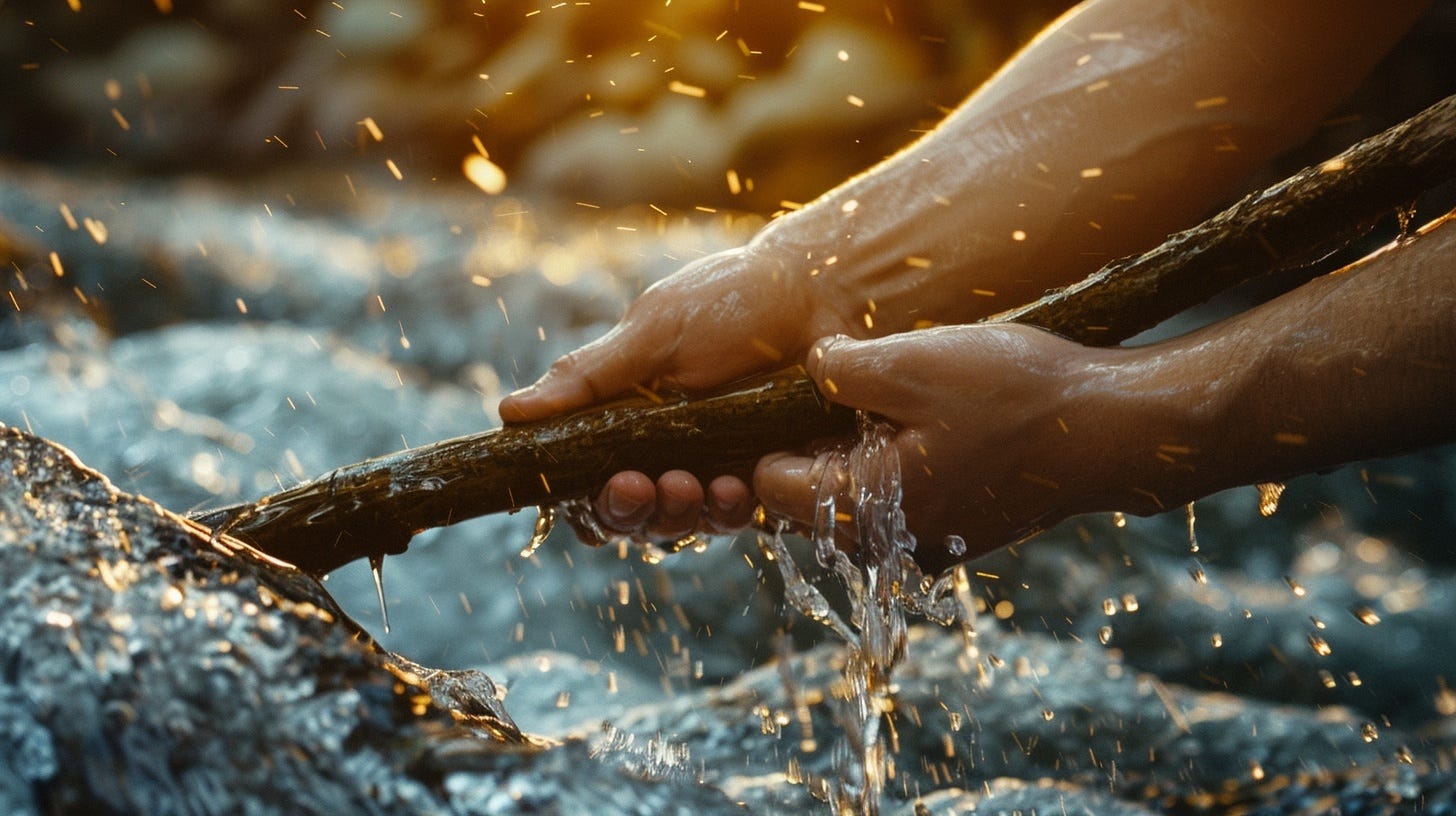
We are in a raging river, scared and holding on to a branch, battered by the rapids. The current pulls at us. The roar is deafening. And so we grip tighter — to the branch, to the familiar, to the systems and structures we inherited — convinced that letting go would mean drowning.
It won’t.
The branch is the problem. The river is the way.
This is not a metaphor about a choice we might someday face. We are already in the water. The river of history, of civilizational change, of ecological unraveling and technological disruption — it has already swept us off the bank. There is no dry ground to return to. The only question is whether we cling to the wreckage of what was, or release into what could be.
What are we clinging to? The economic and governmental systems we inherited — systems built not on human flourishing but on scarcity, competition, and misaligned incentives. Call it SCIM. These are not neutral forces. They are the rivalrous dynamics that have shaped every institution, every incentive structure, every assumption about how human life must be organized. They are the design logic of what Daniel Quinn called Taker civilization — a civilization that locked the food supply, enclosed the commons, and told us there was no other way to live.
There is another way to live. There always was. Quinn called the peoples who lived it Leavers — cultures that took what they needed without locking the rest away, that coordinated without rivalry, that lived inside the web of life rather than above it. Most of human history was lived this way. Now it is time to leave Taker civilization behind — to walk away from its locked storehouses and rivalrous logic, and let the current carry us toward something we have always known how to be.
But we cannot see it while we are white-knuckling the branch.
“Rivalrous dynamics multiplied by exponential tech self terminate. Exponential tech is inexorable. We cannot put it away. So we either figure out anti-rivalry or we go extinct – the human experiment comes to a completion.” ~ Daniel Schmachtenberger
Here is what those rivalrous dynamics actually do to us, individually and collectively: they pull us down.
Not metaphorically down. Down the spiral of human consciousness — back toward fear, tribalism, fundamentalism, separation. Andrew Schmookler identified the mechanism decades ago: in a world where any group can choose the path of domination, all groups are eventually forced to compete or be conquered. The logic of rivalry becomes inescapable. It selects for aggression, hoarding, and control — not because these are natural human impulses, but because the system rewards them.
The result is what we see around us: a civilization running on the anxiety spiral1 — the self-reinforcing loop in which fear contracts consciousness, and contracted consciousness generates more fear. When fear takes hold, consciousness contracts. We retreat to lower stages of awareness — grasping for certainty, pointing at enemies, reaching for simple answers to complex problems. The postmodern trap of nihilism. The modern trap of consumption. The traditional trap of fundamentalism. The warrior trap of domination. The rivalrous dynamics of SCIM don't just impoverish us materially. They suppress our consciousness. They hold the bobber underwater.
This is the key insight: SCIM is not merely an economic problem or a political problem. It is a consciousness problem. The rivalrous dynamics of our civilization are actively pulling us down the spiral, toward entropy and dystopia, away from the greater wholeness that is our birthright and our destination.
But here is what the branch-clinging prevents us from noticing: the river has a direction.
The universe is not running in circles. It is going somewhere. Atoms come together to form molecules. Molecules organize into cells. Cells differentiate into organs. Organs compose organisms. Organisms form communities, cultures, civilizations. At every level, wholes become parts of greater wholes — what Ken Wilber calls holarchy2, the nested structure of an evolving cosmos. This is not random. This is the shape of reality unfolding toward greater complexity, greater consciousness, greater connection.
Call this Source. Call it the creative force of the universe. Call it — as Julia Cameron does — GOD: Good Orderly Direction. The direction is not always smooth, nor always obviously good — at any scale. Evolution is messy, nonlinear, sometimes brutal, marked by regression and suffering both personal and collective. But the arc is real. Toward greater complexity, greater consciousness, greater wholeness. Ultimately, it is going somewhere.
The Spiral Dynamics model, developed by Clare Graves and expanded by Christopher Cowan, Don Beck, and others, maps the stages of human consciousness as it has evolved through history. While various thinkers have used different naming conventions for these stages, the stage names I use throughout this work are my own adaptation: Archaic, Tribal, Warrior, Traditional, Modern, Postmodern, Integral, and Geotribal3.
The spiral is the shape of human becoming. Graves understood it as a double helix — the intertwining of life conditions (the social, economic, environmental, and cultural challenges any era presents) with the coping systems humans develop in response. As life conditions grow more complex, consciousness expands to meet them. As consciousness expands, it creates new and more complex life conditions in turn. Each spurs the other upward toward greater complexity, greater awareness, greater wholeness. The spiral is not a ladder imposed from outside. It is the shape reality takes when inner and outer evolution dance together.
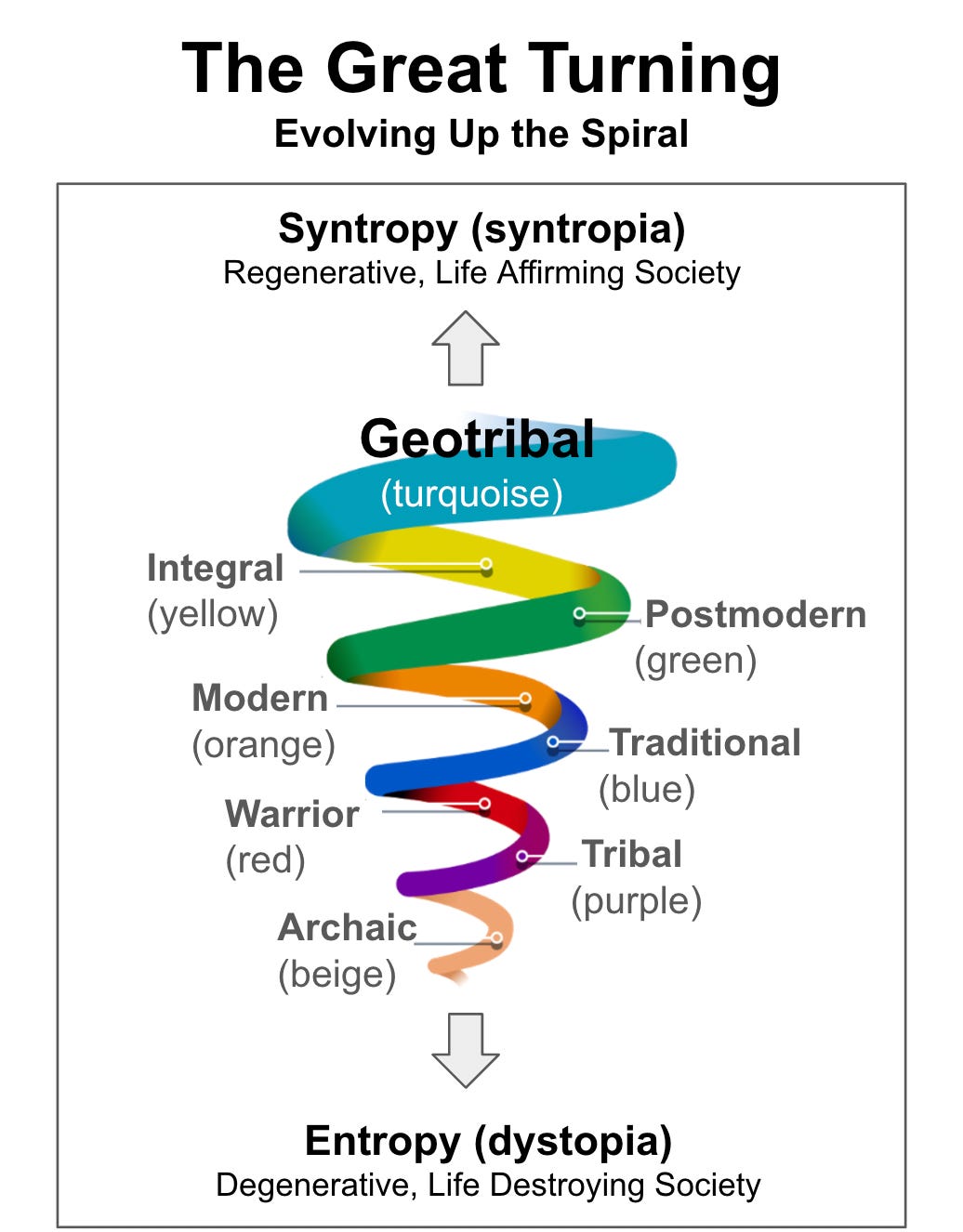
And the next stage — the stage the current is carrying us toward — is what I call the Geotribal Age.
The Geotribal stage is turquoise on the spiral: a regenerative, life-affirming civilization built on Dunbar-scale communities embedded in the living systems of the Earth, operating within an open-access economy of abundance rather than a locked economy of scarcity — one that controls who eats and who doesn't, who thrives and who doesn't, by keeping the commons enclosed and the alternatives unthinkable. It is not a utopia imposed from above. It is what emerges naturally when the rivalrous dynamics are dissolved — when SCIM is replaced by ACAI: Abundance, Cooperation, and Aligned Incentives.
The stream is flowing into the Geotribal Age. We are fighting it by clinging to the branch.
There is a neurological reason why the branch feels safer than the current.
Anxiety and creativity cannot occupy the same space at the same time. When we are afraid, the brain’s threat-response system dominates — narrowing perception, foreclosing options, driving us toward the familiar. This is the anxiety spiral: fear contracts consciousness, contraction generates more fear, and the spiral tightens downward. It is self-reinforcing. It is also, at this moment in history, the default operating mode of our civilization.
The rivalrous dynamics of SCIM don’t just create material scarcity. They engineer psychological scarcity — a chronic low-grade terror that keeps us in the anxiety spiral, unable to imagine alternatives, unable to cooperate across difference, unable to create. This is not an accident of human nature. It is the predictable output of a system designed around competition and fear.
The antidote is not more information, more argument, or more activism in the conventional sense. The antidote is creativity.
Martha Beck puts it plainly: creativity is the only adequate response to unprecedented challenges, and we are living in an age of the unprecedented. When no existing map covers the territory, the only way forward is to create a new one. This requires the right hemisphere of the brain — the seat of intuition, pattern recognition, holistic awareness, and imagination. It requires stepping out of the anxiety spiral and into what Beck calls the creativity spiral: curiosity, exploration, connection, flow.4
Creativity is not a luxury. It is the escape hatch from the anxiety spiral. It is the mechanism by which consciousness rises.
This is where the personal and the political converge.
Julia Cameron, in her work on creative recovery, describes the block that keeps people from their creative lives: fear. Fear of failure, fear of judgment, fear of the unknown. The path through is not to overcome the fear by force but to release it — to let go of the inner censor, to stop white-knuckling the need for control, and to flow with what wants to emerge. She calls this aligning with GOD: Good Orderly Direction. The creative current that flows through all things when we stop damming it.
This is not merely personal wisdom. It is civilizational wisdom.
The branch we are clinging to is the internalized voice of SCIM — the belief that scarcity is real, that competition is natural, that the locked storehouse is necessary, that there is no alternative. Every time we release this belief, even slightly, we free up creative energy. And creative energy, flowing freely, does not merely make better art. It designs better systems. It imagines better institutions. It builds the geotribal communities, the open-access economies, the regenerative cultures that the anxiety spiral told us were impossible.
Joanna Macy describes three dimensions of the Great Turning: holding actions that slow the damage, shifts in consciousness, and the creation of alternative systems. These are not sequential steps. They are simultaneous and mutually reinforcing. But there is a trap that many activists fall into: getting stuck in the first dimension. Holding actions — protest, resistance, reform, replacing one politician with another, regulating corporations without changing the underlying structures — are necessary but not sufficient. The problem is that activists can spend entire lifetimes fighting within the current system without ever questioning the system itself. They grip the branch of reform without realizing the branch is part of the problem. Real transformation requires all three dimensions simultaneously: slowing the damage, yes — but also radically shifting consciousness and building fundamentally new anti-rivalrous structures to replace the old. Without the second and third dimensions, holding actions become the whole of the strategy. Resistance becomes the point. The branch becomes identity.
The Creative Act is what converts holding action energy into systems change energy. It is the through-line between waking up and building something new. It is how the second dimension — the shift in consciousness — flows into the third.
We do not climb the spiral through effort and striving. We release into it. We let the current carry us.
We practice — through art, writing, music, movement, community, the regenerative garden, the cooperative, the commons, and every act of creation that chooses cooperation over competition — not as tactics in a campaign but as acts of alignment with the direction reality is already moving.
This is the post-MMO transition — the shift away from the Money, Markets, and Ownership system that has organized human civilization around rivalry and scarcity, toward the anti-rivalrous structures of ACAI: Abundance, Cooperation, and Aligned Incentives. Not as ideology. As lived practice. One creative act at a time.
Barbara Marx Hubbard called it conscious evolution — the idea that humanity is now capable of participating intentionally in its own development. This is true and important. But the word conscious can mislead. It implies that awareness alone is sufficient, that if we simply wake up to what is happening, the rest will follow.
It won’t. Awareness without creativity remains frozen at the edge of the river, watching the current, never entering it.
Creative Evolution goes further. It holds that consciousness rises through the creative act — that we do not first become conscious and then create, but that we become more conscious by creating. The act of bringing something new into being — a community, a practice, a system, a story — expands our awareness. It dissolves the anxious grip on the branch. It puts us in the current.
This is why any genuine creative practice works. To create is to enter the stream. Not because it produces brilliant insights — though it sometimes does. But because the act of creating — turning off the inner editor, following the stream wherever it goes, silencing the voice that says this is impossible or naive or too late — is training in release. It is practice in letting go of the branch. Every time we create from that open, undefended place, we rehearse the larger letting go that civilizational transformation requires.
The stream of consciousness — the literary technique of following thought wherever it flows, without censorship or control — is not merely a writing method. It is a model for how transformation happens. You cannot plan your way to the Geotribal Age. You cannot argue or optimize your way there. You can only release into the current, create from that place of release, and trust that the current knows where it is going.
Because it does. The universe has been going somewhere for thirteen billion years. Toward greater complexity. Toward greater consciousness. Toward greater wholeness.
The Geotribal Age is not a utopian fantasy. It is the next coil of the spiral — already present in seed form in every intentional community, every open-source project, every regenerative farm, every creative commons, every circle of people who have chosen cooperation over competition. These are not islands of idealism in a sea of inevitability. They are the future, already arriving.
The branch will not hold. The systems we inherited — built on SCIM, on rivalry, on the locked storehouse — are already failing under the weight of the crises they created. The rapids are getting rougher, not calmer.
This is not a reason for despair. It is an invitation.
The current is strong. The stream of higher consciousness has been flowing upward through all of human history, through every expansion of moral awareness, every emergence of new possibility, every act of creation that dissolved an old limitation. It is flowing now, beneath and through the chaos of this moment.
Let go of the branch. Get creative. Go with the flow.
The Geotribal Age is downstream — which is to say, upstream on the spiral of consciousness, in the direction reality has always been going.
We were made for this current. We just forgot we were swimmers.
Thanks for reading Radically Practical! This post is public so feel free to share it.
This essay is part of the Geotribe 2030 Anthology — a growing body of work on Creative Evolution and the Geotribal Age. If it resonated, you might also explore the essay “Evolving Beyond Civilization” and Chapter 4 of Parable of the Rosebush: Hyperlistening & The Creativity Spiral.
The Geotribe Creative Commons is an emerging space for people ready to stop clinging to the branch — to think clearly, create boldly, and practice anti-rivalry coordination alongside others doing the same. It is not a movement, a course, or an institution. It is an inquiry into the most consequential question of our time: how do humans coordinate at planetary scale without rivalry? If this essay resonated and you’d like to be part of what’s taking shape, let me know in the comments.
Notes:
The terms "anxiety spiral" and "creativity spiral" are drawn from Dr. Martha Beck's Beyond Anxiety: Curiosity, Creativity, and Finding Your Life’s Purpose (2025), which maps these as two mutually exclusive neurological and psychological states. The framework developed here extends Beck's insight from the individual to the civilizational scale, as she does also in the footnote below.
Holarchy - A holarchy is a hierarchy of self-regulating, autonomous entities called holons. Coined by philosopher Arthur Koestler in his 1967 book The Ghost in the Machine, a holon is something that is simultaneously a whole in itself and a dependent part of a larger whole.
Dr. Martha Beck, in her book Beyond Anxiety sums up nicely our potential way out of the unprecedented meta-crisis:
“Creativity is our only way of solving problems that are, like many issues facing our species in the twenty-first century, completely unprecedented. When we’re facing a situation we’ve never seen before—one that may have never existed before—there are no established rules for responding to conditions or solving our problems. We have to create those rules and responses, dream them up like a movie hero who’s stranded on Mars…
Unprecedented is the adjective for our age. Unprecedented situations are mushrooming around us. We live with an unprecedented amount of knowledge transfer, in an unprecedented escalation of technology, on a globe whose natural ecosystems we’re destroying at an unprecedented scale. The world is facing a whole lot of never-happened-befores. To deal with all this, we must—absolutely must—let our right hemispheres take the wheel…
I do believe that it will leave your brain less anxious and more inventive. And I know that the most important creative project you’ll undertake—the one you were born to complete—is the shaping of your whole life. As you become more creative than our society deems prudent, you’ll make the choices that will lead to your own greatest happiness, and your best contribution to the world.”
Troy Wiley | Geotribe 2030
No posts
Comments
Nothing yet. Say the first thing.
Sign in to join the conversation.