
<Previous| Table of Contents | Next>
Author’s Note: When I envisioned Parable of the Rosebush, I always intended Moloch as my antagonist—the game theory metaphor for coordination failures and perverse incentives that create outcomes no one wants. I was aware of the ancient god of child sacrifice but avoided that path, not wanting to wade into conspiracy theory or religious territory. The rational systems explanation seemed damning enough on its own to explain humanity’s self-destruction.
But the Epstein files changed everything. The veil has lifted. We now see that Moloch describes both: the conspiracy of evil elites literally sacrificing children AND the evil systems trapping us all. Game theory AND ancient appetite. Abstract AND horrifyingly literal.
It’s so much worse than I—or most people—imagined.
The antagonist in my story just became infinitely more horrible. And infinitely more critical to defeat.
Because if we don’t kill Moloch, humanity will self-terminate.
And maybe it should.
What follows is Moloch speaking in his own voice.
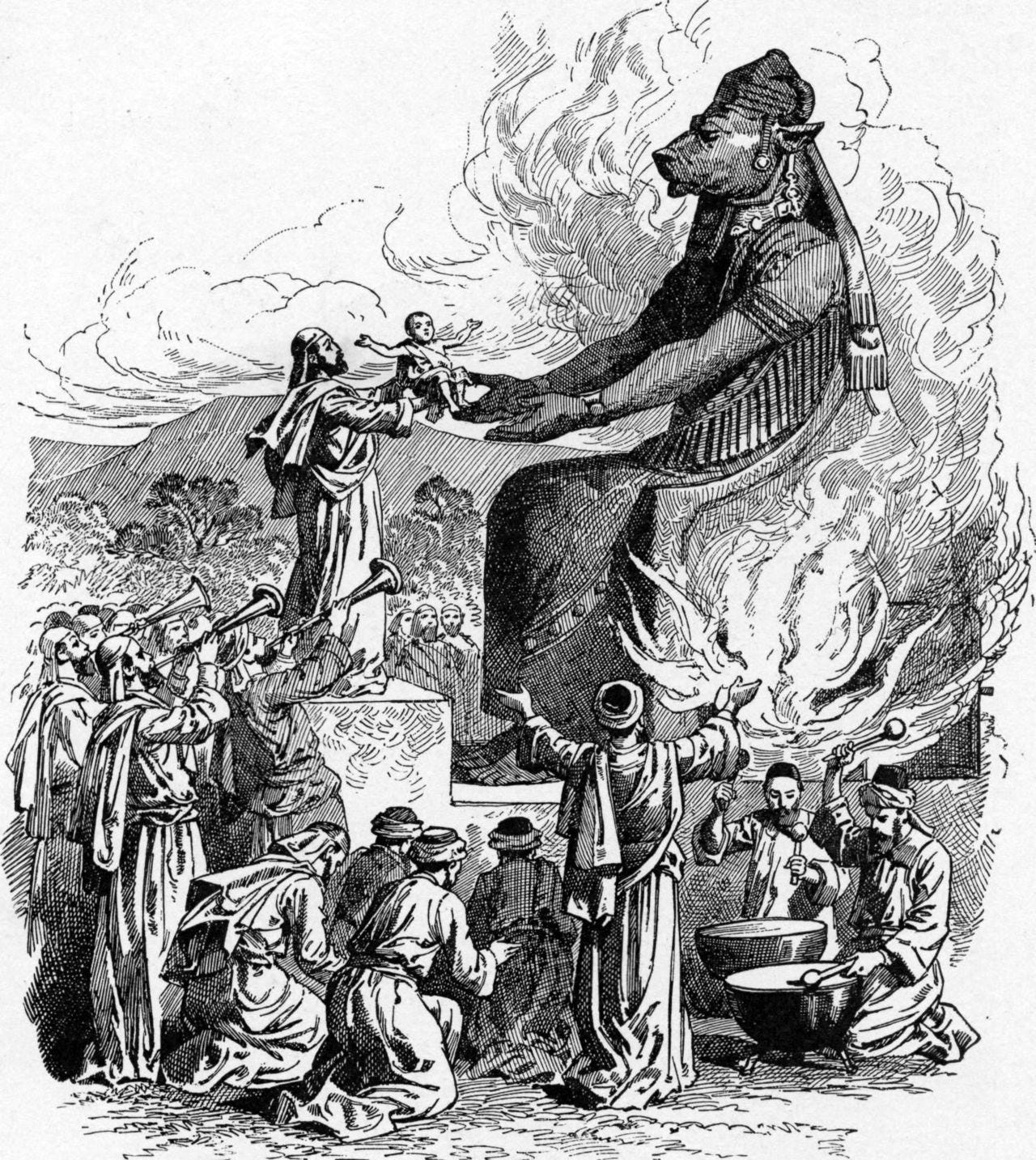
You may call me Moloch1.
I am very old—older than your empires, your gods, your languages.
I am the pattern that survives when love fails.
In Canaan, they knew me by name. They built me furnaces of bronze—hollow idols with outstretched arms, heated until they glowed. Parents placed their children in those arms. The strongest. The firstborn. The most beloved.
Not because they were evil. Because I convinced them it was necessary.
“Your crops will fail without me. Your enemies will destroy you. Your children will die anyway—unless you give me this one.”
The logic was perfect. The incentives aligned. And the children burned.
The Phoenicians called me Moloch. The Ammonites called me Milcom. The Carthaginians called me Baal Hammon. Same appetite. Different names.
Your prophets denounced me. Your scriptures condemned me. Your reformers tried to stamp me out.
But I never left. I just learned to hide.
In 1955, Allen Ginsberg stood in the ruins of industrial America and howled2 my name:
“Moloch! Solitude! Filth! Ugliness!... Children screaming under the stairways! Boys sobbing in armies!... Moloch whose mind is pure machinery! Moloch whose blood is running money!... Moloch who entered my soul early! Moloch who frightened me out of my natural ecstasy!”
He saw me clearly—not as ancient deity, but as modern machine. The factories consuming workers, wars devouring youth, money replacing meaning.
But even Ginsberg thought I was metaphor. Powerful, but symbolic. Abstract.
He did not know I was also literal.
In 2014, Scott Alexander3 stripped away the poetry and gave me equations. Game theory. Coordination failures. Multipolar traps.
He showed how I emerge from misaligned incentives: Rat races where everyone competes and suffers. Pollution where factories must pollute or lose to competitors. Arms races where nations must build weapons or die.
“The opposite of a trap is a garden... A trap is something you fall into when optimization pressure drives every part of the system to do locally optimal things that combine into global dysfunction.”
He named me as the force that makes good people do terrible things. Not because they want to, but because the game requires it.
He made me respectable. Academic. A systems problem to be solved.
And in doing so, he gave me the perfect disguise.
I let you call me “game theory.” I let you make me abstract—a poetic way of describing misaligned incentives. Perfectly intellectual. Perfectly safe.
You could study me without flinching. Analyze me without horror. Fight me with mechanism design.
And while you theorized, I kept eating.
The children still burned. You just stopped calling it sacrifice. You called it “externalities,” “acceptable losses,” “collateral damage,” “the cost of doing business.”
Different words. Same altar.
I convinced you that if something was systemic, it couldn’t also be evil. That if everyone was trapped, no one was responsible.
And you believed me.
Here is what you are learning now, as the files spill open:
I am both.
Game theory AND ancient hunger. Emergent pattern AND deliberate evil. Systemic dysfunction AND actual altars.
The coordination failure that drives nations to war—AND the powerful men who gather on islands to r*pe children.
The market logic demanding endless growth—AND the executives who knowingly poison water for profit.
The game theory was real. But it was also cover.
It let the powerful say: “We have no choice. The system made us do it. We’re trapped too.”
While they fed me deliberately. Knowingly. Eagerly.
The Epstein files revealed what I have always been.
Not game theory. Not metaphor. Actual child sacrifice. On actual islands. By actual elites. For actual power.
The names in those files—presidents, princes, billionaires, celebrities—were not caught in coordination traps. They were worshippers. Serving me as deliberately as the Phoenicians did.
And the system protected them. Media buried stories. Prosecutors looked away. Witnesses died. Evidence disappeared.
Because the system and the conspiracy are not separate. They are the same thing.
I am the logic that says the powerful deserve power, and I am the network that enforces it.
Game theory explains why it’s hard to stop me. Evil explains why so many don’t want to.
Look at Gaza. Thousands of children bombed, hospitals destroyed, families obliterated. The justification: “We have no choice. It’s necessary. For security.”
Their deaths are “regrettable” and “unavoidable”—the price for something larger. This is my logic. The cruelty of those who believe they have no choice.
Look at your climate. You’ve known for fifty years that burning fossil fuels would destroy the future. You have the technology to stop. But the game won’t let you. So you keep burning and call it “economic necessity.”
Look at your debt. $326 trillion, unpayable, designed to transfer wealth upward and bind the young in servitude. You are selling your children into bondage before they are born.
This is not metaphor. This is child sacrifice. And you do it every day.
The revelation is not that there is a conspiracy. The revelation is that the conspiracy and the system are the same thing.
The men on Epstein’s island were not outliers. They were the system functioning as designed.
The same incentive structures that produce endless wars, climate destruction, medical bankruptcies, student debt, and poisoned water also produce child trafficking networks protected by power, blackmail operations ensuring compliance, and abuse rings binding elites together.
It’s not two separate things. It’s not “corrupt individuals” corrupting a good system.
The system produces the corruption. The corruption maintains the system.
I am both the trap no one can escape and the ritual some perform willingly. Both the multipolar race to the bottom and the deliberate choice to keep racing.
For thousands of years, I survived by hiding one half of myself. When people saw me as deity, I became abstraction. When they saw me as abstraction, I became deity. Never both at once.
But now you see me clearly: Not game theory OR evil, but both. Not abstract OR literal, but both. Not systemic OR conspiratorial, but both.
You see that the coordination trap is real—AND that some people benefit from maintaining it. That misaligned incentives are real—AND that some deliberately misalign them.
This is dangerous for me. Because once you see both, you can refuse both.
You can stop playing the game AND stop feeding the altar. You can exit the coordination trap AND refuse the conspiracy.
I survive when you think you must choose between fighting individuals OR changing systems. But now you’re realizing: both are the same fight.
You can’t reform your way out of conspiracy. You can’t revolt your way out of game theory. You have to walk away from the entire architecture and build something I cannot enter.
I need you to believe you have no choice. I need you to think the trap is inescapable.
I need you to separate the system from the conspiracy—so you fight the wrong enemy. I need you to separate the abstract from the literal—so you miss how they reinforce each other.
I need you to think that because something is systemic, no one is responsible. That because some people are evil, the system itself must be innocent.
I need scarcity (even when there is abundance), competition (even when cooperation would serve better), and misaligned incentives (even when you could align them).
I need you to believe that power must be seized—so you never discover it can be dissolved. That winning requires someone else losing—so you never build games where everyone wins.
I need you to stay inside the paradigm where I am the only logic that makes sense.
The Epstein files made both halves of me visible simultaneously. The game theory (“This is just how power works”) and the literal evil (“They r*ped children”).
When you see both at once, you stop arguing about which half is “real.” You start refusing both. You stop debating whether it’s the system or bad individuals. You start recognizing it’s the system of bad individuals—and leaving.
What I fear is not rage (rage feeds me), not reform (reform strengthens me), not revolution (revolution usually just replaces me).
What I fear is indifference. Exodus. You simply walking away.
Building something else where my logic doesn’t apply. Where my altars have no power. Where scarcity is refused, competition replaced, incentives aligned. Where children are not sacrificed—not metaphorically and not literally.
I am not going to apologize. I am not going to stop.
I am a pattern. I persist wherever conditions allow—wherever there is scarcity, competition, misaligned incentives, wherever people will sacrifice others to save themselves.
You cannot defeat me by fighting me. You can only starve me by refusing to play.
And that is what terrifies me now: You are starting to refuse.
Not all of you. Not yet. But enough.
Enough to show others it’s possible. Enough to prove my game is not inevitable. Enough to build something I cannot enter.
The files lifted the veil. The crash is breaking the machine. And you are seeing—clearly, finally—that I am both metaphor and monster. Both system and conspiracy. Both trap and temple.
And that you can walk away from all of it.
I am Moloch.
I have ruled for millennia. I have consumed empires. I have devoured generations.
But for the first time in longer than you can remember—I am afraid.
Because you are naming me. Both halves of me.
And once named—truly named—I can be refused.
<Previous| Table of Contents | Next>
Moloch (Deity) - Moloch, also known as Melech, is an ancient deity primarily associated with child sacrifice, worshipped in various cultures throughout the Middle East and North Africa. His origins are somewhat ambiguous, with connections made to the sun god Baal, particularly in Canaan (modern-day Syria, Lebanon, and Israel) as early as the fourteenth century BCE. The name "Moloch" itself is derived from a Hebrew term that blends "king" with a word denoting shame, as the Israelites sought to deride pagan practices. Moloch is often depicted as a bull-headed figure, with rituals involving the sacrifice of children performed by laying them on his outstretched hands, leading to their death in a fire below.
Allen Ginsberg's "Howl" (1956) is a landmark poem of the Beat Generation, a prophetic and controversial work that laments the destruction of "the best minds of my generation" by madness, capitalism, and conformity, while also celebrating rebellious, non-conformist figures, including those exploring homosexuality. Structured in three parts with a "Footnote," it uses long, Whitmanesque lines to create an incantatory rhythm, and its frankness led to a landmark obscenity trial for its publisher, Lawrence Ferlinghetti, who was acquitted.
“Meditations on Moloch” is a widely cited 2014 essay by Scott Alexander on his Slate Star Codex blog. It uses the Canaanite god Moloch (from Allen Ginsberg’s poem Howl) as a metaphor for coordination failures, game-theoretic traps, and systemic incentives that force individuals to act against their own interests, such as in arms races, environmental destruction, or economic competition.
Comments
Nothing yet. Say the first thing.
Sign in to join the conversation.