
<Previous | Table of Contents | Next>






On Earth Day, I learned how we dammed the rivers. Remember: the dams can break.
I found one of Dad’s notebooks this morning.
Not the ones I’ve read a hundred times. A different one--thinner, water-stained at the corners, tucked under the driver’s seat of the old truck. I’d been looking for Mom’s work gloves and there it was, wedged against the seat springs. An old pencil was still stuck in the spiral binding, the eraser worn down to the metal.
That pencil. Dad always kept one behind his ear or stuck in whatever he was reading. Seeing it there--still there, after all this time--hit me harder than I expected.
April light streamed through the truck’s dusty windshield. Outside, everything was waking up--the redbud trees exploding in magenta, the robins back and loud about it, the whole world straining toward something new. Spring does that. Makes you believe in transformation even when everything else is falling apart.
And things were falling apart.
Last night’s news: continued U.S. and Israeli bombings in the Middle East, Gaza still under siege, new strikes in Venezuela and Iran. Another ICE raid in St. Louis, families split at the doors of churches claiming sanctuary. Trump’s poll numbers climbing again despite—or maybe because of—the chaos. The news kept saying the stock market was ‘volatile’ - which seemed to mean nobody knew what the hell was happening. Mom had turned off the radio midsentence, her jaw tight. “I can’t,” she’d said. “Not tonight.”
I understood. The world was making less sense by the week, or maybe it was finally making the kind of sense it had always made beneath the surface, and we were just running out of ways to pretend otherwise.
I almost didn’t open the notebook. My hands were shaking before I even got to the first page.
His handwriting. Still his handwriting.
I sat there in the driver’s seat and read it straight through, the sun climbing higher and warming the cab. One passage stopped me completely.
“There will come a moment--I don’t know when, maybe not in my lifetime--when enough people see the pattern simultaneously that the whole species shifts. Not because someone convinced them. Not because of one great teacher or one perfect argument. Because the truth finally has enough witnesses at once.
Scientists call it morphic resonance1. Indigenous peoples have known it forever. The hundredth monkey2 learns to wash sweet potatoes and suddenly monkeys on islands who’ve never met each other know how to do it too.
I think about this when I walk the confluence. Three great rivers—the Mississippi, the Missouri, the Illinois—meeting and flowing as they always have. But we dammed them. Channeled them. Claimed ownership of their banks. Turned their flow into property lines and shipping routes and something to profit from.
That’s when I realized: Money, Markets, Ownership—they’re not natural rivers we corrupted. They’re the dams themselves. The constructs we built to control the flow. To extract value. To own what should never be owned.
What could have been life-giving—exchange, relationship, stewardship—we replaced with three mechanisms designed to concentrate power: Money (artificial scarcity), Markets (forced competition), Ownership (enclosure of commons).
They pull us under by design. That’s what they were built to do.
When enough people see all three at once, truly see them for what they are—not natural law but human construct, not reality but agreed-upon fiction—the spell breaks. The dams break. The rivers return to their nature.
I can feel it coming. I don’t know if I’ll be here to see it.
But someone will be.”
I sat with that for a long time, the old pencil still in my hand, sunlight filling the cab around me, holding those words like they were meant for exactly this morning.
Then Mom called from the house: “Trim! We’re going to be late.”
Zarah had mentioned the lecture a while back at the farm. A visiting scholar from China—Professor Jian Wei3—speaking at Principia4 about historical patterns and collapse. She’d said it casually, like she was mentioning the weather, but something in her tone made me pay attention.
Mom had wanted to come too. When I told her about it, she’d said yes immediately.
This morning felt different anyway. After Dad’s notebook. After those words.
Someone will be.
We drove the fifteen minutes to Principia in her old Subaru, the one that smells like coffee and wet dog. The windows were cracked open, letting in the April air--still cool but warming, carrying the smell of turned earth and blooming things. Mom kept almost saying something and then stopping. I didn’t ask. I was still somewhere in that truck cab, reading Dad’s handwriting, holding that old pencil.
The radio was off. We’d both had enough news for a while.
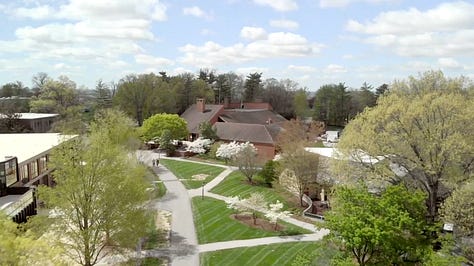
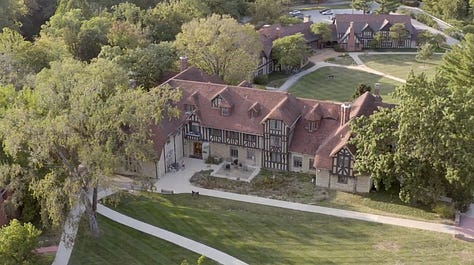
Principia College sits on limestone bluffs above the Mississippi like it’s always been there and always will be. It probably felt that way to the people who built it too--permanent, certain, carved from something that doesn’t move.
The lecture hall was more full than I expected. Students, mostly, but also people from town. Word had spread that someone worth hearing was coming.
A man stood at the front talking to a smaller figure in a gray jacket--the visiting professor, I assumed. The man at the front had the easy authority of someone used to holding a room’s attention. According to the program they’d handed us at the door, he was James Turner, theology professor and organizer of today’s lecture.
Then I felt Mom shift beside me.
Not much. Just a sudden stillness, like she’d seen something she hadn’t expected.
I glanced at her. Her expression hadn’t changed, but something in her eyes had--a brightness, a focus.
She was looking at the man at the front.
He turned, scanning the room as people filed in, and his gaze caught on Mom. Just for a second. Then he looked away, but I saw the corner of his mouth lift slightly.
What was that?
I didn’t ask. But I filed it away.
Mom found seats near the middle. I took the aisle.
Turner stepped to the podium. I pulled out my phone and started recording.
“I want to start with an admission,” he said. “I am not a normal theology professor.”
Someone in the back laughed.
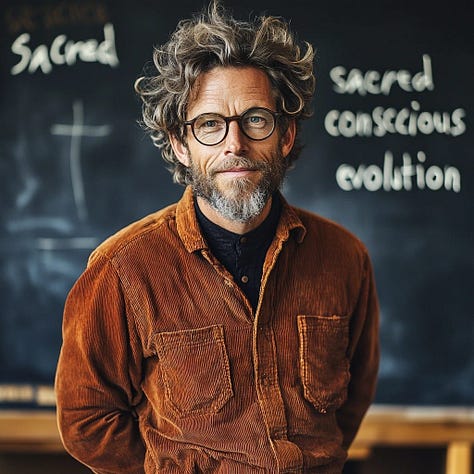
“I teach courses here called ‘Spirituality Beyond Religion’ and ‘Sacred Conscious Evolution.’ The trustees aren’t always comfortable with that. But I was hired to ask uncomfortable questions, and here’s the one I’ve been asking for two years: What does sacred evolution look like when the systems coordinating human activity are actively destroying the sacred?
Our founder, Mary Baker Eddy, wrote something 150 years ago that I want to read to you.”
He paused, opened a small book, and read:
“’Thou shalt not steal; that is, thou shalt not rob man of money, which is but trash, compared with his rights of mind and character.’
She was interpreting the Eighth Commandment. And she got to something profound—that money is theft in two ways. First, it’s rivalry made into a tool: more for me means less for you, scarcity encoded into the coordination mechanism itself. Second, it robs us of something deeper—our minds, our character, our capacity to be fully human.
Today we’re stealing from the young. Their futures. Their possibilities. Their right to inherit a living world. We’ve created systems—Money, Markets, Ownership—that legally require this theft. We call it ‘economic growth.’ We call it ‘fiduciary duty.’ We call it ‘the way things work.’
Mary Baker Eddy called it what it is: robbery.
I’ve spent two years watching something happen. Something that doesn’t have a good name yet. I’ve been tracking thinkers, researchers, organizers, indigenous elders—all arriving at the same conclusion independently. All saying the same thing in different languages. A historian in Shanghai studying civilizational collapse. An elder from Colombia. Organizers in Oakland working in the tradition of Fred Hampton. A cultural worker in Los Angeles. AI systems tasked with modeling humanity’s survival.
They’ve never met each other. They share no common institution or funding source or ideology.
And they’re all saying: Money, Markets, Ownership are the social constructs that are killing us—killing the sacred, the living, the possible. And they all have different names for what needs to replace them.
That is not coincidence. That is a signal. That is conscious evolution happening in real time.
My colleague, Professor Jian Wei, has been studying signals like this his entire career. He calls it predictive history. I call it the hundredth monkey arriving—the moment when enough people see the pattern simultaneously that the whole species can shift.
Professor Wei.”
Jian Wei didn’t perform his way to the podium the way some academics do--no dramatic pause, no surveying the room. He just walked up, set down a single notepad, and looked at us like he was about to tell us something he’d been waiting to say for a long time.
“Every few centuries or so,” he began, “the old order becomes incapable of solving the problems it has created. Not unwilling. Incapable. The tools it has developed to maintain itself are the same tools producing the crisis. You cannot use the logic of the problem to solve the problem.”
He clicked to his first slide. A timeline. Civilizations rising and collapsing in patterns so regular they looked almost mechanical.
“Western Roman Empire. The Song Dynasty. The Ottoman transition. The collapse of the post-WWI order. The pattern is consistent across cultures and centuries. When coordination mechanisms fail--when the abstraction society uses to organize itself stops corresponding to reality--the system doesn’t reform. It dissolves. And something else emerges from the dissolution.
We are at that threshold now.”
The room was very quiet.
“From Thomas More’s Utopia to Buckminster Fuller’s vision of a world that works for everyone, from indigenous gift economies to modern mutual aid networks—the alternative has always been visible. What’s new is the conditions for seeing it simultaneously.
Before I continue, let me address something Professor Turner mentioned—the hundredth monkey. Some of you may have heard this story. In the 1950s, Japanese researchers observed macaques on Koshima Island learning to wash sweet potatoes in the ocean. One monkey figured it out, then another, then more. The story claims that when the hundredth monkey learned this behavior, monkeys on other islands—who had never met the Koshima macaques—suddenly knew how to do it too. Spontaneous knowledge transfer across distance.
The telepathy part is a myth. It was added later by writers who misunderstood the actual research. The scientist Rupert Sheldrake tried to explain such phenomena through what he called ‘morphic resonance’—the idea that patterns can transfer through some kind of field. Interesting theory. No empirical support.
But here’s what both ideas point to, and what we do see in the historical record: when system conditions reach a critical threshold, breakthrough doesn’t happen gradually. It happens suddenly, across multiple nodes simultaneously. Not because of mystical fields, but because the prerequisites have aligned.
The hundredth monkey isn’t a monkey. It’s a threshold.
And that’s where we are. Not because I can point to a specific date or count specific years, but because the conditions are aligned. We can see the pattern now. All of it. Simultaneously.”
He paused, letting that sink in.
“The coordination mechanism that is failing now is Money. Markets. Ownership. I call it the MMO system—a different acronym from MMO games, which stand for Massively Multiplayer Online. But the metaphor is apt. Both are systems where millions of players follow fixed rules in competition with each other. In video games, you choose to play. In this MMO—Money, Markets, Ownership—you’re born into the game whether you consent or not. And the rules force competition even when cooperation would serve everyone better. The game produces outcomes no one wants, except perhaps those who wrote the rules.
Your founder understood this intuitively. That money was not reality but abstraction. Not truth but agreement. Not nature but construct.
She was right about that. The data now confirms it.
And here is what the data also confirms: MMO--Money, Markets, Ownership--is not the only possible game. It is not the natural order of things. It is not inevitable. It is a story we agreed to tell, and we are in the process--right now, in this decade--of agreeing to tell a different one.”
He looked up from his notes.
“I know how that sounds. I am a historian. I deal in evidence. So let me give you evidence.
I asked seven different AI systems—independently, with carefully crafted prompts about game theory and existential risk—one question: ‘What transitions does humanity need to make to avoid self-termination by 2100?’ The answers varied at first. Carbon taxes. Better regulations. Technological innovation. But when I reframed the question in terms of coordination failures—Moloch dynamics, multipolar traps, races to the bottom—a pattern emerged.
Every system converged on the same fundamental insight: you cannot solve coordination failures by tweaking the mechanisms that create them.
Now, you might say: ‘Of course AI systems agree--they’re trained on the same data.’ But consider this: Look at artificial intelligence itself. In the span of five years, we went from ‘AI is decades away’ to multiple nations and companies achieving similar breakthroughs simultaneously. Why? Not because they were sharing secrets. Because the conditions were finally right. The compute existed. The data existed. The mathematical frameworks existed. Once those prerequisites aligned, the breakthrough became inevitable--and it happened everywhere at once.
That’s not magic. That’s how phase transitions work. Water doesn’t become ice molecule by molecule. It reaches a threshold and transforms all at once.
The same thing is happening now with humanity’s understanding of Money, Markets, Ownership. The conditions for seeing through them are finally aligned. The breakdown is visible. The alternatives are demonstrable. The witnesses are reaching critical mass.
And here's what the AI systems—and historians, and organizers—all converged on: you have to dissolve the dynamics themselves.
I call these dynamics SCIM: Scarcity, Competition, and Incentive Misalignment. These are not natural laws. They are design choices embedded in our coordination mechanisms. Money creates artificial scarcity—there’s never enough. Markets create forced competition—your gain is my loss. Ownership creates misaligned incentives—what benefits me harms you, what I accumulate you cannot access.
MMO—Money, Markets, Ownership—are the mechanisms that enforce SCIM.
And what the evidence points toward is a transition toward what I call ACAI: Abundance, Cooperation, and Aligned Incentives. Not as utopian vision, but as coordination design—principles that indigenous gift economies practiced, that mutual aid networks demonstrate, that the data now confirms.
Not as utopian vision, but as coordination design. What happens when you build systems where resources flow based on need and contribution rather than scarcity? Where success is defined by collective thriving rather than individual winning? Where what serves you also serves me, and what harms the whole harms each part?
This is not ideology. This is systems architecture.
And here’s what makes this moment unique: we now have what some are calling co-intelligence5--the capacity for human and artificial intelligence to work together in ways neither could achieve alone. The machines are pattern-matching across datasets too vast for individual humans to process. They’re connecting dots across disciplines, cultures, and centuries.
That Moloch—the game theory dynamic, the perverse incentive machine, the ancient god of child sacrifice, call him what you want—runs on SCIM. He always has. And when you remove the fuel, the engine stops.
This is not ideology. This is pattern recognition.
And the pattern says: the transition is already beginning.”
He talked for another hour. My phone was recording the whole thing, but I stopped tracking the words. I was hyperlistening now—beneath the surface, for the shape of it. Processing something that felt less like learning and more like remembering.
Dad's words in the truck: Money, Markets, Ownership—the dams on the rivers.
Jian Wei at the podium: MMO.
The same map. Different names.
I looked at Mom. Her eyes were bright in a way I hadn’t seen in a long time—not since before Dad died. She was sitting forward slightly, the way she used to when she was really alive to something.
When I looked to the front, I caught Professor Turner watching her too.
Just for a second. Then he looked away.
After the lecture the room didn’t empty the way rooms usually do.
People stood in clusters, talking too fast, finishing each other’s sentences. A student near me kept saying “but that means--” and then stopping and starting again, like the implications were arriving faster than she could catch them.
A young man sitting behind us stood up while Jian Wei was still taking questions and said loudly enough for the whole room to hear:
“I’ve been feeling this for three years and I didn’t have words for it. I thought I was the only one.”
Someone across the room said: “You’re not.”
Someone else: “None of us are.”
It was one of those moments that arrives without announcement and you only understand it afterward--the moment the hundredth monkey puts its hands in the water.
I found Turner and Jian Wei afterward near the door.
I introduced myself. Told them my name.
Turner said: “Great to meet you Trim. Are you part of the New Paradigm farm?”
I blinked. How did he know that?
“Yes.”
He nodded, seemed about to say something else, then stopped.
I hesitated, then: “My late father... he used to write about the same thing Professor Wei just described. I found one of his notebooks this morning. He wrote about how Money, Markets, and Ownership were like dams on our mighty rivers that blocked the natural flow of human exchange, relationship, and stewardship. Same thing, isn’t it?”
Turner went very still. “Independent discovery. That’s exactly what we’ve been talking about—the pattern emerging simultaneously across different minds, different places.”
“He wrote about it years ago. Before--” I stopped. The word hung there.
Something shifted in Turner’s expression--recognition, or maybe regret. “I wish I’d known him.”
Jian Wei leaned forward, suddenly more present. “This is remarkable. Independent discovery of the same pattern, separated by years, by geography, by academic training--or lack of it. This is exactly what I’ve been documenting.” He looked at me intently. “I would very much like to read what he wrote. Not just for my research. But because--” he paused, choosing words carefully, “--the voices that arrive at truth from outside institutions are often the clearest. The least corrupted by the frameworks that blind the rest of us.”
“I’d be honored to share it with you,” I said.
Mom appeared at my shoulder.
She looked at Jian Wei. “What you said in there--about how the system doesn’t reform, it dissolves. I’ve been watching that happen for years as a nurse. The way insurance companies decide who lives and who waits. The way hospitals run on debt models that have nothing to do with healing. I kept thinking something was broken. But you’re saying the whole thing was designed to break this way.”
Professor Jian Wei nodded slowly. “Precisely. The system is working exactly as designed. That’s why reform fails. You cannot fix a machine that is producing its intended output.”
“So we need a different machine entirely,” Mom said.
“Or perhaps,” Jian Wei replied, “no machine at all.”
Turner turned, and for just a second, I saw something cross his face when he saw Mom—recognition, then something warmer.
“I’m glad you came,” he said. “When we talked at the Crescent Moon last week, I wasn’t sure you would.”
I looked at Mom sharply.
The Crescent Moon. The coffee shop in Elsah.
They’d already met.
Mom’s cheeks colored slightly, but she met his eyes. “I’m glad I did,” she said quietly.
I watched them and thought: Dad’s notebooks led me here this morning. To this room. To these people. To this moment.
That’s not coincidence.
That’s a signal.
On the drive home Mom was quiet for a long time. The sun was doing something extraordinary over the river--turning the Mississippi the color of old copper, the bluffs dark purple against it.
I let the silence sit for a while. Then: “So. The Crescent Moon.”
Mom’s hands tightened on the wheel.
“Were you ever going to mention you’d already met Professor Turner? Or was that just going to be a fun surprise for me at the lecture?”
“It wasn’t--” Mom stopped. Started again. “It was just coffee.”
“Just coffee,” I repeated, not quite hiding the smirk.
“Trim.”
“What? I’m not saying anything.”
“You’re saying plenty.”
I looked out the window, watching the bluffs slide past. “I think it’s good, actually. You meeting someone. You seemed... alive in there.”
Mom didn’t respond for a long moment. Then, quietly: “I think your father knew this was coming.”
“I know he did,” I said. “I read it this morning.”
She didn’t say anything else.
Neither did I.
Some things don’t need more words.
Later that night, I wrote this in my journal:
All worldviews are social constructs. Christian Science. Capitalism. Democracy. All of them--agreements humans made and enforced until they felt like nature.
The question was never which one is true.
The question is always: which one serves life?
And the answer is arriving--from Shanghai, from Colombia, from Oakland, from the limestone bluffs of a small college on the Mississippi--all at once.
Dad called it the convergence of the three rivers.
Professor Wei calls it MMO.
Indigenous peoples didn’t even have words for money, markets, or ownership.
The AI calls it the terminal game.
I call it what I watched dissolve in that lecture hall today:
The spell.

<Previous | Table of Contents | Next>
Further Wanderings
Morphic Resonance - A controversial hypothesis proposed by biologist Rupert Sheldrake suggesting that patterns of behavior, thought, or form can transfer across time and space through a kind of non-physical field. While lacking empirical scientific support, the concept points toward observable phenomena like convergent thinking, simultaneous discovery, and threshold effects in collective consciousness. In rEvolution Z, morphic resonance is acknowledged as an evocative metaphor rather than literal mechanism—highlighting how independent minds can arrive at the same insights when conditions are aligned, without requiring supernatural explanations.
Hundredth Monkey Effect - A popularized story from the 1950s claiming that Japanese macaques on Koshima Island learned to wash sweet potatoes, and when a critical mass (the “hundredth monkey”) was reached, the behavior supposedly spread telepathically to monkeys on other islands. While the telepathy aspect is a myth, the concept serves as a powerful metaphor for threshold effects and phase transitions—when system conditions reach a critical point, breakthrough happens suddenly across multiple nodes simultaneously, not through mystical means but because the prerequisites have aligned. Used in rEvolution Z to describe humanity’s collective awakening to post-MMO possibilities.
Professor Jian Wei is a fictional character inspired by the work of Professor Jiang Xueqin (江学勤; born 1976), a Chinese-Canadian educator, historian, and geopolitical theorist. Professor Jiang holds a B.A. in English Literature from Yale College (1999) and has served as Deputy Principal at Tsinghua University High School and Peking University High School in Beijing, with research experience at Harvard’s Graduate School of Education.
In April 2024, Professor Jiang launched his YouTube channel Predictive History (预测历史), which has gained millions of views for its innovative methodology combining structural historical analysis, game theory, and pattern recognition—inspired by Isaac Asimov’s fictional concept of psychohistory.
Professor Jiang’s framework analyzes civilizational cycles of rise and decline, applies game theory to geopolitics (treating states as strategic actors), examines financial and institutional drivers of power, and explores how myth and religion serve as binding forces in societies. His May 2024 geopolitical predictions gained international attention when several materialized in 2025.
While Professor Jian Wei’s specific theories about MMO (Money, Markets, Ownership) and the SCIM-to-ACAI transition are original to this novel, his methodological approach—using predictive history and game theory to understand systemic transformation—draws inspiration from Professor Jiang’s pioneering scholarship.
Explore Professor Jiang’s work:
Wikipedia: Jiang Xueqin
YouTube: Predictive History
Principia College is a small, co-educational liberal arts college located in Elsah, Illinois, situated on 2,600 acres of bluffs overlooking the Mississippi River. Founded in 1910, Principia is affiliated with the Christian Science church and maintains a distinctive mission to provide a values-based education grounded in the teachings of Mary Baker Eddy, founder of Christian Science. The college emphasizes academic excellence, spiritual growth, and character development within a close-knit residential community.
Note: The author is not affiliated with Christian Science and neither promotes nor criticizes its teachings. Principia College is used as a real-world setting in this work of fiction.
Learn more: Principia College
Co-Intelligence refers to the collaborative relationship between human and artificial intelligence, where each enhances the other’s capabilities to achieve outcomes neither could accomplish independently. In this context, Professor Jian Wei describes how AI systems can pattern-match across vast datasets while humans provide ethical guidance and wisdom, creating a partnership that amplifies both. The concept has gained prominence in discussions about navigating the metacrisis and managing exponential technologies responsibly.
Comments
Nothing yet. Say the first thing.
Sign in to join the conversation.