
<Previous | Table of Contents | Next>
I had a dream last night that felt more real than waking.
It started with scrolling. My phone, the news, everything bleeding together. Iran. Venezuela. Gaza still burning. Empty gas stations. Empty grocery stores. J.D. Vance’s face everywhere, that smile that doesn’t reach his eyes. The world on fire and underwater simultaneously.
Then I wasn’t scrolling anymore. I was standing at the confluence. The three mighty rivers—the Illinois, the Missouri, the Mississippi—swirled together like a giant hurricane right in front of Elsah. But they weren’t rivers. They were dams. Massive concrete walls holding back oceans, pressure building, cracks spreading like veins.
Dad’s voice, clear as if he were standing next to me: “The rivers wash away everything that isn’t real.”
But the river took you, I thought.
“Did it?” His smile—I could feel it more than see it. “My body, yes. But not this. Not us.”
Then everything broke at once.
The water didn’t destroy. It liberated. As the rivers flowed, other dams broke too—walls made of money dissolving like sugar, towers crumbling into dust, every barrier humanity built against itself washing away.
The images came faster, overlapping, dreamlike but hyperreal—reality folding in on itself, showing you what was always there beneath the surface.
I saw fences. Miles and miles of barbed wire stretching across the West, across everywhere. Hands cutting them. White hands, brown hands, all cutting. Snip, snip, snip. The wire falling like sutures being removed from a wound, releasing tension held for centuries. Posts toppling. The land exhaling. And in that first breath—children running through the gaps, laughing.
Deer leapt through the gaps—they’d never recognized fences anyway, boundaries meant nothing to them. Squirrels ran along the falling posts like it was all just another tree. Then cows, sheep, all the domesticated animals shaking off their chains, eyes wide with remembered freedom. Rewilding. We were them. They were us. Then people—thousands of them, walking out of invisible reservations, crossing borders that had already dissolved. Walking the trails their ancestors were forced down, but in reverse now. Not a trail of tears but a river of return. All of us rewilding. All of us walking home to land that had never stopped being home, where strangers were already planting gardens together.
In the dream, I understood: this wasn’t land back. It was earth back. Not ownership transferred from colonizer to colonized, but ownership itself dissolving. The land belongs to itself. We just get to belong to it for a while.
The walls fell. Border walls. City walls. Prison walls. The walls inside people’s minds. Everything enclosed: freed.
I saw glass towers sinking into rising floodwaters. Surveillance cameras drowning. Screens going dark. All the machinery of control shorting out, sparking, going silent. The people in power looked confused, small, powerless. Then they washed away like everything else that wasn’t real. And where they’d stood—common houses rising, filled with music and the smell of bread.
But other things were rising.
Communities forming like crystals in solution—spontaneous, natural, inevitable. People sharing food without payment, meals cooked together, children fed. Strangers becoming family. Faces that were tight with fear—relaxed now, laughing. Glowing networks spreading underground like mycelium, then breaking the surface everywhere at once. The gift economy wasn’t being built. It was emerging. Like it had been there all along, waiting.
The land without fences stretched forever. White flowers—the same daisy I saw alone on a parched riverbank months ago—now blooming in impossible numbers wherever the floods had reached. What nearly died in drought now thrived in deluge, carried by the water like seeds of a new world. The monoculture fields becoming forests, diverse and alive. Children playing across what used to be property lines. People planting together on commons that had never really stopped being commons.
Then I saw him.
An old man in white, standing by the rivers. Indigenous—I knew this somehow, the way you know things in dreams. A white conical hat crowned his head, shaped like the sacred peaks of distant mountains. His long black hair streaked with silver moved in wind that wasn’t there. He held a flower in his cupped hands—the same white daisy. He looked at me with eyes that had seen centuries.
He didn’t speak, but I heard him anyway: “The flood clears space for what needs to grow.”
Then Mom and Dad were there too, standing together at the water’s edge. Holding hands. Whole.
Dad said: “Tell them it’s okay to let go.”
Mom said: “Tell them we’re already free.”
They became water. They became light.
And I was the river. I was the fence cutter. I was the walker returning. I was the daisy blooming in the flood. I was everything dissolving and everything emerging after.
I was the bridge between what was and what’s coming.
When I woke, it was raining. Hard. The kind of rain that knows things.
I lay there in the dark listening to it hammer the roof, and I understood: the dream wasn’t prophecy. It was already happening. The rivers were already rising. The walls were already cracking. The old world was already washing away.
We just hadn’t admitted it yet.
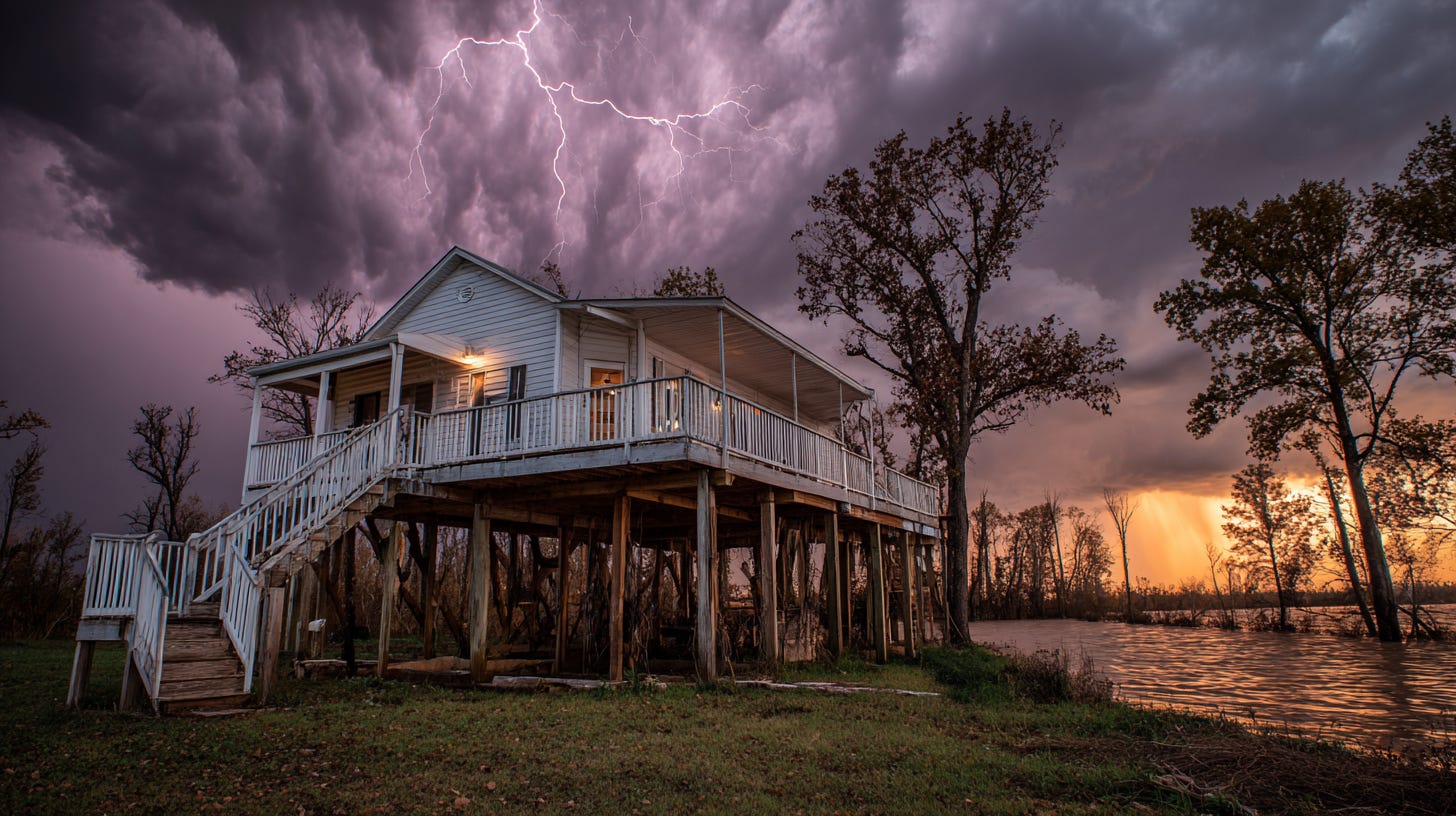
I got up and looked out the window. The sky was the wrong color—bruised purple-black even though dawn should have been breaking. Lightning flickered on the horizon. The kind of storm that changes everything.
Mom was already up, I could hear her in the kitchen, the quiet sounds of preparation. Getting ready for whatever comes.
The sound reminded me of another part of the dream. Our house—all the houses along the river on their tall stilts. In the dream they woke up and started walking, trying to escape the rising water on their long spindly legs. But the flood was patient. It swept the legs out one by one. Our house fell. Then the others. All of them crashing into the current, becoming driftwood, becoming nothing.
Even the high places weren’t high enough.
The rain hasn’t stopped.
I don’t think it’s going to.

<Previous | Table of Contents | Next>
Comments
Nothing yet. Say the first thing.
Sign in to join the conversation.