
When Alma stepped down from the responsibilities of Chief Judge and the seat of judgment to take up more fully the mantle of high priest over the church he began a missionary journey that took him around the lands of the Nephites, “preach [ing] the word of God unto them, to stir them up in remembrance of their duty, and that he might pull down, by the word of God, all the pride and craftiness and all the contentions which were among his people, seeing no way that he might reclaim them save it were in bearing down in pure testimony against them.”

This guiding principle of “bearing down in pure testimony” is one that I’ve sought to emulate in my missionary experiences and with my children as I share the gospel with them. Additionally, it is how I pattern the talks and lessons I give at church. If I find myself ever diluting my testimony or failing to “bear down,” I will rewrite and simplify as much as possible.
What struck me in a recent re-read of Alma 5 was how transformative the chapter was, both in its focus and its effect on the people. The power of pure testimony has the ability to change because pure testimony points people to the atonement of Jesus Christ, and the atonement is the great anabatic philophoser’s stone. It is the rescuing power and the transformative agent for individuals and for communities. Alma’s testimony is a lesson in Alchemy, and his actions of shedding the chief judge position to focus on the high priest also call to mind some imagery from the tarot’s major arcana. In fact, this is the movement from major arcana IV to V- the Emperor to High Priest.
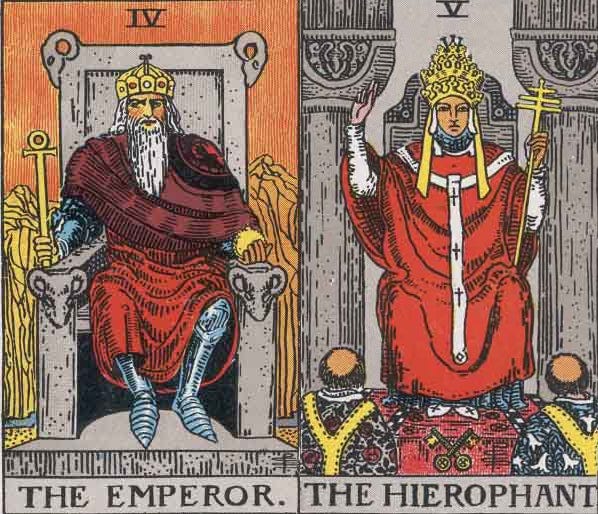
The Emperor card is one of power, authority, and masculine imagery- the emperor is clothed in armor and robes, he is crowned, and he holds a scepter and globe while he is seated on a throne adorned with rams heads. The throne calls to mind the judgment seat that Alma has just given up. The scepter represents that state power, the right to issue judgments and decrees, while the globe is typically representative of the whole world and the Christian obligation of rulers. The globus cruciger also calls to mind the cross of Christ, and the spirit ruling over matter. Alma’s call to the missionary field may indicate that he had the desire to hold more tightly and honor this obligation. The globus cruciger is often used in alchemical art to represent the sublimation of lower energy and materials in preparation for their refining. With his delivering over the judgment seat to Nephihah, Alma steps down from one “throne” and steps up to another- the High Priest, or Hierophant. Alchemically, he moves the dissolved material into a new basin where it can begin precipitating.
The High Priest is also known as the hierophant and had previously been known as the Pope. The use of the name hierophant was an attempt to de-Christianize some of the tarot symbolism; however, for our purposes, it may be instructive to recognize that the hierophant comes from the name of the chief priest of the Eleusinian mysteries. These mysteries were a participatory ritual where the tale of Persephone was re-enacted on a yearly basis. Please keep in mind this idea of a regular cycle of remembering a story. This story was of katabasis and anabasis- Persephone leaving the company of her mother and being lost in the underworld, the search for Persephone by Demeter (her mother and a God), and the reunion of mother and daughter. (Small side note but in the story, Persephone is tricked by Hades into consuming pomegranate seeds, and in some of the Emperor cards the globus cruciger is a pomegranate).
This mystery play may be one of the oldest “secret acts” in history. While the focus was on the story of Persephone and Demeter, numerous other things occurred over the multi-day celebration including1:
read[ing] a proclamation calling forth the initiates
washing their hands in lustral water
mak[ing] sacrifices on behalf of their home cities
t[ying] a woolen "kroke," a saffron-colored ribbon, around the right hand and the left leg of each initiate
men with covered heads, known as "gephyrismoi," wait[ing] to hurl insults, jeers, mockery, and abuse at initiates
a day of fasting and purification
drinking of the kykeon
libations to the dead
Now, keep in mind that this is an imperfect re-creation of the Eleusinian mysteries, and much is still unknown about the specifics. For our purposes, a general sense of the rite will do.
Alma’s first stop in his “Pure Testimony Mission” is Zarahemla. Chapters 5 and the first few verses of chapter 6 detail his visit there. Alma 5 is well-known as one of the great chapters in the Book of Mormon and I believe it is an incredibly powerful and instructive chapter that provides insights and patterns into the atonement of Jesus Christ and the alchemy of repentance.
In the opening verses of chapter 5, Alma reminds the people of how the church in the land began:
4And behold, I say unto you, they were delivered out of the hands of the people of king Noah, by the mercy and power of God.
5 And behold, after that, they were brought into bondage by the hands of the Lamanites in the wilderness; yea, I say unto you, they were in captivity, and again the Lord did deliver them out of bondage by the power of his word; and we were brought into this land, and here we began to establish the church of God throughout this land also.
Alma reminds the people of the history of the church- one of separation, of wandering, of captivity, and ultimately of freedom and restoration. This, I think is reminiscent of the Eleusinian mysteries, and is perhaps more directly comparable in the next verse where Alma reminds the people that the Lord “… delivered their souls from hell.” While the underworld in Greek mythology is not the hell of Christian theology, hades is one of the Greek words in the New Testament translated as hell.
The process of alchemy involves the transmutation of base or lesser substances to higher or more refined ones. Traditionally this has been seen as changing lead into gold, refining metals to their pure essence, or it has been the quest for the ultimate creation- the philosopher’s stone, a thing which gives the alchemist immortality. In the traditional process of alchemy, there are a number of stages (sometimes 4, sometimes 7)2 which are used for this transmutational process. I believe all of the stages of alchemy can be found in Alma 5.
The heating of a substance until it turns to ash.
In verses 7-8 we get some of the most explicitly alchemical language:
7 Behold, he changed their hearts; yea, he awakened them out of a deep sleep, and they awoke unto God. Behold, they were in the midst of darkness; nevertheless, their souls were illuminated by the light of the everlasting word; yea, they were encircled about by the bands of death, and the chains of hell, and an everlasting destruction did await them.
8 And now I ask of you, my brethren, were they destroyed? Behold, I say unto you, Nay, they were not.
This step in alchemy takes the raw material- in this case the human heart- and it awakens it to its state. In this case, it reveals that it is in hell and darkness prior to its awakening.
Dissolving the ash into water
9 And again I ask, were the bands of death broken, and the chains of hell which encircled them about, were they loosed? I say unto you, Yea, they were loosed, and their souls did expand, and they did sing redeeming love. And I say unto you that they are saved.
This stage involves the revealing of something hidden- this expansion of the soul from what had been bound down. We might also see the dissolution as the dissolving of the chains with which they had been bound. It may also have a reference to baptism.
Isolating and filtering the products of dissolution
This is perhaps the sharpest part of Alma’s speech to Zarahemla where he asks a series of probing, poignant questions. The point of separation is to essentially perform a self-audit of the material that comes after being burned and washed. This is a painful, laborious process in this case. I will quote just a sample:
14 And now behold, I ask of you, my brethren of the church, have ye spiritually been born of God? Have ye received his image in your countenances? Have ye experienced this mighty change in your hearts?
15 Do ye exercise faith in the redemption of him who created you? Do you look forward with an eye of faith, and view this mortal body raised in immortality, and this corruption raised in incorruption, to stand before God to be judged according to the deeds which have been done in the mortal body?
As the individual picks apart their lives they may do well to keep this list of questions as a regular self-audit. This point is re-emphasized in verse 21 where we are reminded that “[your] garments must be purified until they are cleansed from all stain, through the blood of him of whom it has been spoken by our fathers, who should come to redeem his people from their sins.” Purification is a separation of the filthy and the clean.
Take the separated elements and combine them
While Alma’s line of questioning does serve as a good self-audit review, if it doesn’t allow for one to combine the good and discard the bad it wouldn’t truly be transformative. I believe this is why there is a turn in the series at verse 26 after Alma has reminded his listeners about the consequences of failing to fully separate themselves from their sins.
26 And now behold, I say unto you, my brethren, if ye have experienced a change of heart, and if ye have felt to sing the song of redeeming love, I would ask, can ye feel so now?
How do we know when the work is done? At what point have we refined the dross to gold? And here, while some may laugh at alchemists tricking people with the promise of turning lead into gold, we must remember that the truth has always been that alchemy is not just about literal metals, “Aurum Nostrum Non Est Aurum Vulgi” as they say “Our gold is not common gold.” What is gathered from the dissolved ash, but the only thing we can truly offer to God- a broken heart and contrite spirit? He is the one who combines them into a redeemed soul that can sing the song of redeeming love.
A further breakdown- a chemically induced one instead of physical
The questioning continues and increases in sharpness and probing. Additionally, a mystery is introduced when Alma asks if the people would be able to say “That [their] garments have been cleansed and made white through the blood of Christ.” This mystery is a reminder of the invisible processes (e.g. fermentation) which have a visible result. Just as fermentation produces bubbles, washing our blood-stained garments in the blood of Christ produces white and pure garments. This is something we cannot see with our eyes- dipping the blood in the blood should make it bloody! Just as leaving flour and water out should cause it to spoil as with all food that is left to the elements. Thankfully, there are invisible (to us) processes- biological, enzymatic, spiritual- that all break down the things that we could not.
Boiling and condensing for increased purity
40 For I say unto you that whatsoever is good cometh from God, and whatsoever is evil cometh from the devil.
46 Behold, I say unto you they are made known unto me by the Holy Spirit of God. Behold, I have fasted and prayed many days that I might know these things of myself. And now I do know of myself that they are true; for the Lord God hath made them manifest unto me by his Holy Spirit; and this is the spirit of revelation which is in me.
There are two aspects of distillation I think are applicable to this discussion. The first is the idea of a summarization, a condensing of the parts into one simpler whole, an extraction of the main point. Verse 40 stuck out to me as a nice distillation of the entire line of questioning and the whole point of reflective self-questioning. Are the acts we do good? Or evil? That should be enough to tell whether we continue with them or not.
The other aspect is the idea of purification through distillation, that is, not to summarize a point but to refine a thing usually through heating and collection of the vapor. Alma’s use of fasting and praying, in this case, stuck out to me as a good analog: fasting is the removal of physical food which allows us to focus on the important things, in this case, it is the reception of a testimony. The physical act of not-doing becomes a source of heat and the introduction of prayer allows us to capture the spirit’s manifestation.
Solidification, the end goal of the act
The philosopher’s stone was rumored to grant immortality, but if the whole point of the alchemical process was not physical but spiritual, what then does it grant? Not immortality, but eternal life!
58 For the names of the righteous shall be written in the book of life, and unto them will I grant an inheritance at my right hand. And now, my brethren, what have ye to say against this? I say unto you, if ye speak against it, it matters not, for the word of God must be fulfilled.
62 I speak by way of command unto you that belong to the church; and unto those who do not belong to the church I speak by way of invitation, saying: Come and be baptized unto repentance, that ye also may be partakers of the fruit of the tree of life.
There is but one way to eternal life- that is through Jesus Christ. His ultimate promise is that we might have all the Father has given him. That’s the whole point of Alma’s teaching and bearing down in pure testimony, it’s the purpose of the questions asked, it’s why he attended to his calling as high priest- so that he could draw the people to Jesus.
Alma’s transition from combination chief judge/high priest into just high priest was a transformative process that allowed him to focus on bearing down in pure testimony. Alma 5 is some of the purest testimony that has been delivered and is a map of the process by which we can change our hearts. The story and series of questions Alma asks, regardless of whether it does map onto the alchemical process as presented here (and I am open to other mappings that may be more suitable) is ultimately a way for one to check themselves and come closer to Jesus if they ask the questions humbly and sincerely.
https://www2.classics.upenn.edu/myth/php/hymns/index.php?page=eleusis
https://labyrinthos.co/blogs/learn-tarot-with-labyrinthos-academy/the-seven-stages-of-alchemical-transformation-a-spiritual-metaphor-infographic
No posts
Comments
Nothing yet. Say the first thing.
Sign in to join the conversation.