
From the intro to Carl Jung’s Red Book:
In his preface to the 1952 revision of Transformations and Symbols of the Libido, Jung wrote that the work was written in 1922 when he was thirty-six: "The time is a critical one, for it marks the beginning of the second half of life, when a metanoia, a mental transformation, not infrequently occurs." He added that he was conscious of the loss of his collaboration with Freud, and was indebted to the support of his wife. After completing the work he realized the significance of what it meant to live without a myth. One without a myth "is like one uprooted, having no true link either with the past, or with the ancestral life which continues within him, or yet with contemporary human society.”
The intro goes on to quote Jung talking about personal myth-making, and it’s really interesting to read, given that it takes up 100-some-odd pages in a 500-some-odd-page book. This metanoia, this transformation, is something that I’ve been considering more as I have been actively undergoing a renewal of my personal faith and feeling a strong restructuring (revival?) in how I orient my ontology, metaphysics, and ethics.
I was also thinking about the opening of the Book of Mormon and Lehi’s leaving Jerusalem. In a very real sense Lehi was uprooting his family (and, pure speculation here but Lehi could have been in his late 30s at this time as well… Nephi could be in that 14-16-year-old age range in this case. Again, pure speculation).
So how appropriate would it be for someone who was uprooted by the command of the Lord to receive a vision where he was shown the Tree of Life? Lehi's (and by extension Nephi’s) story is an indication of someone who loses their own mythology and has to receive a new one.
The pattern I’m proposing here is Uprooting → Stasis → Planting → Growth.
Let’s look at Lehi:
And it came to pass that the Lord commanded my father, even in a dream, that he should take his family and depart into the wilderness.
And it came to pass that he was obedient unto the word of the Lord, wherefore he did as the Lord commanded him.
1 Nephi 2:2-3
This is the uprooting. Lehi leaves his comfortable life (leaving house, land, gold, silver, and precious things) in Jerusalem. Considering the importance of Jerusalem to the Jewish people especially in light of the reforms from Josiah, this had to be a difficult ask from a religious perspective as well. This is a loss of myth - personal, historic, and religious.
Consider the story of the Hebrew bible pre-Lehi’s time and consider how strange it would be to leave the city (and ultimately the nation) where the great arc of history had seemingly led your people. And hadn’t God led them there? I wonder sometimes what insights we might gain if we had Lehi’s record. I’d be really interested in his personal state of mind at this point. What was he feeling? What did he think the future would hold?
And my father dwelt in a tent.
1 Nephi 2:15
This is my father’s favorite verse in the Book of Mormon. He has his reasons and they’re not just silly about the relative length, but it does reveal something about Lehi. It also provides a strange window of opportunity in this story where what is left out is potentially massively important- there’s no time attached to it. They traveled to the borders of the shore of the Red Sea, then spent three days more traveling into the wilderness with his whole family (or did it take them three days total? I think there may be some ambiguity), and then he dwelt. Time unknown. Some have concluded that Lehi would have wound up in Al Beda (In Search of Lehi’s Trail, Lynn M. and Hope Hilton), which may have been close to Midian, where Moses’ father-in-law Jethro lived.
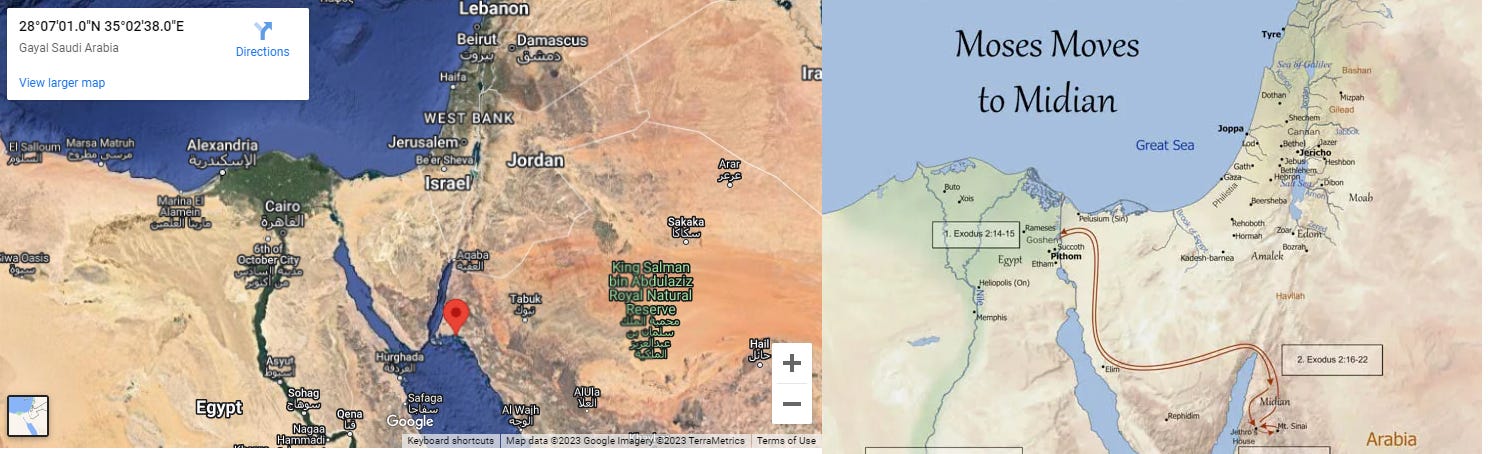
Lehi does spend time here- enough time to offer sacrifices and start naming things after his sons. I sometimes wonder if Lehi figured that this was going to be where he would dwell. Surely he knew Jethro seemed approved by the Lord, so maybe this was as far as his family would go to “flee Jerusalem”. We don’t know how long he was dwelling here while Nephi had his desires to know the mysteries of God, how long it took Nephi to even get to the point where he had those desires, or how long it took between Nephi’s praying and Laman and Lemuel’s rebelling before Lehi had his next dream that Nephi and his brothers needed to return to Jerusalem.
I consider the impact of varying lengths of time. What if they had only been there a few days? Maybe a couple of weeks? How about three months? A year? Five? Try to consider how different it would feel to be commanded to return to Jerusalem based on how long Lehi spent dwelling in his tent with Nephi seeking the Lord and L&L rebelling and murmuring. This is the stasis. Once uprooted, the land is left to rest, and it must be prepped for new planting.
The next vignette in Nephi’s life is an instructive one because in it we see the building of a personal mythology. Much has been written about Nephi’s slaying of Laban- legally, morally, historically, etc- though very little has dealt with the whole episode as a study in the art of crafting personal mythology. There is a double edge to this sword as it carves out the personal and historical founding myth of the Nephites. Firstly, Nephi is exemplifying obedience to “a commandment of the Lord” through his non-murmuring return to Jerusalem to get the records and genealogy from Laban. Secondly, Nephi has a double-obedience in his slaying of Laban. The point of this journey is to get the plates, which is a command, but the theme of this journey, as a story, is obedience to the Lord’s commands.
And inasmuch as ye shall keep my commandments, ye shall prosper, and shall be led to a land of promise; yea, even a land which I have prepared for you; yea, a land which is choice above all other lands.
1 Nephi 2:20
This is a core theme of the Book of Mormon. It’s arguably the core theme, though I could see a case for a few others; however, I would submit that from a myth standpoint, this is the theme that comes from this story and pervades the rest of the Book of Mormon. I think it’s fair speculation to say that Mormon and Moroni may have, in their capacities as editors and compilers, chosen and crafted the entire narrative of the Book of Mormon around this theme. Hence why we occasionally see editorial inserts, such as
And thus we can behold how false, and also the unsteadiness of the hearts of the children of men; yea, we can see that the Lord in his great infinite goodness doth bless and prosper those who put their trust in him.
Helaman 12:1
So, if obedience is a theme of the Book of Mormon, and the opening of the Book of Mormon is helping to establish this theme through a mythic origin story, the Plates of Brass retrieval story is an example par excellence. It opens with Nephi being obedient to the Lord’s command, Nephi continues in obedience when his brothers give up on their failing, and Nephi obeys what may be the hardest decision he makes up until that point in his life with the execution of Laban. This story sets up the obedience theme. To return to the quote at the top of the article, this story provides a link to the past, to ancestral life, and to contemporary society for the Nephites. The Brass Plates and the Sword of Laban are physical manifestations of the myth itself, of the power of obedience.
Consider also another founding myth where a young man is commanded to retrieve records- Joseph Smith and the gold plates. Here in this story, Joseph is told by the angel he is to get the plates but only if he follows the divine command given by the angel. In this case, it is to purify his motives and only use the plates for the building up of God’s kingdom and not for personal enrichment.
Both these stories are of receiving records- themselves containing stories from which mythology can be gained- making these a meta-mythological framework. How ought we build myths? Well, let’s consider these stories where these young men received (or perhaps more accurately: retrieved) stories. In both cases, their stories about retrieving stories would become myths personally and in their extended communities.
When we uproot our old myths (usually not by choice) and after we have allowed the ground to rest, we must then have something to plant. What are we to plant? Alma 36 suggests that the seed we plant ought to be the word of God. From where do we receive the word? Both Nephi and Joseph teach us: from the scriptures.
Having now planted the seed and making the planting itself a part of the myth we are prepared to move into the new mythology, the new story that defines us and connects us. The metanoia has cleared the old and is ready to receive the new. It strikes me then that the next thing to occur in the Book of Mormon story is when the sons of Lehi return to Jerusalem to get wives to marry from Ishmael’s family, and then we get the vision of the Tree of Life from Lehi. In the first case, we have the inception of a new family, where Nephi marries and now can take his new mythology beyond himself via his progeny. If mythology exists to connect us, then we have to have people with whom to connect, and we have to pass these things down- hence why we see Nephi so concerned with record keeping back in 1 Nephi 6.
The vision of the Tree of Life is the continuation of this myth-making for the Nephites where again the theme of obedience to God, and the reliance on the word of God (the Iron Rod) are reiterated. This is an enhancement of the myth as well as a branching of the myth- it’s no longer just Nephi being required to obey, it’s the pattern of obedience itself that brings us to the tree. As if to underline this point, Nephi informs us that the Iron Rod is the word of God, and it was his obedience to God in obtaining the word in the form of the plates of brass that makes up the founding myth of Nephi and the Nephite nation.
Now this is all well and good, we see here a pattern of personal myth-making, but seeing as I’ve fleetingly few Labans guarding plates of brass in my life I think it’s fair for me to ask: how am I personally to build my myth? What crafting can I do, and what narrative can I build? How else can I clear the land, give it rest, plant, and see the growth for myself?
That question led me to consider the temple. An interesting fact that relates to the temple is that prior to the wide availability of garments through distribution centers or online ordering, members could make their own garments, following a pattern. That is a bit of a physical manifestation of the endowment itself, where members are given a pattern to follow in the form of the dramatic recounting of the Fall of Adam and Eve, with accompanying tokens, signs, and names.
Maybe it was clearer when members had to make their own garments, but I believe the temple provides a framework for creating our personal myths. After all, if we’re going to form an ancestral connection, how much more ancestral can we get than Adam and Eve? We’re even invited in the ritual itself to consider ourselves as if we are Adam and Eve. So just like there was a garment pattern to bring home and make a garment, the temple provides a myth pattern to bring home and reframe our understanding. Nephi’s story might be seen then as seeing someone else use the pattern to make their own myth– after all, the Plates of Brass would have contained the Pentateuch and therefore the Eden story.
What do we take home from the temple then? Is it the same pattern we see in Nephi’s story? Well, Adam and Eve are uprooted from a premortal existence, and then again, uprooted from their creation and placed in a garden, and then again uprooted from the garden and cast out into the lone and dreary world. Are they in stasis? Well, Adam is briefly in stasis post-creation waiting for Eve’s creation, Adam and Eve are in stasis in the garden waiting for anything to happen, and then they’re in stasis again waiting for further light and knowledge (doubly so on that last count). Do they plant anything? Now pre-expulsion from the garden this may be more difficult to say, I have in mind some connection between their reaction to the instruction of the Lord to multiply and replenish the earth and the partaking of the fruit of the tree of knowledge of good and evil. After all, we saw the planting in Nephi’s story be a question of obedience, so I don’t think it’s a stretch to say that these directives become the generative seeds that drive the drama forward. Post-expulsion there’s the literal tilling and planting that Adam and Eve must do, as well as their obedience to the keeping of their tokens, signs, and names. Finally, growth. Adam and Eve are placed in the garden where things grow freely and abundantly. After their fall they’re cursed to till the ground and watch patiently as things grew according to their labor. While not in the temple, there’s the growth of family as they bear children. There’s also the growth that comes as the messengers return and instruct them, distributing more tokens, signs, and names.
I think the pattern holds well.
The following questions have helped me as I’ve studied and as I have attempted to draw closer to God, more firmly developing my personal myth in the process:
What do I need to uproot? What is taking up space that could be moved around or removed entirely?
Am I taking the time to rest? All things ought to be done in the proper order and pace. God rested on the Sabbath, ought we not follow His example?
Am I planting the right things? What good words am I planting? Faith, after all, might be like a little seed, but it is not the seed itself- the seed is the word, and the seed is also The Word.
Does this grow? If it doesn’t grow, it may be worth starting from step 1, assuming we have given the patience needed for our myth-plant to sprout.
No posts
Comments
Nothing yet. Say the first thing.
Sign in to join the conversation.