
This article was written by Aaron D. Schneider, who is a regular contributor to Here Are The Headlines. You can find Aaron’s work here, and for all of his contributions to this platform, search “Aaron Schneider.”
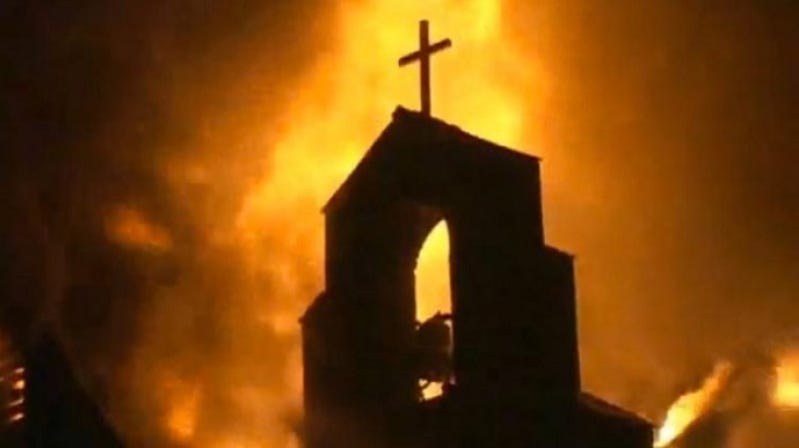
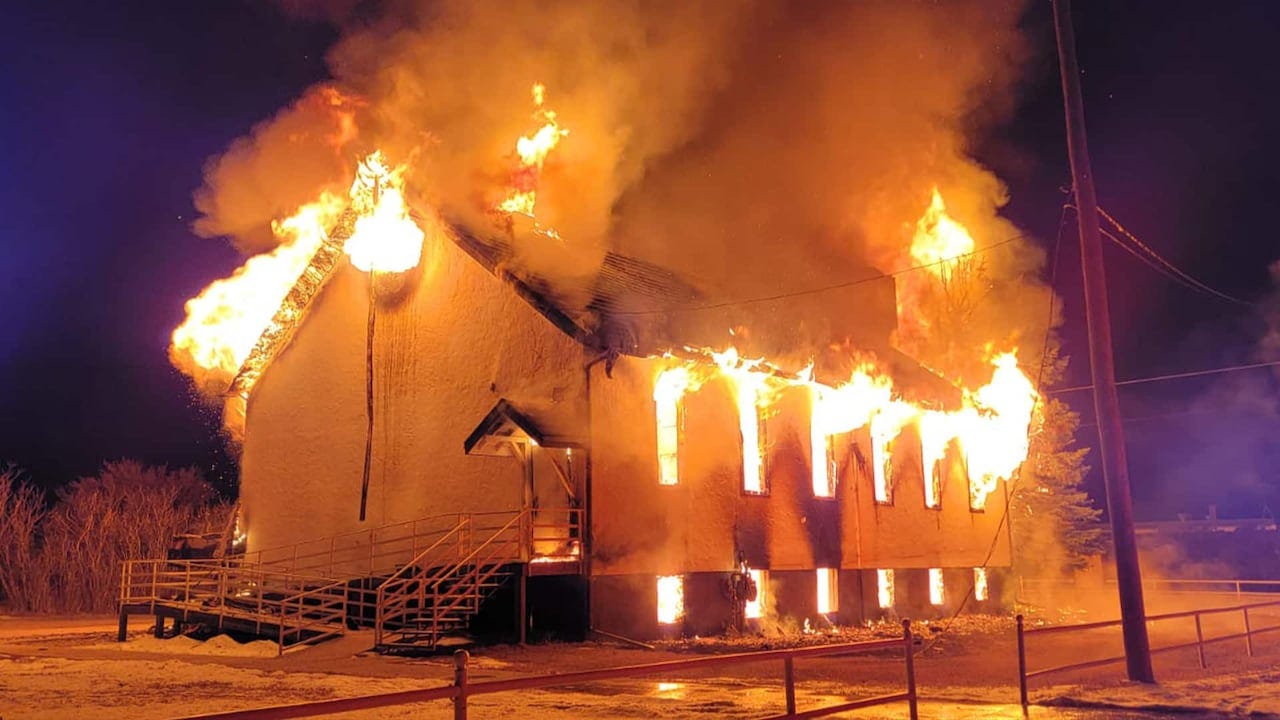
The church is on fire.
Once, walls housed the burgeoning faithful of generations.
Once, the roofs sheltered the prayers and psalms of multitudes.
Once, foundations held through floods of tears, both joyous and mournful.
It stood the test of time, the vagaries of weather and man’s negligence, this perpetual edifice pointing heavenward with steepled hands and raised cruciforms. At the heart of the community that built it and that it served in turn, it was a constant reminder to man of his duty and love for his Creator.
But now instead of crowned with morning sun or wrapped in the twilight’s nightcloak, they are wreathed in fire.
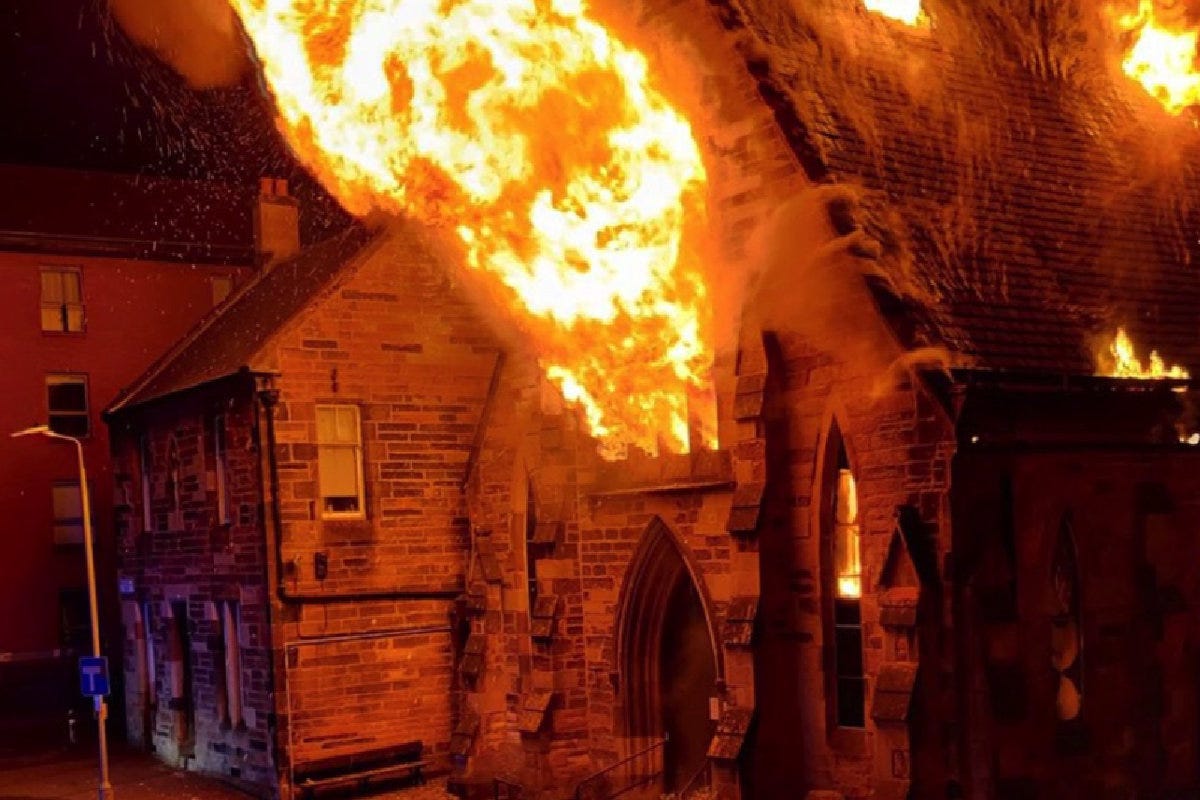
The flames crackle and twist as they devour the venerable wood and blacken the august stones. Halls echo with the roar of the blaze, a bestial sort of sound, punctuated here and there by snapping like fangs champing in ravenous jaws. The ringing cries of stained glass shattering mock the silent church bell, sitting doomed and stoic on his perch. Below, the hissing of burning paper seethes as so many Bibles, hymnals, bulletins, and records of christenings, marriages, and funerals are rolled up into ashen ribbons.
The people have begun to gather in earnest just beyond the searing rim of the inferno’s mounting fury, helpless and hollow as they behold the travesty.
The snaps become pops, and then the pops become cracks as the timbered bones and earth-born foundations start to give way. The weakest sections of the roof surrender to the onslaught, gaping wide to permit more air to feed the inferno. The devilish tongues have lapped across every carpet, over every pew, insatiable to erase every vestige in a swirl of ashes and cinders.
The city slinks back as the holocaust reaches its crescendo, the spired bell tower crumbling out from under the church bell. The last brazen sentinel plummets, crunching through the last desperate struts and supports.
It finally meets the scorched earth amid the chorus of the tortured remnants of God’s house, a final, fatal ring reverberating out, echoing in the hearts and minds of the gathered witnesses.
Impotent firemen douse the smoldering ruins, but the damage is done.
The church burned.
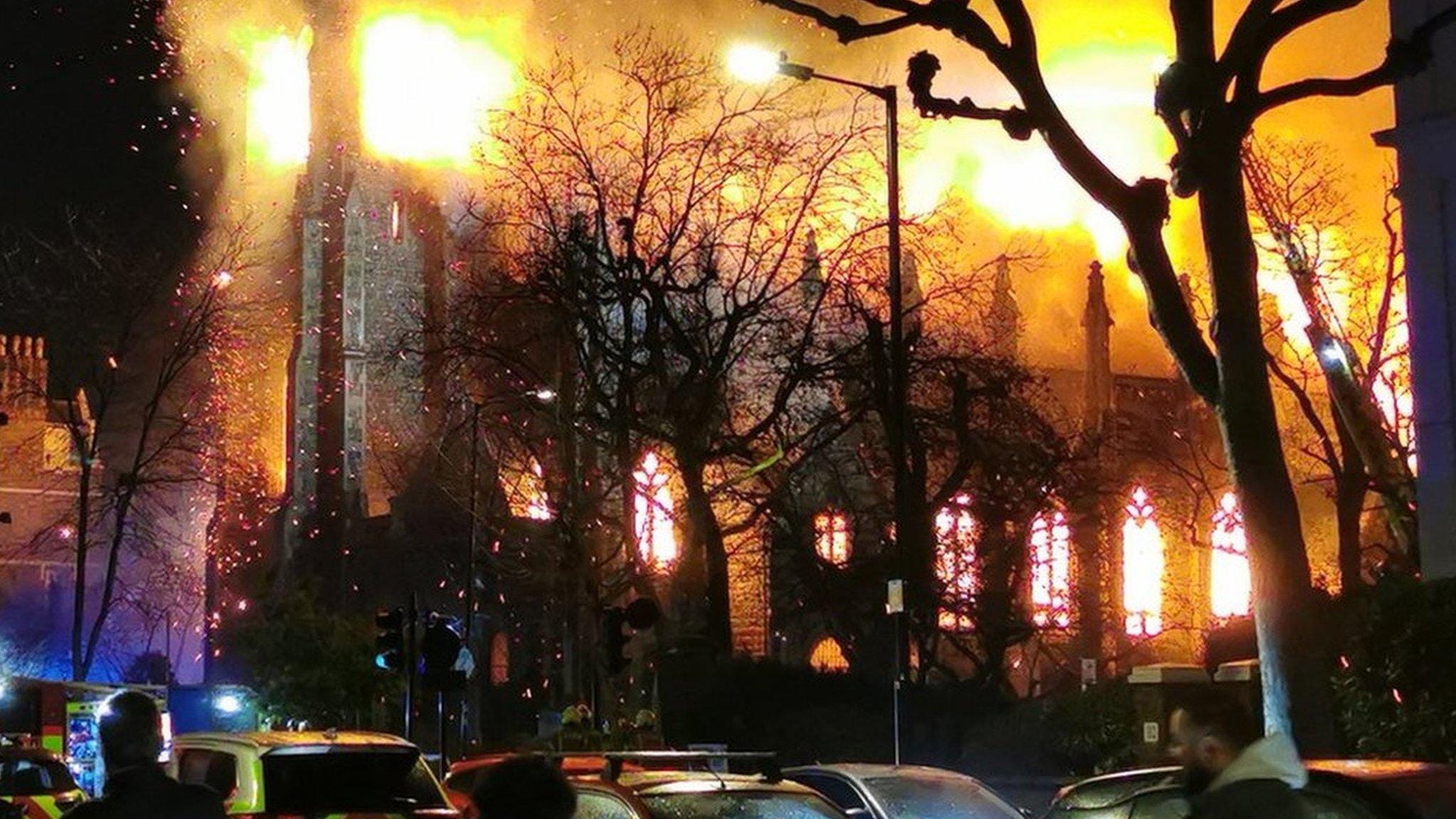
People shed their tears, congregations scrape up what they can, and communities seek to move on from the tragedy. Yet, those of us perhaps a bit more stricken, a bit more angry, or perhaps a bit more sensitive are not satisfied with this final, meager shuffling on.
We begin to ask questions, to drag things out into the light, curiosity and conviction wedded to bear whatever fruit may be found.
Unfortunately, the pustulent crop is one the more world-weary among us are all too familiar with.
Today we are going to talk about church burnings in both Europe and the United States, because it is becoming a more and more significant issue in the Western World. We will look at the numbers, the trends, what explains them, and what those explanations mean for those of us seeking to live as Christians in this fallen world.
I began this article with such an evocative image of a church not just because it is imperative that we feel what many people do when this happens in their community, but particularly amongst the quasi-Protestant, post-Christian West, even those claiming to be believers can often strike a cavalier tone regarding a church burning down. From the thoughtless “at least it’s just a building” to the insistently insulting “well, it’s all gonna burn someday anyway”, I have seen and heard too many Christians simply shrug at such tragedies before turning back to their materialistic, secularized lives to watch another round of sportsball or flick to the next dopamine-chasing clip.
This should bother us; this should get our blood pumping, but inevitably some Jesus-juking, limp-wristed, wheedling Ackchyually-cretin will saunter over and remind everyone that a church is just a building, and you shouldn’t be so fixated on things, and where two or more are gathered… and a gospel-centered approach… and it’s concerning how… and… and… and…
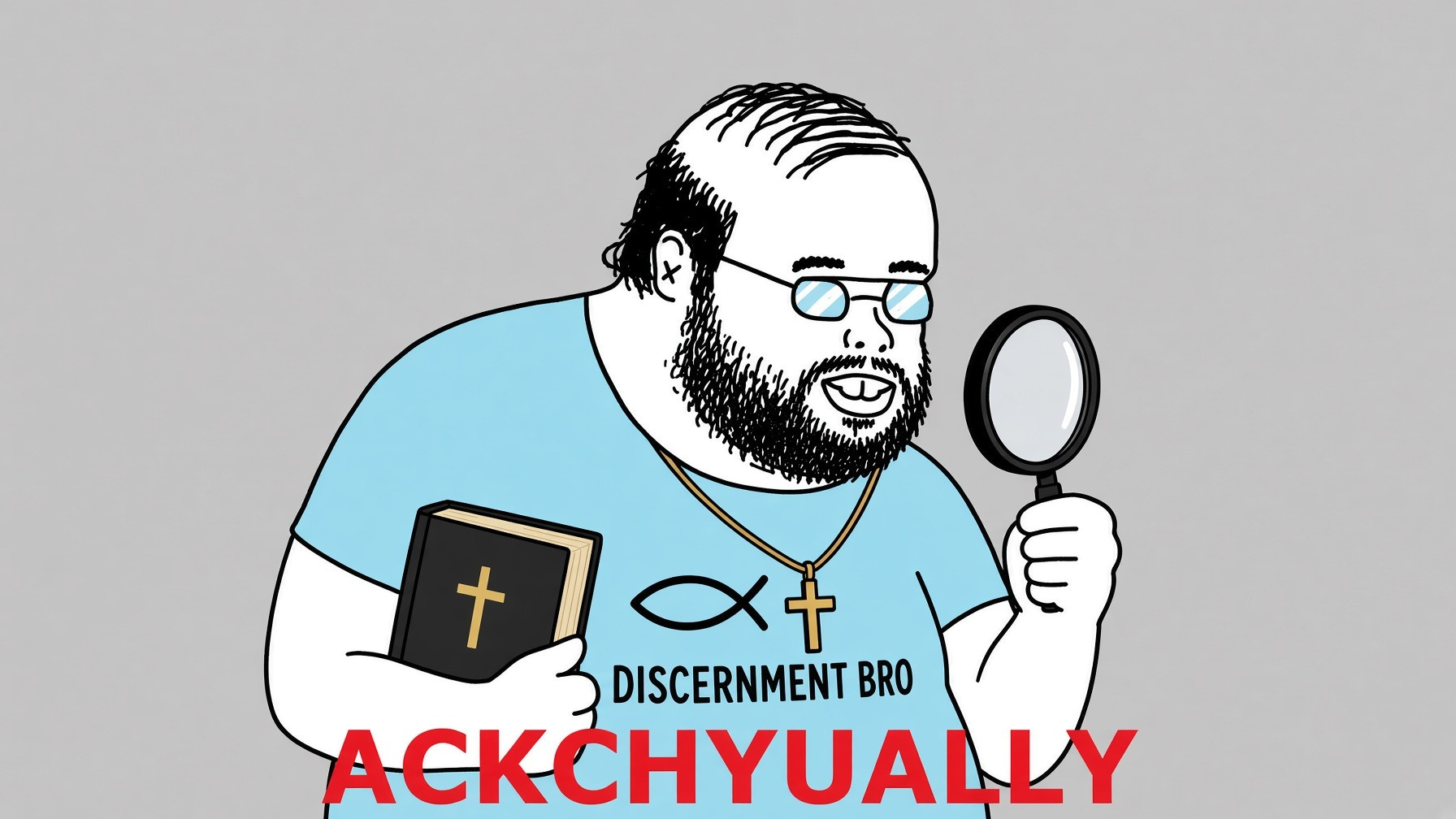
To try to shut the pompous little midwit up (though we all know that it is impossible), we can concede that:
YES, a building, no matter how grand, is not to be the focal point of our adoration
YES, God can be just as honored, just as glorified amid the moldering bones of catacombs as among the gilded walls of the grandest cathedral, as demonstrated by church history
And
YES, a fixation on the material and temporal can be a distraction from the work which God has us to do on this Earth, which includes, but is not limited to, the Gospel.
But…
But any but the most cursory reading of God’s Word reveals to us the importance of symbols in the Christian faith. Almost every sacrament in our faith is vested and expressed through the observance and recognition of symbols. The sacraments are replete with symbolism, from matrimony illustrating Christ’s union with the Church to baptism’s identification of the supplicant with the death and resurrection of Christ to the Eucharist to the laying on of hands to the anointing of the sick, and so many other examples.
These symbols which we are commanded to observe require tangible things, because that is how symbols work; they must be seen to signify something, which is what gives them significance.
This applies to churches no less than to anything else.
The church building represents an investment of time, resources, and space as evidence of the significance of what takes place within it. Before pseudognostic Jesus-juking became a professional sport amongst our clerical class, it was broadly understood that the importance of the church building for the faithful and the community at large required that they be duly recognized.
A church building standing tall and prominent in a community is both invitation and assertion: come be a part of this because this matters.
And as we will see, it is not just the Christian faith which understands the importance of this symbolism.
But let’s not get ahead of ourselves.
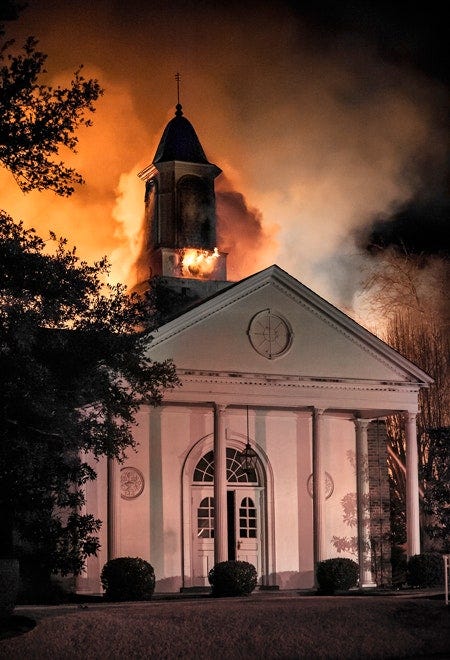
Now many of us have seen the new reports about another church burning, but in the oversaturated media landscape we inhabit, it is understandable if you don’t realize exactly how severe this issue has become. We catch fleeting glimpses in headlines we don’t have time to read, or reels we don’t have the stomach to watch, and so over and over we scroll past and thumb through, blissful in our anesthetized ignorance.
Well, it is time to wake up.
In the United States from1996 to 2015, according to Pew Research, there were about 2,378 events at places of worship which were deemed to be arson (the vast majority of those being churches, as would be expected in a culturally Christian country). Combining this with information provided by the ATF, we come up with an average figure of about 103 arsons a year committed on churches from 2000 to 2015.
That number alone probably surprises many people, and it surprised me too. Until I started looking into this, I probably would have placed church burnings sub-100, probably closer to half that.
But don’t worry, it gets worse.
Using open-source tracking done by the Family Research Council, in 2018 we seem to have hit a nadir, with only 50 church arsons reported (close to the number I thought was the average). Over the next few years, the numbers began to spike in 2022, nearly doubling to 198 total incidents, but it didn’t stop there. In 2023, the number peaked at nearly 500 arsons that year (485). In 2024, things cooled down slightly to just over 400 arson incidents (415), which suggests the astronomical growth in the two years before might not have been a fluke.
Now the figures for 2025 and 2026 are still coming in, but per the research already cited above, there doesn’t seem to be any sign that these remarkable numbers are going to drop back to their previous levels any time soon.
States that particularly saw these increases were California, Pennsylvania, Florida, New York, and Texas, and this is an important point because all of these areas saw demographic changes in recent years, which we will get to in just a second, but first we need to hop across the pond.
Over in Europe, the initial numbers might look substantially better, but a few things need to be taken into account.
U.S. advocacy groups actively publicize church-specific incidents, producing visible year-over-year rises from a low baseline that are easier to track. European data is more fragmented across multiple national systems, and it becomes even more complicated because different countries report and classify these events differently in their datasets. Some countries under-report or classify things as religiously motivated arson only if political motivations can be established alongside the event.
America also has a high density of churches per person, meaning more targets. This, along with the relative populations of the two places we are going to zoom in on (France ≈66 million, Germany ≈83 million vs US ≈350 million).
As a result, absolute European volumes can therefore look lower in certain summaries even when overall anti-Christian incidents are substantial.
So with that in mind, let’s take a look at the two places which have seen some of the worst anti-Christian acts, which include significant church burnings and vandalism.
Over in the land of the Franks, we consistently see some of the highest volume of anti-Christian incidents in Western Europe, the vast majority of which are property-related. In many ways, France is particularly vulnerable because of its large stock of historic churches, which are lightly attended and often left open and vulnerable. This, combined with the demographic changes (we get there when we get there), has heightened concerns.
Official territorial intelligence and Ministry of the Interior figures track “anti-Christian acts” — again mostly property crimes. The current peak occurred in 2018 with over 1,000 incidents reported. From that peak, the yearly breakdown is: 2021: 857, 2023: 853, and 2024: 770. Early 2025 data indicated renewed rises (e.g., +13% in the first half versus the same period of 2024 in some reports). Roughly 90%+ of these target places of worship.
Despite the number of anti-Christian acts going down, the number of arsons has actually increased. Arson figures show 38 full-scale arsons in 2023 and then over 50 for 2024, an increase of more than 30% in just one year, and again the data that is currently rolling in from 2025 and 2026, as reports and investigations are completed, suggests this number is going to increase.
Then there is Germany, France’s rough-and-ready neighbor.
German police statistics on politically and religiously motivated crime show rising anti-Christian offenses, but broader property-damage figures for churches are higher and not always fully captured in hate-crime reporting due to structural methods in German policing.
Taking the data that we have, we see that anti-Christian offenses, which are only reported if combined with political motivations, are as follows: 2022 ≈ 135, 2023 ≈ 277 (+105%), 2024 ≈ 337 (+≈22%). Offenses directly tied to vandalism and violence against church property totaled 92 in 2023, rising to 111 in 2024 (+≈20%), with 33 of those incidents being strictly arson.
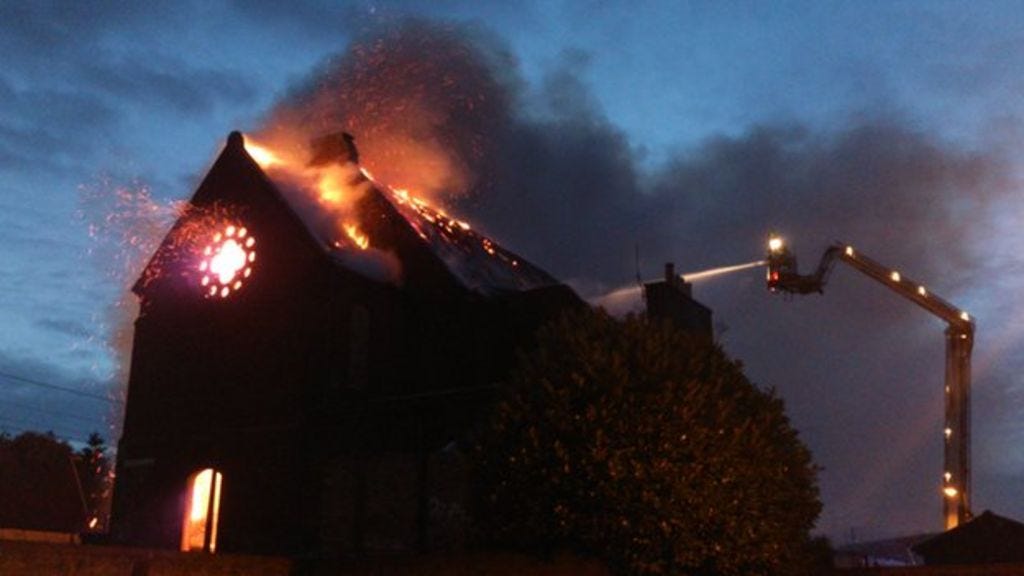
Across the Western world, the trend seems to be more and more towards this new reality where the burning of churches is more and more commonplace.
But why is this happening?
For those paying attention to current events, it may not be surprising that the rising number of churches being burned directly correlates with demographic changes in both the United States and Western Europe.
As mentioned when discussing the astronomical number of church burnings in the United States, the primary places where these incidents are happening were in states that saw growth and demographic change occurring together. Now the reflex might be to simply say, “Oh more people means more crime”, but it is not that simple.
There were other areas which saw some marked growth, particularly from relatively different demographic groups, but did not see the same increases in violence against churches. For example, Nevada, New Mexico, and, to some extent, Arizona all saw growth, but most of it was in Hispanic demographics.
But it is just as much about what was not there.
Areas that did not see sizable increases in arsons were the same areas that did not see significant increases in their Muslim populations.
Now this is where things get tricky, because in sheer volume Muslims have had much smaller absolute gains in population in places like Texas or California relative to other groups (particularly Hispanics), but what needs to be looked at is relative increases.
Using U.S. Religion Census/ARDA estimates a clear pattern emerges.
In almost every single state that saw an increasing number of arsons, we see that the Muslim population increased by approximately 71%, or a factor of about 1.7. Here are those numbers for the top states, as a percentage of the population.
California
0.73% (2010) → 1.27% (2020)
Pennsylvania
0.63% (2010) → 1.15% (2020)
New York
2.03% (2010) → 3.59% (2020)
Ohio
0.29% (2010) → 1.02% (2020)
It is also far from shocking that we see similar (if not more extreme) figures coming out of our Western cousins as regards the growth of their Muslim populations.
France
4% (2010) → 11% (2020)
Germany
4.6% (2010) → 8.5% (2020)
Again, these numbers are not surprising to anyone who has been paying attention over the last few years. Now, whether you instinctively knew this from years of seeing what has been happening across the Western world, or you are just now waking up to the realities, the numbers give clearer context for what we are facing.
And unfortunately it is not something new.
We don’t have to look too far to see that when it comes to Muslim interactions with Christian places of worship, the results remain perpetually and uncomfortably similar.
Whether we are looking at attacks perpetuated across Mozambique, Pakistan, Sudan, Nigeria, and Egypt in the year of our Lord 2026, or into the early days of Islam's spread from the Arabian Peninsula, the situation always remains the same. Muslims destroy churches, specifically targeting them for violence and vandalism. Any time Islam is in ascendance, churches will burn.
As one particularly striking example, we can turn to historic Muslim’s own words about their people and their deeds. Muslim historian al-Maqrīzī describes the order to destroy the Church of the Holy Sepulcher in Jerusalem (one of the holiest sites in all of Christendom at the time) in his Ittiʿāẓ al-Ḥunafāʾ:
“In [the year 1009] the Christians went out from Egypt to Jerusalem to celebrate Easter at the Church of Garbage [the Church of the Holy Sepulchre]... Al-Ḥākim... wrote to Aḥmad ibn Yaʿqūb, the missionary, telling him to head for Jerusalem, destroy the Church of Garbage and let the people plunder it until all traces of it were obliterated, and that was done. Then he ordered the destruction of the synagogues and churches that were in the districts of his kingdom…”
The Christian historian Yahya ibn Saʿīd al-Antākī (Yahya of Antioch), writing in Arabic relatively soon after the events, provides a contemporary account affirming the details:
“They seized all the furnishings they found in the church and completely destroyed it, leaving only those things whose destruction would have been too difficult. They also destroyed Calvary and the church of St. Constantine, and all that was located within its confines, and they tried to destroy the sacred remains. This destruction began on Tuesday the fifth day before the end of the month of Safar in the year 400 of the Hegira [28 September 1009].”
Once the churches were under their power, Muslims knew what was to be done.
The far more pressing question is why Muslims, many coming to our nations not with sword in hand but with open, needy palms, are finding the confidence to already begin the process of destroying the sites of religious worship which so offend them?
The answer is, of course, because we allow them to, in much the same way that we allow them to come. Arrogantly thinking that people coming from other places and other faith-traditions must think as we do, we open the doors to people who see our tolerance as weakness, and weakness is increasingly an invitation to subvert, usurp, and yes, eventually destroy.
But why? Why does the faith of the followers of Mohammed seem so insistent upon this?
Because they have remembered what so many of us in the post-Christian West have forgotten: the truth I already described involving symbols. Symbols must be seen to have an effect, and despite what we might think, seeing them does indeed affect us. A church, well-kept and centrally located to the community, is a constant reminder of the Christian faith, its persistence and power.
By the same token, a burning church is a symbol of Christianity neglected, the faith in decline, and a people who are moving further away from their God.
Muslims understand this, being temporarily immune to the delusions which prosperity, debauchery, and a compromised educational system have saddled us with.
They understand that the soul of a nation rests upon the heart of its people, and when its people see their houses of worship in flames, even if they don’t understand why, their hearts quiver.
So what then is the answer?
Well, the simplest thing would be to stop bringing in Muslims (along with pretty much everyone else, but especially Muslims) and see any and all of those here on temporary visas sent back. That is at least the dream I hold to, even as I recognize that such is probably not in the cards for now.
In the meantime, though, while we wait for that glorious day, every effort must be made to discourage the establishment of and the expansion of Muslim ethnic enclaves in the United States. Call your representatives, discourage and have nothing to do with immigration programs which bring in Muslims, and carefully choose where you place your money and support both politically and financially.
As the events in Dearborn, Michigan continue to illustrate for us, once the Mohammadens have taken up full residence, they are very difficult to dislodge. This, combined with their deliberate use of symbolic gestures, reveals what has always been the case.
It is time that we start showing that we will not be disheartened, we will not be subverted from within, and we will refuse to let the symbol of our faith be surrendered to the flame.
Take care, saints.
Comments
Nothing yet. Say the first thing.
Sign in to join the conversation.