
The first time I heard Dory Previn’s name was in the eponymous song by Camera Obscura from their 2006 album Let’s Get Out of This Country. It’s a beautiful song, but the lyrics are vague and fragmentary, and I didn’t do much research into Dory’s history other than learning that her husband had left her for a young Mia Farrow. A couple years later, midway into a Didion deep dive my first year of college1, I encountered her name again. But rather than re-listening to the Camera Obscura song, I listened to the source material herself—referential while still being original, funny and heartbreaking, a writer first and foremost (notice all the detail she works into this four-minute song about a one-night stand). Her voice is hypnotic; it lingers long after the song is over. Who was this woman? A PBS documentary that came out earlier this year, Dory Previn: On My Way to Where, delivered some answers—and inspiration.
Dory Previn’s early life provided her with plenty of dark material (at one point during the documentary, she’s asked about the time her father locked her and her mother and siblings in their dining room for a couple of months and just confirms it matter-of-factly?!). She wrote constantly, long before it became her vocation. There are several vaguely apocryphal origin stories about how she ended up in California, ranging from the fanciful (took a train to Hollywood at seventeen to become a chorus girl) to the merely improbable (in her early thirties, a friend sent some of her lyrics to a studio executive who brought her out to California). Either way, she was hired at MGM and paired up with a musician named Andre Previn—and a creative and romantic partnership was born. At that point, Dory2 looked and dressed like this—and was writing songs with lyrics like this:
Control yourself, contain yourself
Restrict yourself, restrain yourself
And always let tranquility be your goal
Shortly after a hospitalization for a nervous breakdown in 1965, Dory and Andre were asked to compose the soundtrack for the Valley of the Dolls film adaptation. Her account of writing the lyrics for the theme song (as she put it, “ma[king] professional use of my own experience”), is poignant and thoughtful: ”I knew what pills did to the speech pattern, the way one repeats phrases and never gets out the entire sentence. I was fearful someone would catch what I’d done.” Dory and Andre achieved success together, but as Dory decompensated and her mental illness and substance abuse became more severe, Andre’s fame grew independently.
One of the last straws in their partnership was his decision to take a prestigious conducting job in Texas with the Houston Symphony (and spend most of his time off touring in London). Dory, always fearful of flying, felt trapped in Los Angeles, refusing to even travel by train at this point. It was around this time that Andre Previn began an affair with the much-younger Mia Farrow (a member of their larger Hollywood circle who Dory had considered an acquaintance, if not a friend). By 1970, Dory and Andre were officially divorced. And post-divorce Dory went through a dramatic style evolution, in both the music she began to write and the clothes she began to wear.
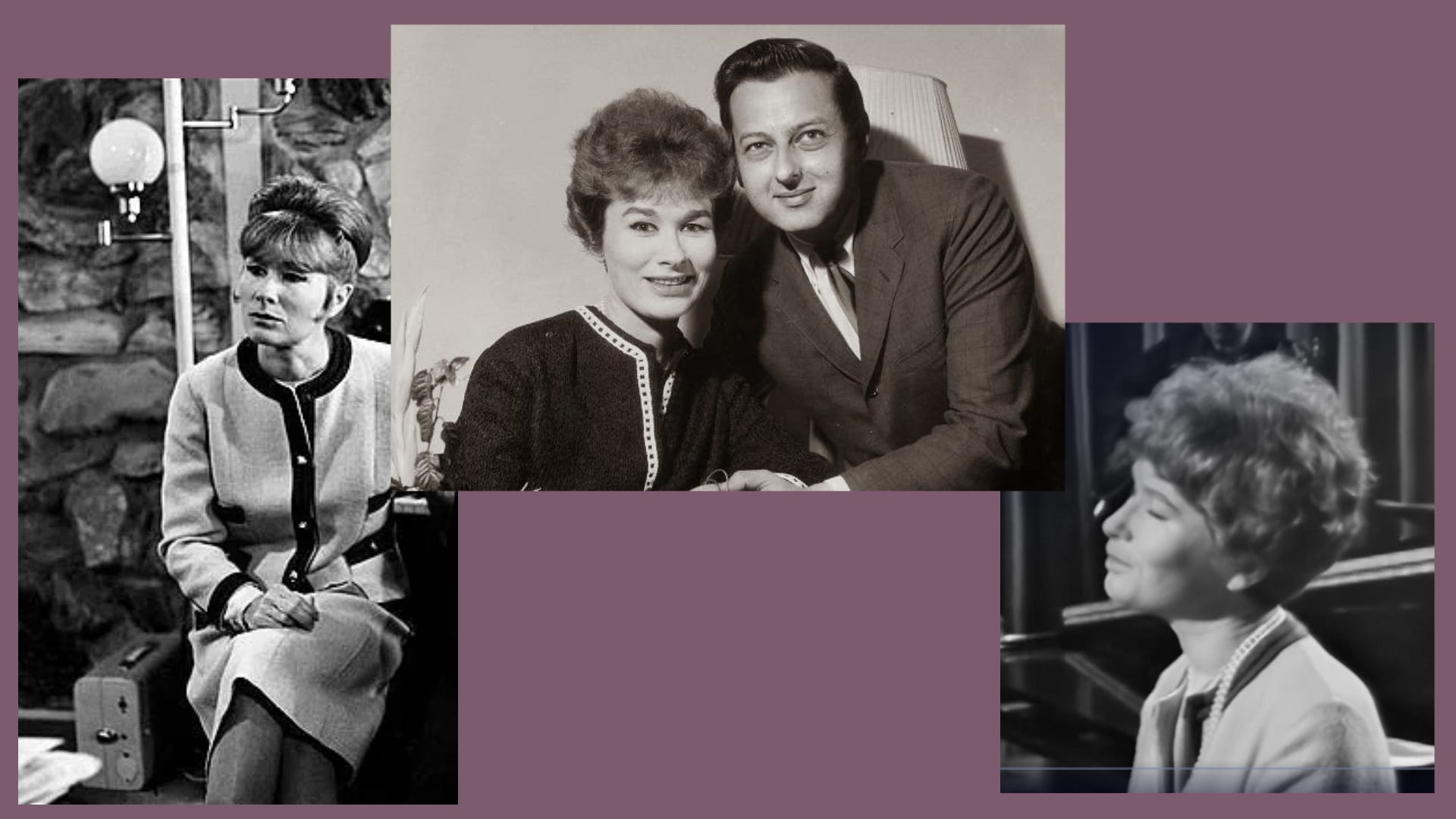
Some of this fashion evolution is due to shifting trends and norms, of course—she wasn’t the only woman who moved away from skirt suits and towards peasant blouses and flared denim in the 1970s. But even the way she did her hair was a complete pivot from her days as Andre’s musical companion. Her hair was naturally quite curly, but it’s impossible to find a photo of her from her time with Andre where that natural texture is on display. It’s almost always in a bouffant-adjacent updo, heavily teased and straightened. Post-divorce, it doesn’t look like she ever returned to that heavily styled hairstyle. You would also have a difficult time finding many photos of her post-1970 without a pair of aviator-frame glasses. The lenses were often tinted a slight orange-y brown, and she wore them both indoors and out.
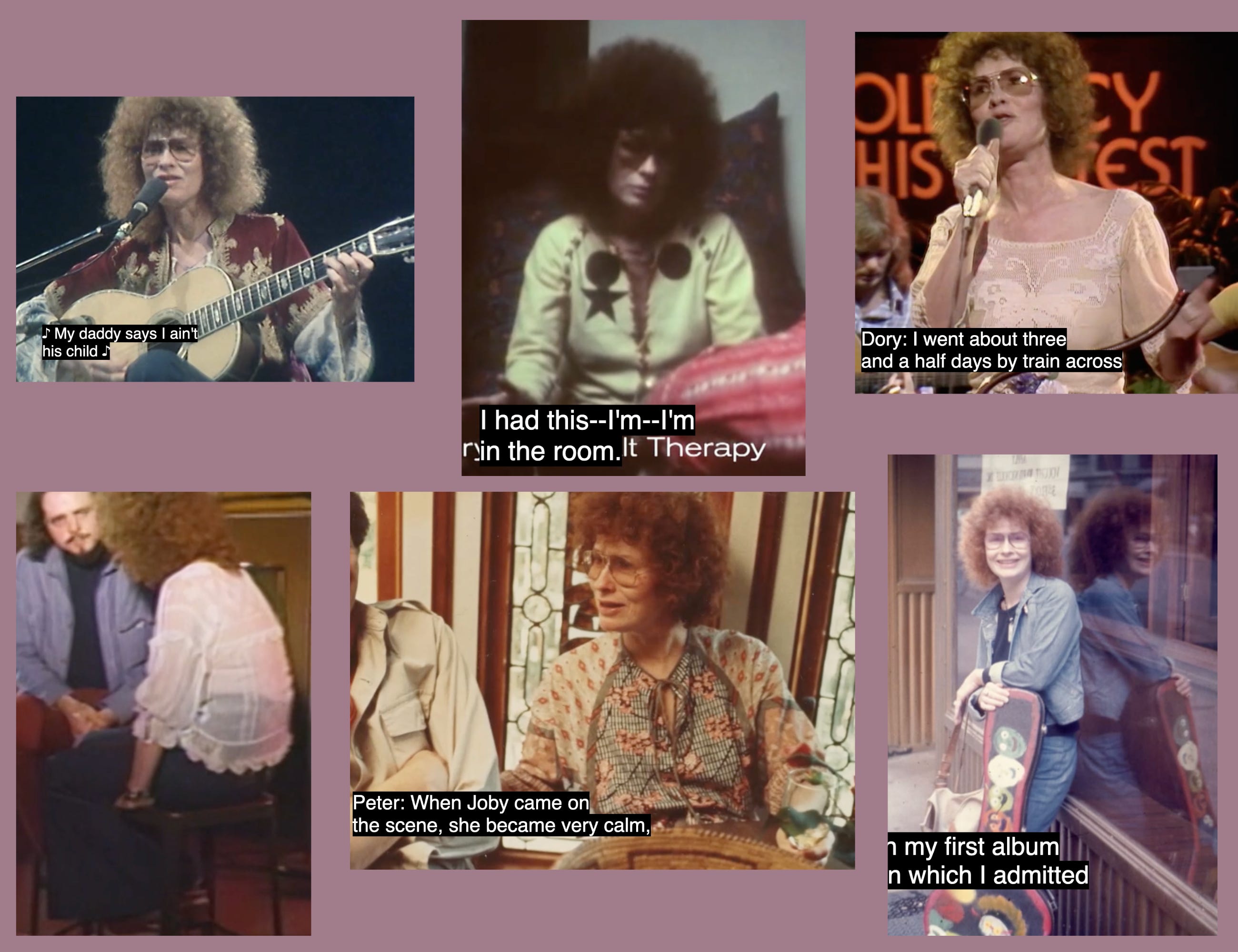
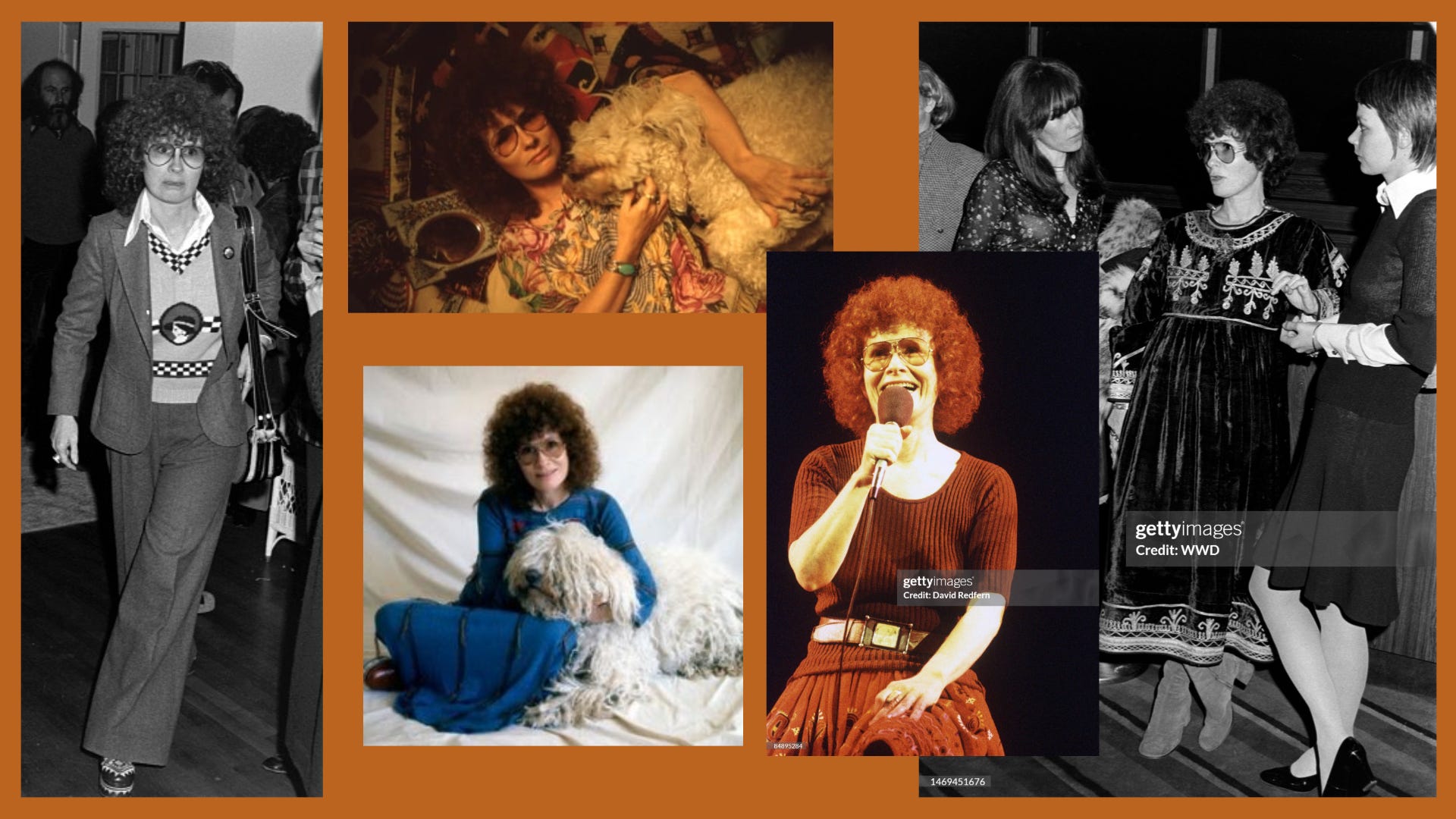
Without Andre by her side, Dory moved away from commercial songwriting, and ended up releasing six albums of her own music in that decade alone. These albums weren’t bombastic or immediate chart toppers, but they were quietly revolutionary in their own right. It was unusual material, even for an emerging golden era of folk music. Her songs were at once confessional and quite plain-spoken (‘Mary C. Brown and the Hollywood Sign’). She ventured into fable and surreality (‘Mythical Kings and Iguanas’). There’s even a song about the Hindenburg disaster (which, according to Dory, was the origin of her fear of flying). The song that I would consider the apex of her talent, ‘The Lady with the Braid,’ sublimates the mundane into something heartbreaking, and needs to be listened to in its entirety—but at least read the lyrics if you don’t listen. It’s a one-sided conversation, a monologue from a woman who is so desperate for company that despite herself, her desperation is going to drive that company away.
In the documentary, Dory is compared to both Joni Mitchell and Carole King, two other female singer-songwriters who released seminal albums around that same time. While Dory’s voice doesn’t quite fall into that ‘force of nature’ category, I could absolutely see a world in which she’d ended up with just as much name recognition as either of them. Ultimately, she became more of an if you know, you know musician, ‘your favorite artist’s favorite artist’ vibes, more on the level of Judee Sill or a Karen Dalton.
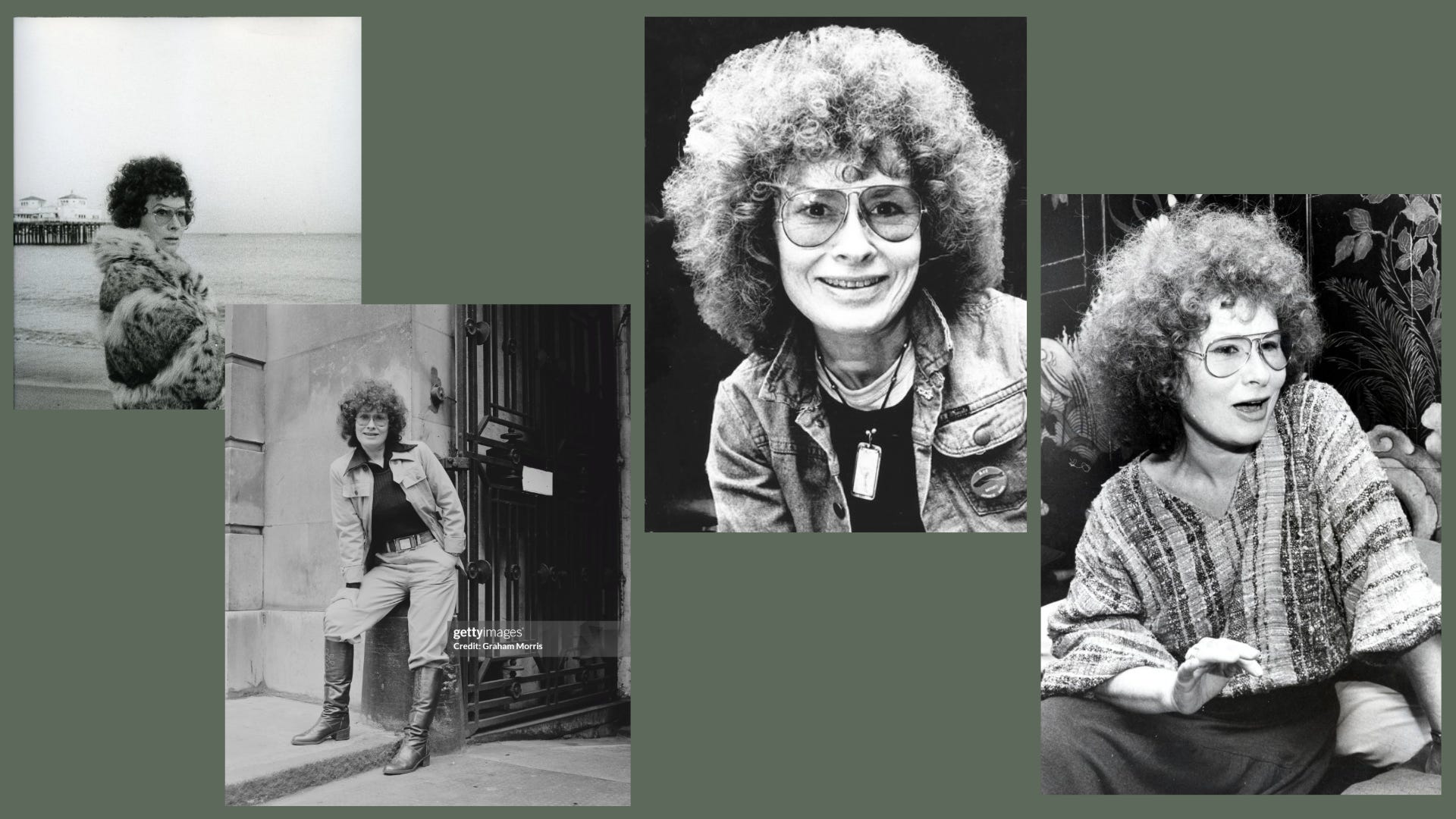
But while Dory didn’t end up a Joni or a Carole, she also didn’t suffer the same fate as Judee and Karen did. She lived to the age of eighty-six, and died of natural causes on her farm in Massachusetts in the company of her second husband, Joby Baker, to whom she’d been married for almost thirty years. She didn’t die young, or alone and isolated, of an overdose or by suicide—when we listen to Dory Previn, we don’t have to mourn her as someone who was gone too soon.
Instead, Dory was able to talk quite coherently about her struggles with mental illness, confront some of her demons, win an Emmy (and thank some of those demons in her acceptance speech!). She was able to recover from the betrayal and heartbreak of her first marriage, and remarry someone who spoke about her with obvious fondness (he just died earlier this month! RIP Joby!) The darkness in Dory never truly left her, but the documentary shows how her creative freedom, her openness and honesty and humor, helped her to counter it. And I can’t help but feel that her dramatic sartorial shift in self-expression contributed to that sense of freedom, too.
If you, too, would like to emulate a post-divorce Dory Previn in her creative prime, secondhand options abound!


Along with some professional overlap in the Hollywood world of that era, Dory Previn had remarried, to a man named Joby Baker, who was Joan Didion’s husband’s brother-in-law. Six degrees of Didion!
Comments
Nothing yet. Say the first thing.
Sign in to join the conversation.