
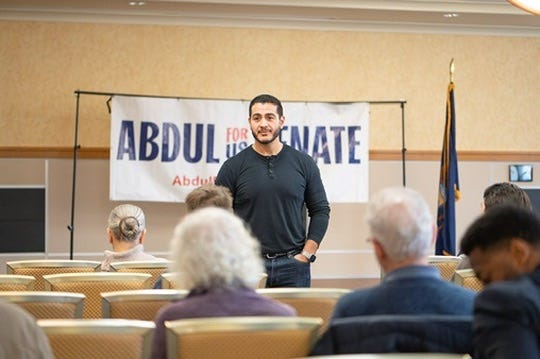
The question is not whether he hates us.
The question is whether his concern for Jews survives contact with Jews as we actually are.
Abdul El-Sayed says he cares about Jewish safety. I assume he means it. I have no particular interest in declaring him an antisemite, diagnosing his soul, or pretending I know what resides in another person’s heart.
Judaism tends to be suspicious of people who claim such powers.
So let us grant him the benefit of the doubt.
He cares about Jews.
But I am increasingly interested in a different question: What does that care actually cost him?
It is easy to care about Jews when a synagogue is vandalized.
It is easy to condemn a swastika.
It is easy to say that Jewish children should not be afraid to go to school, that Jewish families should not fear attending services, that a man wearing a kippah should be able to walk down the street safely.
Those are important statements. I am glad when political leaders make them.
But they are also, politically speaking, relatively cheap.
The harder test comes when caring about Jews requires disappointing the people applauding you.
When it requires challenging your ideological allies.
When it requires acknowledging that perhaps the Jews describing antisemitism are not merely confused about anti-Zionism.
When it requires recognizing that Jewish attachment to Israel is not some embarrassing pathology that enlightened Jews will eventually outgrow.
When it requires saying to your own coalition: You are wrong about the Jews.
That is a substantially more expensive form of concern.
And I am not yet convinced Abdul El-Sayed possesses it.
The distinction matters because there is a particular kind of sympathy for Jews that has become common in progressive political life.
It sounds generous.
It protects Jewish religion while remaining deeply suspicious of Jewish peoplehood.
It loves the synagogue and distrusts Zion.
It respects the menorah and interrogates Jerusalem.
It will defend Jews as vulnerable individuals while viewing Jews acting collectively as morally suspect.
It is prepared to protect us from the people who hate Jews.
It is considerably less prepared to protect us from the ideas of its friends.
That is the problem.
After the attack on Temple Israel in West Bloomfield, El-Sayed condemned the violence. But he also spoke about the attacker’s personal losses connected to the war and invoked the notion that hurt people hurt people.
Perhaps he meant this as an explanation rather than an excuse.
But Jews have become remarkably familiar with explanations.
Every act of antisemitic violence now seems to arrive with a graduate seminar attached.
Yes, attacking a synagogue is terrible, but Gaza.
Yes, Jewish students should not be harassed, but occupation.
Yes, October 7 was horrifying, but history did not begin on October 7.
Somehow, when Jews bleed, context becomes urgent.
There is a Jewish response to this instinct in the Book of Job.
When Job loses his children, his wealth, his health and nearly everything that constituted his life, his friends come to him.
For seven days, they sit silently.
It is the wisest thing they do.
Then they begin explaining.
And the book spends dozens of chapters demonstrating how badly that goes.
There is a time for political context. There is a time for history. There is a time to understand grievances and ideologies and the circumstances that produce violence.
And there is also a time to recognize that a terrified Jew does not need a geopolitical footnote.
He needs someone beside him.
Concern begins with knowing the difference.
What increasingly troubles many American Jews is the sense that our fear alone is never sufficient evidence.
Other minorities are generally permitted to describe the prejudice directed toward them.
Jews submit paperwork.
Was it really antisemitism?
Was it perhaps anti-Zionism?
Was the victim visibly Jewish or merely associated with Israel?
Did the incident occur after something Netanyahu did?
Does criticism of Israel make Jews uncomfortable?
Are Jewish claims of insecurity perhaps attempts to silence legitimate protest?
At some point one notices the pattern.
Jewish testimony is not received.
It is litigated.
And that brings us inevitably to Israel.
Israel is inconvenient because it reveals the limits of a certain kind of Jewish concern.
Judaism, as a private religion, is easy for liberal America to understand.
Synagogue. Rabbi. Holidays. Kosher food. A charming Hebrew song.
Jewish peoplehood is considerably more difficult.
We are not simply practitioners of a faith.
We are Am Yisrael.
Our prayers face Jerusalem.
Our calendar follows the seasons of the Land of Israel.
At weddings, at the moment of greatest joy, we break a glass and remember Jerusalem’s destruction.
At the conclusion of Yom Kippur, exhausted and hungry, Jews do not traditionally declare, “Next year may everyone enjoy robust constitutional protections for religious minorities.”
We say:
Next year in Jerusalem.
Israel did not wander accidentally into Judaism in 1948.
You can oppose Israeli governments.
You can oppose settlements.
You can condemn military decisions.
You can believe Israeli leaders have behaved immorally. The Jewish tradition itself produced prophets whose task was to rebuke Jewish kings.
But what you cannot do is claim profound concern for Jews while treating Jewish peoplehood as incidental to Jewish identity.
Nearly half the Jews on earth live in Israel.
They are not “the Netanyahu government.”
They are Jews.
The child in Be’eri is a Jew.
The grandmother in Ashkelon is a Jew.
The Ethiopian family in Jerusalem is Jewish.
The left-wing protester in Tel Aviv is Jewish.
The Haredi student in Bnei Brak is Jewish.
The Mizrahi family whose grandparents fled Baghdad is Jewish.
And this is where I become skeptical when politicians assure me how deeply they care about Jews.
Which Jews?
The ones in your district?
The ones attending the synagogue down the road?
The Jews who vote correctly?
The Jews whose Jewishness can be comfortably translated into American liberal religious pluralism?
Or the Jews who insist that our identity includes peoplehood, history, land, vulnerability and sovereignty?
Because if your concern extends only to Jews once those things have been removed, I am not sure you care about Jews.
You may care about a version of us.
You may care about Jews who have been rendered ideologically convenient.
Those are not quite the same thing.
The other test is even simpler.
Who are you willing to confront?
Political courage is rarely demonstrated by denouncing the prejudices of the opposing party.
Republicans condemning left-wing antisemitism impress me very little if they cannot confront antisemites on the right.
Democrats condemning neo-Nazis impress me very little if they become suddenly philosophical when antisemitism emerges from progressive movements.
Everyone is brave when courage is rewarded with applause.
The Torah’s command, “You shall not stand idly by the blood of your neighbor,” becomes meaningful precisely when standing up is inconvenient.
That standard applies to Jews as well.
If Abdul El-Sayed is targeted because he is Muslim, Jews should say clearly and loudly that such bigotry is unacceptable.
Not because we agree with him.
Not because he has earned it.
Because he should not have to earn it.
That is what moral principle means.
But reciprocity matters.
If I am expected to challenge someone on my political side who demeans Muslims, then I am entitled to ask El-Sayed to challenge people on his side who demean Jews.
Not after they cross some impossible threshold into explicit declarations of hatred.
Before that.
When Jewish history is trivialized.
When October 7 is relativized.
When Zionists become acceptable objects of collective contempt.
When Jewish fears are mocked as cynical manipulation.
When people begin speaking about “Zionists” in sentences where everyone understands perfectly well which human beings they mean.
That is when concern becomes costly.
And that is when we discover whether it was concern in the first place.
So does Abdul El-Sayed care about Jews?
Maybe.
I am less certain than I would like to be.
I believe he cares about Jewish safety in the abstract.
I believe he probably does not want Jews attacked.
I believe he would condemn a swastika.
Those are not meaningless things.
But after October 7, many American Jews have learned to distinguish between people who oppose antisemitism and people who will actually stand with Jews.
The categories overlap.
They are not identical.
Standing with Jews sometimes means hearing Jewish fears without immediately translating them into someone else’s political vocabulary.
It sometimes means understanding that Zionism, for most Jews, is not an exotic right-wing ideology but one expression of an ancient conviction that the Jewish people are, in fact, a people.
It sometimes means defending Jews whose politics you dislike.
And above all, it means being willing to spend political capital on Jewish safety when the threat comes from people whose approval you value.
That is the part I am watching.
Because every politician knows how to visit a synagogue after an attack.
Every politician knows how to issue a statement on Holocaust Remembrance Day.
Every politician knows how to say antisemitism has no place in America.
I no longer find those statements especially reassuring.
The question is what happens the next day.
What happens when the applause is coming from someone who despises Zionists?
What happens when Jewish students say they are frightened and your allies tell you they are lying?
What happens when the Jews asking for your solidarity refuse to apologize for Israel’s existence?
Do you still care about them?
Or was your concern dependent upon their becoming the kind of Jews you had already decided were worthy of concern?
The Torah says, “V’ahavta l’re’acha kamocha” — love your neighbor as yourself.
The challenge is not merely the command to love.
The challenge is allowing your neighbor to remain himself.
I do not need Abdul El-Sayed to agree with Jews.
I do not need him to adopt my politics.
I do not need him to become a Zionist.
I do need something more demanding than assurances that he opposes antisemitism.
I want to know whether his concern extends to Jews when Jewishness itself becomes inconvenient.
Because Jews have had many people throughout history who were perfectly willing to tolerate us once we surrendered the parts of ourselves they found objectionable.
We should know by now that this is not acceptance.
And we should be skeptical when it is marketed to us as concern.
The question is not whether Abdul El-Sayed hates Jews.
I do not believe that is the most important question.
The question is whether he sees us.
All of us.
And whether, having seen us clearly, he still believes we are worth defending.
Comments
Nothing yet. Say the first thing.
Sign in to join the conversation.