
The rabbis teach, ein la dayan ella mah she einav ro’ot: a judge may rule only on what his own eyes can see. So let us begin with what our eyes can see in Michigan, and let me state in advance where this is going. A primary victory is not a mandate. Andy Levin is not American Jewry. And a promise of Jewish safety cannot be severed from the question of Jewish sovereignty.
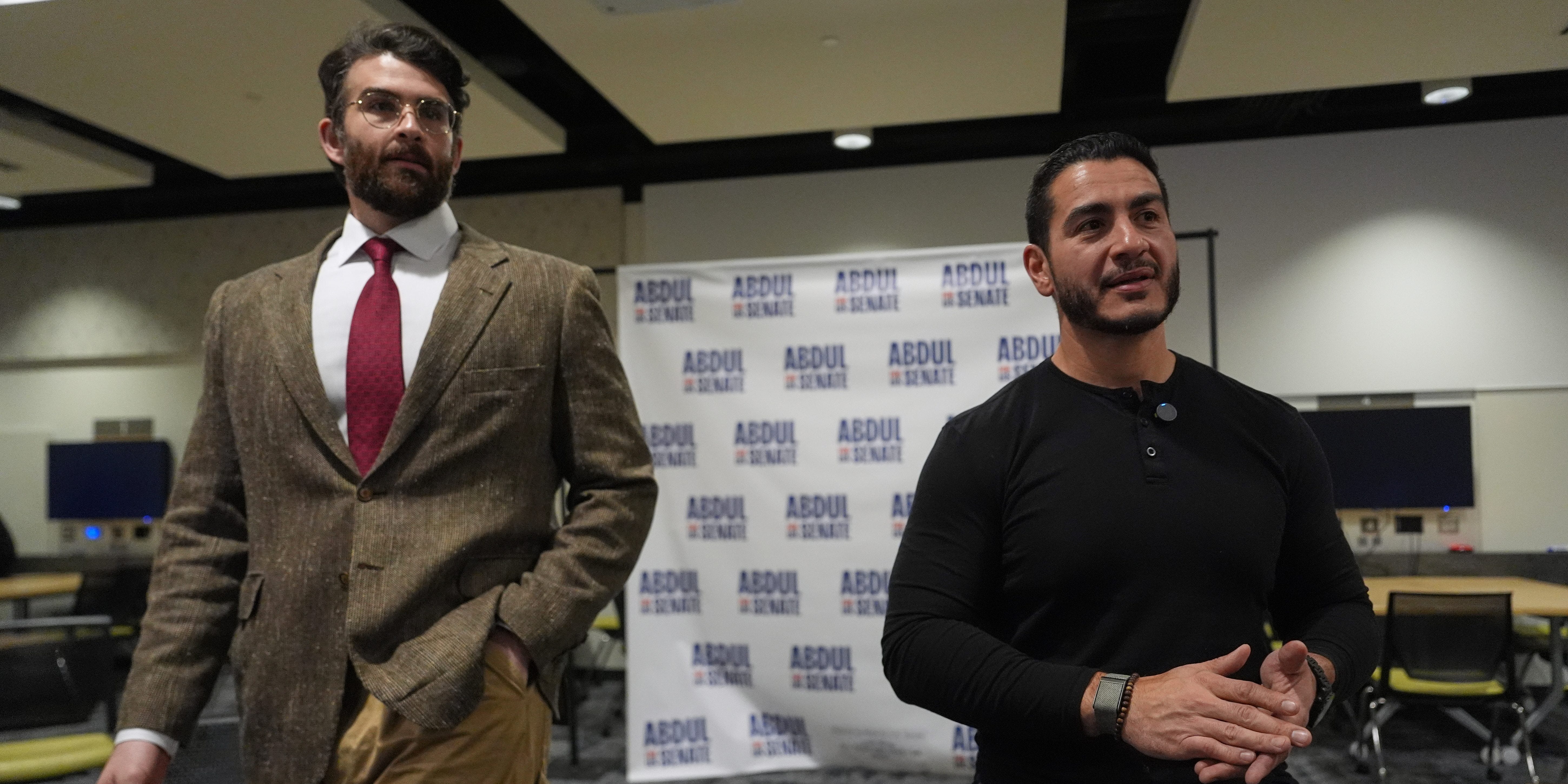
We can see that Abdul El-Sayed won the Democratic nomination for the United States Senate. We can see that he defeated Representative Haley Stevens despite an extraordinary amount of outside money spent on her behalf. We can see that anger at political establishments, corporate donors, and AIPAC became a powerful engine of his campaign.
All of that is true.
But a partial truth conscripted to carry more weight than it can bear stops being truth and becomes propaganda.
Peter Beinart has already converted El-Sayed’s victory into a parable. In his Substack conversation with former congressman Andy Levin, the topics are arranged with care: AIPAC’s money, the alleged collapse of centrist electability, the coming confrontation with Mike Rogers, coalition building between Muslims and Jews, and Islamophobia. In a companion essay, Beinart goes further, crediting El-Sayed with a progressive nationalism that could offer Democrats a national roadmap out of Trumpism.
It is an elegant story. It is also far too convenient, and it was written before the most important votes were counted.
Begin with the arithmetic, since nobody seems eager to look at it. El-Sayed took roughly 48.5 percent of the vote. Stevens took roughly 47.5 percent. The Associated Press called the race with El-Sayed ahead by approximately fifteen thousand votes out of more than 1.5 million cast. He did not win a majority. More than sixty thousand Michigan Democrats voted for Mallory McMorrow, who had suspended her campaign a month earlier. Her residual vote exceeded the entire margin between the two candidates who were still running.
That is a victory. It is not a mandate.
Read the result from the other direction and the triumphalism looks even stranger. After tens of millions of dollars in outside spending, after an establishment stampede, and after Gretchen Whitmer’s conspicuous endorsement, nearly half of Michigan’s Democratic primary voters still supported Haley Stevens. After a year in which many institutional voices in the party treated support for Israel as the safer political position, nearly half went the other way.
That is not a wave. It is a fracture, and both edges of it are carrying weight.
Exodus 23:2 is the verse from which the rabbis derive majority rule, aharei rabbim lehatot, incline after the many. It is worth remembering how the verse opens: lo tihyeh aharei rabbim lera’ot, do not follow the many toward evil. The Torah grounds majoritarianism in a sentence that begins by distrusting it.
The Sanhedrin went further. A court that convicted unanimously could not execute the defendant, according to one talmudic tradition, because a verdict with no dissent raised the suspicion that nobody had examined the case with sufficient independence.
A margin of one point in an August primary is a paradigm case for humility. Beinart reads it as a judgment on Zionism, AIPAC, centrism, American foreign policy, and the future of the Democratic Party because he arrived needing one.
The general election has not happened. Michigan voted for Donald Trump in 2016 and again in 2024. Mike Rogers came within roughly nineteen thousand votes of taking the state’s other Senate seat from Elissa Slotkin, who ran as a conventionally hawkish Democrat. At least one earlier poll showed El-Sayed trailing Rogers in a direct matchup while Stevens led.
Perhaps those numbers will prove meaningless. Perhaps El-Sayed, plainly the most gifted communicator placed on a stage in this primary, will win convincingly. If he does, those of us who doubted his general election appeal should say so honestly.
But electability has not been disproven. It has been deferred until November. Declaring an experiment successful before running it is not political analysis. It is an alibi prepared in advance.
If the seat is lost, control of the Senate may be lost with it. The consequences will be borne by millions of people who cast no vote in this primary, hold no developed opinion about Israel, and will never read a word that Beinart or I write.
Then there is the money, where the argument begins to collapse under the weight of its own imprecision. Beinart’s subtitle says Stevens outspent El-Sayed eleven to one. Other reporting described a nine to one advantage in television advertising. The Associated Press reported more than sixty million dollars in outside spending on Stevens’s behalf, with more than thirty million connected to AIPAC and its affiliates.
These are extraordinary figures. They are also measurements of different things.
Candidate spending is not outside spending. Television advertising during a particular period is not total expenditure. Money spent supporting Stevens was not necessarily money controlled by Stevens. Collapsing every category into eleven to one produces a satisfying David and Goliath story, but a fairly imprecise account of campaign finance.
It also obscures the possibility that the money was worse than wasted.
El-Sayed made AIPAC’s involvement central to his case that Michigan was for sale. Voters in focus groups reportedly cited AIPAC and corporate influence when explaining their discomfort with Stevens. He converted his opponent’s financial advantage into evidence for his own indictment, which was politically brilliant.
I will go further than Beinart does. Thirty million dollars in negative advertising poured into a Democratic primary was strategically foolish and morally shabby. It insulted the intelligence of voters, reinforced the ugliest caricatures of Jewish political power, and may have damaged the very cause it was intended to protect.
That argument belongs within the Jewish community, and we should have it loudly.
But notice what Beinart does with the result. For years, critics of American support for Israel have argued that pro Israel money is the hidden hinge of American foreign policy, that it purchases Congress, disciplines candidates, and explains why the United States behaves as it does in the Middle East.
Michigan became an unusually large test of that proposition, and the proposition failed on contact. Tens of millions of dollars could not move the Democratic primary electorate of a swing state by a single percentage point.
A serious writer should treat that as evidence.
Instead, the theory consumes its own refutation and returns even stronger. When the money wins, the victory demonstrates its power. When the money loses, the defeat demonstrates how much courage was required to resist its power.
A claim confirmed by every conceivable outcome is not a claim. It is a mood.
That mood has a recognizable and dangerous political grammar. It imagines Jewish influence as dispersed throughout the machinery of government, difficult to see precisely because it is everywhere, and impossible to disprove because every result becomes evidence of its reach.
Beinart is not Haman, and intellectual seriousness requires saying so plainly. But the theory he employs resembles a much older structure of suspicion. In Esther, Haman does not accuse the Jews of a specific crime. He describes them as a people scattered and dispersed among the nations, governed by different laws, present within the kingdom in a manner that renders their loyalty suspect.
The danger lies not only in what such arguments allege, but in their unfalsifiability.
The same collapse of categories runs through the rest of Beinart’s analysis. Opposition to AIPAC, opposition to Israeli policy, opposition to military assistance, opposition to Zionism itself, and support for El-Sayed are treated as interchangeable expressions of one moral awakening.
They are not.
A voter can resent outside money without believing Israel should be abandoned. A voter can despise AIPAC’s tactics without believing the Israeli government is morally equivalent to Hamas. A voter can want money removed from politics without rejecting the legitimacy of Jewish national self determination. Many people who voted for El-Sayed were voting about healthcare, grocery prices, party leadership, generational change, or their contempt for the Democratic establishment. Nobody has demonstrated that they were rendering a collective judgment on the Balfour Declaration.
Beinart’s treatment of Andy Levin involves the same maneuver in miniature. The subtitle describes Levin as the congressman who lost in 2022 to AIPAC and Haley Stevens. The ordering is deliberate. AIPAC becomes the actor. Stevens becomes its instrument.
AIPAC did spend heavily in that race and deserved scrutiny for doing so. But Levin lost by nearly twenty points. Stevens had represented more of the newly drawn district. The district was filled with suburban voters who had already elected her while she flipped a Republican seat. Money mattered. So did redistricting, geography, incumbency, constituent relationships, and candidate quality.
To say Levin simply lost to AIPAC is not analysis. It is martyrology.
Now El-Sayed’s victory becomes Andy Levin’s revenge. That word is not my invention. Beinart published the essay under the headline “How Abdul El-Sayed Won,” but the web address still preserves the earlier phrase, “Andy Levin’s Revenge.” Somebody softened the headline. Nobody bothered to soften the URL, and the first title is often the more honest one.
Leviticus 19:18 opens with two words the tradition has never permitted us to soften: lo tikom, you shall not take vengeance. The verse that concludes by commanding love of neighbor begins by denying us the pleasure of the settled score.
A Senate primary involving more than 1.5 million voters has been recast as the final scene of one man’s grievance. Levin may feel vindicated. He has earned the feeling. He has not earned the right to make his own defeat the master key to American Jewish politics.
This brings us to Beinart’s language about coalition building between Muslims and Jews, a phrase that performs more rhetorical work than the evidence can sustain.
There are Jews who support El-Sayed enthusiastically. Congregation T’chiyah, the Reconstructionist community Levin once led, welcomed him. Congregants organized as Jews for Abdul. Bernie Sanders campaigned for him. Their Judaism is real, their convictions are sincere, and they deserve neither ridicule nor excommunication.
They also represent one identifiable theological and political segment of American Jewry.
The Michigan Democratic Jewish Caucus endorsed Stevens. The Jewish Democratic Council of America endorsed Stevens and McMorrow while declining to endorse El-Sayed. There is no reliable polling showing how Michigan’s Jews voted.
There is an El-Sayed coalition that includes some Jews. There is also substantial Jewish apprehension about El-Sayed. Both statements can be true at the same time.
One progressive synagogue does not stand in for American Judaism. Andy Levin cannot certify El-Sayed as politically kosher on behalf of the Jewish people. Neither can Bernie Sanders. Neither, for that matter, can I.
One Jew’s dismissal of another Jew’s fear settles nothing. It establishes only that Jews are not unanimous, which we never have been, and which Beinart understands perfectly well. The entire premise of his newsletter is that he is the dissenter.
Now look at Beinart’s topic list again, because the absence is part of the argument. Islamophobia appears as a condition of the world to be combatted. Antisemitism appears primarily as an accusation to be dismissed.
One form of bigotry is weather. The other is weaponry.
Here is what did not make the list. Michigan’s Jewish population is small, and in March one of its preschool buildings at Temple Israel in West Bloomfield was attacked. El-Sayed condemned the attack, and I credit him for the condemnation. He also noted that the attacker had lost family members in an Israeli strike in Lebanon and observed that hurt people hurt people.
I have no interest in using the word antisemite as a projectile, and I am not throwing it at El-Sayed. He says he loves and reveres Judaism and the Jewish people, and I take him at his word.
But we should name precisely what his response accomplished. It informed a frightened Jewish community that its terror arrived with a footnote. He did not justify the attack, and I believe he meant his condemnation. But he contextualized Jewish fear on the day it occurred in a manner that Democratic leaders would rightly hesitate to employ immediately after an attack on almost any other vulnerable minority.
Five months later, Jewish physical safety still did not make Beinart’s list of the central questions raised by a Michigan election.
After his victory, El-Sayed said his commitment to Jewish safety was the same as his commitment to the safety of his own daughters. I hope he means it. Every decent person should welcome the sentence.
But Jewish safety cannot be reduced to protecting individual Jews from vandalism and assault while treating the collective security of millions of Jews as morally suspect.
El-Sayed has called the Israeli government as evil as Hamas. He has described Israel’s conduct as genocide. He has advocated ending American military assistance, including defensive assistance. He has repeatedly declined to affirm clearly the legitimacy of Israel as a Jewish state.
He also chose to campaign with Hasan Piker after Piker compared liberal Zionists to Nazis, said he had no problem with Hezbollah, and declared Hamas vastly preferable to Israel. When asked, El-Sayed declined to defend those statements but dismissed the criticism as cancel culture and praised Piker’s ability to reach alienated young men.
That answer is not sufficient.
A politician cannot insist that rhetoric matters when Muslims are its target and treat rhetoric as an incidental detail when Jews are its target. He cannot offer tenderness toward Jewish religious practice while remaining indifferent to the political vulnerability that produced Zionism in the first place.
Jewish existence is not merely individual. Judaism is a covenantal civilization, a people, a historical family, and, after two millennia of powerlessness, once again a sovereign nation.
Criticize the Israeli government. Oppose the war. Demand conditions on assistance. Condemn settlements, Netanyahu, or any coalition Israel has ever assembled.
But to promise Jews their safety while describing the government responsible for protecting nearly half the world’s Jews as morally equivalent to Hamas is not reassurance. It is a contradiction delivered with a smile.
El-Sayed will also face genuine Islamophobia, and that truth should not be buried in the middle of a rebuttal or wrapped in qualifications.
Republicans have spent months turning his name into a punchline, mispronouncing it deliberately and treating an American physician and public health official as a foreign object smuggled into the body politic. It is contemptible. His offer to give them pronunciation lessons was more gracious than the moment deserved.
Jews, of all people, should recognize the grammar of that insinuation. We have been its object for most of our history.
But condemning Islamophobia does not require suspending judgment.
It is not Islamophobic to examine what a candidate has said about Hamas. It is not Islamophobic to ask about Hasan Piker. It is not Islamophobic to ask whether a candidate recognizes the Jewish people’s right to national self determination or to worry about the consequences of ending cooperation on missile defense.
Prejudice attacks a man because he is Muslim. Political criticism evaluates what a candidate says, supports, and does.
A serious journalist preserves that distinction. Once it disappears, the charge of bigotry stops answering arguments and begins ending them.
One final piece of Beinart’s parable deserves attention. He is impressed by El-Sayed’s argument that money spent on Israeli security should instead be spent on Michigan schools. He calls it a progressive version of America First, a nationalism married to domestic investment rather than Trumpian cruelty.
It is politically clever and arithmetically misleading.
Even using the most expansive accounting offered by critics of the war, American military assistance to Israel remains a tiny fraction of total federal spending. A small percentage of the federal budget may still represent a grave moral choice. Size alone does not determine justice.
But Israel cannot honestly be blamed for the structural failure of American schools, hospitals, or healthcare. Michigan’s schools are not underfunded because Iron Dome exists. American healthcare is not expensive because Israel receives missile defense assistance. Those failures are products of domestic choices involving sums orders of magnitude larger than the foreign aid budget.
Jewish law does teach aniyei irkha kodmin, the poor of your own city take precedence.
Precedence is not exclusivity.
The tradition has never held that the need nearest to us dissolves every obligation beyond our borders. Particular responsibility and universal responsibility must live together. That is difficult, which is why it is a tradition and not a slogan.
Beinart’s formulation instead adopts an accounting he would reject in another context, one in which every dollar protecting people abroad is a dollar stolen from children at home. That argument does not stop with Israel. It provides the architecture for dismantling every international obligation whenever a domestic need can be named.
A domestic need can always be named. There is always another school. There is always another hospital. There is always another hungry family.
A country serious about moral responsibility must be able to fund a classroom in Detroit and an interceptor over Tel Aviv. The wealthiest society in human history is not actually being forced to choose.
So how did Abdul El-Sayed win?
He won because he is enormously talented. He won because he built a real organization, held hundreds of events, visited more than a hundred cities, and assembled a volunteer network numbering in the thousands. He won because he spent years building an audience while holding no office. He won because Democratic voters are furious with their own party’s leadership. He won because Stevens could not articulate an identity beyond institutional competence and a résumé from the Obama years. He won because AIPAC’s spending allowed him to cast her as a purchased candidate. He won because McMorrow withdrew. He won because he understood the media environment and his opponent did not.
Israel was part of that story. AIPAC was part of that story.
Neither was the story.
Beinart has written a midrash and published it as peshat. Every element of his reading is recognizably present in the text, but he has arranged those elements into the redemptive narrative he wanted before a single ballot was counted: AIPAC as villain, Andy Levin as wounded prophet, Abdul El-Sayed as insurgent hero, and a populism defined by its opposition to Zionism as the promised land toward which the Democratic Party is marching.
The plain sense is less satisfying.
El-Sayed won a divided primary by less than one percentage point. AIPAC suffered a real defeat and inflicted much of it upon itself. Haley Stevens ran a poor campaign. Andy Levin received a measure of personal vindication. Some Jews joined El-Sayed’s coalition, while many others remain frightened by what the candidate has said and by those beside whom he has chosen to stand.
The nominee now faces a competitive general election in a state Donald Trump has carried twice. Control of the Senate may turn on the result.
That is what our eyes can see.
The rest is commentary. November will determine whether it was prophecy or wishful thinking.
Beinart changed the headline.
He should have changed the piece.
Comments
Nothing yet. Say the first thing.
Sign in to join the conversation.