
Click here for a printer-friendly version of this article.
The Torah content for the month of Av is sponsored by Aliza Feder in honor of the yahrzeit of her mother, Mindy Pincus a”h. I had the pleasure of getting to know Mindy during my first year of yeshiva. She and her husband Gersh hosted me so often that she told me I could assume that a place would automatically be set at their table every Friday night. I will always remember her as a living embodiment of chesed and hachnasas orchim.
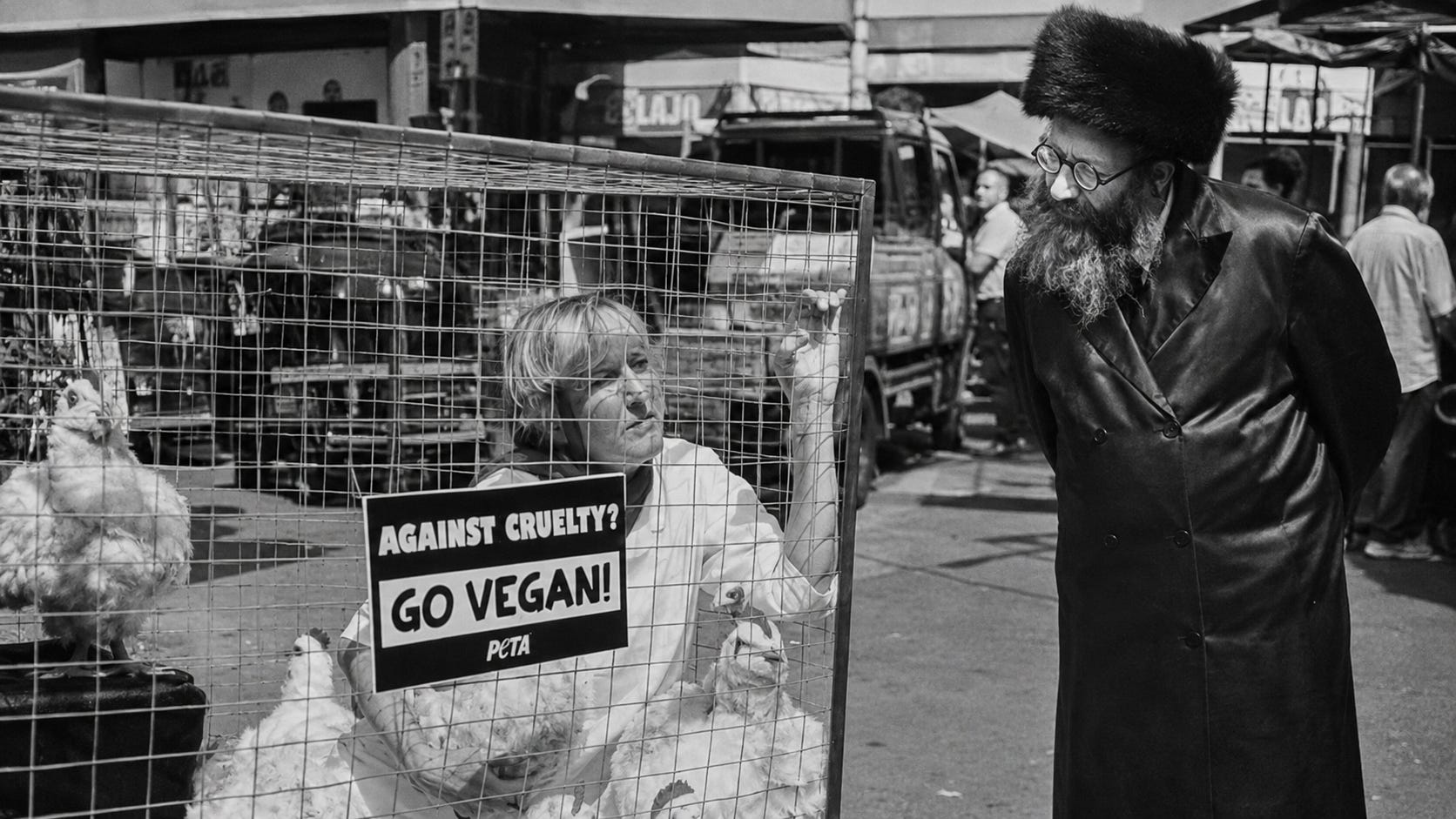
“Anti-vegetarian? Don’t you mean pro-vegetarian?” Nope. I meant what I wrote.
Before I read Le-Nevukhei ha-Dor: Rav Kook’s Guide for Today’s Perplexed [1], I knew virtually nothing about Rav Kook’s hashkafah. Other than his Zionism, one of the few things I’d heard was that he was pro-vegetarianism. Little did I realize how nuanced his view on this matter was.
Before we commence with the main body of this article, I’d like to state three disclaimers.
Disclaimer #1: This is not intended to be a comprehensive overview of the Torah’s stance on vegetarianism. As far as I am aware, there are three major exegetical views on the permission to eat meat granted by the Torah in Parashas Noach (Bereishis 9:1-7): (a) that meat was never prohibited in the first place, (b) that it was initially permitted, then prohibited after Adam’s sin, then re-permitted after the flood, and (c) that meat was forbidden from creation and only permitted after the flood. For an overview of these three views, with their rationales and sources, see AlHaTorah’s Study Topic article. See also my 2015 article Re’eh: MEAT IS MURDER!!!
Disclaimer #2: This isn’t even intended to be a comprehensive presentation of Rav Kook’s position. Like I said, it’s nuanced. And I’m not familiar with it. If you’re interested, read chapter 10 in its entirety and/or check out R. Sklar’s translation with extensive footnotes.
Disclaimer #3: In my Rhapsody on Rav Kook: First Impressions of a New Chapter in My Learning, I wrote “I’m going to keep all my Rav Kook-related writing behind a paywall as a default.” I explained:
The main reason is that I need to be able to explore this new world freely, following my mind wherever it goes, without feeling pressure to be “authoritative.” I need to be able to think out loud as someone who knows nothing about Rav Kook, but who conducts his investigations in writing. If every post I write is met with objections (“That’s not what Rav Kook holds!” “You need to learn such-and-such before you can write about such-and-such!” “How dare you misappropriate concept such-and-such into your worldview when that’s clearly not what Rav Kook would have said!”), then I know I’ll just clam up and lose the ability to think freely in public.
I’m tentatively making an exception here because I really wanted to write about this, and I’m traveling so I don’t have time to write a paywalled and a non-paywalled article. We’ll see what happens!
When I ask my high school students what the difference is between chukim and mishpatim, they usually say, “Mishpatim have reasons and chukim don’t.” This view is not held by most (if any) of the Rishonim. A more accurate distinction is: mishpatim have reasons that are obvious, whereas chukim have reasons that are not obvious. The Rambam (Moreh 3:26) maintains that this view of chukim is unanimous:
All of us, the masses as well as the elite individuals, maintain that there is a reason for every mitzvah, although there are mitzvos the reason of which is unknown to us, and in which the ways of [Divine] wisdom are not known. This view is distinctly expressed in Scripture, as it is stated, “chukim and mishpatim of justice” (Devarim 4:8), “The mishpatim of Hashem are true and righteous altogether” (Tehilim 19:10).
My friend Rabbi Joshua Maroof wrote an excellent article in which he asks a further question on this distinction:
On the surface, it is difficult to understand why this method of classification is justified. Does it make sense to categorize commandments simply based on whether we can provide a logical explanation for them or not? Isn’t there a more meaningful criterion to use for grouping the mitsvot?
(I encourage you to read Rabbi Maroof’s answer there, which is consistent with Rav Kook’s view below.)
In the middle of our chapter, Rav Kook provides a thought-provoking answer to this question:
The category of “chukim” is [defined as] commandments whose relevance in the present cannot be found, and are rather a sowing of the seeds and a preparation for the future. Only when that fortunate time comes, only then will this great purpose that this wondrous nation took on will [sic] be felt, a preparation for guidance so lofty as this. When our judges and counsellors look into the Torah and find our nation ready to activate these sprouts, then light will go out to the entire nation. The nation that is elevated for that wondrous leadership, in the innate feeling “of compassion, of shame, of acts of kindness” which will manifest in their fullest sense, that will surely be “for the light of nations” (Isaiah 42:6, 49:6). “When all the nations hear about these chukim, they will say, ‘Surely this great nation is a wise and understanding people!’” (Deuteronomy 4:6).
The seed analogy is beautiful. Imagine a person who had only ever seen fruit trees but had no knowledge of how they came to be. Imagine you showed them a handful of seeds and told them they yielded just as much value as the trees. They wouldn’t believe you. How could something that appears so useless possibly bear fruit? But plant those seeds, and the truth will be evident in its proper time.
According to Rav Kook, the same is true of chukim: the wise can appreciate the wisdom and understanding embedded in these chukim, but the masses – Jews and non-Jews alike – will only be able to appreciate their utility in the future, at the right time.
Rav Kook states his essential view early on in the chapter:
Let us consider … the ethical yearning of not killing any living thing for the needs of man. It is impossible to deny what is sensed by any feeling heart, that there is a general ethical deficiency in how the human species fails to uphold the good and lofty feeling that it should not take the life of any living thing for its own needs. And it is absolutely impossible that the good God would decree a permanent law in a very good creation dictating that the human species will not be able to sustain itself unless it clouds its ethical feelings by spilling blood, even the blood of animals.
Ultimately, God’s wish is to “[connect] humanity with all other living things,” causing man to “yearn for the highest ethical nobility” and “demand of himself his obligation towards all creation, his fellows in creation and in life.”
What, according to Rav Kook, was the intended state of man in relation to animals at the time of creation?
There is no doubt to any inteintelligent person that when the Torah says to Adam, “You shall have dominion over the fish of the sea and the birds of the heaven, and all animals that crawl upon the earth” (Genesis 1:28), it does not mean the domination of a cruel dictator who treats his people harshly only in order to bring about his own personal desires. Heaven forbid that such a disgusting law of enslavement should be of the ways of the good God, of whom it is said, “the world is built with kindness” (Psalms 89:3) and we see that all His ways are filled with justice and compassion. The Torah itself surely expresses this clearly from the fact that Adam was not allowed to have meat as food. If that is true, what kind of domination [was he to have] over all animals and insects, if not dominion over the well-being of those under domination, to develop them, to improve their situation, to be involved in their physical and spiritual advancement?
Note the strength of Rav Kook’s stance. It’s not that vegetarianism would be preferable, but that a permanent license to kill for food would be incompatible with God’s goodness.
As we shall soon see, Rav Kook holds by the third of the three views cited above, that meat was forbidden from creation and only permitted after the flood. And this permission was a concession to human nature.
Up until this point, Rav Kook’s view might be considered unremarkable. But here’s where things get interesting:
However, after the generation of the Flood, when meat was allowed for food, this concession was certainly not meant to remain forever, for how can there be an ethical situation that changes and is nullified after it had already been the practice [originally] – we are to “add holiness, not diminish it!” Rather, the Divine Intellect saw that man had fallen from his ethical state, and until the time comes when man will stir himself awake and arrive at the true ethical recognition, he should not be burdened [with moral obligations] that do not accord with his level.
In other words, this was not merely a concession on the particular issue of eating meat. Instead, it marked a concession in the method used by the Torah to promote the ethical development of mankind. Formerly, the Torah had legislated the ethical ideal; after the flood, the Torah employed the approach of “chanoch l’naar al pi darko, gam ki yazkin lo yasur mimenah – train the youth in accordance with his way, and even when he grows old, he will not deviate from it” (Mishlei 22:6). In my shiur How the (Seemingly) Outdated Elements of Torah Are Evidence of Its Perfection, I refer to this distinction using Rabbi Hayyim Angel’s terminology: static vs. evolutionary morality.
Why was such an approach necessary? Because the alternative would have been disastrous, as Rav Kook writes:
There is no doubt that if the prohibition against killing animals would be practiced now, when man’s ethical state has not yet been rectified, it would cause tremendous damage. When the animalistic desire to eat meat would intensify, it would not make a distinction between human and animal, since it would be the same prohibition either way; cannibalism would then become a very constant sight … And sometimes, there also needs to be a concession of some impressionable aspect of the ways of morality in order to prepare man for an even higher level, because if we were to put first what should really come later, then all would be lost.
Herein lies the nuance alluded to at the beginning of this article. Rav Kook really does hold that the cruel exploitation of animals for our own needs is akin to (albeit not absolutely equal to) the oppression of our fellow human beings. Both run contrary to the will of the Creator insofar as they cause harm and suffering to His creatures. However, the blurring of the distinction between human and animal will lead to even greater harm: if killing an animal and killing a human fall under a single prohibition, then whoever violates it for a steak has already crossed the only line there is, and human flesh no longer stands in a category of its own.
The solution is not to implement the ethical ideal at the present time. Rather, the antidote to this moral equivalency and its attendant moral degradation is to draw a sharp distinction between how we treat animals and how we treat our fellow human beings:
To illustrate, since the ethical state of man continues to waver, his animalistic love of self always prone to overcome him [even] to the point that all the rules of ethics and morality would be a joke to him, it makes sense that he would need to keep a social distance between himself and the lowly animals. This is in order that he should not see himself as one of them, for then they would make an impression on him with their animalistic ways to bring down his spirit to the “dark valley” (Joshua 7:24, 26, 15:7, Hosea 2:17, Isaiah 65:10) of the wild animals. He would be prone to leaving aside his human superiority and be counted among the wild beasts. Were it so that the [equivalent] moral obligation was set for all, the same for the rest of the animals as for other human beings, it would leave an impression of a community and partnership between man and all [other] living things. Even if this would not be harmful for the best of humanity, the ethical level of the common people would be greatly lowered … The temptation is greater to descend into the ways of the animals in order to be exempt from the many ethical calculations, and to enjoy the many crass pleasures of the moment.
Rav Kook concludes his thesis by rounding out and reiterating the picture of mankind’s proper development:
Thus, it is unfathomable how good for the world the impact of severing the relationship between humans and all other living things has been. All of this could only happen by way of an exemption that freed man from many ethical obligations [toward animals], and he was permitted to satisfy his desires even through killing them, so that he would recognize on a very deep level his superiority over them, and thus, his soul would be elevated toward the highest ethical yearnings.
In the end, absolute ethical truth – which is truly the knowledge of God – will win out, at which point man will no longer need these concessions. If ethical obligations were overly practiced between man and the animals, then in a time lacking in ethical perfection, it would have caused a great amount of evil to humanity … Therefore, there was a necessary decision made by the Divine Intellect, “who discerns the mind and heart” (cf. Jeremiah 11:20, 20:12), to sever the connecting thread between man and beast, so that the concentration of man’s ethical focus could be specifically for his own betterment, and then man will successfully arrive at his good fortune in the End of Days.
And when humanity arrives at that glorious and free age, then man will have the proper understanding of his relationship to the animal kingdom from the standpoint of pure morality. Man will no longer need any exigent concessions and exemptions, for “the Torah only speaks against the evil inclination,” only in order to walk in the way of absolute goodness.
He then offers explanations of many animal-related mitzvos in light of this theory: shechitah (ritual slaughter), kisui ha’dam (covering the blood of slaughtered beasts and fowl), cheilev (prohibited fat), kilayim (prohibited mixtures), and more.
In sum, although God cares about the welfare of all creatures, He prioritized the ethical development of human beings. This necessitated differentiating between man and animal. Without this sharp distinction, man would descend to the level of the wild beasts. Only when this phase of ethical development is well-established will we rise to the universal ethics of the Creator “Who is good to all, and Whose mercies are upon all His works” (cf. Tehilim 145:9).
Consider Ingrid Newkirk (born 1949), animal rights activist and cofounder of PETA (People for the Ethical Treatment of Animals). She and her organization illustrate the very mechanism Rav Kook identified: what happens to moral intuition when the distinction between man and animal is flattened before mankind is ready. Here are just a few of the many examples:
Newkirk’s most famous quotation is “There’s no rational basis for saying that a human being has special rights. A rat is a pig is a dog is a boy. They’re all animals.” The obligation toward animals underlying this claim is one Rav Kook affirms as part of God’s ultimate plan, but the flattening of the distinction between human and animal is precisely what he warns will fuel moral deterioration if implemented prematurely.
PETA’s It’s Still Going On campaign featured ads “comparing widely publicized murder-cannibalization cases to the deaths of animals in slaughterhouses.” Newkirk herself has drafted an elaborate will specifying what should be done with her body after her death. She wants her skin turned into wallets, her feet into umbrella stands, her flesh carved out, fried up with onions, and incorporated into “a human barbecue,” and her various other body parts processed in other ways and sent to specific public figures. While these attention-grabbing stunts may not be tantamount to a full-throated advocacy of cannibalism, they certainly veer in that direction.
One of PETA’s most controversial campaigns was its 2003 Holocaust on Your Plate exhibition, which
consisted of eight 60-square-foot panels, each with a juxtaposition of images of the Holocaust with images of factory farming. Photographs of concentration camp inmates in wooden bunks were shown next to photographs of battery chickens, and piled bodies of Holocaust victims next to a pile of pig carcasses. Captions alleged that “like the Jews murdered in concentration camps, animals are terrorized when they are housed in huge filthy warehouses and rounded up for shipment to slaughter. The leather sofa and handbag are the moral equivalent of the lampshades made from the skins of people killed in the death camps.”
Newkirk’s misguided moral intuitions are evident in the letter she wrote in 2003 to Palestinian leader Yasser Arafat protesting the use of a donkey as a suicide bomber, not because this was an act of terrorism intended to murder innocent human beings, but because she didn’t want any more donkeys to die.
(By the way, this is why I titled this “Rav Kook’s Anti-Vegetarian Views” rather than “Anti-Vegetarianism.” He is staunchly pro-vegetarian, but warns against the kinds of vegetarians who promote or are produced by a vegetarianism improperly implemented. Vegetarians like Newkirk and her organization.)
PETA and its cofounder may seem like an extreme example, but such extremism is exactly what Rav Kook warned would follow from the erasure of the distinction between man and animal before mankind is ready for it. This leads to a final question.
At what point should mankind transition back into vegetarianism? Rav Kook notes that the criterion is embedded within the Torah’s presentation of the permission to eat meat:
But when the Torah gave permission to eat meat, it elaborated [with a narrative element], “When your soul desires to eat meat…” (Deuteronomy 12:20), creating a limitation, as if to say, “Only so long as your natural ethical state does not abhor the eating of living things like you abhor the eating of human meat ….” Indeed, this is why the Torah did not have to explicitly prohibit cannibalism, for man had already acquired the correct natural idea regarding this, and the Torah does not need to prohibit it, just as it does not need to specify good and bad character traits, which are innate and familiar. But when the time comes of an ethical state of abhorrence for meat because of a natural repulsion to it, there will be no “desire of your soul to eat meat” – “and you shall not eat it” (ve-lo tokhal).
There are many vegetarians, and even entire cultures, who feel such an abhorrence for meat. But should these people be proactive in persuading their fellow human beings to cultivate similar sentiments, or are these feelings supposed to develop organically? Does Rav Kook envision this change occurring throughout the species, or should it be spearheaded by the Jews, under the auspices of Torah? Should we become vegetarians if we are swayed by Rav Kook’s arguments?
I’m sure Rav Kook addresses these and other questions in his other writings on this topic. Those who are interested should start with the many citations compiled by Rabbi Sklar in his notes to this chapter.
As stated at the outset, my intention in this article was not to provide a comprehensive treatment of this topic or Rav Kook’s position. My main goal was to showcase a fascinating example of the Torah’s approach to shaping mankind’s values through the system of chukim. May we merit to see the sprouting of these life-giving seeds.
[1] published in 2026 by Kodesh Press, translated by Rabbi Aryeh Sklar, whose translations I’m relying on here with my own emphasis in bold and my own paragraph breaks
Ordinarily I’d open the floor to any and all questions about this, and I still will. Just remember that I’m VERY new to Rav Kook, and might need to refer your question to Rabbi Sklar or one of the other Rav Kook experts I know.
Like what you read? Give this article a “like” and share it with someone who might appreciate it!
Want access to my paid content without actually paying? If you successfully refer enough friends, you can get access to the paid tier for free!
Interested in reading more? Become a free subscriber, or upgrade to a paid subscription for the upcoming exclusive content!
If you’ve gained from what you’ve learned here, please consider supporting my work via Patreon, Venmo, Zelle, or PayPal — links below. Even a small contribution helps cover production costs and gives me the freedom to create more Torah content. To sponsor a day’s or week’s worth of content, or to inquire about tutoring or teaching, reach me at rabbischneeweiss at gmail. Thank you for listening, reading, and supporting my efforts to make Torah ideas available and accessible to everyone.
Patreon | [Venmo: @Matt-Schneeweiss] | [Zelle/PayPal: mattschneeweiss at gmail]
Substack | YouTube | YUTorah | Instagram
Podcasts: The Stoic Jew | Machshavah Lab | The Mishlei Podcast | Rambam Bekius | The Tefilah Podcast
Comments
Nothing yet. Say the first thing.
Sign in to join the conversation.