
I’ve been waiting a while to have this wonderful chat with author and historian Hugh Ryan. You probably know him for his deep dives into public queer spaces, and his award-winning books When Brooklyn Was Queer and The Women’s House of Detention.
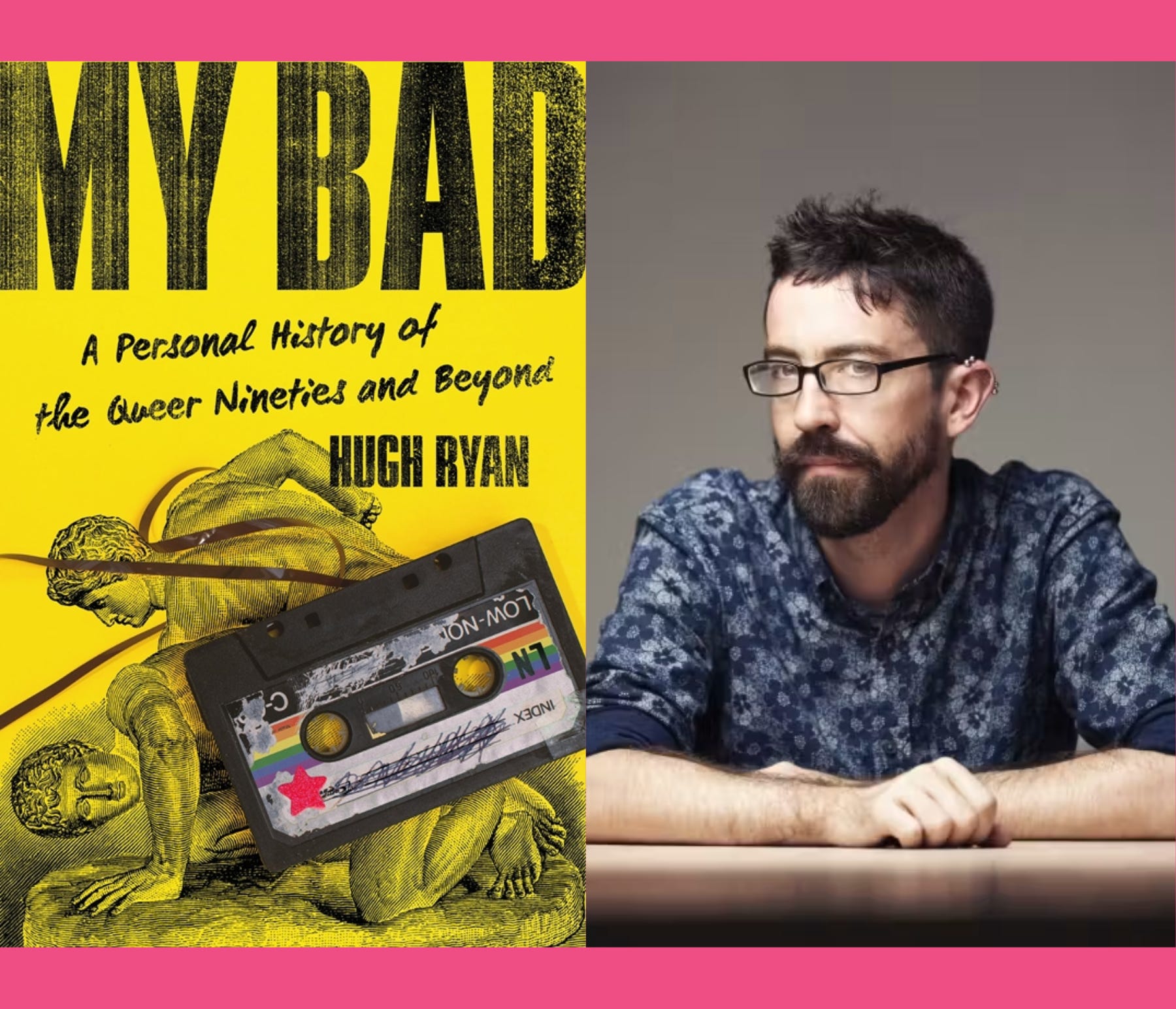
His new memoir, My Bad: A Personal History of the Queer Nineties and Beyond, is deeply personal. Not only do you get radical honesty, a lot of ‘90s dance floors, and an unblinking look at non-monogamy, it’s vulnerable, sharp, and helps redefine what a “successful” relationship looks like.
One of my favorite lines in the book—which I’ve been sharing with others all summer at presentations and lectures—is about a topic that I’ve been trying to explain to non-queer people for years and which Hugh articulated so eloquently:
“Queerness is a fickle blessing: unlike religion, ethnicity, class or race, it’s rarely shared between parents and children or neighbor with neighbor. Queer people don’t often grow up experiencing gatherings of others ‘like us.’ And when we create those gatherings as adults, they are more likely to be diverse out of necessity.”
I also mentioned a beautiful quote from writer Garrard Conley about how Hugh treats "mistakes as evidence: of desire, of survival, of how we got here." So I asked him about looking back at his younger self navigating early relationships, and how he grappled with "mistakes" and regrets from that era and whether he could view them with absolute tenderness and gratitude.
As he shared, looking back on his time in college in the 1990s, he did wish he’d had the “opportunity to do the things straight people do; the stupid dating in high school when it doesn’t matter and you practice and you get your feelings hurt and you learn how to deal with it and then you learn how to hurt other people’s feelings and say you’re sorry.”
“And you learn to have sex slowly because you’re 15 and not thrown off the deep end at 22. But I don’t know. I spend too much time thinking about all of those things, and it’s just like a weight that bears you down. It doesn’t help me to regret those things. It helps me to analyze them.”
Next, we discussed the long process of "undoing shame," which Hugh writes about so well in My Bad. In particular, I was curious if his archival work on his previous books helped him do battle with internalized homophobia and shame.
“I do think that the research of these other books that I’ve written was very helpful at giving me role models. But also it just like, tearing apart a lot of the ideas that I received around what a relationship looks like or what gender is or maybe—even more than anything else—these ideas that nothing changes. … It freed me to say, ‘Yeah, people have had really different ideas in the past, different ideas about how to live, about what it means to live, about what a body is, about what gender is.’ And that was so freeing.
“To understand that if, 150 years ago, people thought about things absolutely differently than I think about them today, well, then that means that 150 years from now, people are going to look back and be like, ‘Whoa, that is so weird.’”
He then explained that, during his Queer History 101 book club, which he co-hosts with Peppermint, they focused on Straight Acting by Will Tosh, which investigated the history of the ideas Shakespeare would have been encountering in his time period. As he explained, in Shakespeare’s time educated people would have believed that the body was made up of humors that are kept in balance and, when those humors get profoundly imbalanced, you can change sex.
“So he lived in a world where a normative understanding for all people was that it is possible for human beings to change sex under certain conditions,” Hugh explained. “That is not a shared understanding we have today, right? It’s an understanding some of us have, but even the mechanism by which that change happens, we have a different idea about that. But we don’t think about that when we approach Shakespeare’s work.”
I told Hugh I’d been impressed how he discussed his polyamorous relationship so openly in public at readings and events, and he said that the hardest decision had been sharing his personal life with colleagues at work. But he remembered the lesson a boss he had when he was in college who taught him about queer life and organizing and politics and “how we work for social justice.” So he sees it as a political action to share details of his successful poly and queer co-living reality.
Before we wrapped up, I asked Hugh if he had any advice for queer writers who might be trying to document their own complex coming-of-age narratives or non-traditional relationships and are struggling to write about chosen family, partners, and exes with both honesty and care. He had an excellent response (and name-checked Melissa Febos and some advice she gave during a talk), so I hope you’ll listen in to that as well (it’s around the 43:30-minute mark). He also shared the news about his involvement as a lead historian with the American LGBTQ+ Museum, which opens in New York City in 2028!
Once again, I want to thank everyone who joined us live and Hugh for taking the time to talk about so many important topics.
**(if you’re currently paying $5 a month, consider upgrading since it will save you a bundle and help keep QLP growing and publishing essays, poetry and supporting queer creativity)**
Comments
Nothing yet. Say the first thing.
Sign in to join the conversation.