
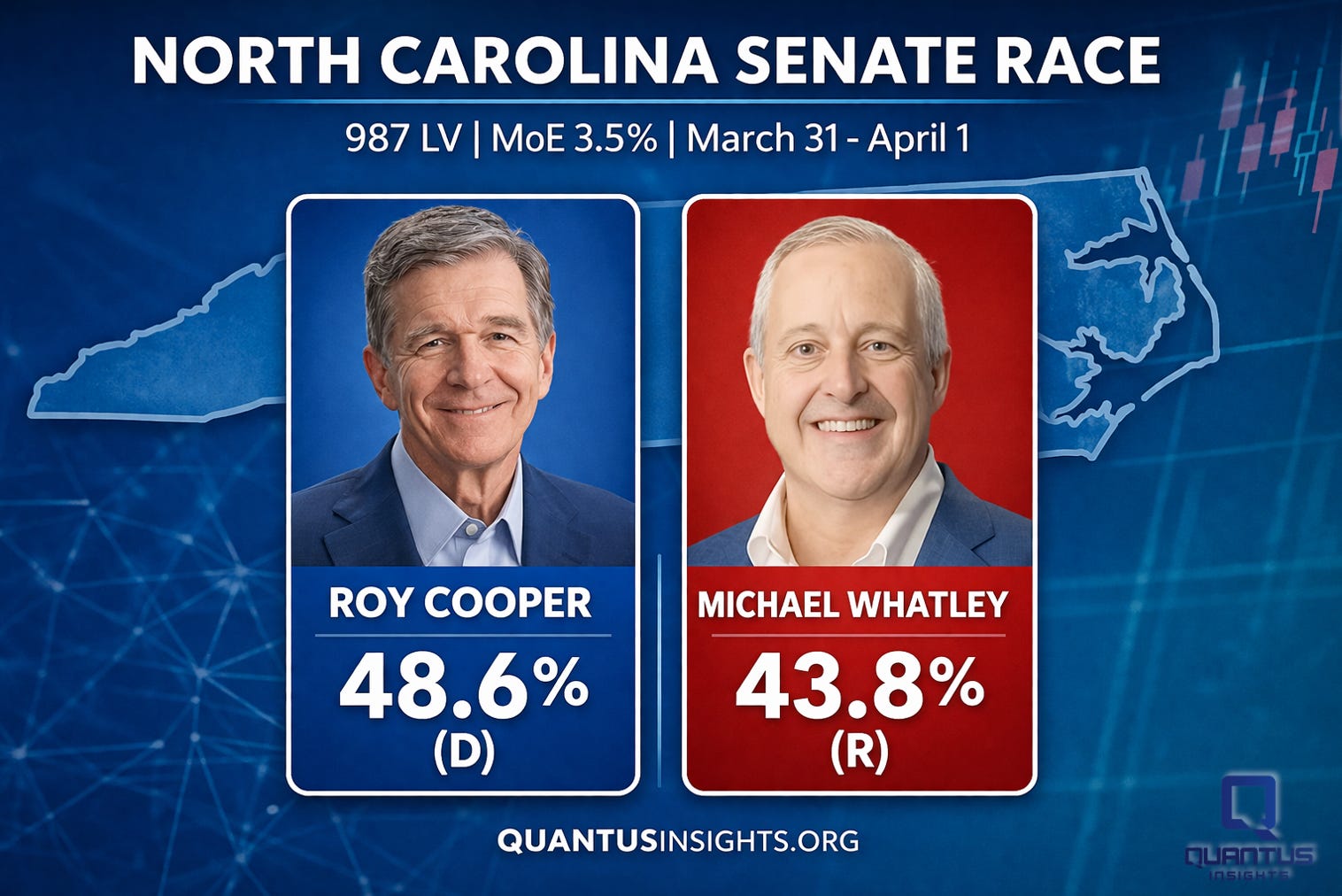
North Carolina enters the 2026 midterm cycle as what it has long been: a closely fought state, politically divided, regionally distinct, and competitive enough to keep both parties fully engaged. But if this survey is an early guide, Democrats begin the cycle with the advantage. (See results and cross tabs at our interactive website).
In the race for U.S. Senate, former Gov. Roy Cooper leads Republican Michael Whatley 48.6% to 43.8%. On the generic congressional ballot, Democrats hold a narrower 44.7% to 43.3% edge. President Trump, meanwhile, is underwater in the state, with 43.0% approving of his job performance and 54.4% disapproving. Taken together, the results suggest a midterm electorate that remains fundamentally competitive, but one that is presently tilting against the national Republican brand and giving Democrats a modest opening.
The Senate ballot is the clearest indication of that advantage. Cooper is not simply consolidating Democrats. He is also winning the center of the electorate, carrying independents by a substantial 51.1% to 35.3%. That matters in a state like North Carolina, where statewide races are often decided less by partisan enthusiasm than by which side better captures the voters who are not firmly anchored to either party. Cooper’s lead suggests he is doing more than holding the Democratic base. He is expanding beyond it.
The generic House ballot paints a more restrained picture. Democrats still lead, but narrowly by 1.4 points, and with 8.7% of voters undecided. That tells us the broader environment is competitive and still unsettled. It also suggests the Senate race is benefiting from candidate-specific strength that has not yet fully translated to the congressional level. In other words, Democrats appear to have the better statewide figure in Cooper, but the underlying partisan terrain remains much closer in down-ballot contests.
The state’s political map remains as recognizable as ever. Cooper dominates in urban North Carolina, leading 62.7% to 30.8%, while Whatley performs best in rural areas, where he leads 52.6% to 36.9%. The suburbs once again stand near the center of the contest. Cooper holds only a narrow 48.9% to 46.7% advantage there, while the generic House ballot actually shows a slight Republican edge in suburban districts, 46.3% to 42.6%. That split is important. It suggests Democrats are benefiting from Cooper’s personal profile, while Republicans remain competitive in the broader structural fight for the electorate that decides control of Congress.
The demographic divisions are equally clear. Women back Cooper by 15 points, 54.9% to 39.5%, while men support Whatley by roughly 7 points, 48.8% to 41.6%. The House ballot follows the same pattern: women favor the Democrat by double digits, men lean Republican by nearly 10 points. These are not minor crosscurrents. They are among the defining features of the state’s current political alignment.
Age tells a similarly revealing story. Voters between 30 and 44 years old give Cooper his strongest margin, 58.3% to 30.8%, and back the Democratic House candidate 55.2% to 32.9%. By contrast, voters aged 45 to 64 are the strongest Republican bloc in the survey, favoring Whatley 51.1% to 42.1% and backing the GOP House candidate 52.6% to 37.2%. Seniors are almost evenly divided in the Senate contest, another sign that North Carolina remains highly competitive even where Republicans have historically expected more reliable strength.
Race and education continue to sort the electorate in familiar ways. White voters favor Whatley 50.5% to 42.4% and support the Republican congressional candidate 50.9% to 37.0%. Black voters, by contrast, give Cooper 73.6% support and back the Democratic House candidate by an even wider margin. Voters with bachelor’s and postgraduate degrees lean Democratic, while voters without a four-year degree remain much more competitive territory. This is not a reshaped North Carolina. It is the same North Carolina seen through the conditions of an early midterm cycle: closely divided, but with Democrats presently benefiting from stronger momentum in the decisive middle.
Trump’s standing provides the broader political backdrop. His job approval in this survey stands at 43.0%, with 54.4% disapproving. The most striking feature is not merely that he is underwater, but that disapproval is heavily intense. Fully 50.2% strongly disapprove, compared with 32.2% who strongly approve. Among independents, 57.2% strongly disapprove. Those are numbers that suggest dissatisfaction is not soft or passing. It is rooted, and it is helping shape the atmosphere in which these 2026 contests are beginning to take form.
That does not mean North Carolina has ceased to be a Republican-leaning battleground. Republicans retain clear strengths among men, white voters, rural voters, and much of the older electorate. But the 2024 recall results also underscores the central lesson of the poll: the state’s recent presidential history and its early midterm mood are not presently aligned. North Carolina still contains a durable Republican base, but the electorate at this moment appears more open to Democratic candidates than the last presidential result alone would suggest.
That is the central finding of this survey. North Carolina remains competitive, and neither party should mistake this moment for permanence. But in this early 2026 snapshot, Democrats have the advantage. Roy Cooper is running ahead of the broader party baseline, independents are leaning his way, Trump is underwater, and the state’s most important swing constituencies appear more open to Democratic candidates than they were at the presidential level. In a state that rarely offers either party much room for error, that is a meaningful place to begin.
U.S. Senate: Roy Cooper 48.6%, Michael Whatley 43.8%, Undecided 5.7%, Other 1.9%
Generic U.S. House ballot: Democrat 44.7%, Republican 43.3%, Undecided 8.7%, Other 3.3%
Trump job approval: 43.0% approve, 54.4% disapprove, 2.5% unsure/no opinion
2024 presidential recall: Trump 46.3%, Harris 43.2%, Prefer not to say 6.4%, Other 2.3%, Did not vote 1.9%
No posts
Comments
Nothing yet. Say the first thing.
Sign in to join the conversation.