
South Carolina Republicans are preparing to choose a Senate nominee under circumstances few could have imagined a month ago. (See technical report and cross tabs here).
The July 11 death of Sen. Lindsey Graham created a sudden vacancy, an abbreviated campaign and a political succession fight that has brought several of the state’s best-known Republicans onto the same ballot. Darline Graham, appointed to her brother’s seat by Gov. Henry McMaster and endorsed by President Donald Trump, enters the closing days as the clear front-runner but nowhere near the majority required to avoid a runoff.
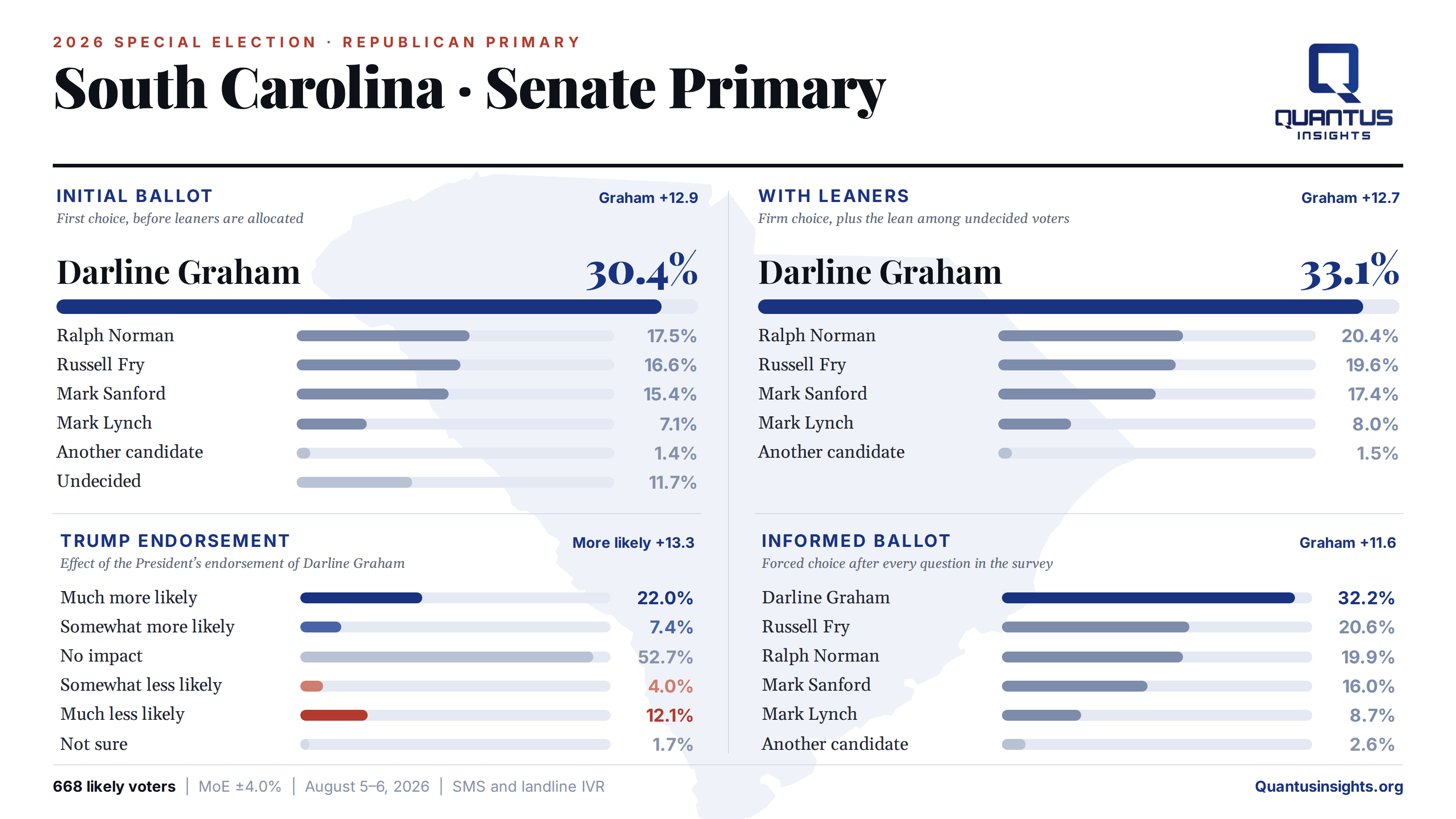
Our latest Quantus Insights survey of 668 Republican primary voters, conducted Aug. 5-6, finds Graham at 30.4% on the initial ballot. Rep. Ralph Norman follows at 17.5%, Rep. Russell Fry at 16.6%, former Gov. Mark Sanford at 15.4%, and Mark Lynch at 7.1%. Another 11.7% remain undecided.
When voters who expressed a lean toward a candidate were forced, Graham’s position strengthens to 33.1%. But beneath her, little separates the three principal challengers: Norman stands at 20.4%, Fry at 19.6%, and Sanford at 17.4%. While Lynch reaches 8.0% and farther back in the distance.
The most interesting part of this race is three candidates are fighting over a narrow piece of the electorate, and there is no clear order or even a favorite among them yet. Between now and next Tuesday, any one of the three could emerge from that scramble and become the Republican left standing opposite Graham.
Age shows division and is partly generational in nature. Among voters age 66 to 75, Graham takes 36% on the initial ballot, and she draws 35% among those 76 and older. Among voters under 56, however, she receives only 18%, while Norman leads that group at 23% and Sanford emerges to take 19%.
Geography tells a similar story and shows how competitive the race is and gives an idea how a competitive a runoff could be. Norman is strongest in the Greenville-Spartanburg market, where he leads Graham 27% to 25% but Fry dominates Myrtle Beach-Florence at 36%,. Graham is strongest in the Columbia and Charleston markets, Columbia and is dominant in the Savannah and Augusta-Aiken markets.
Hovering over the contest, as over nearly every Republican primary of the Trump era, of course, is the president. Despite what polls tell us about the the impact of Trump’s endorsement, it matters and often matters enough to turn a lead into a clear win and a clear winner already, into a landslide.
Important, then, is Trump’s standing with these voters. It is overwhelming: 81.5% approve of his job performance, including 66.1% who strongly approve, while just 17.0% disapprove. Yet his endorsement of Graham is not the driver in this race according to the respondents. Some 29.4% say it makes them more likely to support her, but 52.7% say it has no effect on their decision, and 16.1% say it makes them less likely.
Trump remains the dominant figure in a Republican electorate but perhaps, in this race, at least, these voters are making their own judgment on the candidates already well known in the state.
However, it’s not a coincidence that Trump endorsed Graham has strongest overall personal favorability at 50.2% compared with 37.8% unfavorably. Norman is viewed favorably by 44.0%, while Fry posts a 45.3% favorable rating but remains less defined, with 30.0% offering no opinion. As for Sanford he is the only major candidate underwater with 39.5% favorable and 54.1% unfavorable.
Barring a dramatic late consolidation, the numbers point toward a runoff. Our reading shows Graham is plainly in first. What South Carolina Republicans have not yet decided is who gets the chance to face her a second time.
No posts
Comments
Nothing yet. Say the first thing.
Sign in to join the conversation.