
This is section III.2 (that builds upon the previous section here) of the first volume of my book, “Quantum Physics: An Overview of a Weird World.” I plan to post regular updates, including minor and substantial revisions, on Substack. Here is the full table of contents and guidance on how to follow the book as it unfolds.
Now let us analyze what interpretation Heisenberg gave to his own principle. He illustrated this with a famous “thought experiment”. 1
Heisenberg’s thought experiment elucidates what nowadays is remembered as Heisenberg’s microscope interpretation. It is an interpretation that, unfortunately, several professional physicists have also adopted (probably to make it more understandable to the public or, being busy only with calculations, to avoid digressions in the conceptual foundations that might trigger annoying questions from too-curious students). However, if you have carefully followed what we have said so far, you will be able to recognize that Heisenberg’s interpretation is somewhat misleading. It went as follows.
Imagine (see Fig. 1) that we want to detect the position and momentum of a particle in a region x by using an incoming photon which interacts with the particle. This photon is then scattered toward some direction. We have already described something similar with the Compton scattering effect.
Then, as was Heisenberg’s reasoning, we can look to where the photon has been scattered to deduce the electron’s position.
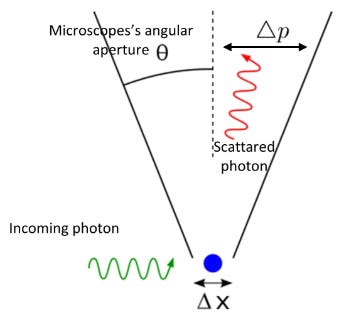
However, according to classical optics, the larger the angular aperture θ of the microscope, the better it will resolve the position of the scattered photon and, therefore, deduce the position of the electron. Yet this angular aperture depends not only on the size of the microscope lens but also on the wavelength of the photon. To have high precision in determining from which direction the photon comes—that is, in determining the position of the electron—we must use a photon with a short wavelength. However, if the photon has a short wavelength (high frequency), it will carry more energy (recall Planck’s relation Eq. 1) and, thereby, more momentum (recall Eq. 2), and a smaller de Broglie wavelength (recall Eq. 1). Therefore, the “kick” that it imparts to the electron will also be larger. That is, if I want to observe the precise position of the electron, I must use photons which will produce a large recoil on the electron itself. This makes its position again indeterminate. On the other hand, if I want to more precisely determine the momentum of a particle, I’m forced to use photons with large wavelengths because only they have a small momentum and will not displace the electron too much through Compton scattering. Yet if I use long wavelength photons, the microscope optics will resolve their position with less accuracy. So, again, we must search for a tradeoff between the wavelength we use (the precision over the momentum p) and the microscope aperture (the ability to look at a precise position x).
In the macroscopic world of our daily experience, this effect does not play any role for practical purposes because objects are huge compared to elementary particles, and are not disturbed by tiny photons. However, for atoms and even more for particles like electrons, a single photon introduces a non-negligible interaction scattering them away and, thereby, preventing us from determining their position. That’s why Heisenberg’s uncertainty principle is invoked to explain that in the microscopic world, a measurement always perturbs a system in such a way that the scale of the measurement’s perturbation is about the same magnitude of the effect it produces and, therefore, renders the result imprecise if not entirely useless.
Heisenberg was able to show that, by reasoning in such a manner, making the appropriate calculations which resort to classical optics, he could indeed reobtain his famous inequality over momentum and position of Eq. 1. Heisenberg’s microscope thought experiment boils down to the following argument: We cannot determine the position and momentum of a particle at the same time because when we make an observation, we must inevitably interact with the object we want to observe, such as sending other particles of comparable mass or energy to the particle being observed. This inevitably disturbs the system, which then loses its original position and momentum that we sought to determine.
This argument is correct insofar that every interaction with microscopic particles inevitably causes them to scatter and prevents us from knowing their precise position and momentum. In spite of that, it becomes wrong when it is invoked as a restatement that is supposed to explain the origin and cause of quantum uncertainty. That would be in stark contrast to the wave-particle nature of matter itself, which doesn’t need any interactions with the outside world to be described consistently. It is an interpretation that does not stand up to the tests of modern QT. The popular belief that Heisenberg’s uncertainty principle is about the interaction between the observer and the observed object is wrong. Heisenberg’s uncertainty principle is a fundamental law of Nature whose roots are in the wavy nature of matter and has nothing to do with the interaction between the measuring apparatus and the measured objects.
Of course, the interactions and imperfections of measurement devices must always be taken into account in a real laboratory but these add further uncertainty to the intrinsic “quantum fuzziness” that is present a priori. In fact, we shall see later that, as strange as it might sound, it is nevertheless possible to set up experiments which make measurements without necessarily interacting with the system, and yet the Heisenberg uncertainty principle remains inescapable. It also holds in the case in which we are able to reduce to zero any interaction with the observed object. It is an inherent law of Nature that is independent of observational interactions.
At the time of Heisenberg, it was still legitimate to think of particles in this way. Heisenberg can be excused because several experiments which showed how his own interpretation must be revised came much later—some not even until before the 1990s, with the development of sophisticated laser and quantum optics devices. So, while the historical context and the lack of more experimental evidence justifies Heisenberg, it does not do the same with modern physicists. Nowadays, we can no longer stick with the microscope interpretation as a correct understanding of the workings of the uncertainty principle. This is no less fundamental than Bohr’s atomic model, the geocentric model or a flat earth theory.
We should accept that Nature is telling us that we should never forget the wave-particle duality. When a particle goes through a pinhole, we must think of it as a physical process described by a transverse planar matter wave, which is diffracted like any other wave and produces a spherical wavefront—neither more nor less than in Fig. 2.
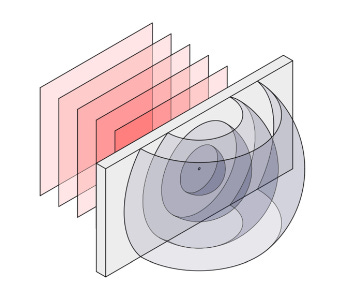
Forget about classical understandings of particles which possess definite properties such as a position, and which move along precise deterministic trajectories and possess a definite momentum. There are no positions or momenta which describe a particle. Instead, we must seriously consider these to be emergent properties (or qualities?), not intrinsic properties.
Particles do not at all have a clear and precise position and momentum as we imagine them to have at our macroscopic level and as our naive intuitive understanding wants to make us believe.
QP seems to suggest that the physical objects we imagine as point-like or hard material billiard balls are, instead, entities which are intrinsically somewhat fuzzy, with no sharp and well-defined boundaries and that travel throughout space as waves that eventually “collapse.” This nature of particles is independent of the precision of our measurement apparatus and independent of the fact that we interact (or do not interact) by observing it.
Thus, quantum indeterminacy is not epistemic—that is, it is not a matter of ignorance—it is ontological. Heisenberg’s uncertainty principle is not a principle about a lack of information. It is not about particles whose whereabouts and speed we cannot determine. It is about physical entities that simply don’t have anything to do with our anthropocentric imagination.
This is, ultimately, what truly distinguishes classical from quantum physics.
But what is then this “matter wave” we are talking about? This will be the topic of the next section on the wave function.
By thought experiment (from the German Gedankenexperiment), one means an ideal experiment which could be realized in principle and does not violate the laws of physics but can’t be performed in practice due to technological limitations or other constraints.
No posts
Comments
Nothing yet. Say the first thing.
Sign in to join the conversation.