
August has no quantum news! Well, hold my (quantum) beer. While global quantum superpowers sling billions at hardware moonshots, some regions are embracing a sharper play. Brazil, for instance, just earmarked R$69 million for quantum software, sensing, and metrology—and proved its mettle by prototyping a domestic cesium fountain clock. On the science front, the Fraunhofer Institute and partners are calling out the “closed system” fallacy in quantum advantage claims, proposing practical open-system benchmarks and problem scaling studies to keep the hype in check—brutal, but overdue. On the commercial chessboard, the deal volume is ticking up. Honda has led a new round in Quemix after earlier quantum R&D success aimed at next-gen batteries—solid signal, but commercial impact remains downstream. Silicon Quantum Chips out of Hefei pulled in over 100 million yuan to develop large-scale silicon-photonic processors and systems, while Pasqal, in partnership with Aeponyx, announced they can now control neutral atom qubits on-chip using photonic integrated circuits—a necessary, if incremental, push toward scalable architectures. Quantinuum and Oracle want to demystify enterprise quantum access through a new Helios integration on Oracle Cloud, touting managed hybrid workloads (though “reducing energy use” claims may need careful scrutiny). Meanwhile, quantum is working its way into regional industrial policy. New York fired a $60 million shot at the commercialization “Valley of Death” with a hub competition to support startups straddling lab and market. Tamil Nadu inked deals with four quantum ventures for new hardware and R&D centers, betting the sector can anchor local tech gravity. Telecom gets its own sandbox now, thanks to GSMA and QCentroid, with a playbook expressly for operators unsure where to even start. Bottom line: the noise level is high, but the signal this week is unmistakable—quantum’s next advances won’t just look like physics papers or blockbuster fundraises, but like regions, sectors, and industries getting smarter (and maybe, just maybe, a little more real).
Quantum Bits with Quantessa & Atomique
Latest strip published August 16, 2026 · by Yuval Boger
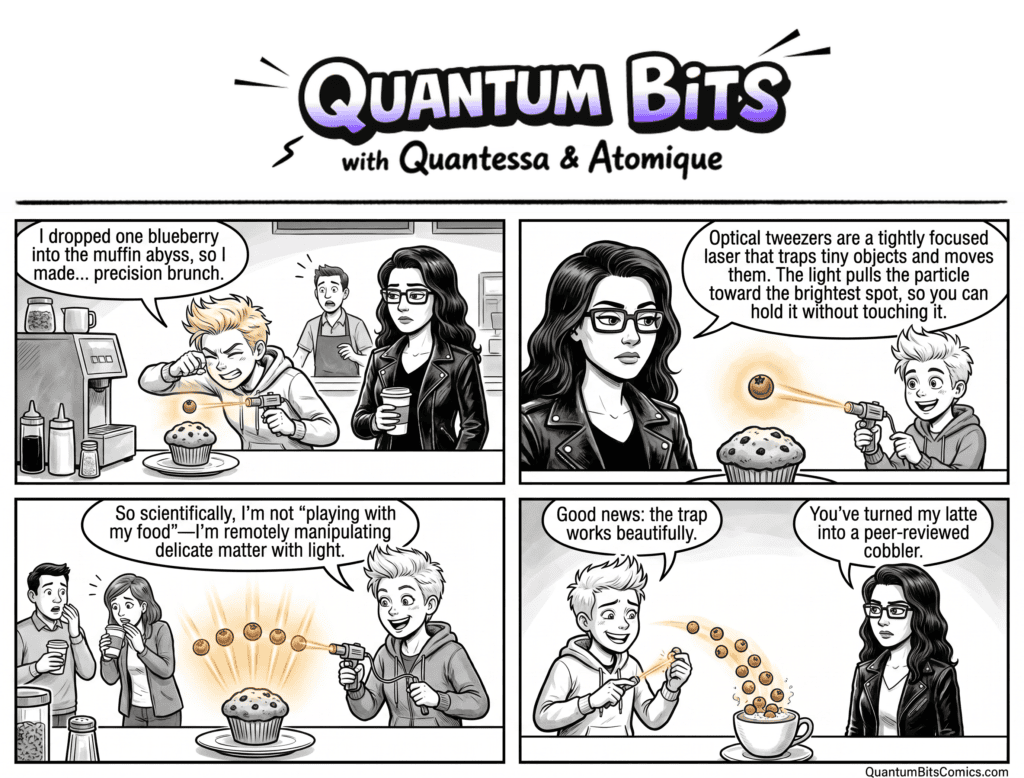
Neutral-atom quantum computers use individual uncharged atoms as qubits. Because these atoms carry no net electric charge, they do not repel each other, allowing researchers to pack large numbers of qubits into dense, configurable arrays. Individual atoms are trapped using The post Optical Tweezers first appeared on quantumbitscomics.com .
Read the full comic on Quantum Bits Comics
Share the tweez, because your inbox is empty during holidays.
Q-CTRL researchers have successfully executed a 100-qubit Quantum Fourier Transform (QFT) on IBM’s quantum hardware, doubling the previous record for experimental QFT implementations. This achievement demonstrates that sophisticated quantum algorithm components can function effectively at much larger scales than before, suggesting that meaningful computation is becoming feasible on current-generation quantum devices.
![[PAPER] Brazilian quantum researchers target sovereignty with R$69 million bet on software, sensing, and metrology—domestic cesium fountain clock marks technical stride, imported parts underscore lingering hardware gap](https://substackcdn.com/image/fetch/$s_!4UoN!,f_auto,q_auto:good,fl_progressive:steep/https%3A%2F%2Fsubstack-post-media.s3.amazonaws.com%2Fpublic%2Fimages%2Fb91562c3-70b2-4406-82ea-6762dca782f6_1200x600.jpeg "[PAPER] Brazilian quantum researchers target sovereignty with R$69 million bet on software, sensing, and metrology—domestic cesium fountain clock marks technical stride, imported parts underscore lingering hardware gap")
Brazil’s quantum strategy is clear: skip the arms race for headline-grabbing quantum hardware and double down on software, sensing, and metrology, where brains matter more than billion-dollar fabs. The country’s R$69 million (about US $14 million) in public investment is a rounding error compared to U.S. And Chinese budgets, but it’s being steered toward quantum software, communications, and enabling technologies like atomic clocks and sensors.
Recent research has challenged conventional approaches to quantum advantage by introducing more realistic benchmarks for quantum algorithms, particularly in quantum chemistry. A review published on arXiv by a consortium including HQS Quantum Simulations, ETH Zurich, and Fraunhofer IAF argues that quantum algorithms should model open-system dynamics—where molecules interact with their environment—instead of the traditional focus on idealized, closed systems. Another study from Fraunhofer IAF, published in Physical Review A, demonstrates that evaluating how quantum algorithms like the Quantum Approximate Optimization Algorithm scale with problem size is crucial for assessing practical quantum advantage.
Honda has led an early-stage investment round in Quemix, a Tokyo-based quantum computing startup, to accelerate the development of next-generation battery materials. This follows prior joint research between the two companies: in May 2025 they co-developed technology for reading quantum states, and by June 2026 created a quantum algorithm to speed up density functional theory calculations, a key approach in materials science. The investment is channeled through Honda Xcelerator Ventures and aligns with Honda’s carbon-neutrality goals.

Quantinuum and Oracle have formed a multi-year partnership to integrate Quantinuum’s latest Helios quantum computer with Oracle Cloud Infrastructure (OCI), aiming to support enterprise, research, and academic workloads in fields such as drug discovery, materials science, and financial modeling. Helios, a 98-physical-qubit trapped-ion system, will be deployed in a US-based OCI AI data center, providing direct, managed access to quantum computing within Oracle’s existing cloud services. The collaboration is designed to enable hybrid quantum-AI workloads, reduce energy consumption compared to traditional supercomputers, and simplify the adoption of quantum resources through seamless integration with OCI’s classical and AI environments.
Related coverage: Qunnect and Monarch Quantum announce partnership to commercialize deployable quantum networking infrastructure · Quanta Computer and Quantinuum enter partnership to co-develop infrastructure for large-scale quantum computing
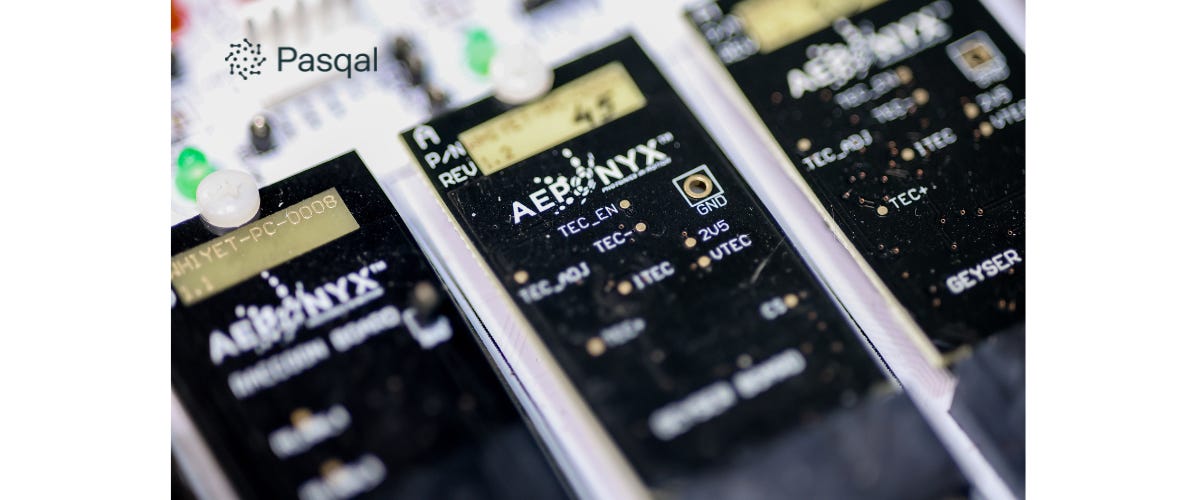
Pasqal announced a technological milestone in neutral-atom quantum computing by successfully trapping individual atoms using laser light from a photonic integrated circuit (PIC). This integrated approach aims to reduce the optical footprint of future processors by up to 50 times, enabling pathways toward large-scale, fault-tolerant quantum computers supporting more than 10,000 atoms and 100 logical qubits. This feat, developed in partnership with Aeponyx, involved generating four optical traps through a single chip to hold four individual rubidium atoms within a quantum processing unit.
GSMA and QCentroid have introduced the Quantum Computing Implementation Playbook for Telco Operators, aiming to guide telecom companies from awareness to practical quantum adoption. To support practical experimentation, GSMA and QCentroid are launching the Discovery Sandbox, offering accelerated and standard tracks where operators can test quantum applications, gain experience, and develop informed strategies. These initiatives are designed to help telco operators navigate early-stage quantum experimentation and readiness for future deployment.
New York State has launched a $60 million competition to establish up to four Regional Quantum Technology Commercialization Hubs, each eligible for up to $15 million, aiming to bridge the gap between quantum research and commercial deployment. The hubs will provide shared lab infrastructure, mentorship, and industry networks for early-stage companies, with applications due by October 2026. Announced by Governor Kathy Hochul, the initiative targets the so-called ‘Valley of Death’ where quantum startups often fail due to high infrastructure costs and lack of commercial traction despite scientific breakthroughs.
Tamil Nadu has formalized agreements with four quantum technology ventures as part of its strategy to establish a strong presence in the rapidly developing quantum computing sector. At the Vetri Tamil Nadu Investment Conclave 2026, the state signed memoranda of understanding with Quantum Integrated Machines—which will set up a major operation in Chengalpet in collaboration with the Indira Gandhi Centre for Atomic Research—and Chennai-based Quntrolsphere, which will focus on quantum control hardware. TriQuanta Labs is expanding its hybrid quantum computing R&D and engineering operations to Chennai, building on its existing bases in Hyderabad and Amaravathi.
Hefei Sizhen Chip Technology, operating as Silicon Quantum Chips, has secured over 100 million yuan (approximately $14.8 million) in Series B funding to advance its silicon-photonic quantum computing technology. Founded in 2020 and rooted in research from the University of Science and Technology of China, the company is developing both core quantum devices and full computing systems. The new investment will fuel research and development on 10,000-bit optical computing clusters and general-purpose quantum chipsets, with plans for a 5,000-bit product launch by 2026. The round was co-led by Goertek and Weihao Core Semiconductor, with additional support from several venture capital and local government-affiliated funds.
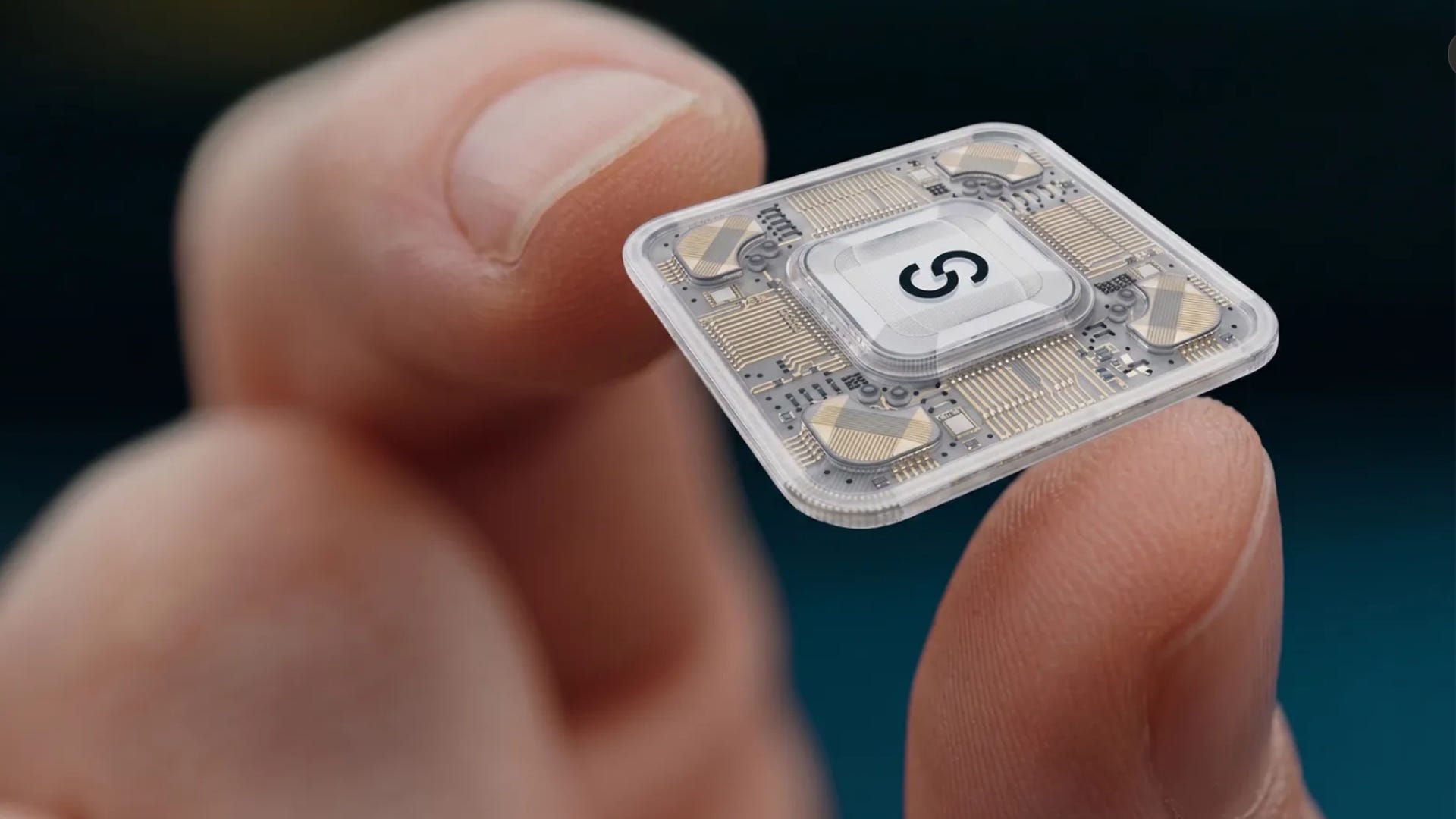
German startup Saxon Q has introduced what it claims is the world’s first portable diamond-powered quantum computer able to operate at room temperature without the need for cryogenic cooling, advancing accessibility in quantum computing. The device fits into a standard server rack and plugs into a conventional wall outlet, supporting up to 128 qubits, with plans for a 512-qubit system next year and ambitions to surpass 10,000 qubits after 2030. Unlike traditional quantum machines, it uses nitrogen-vacancy centers in synthetic diamonds as qubits, enhanced by sulfur co-implantation to improve qubit stability and control, reportedly reaching single-qubit fidelity of 99.98%.
No posts
Comments
Nothing yet. Say the first thing.
Sign in to join the conversation.