
Section 1
Netflix reported a second quarter that did almost nothing wrong. Revenue of $12.56 billion grew 13.4% and landed inside guidance. Operating margin of 33.4% came in slightly ahead of the company’s own forecast. Diluted earnings per share of $0.80 beat the consensus figure by a penny. Full-year revenue guidance was narrowed rather than cut, and the operating margin target of 31.5% was reaffirmed. Then the stock fell 7.3% on Friday to $68.95, touched an intraday low of $65.08, and closed at the lowest level in more than a year. The proximate trigger was a Q3 revenue guide of $12.86 billion — growth of 11.7%, the fourth consecutive quarter of deceleration from 17.6% in Q4 2025. The deeper context is that this is not a one-day event. Netflix has fallen roughly 46% from its July 2025 high and about 25% year to date, an unwind that began well before this print.
What the market is repricing is a change in the nature of the business. For two decades Netflix was a subscriber-growth story, and the subscriber count was both the engine and the scoreboard. That scoreboard is gone: the company stopped reporting quarterly membership figures in 2025, offering a 325 million milestone at year-end as a valediction, and on July 16 it announced that its semi-annual view-hours report will drop to annual frequency beginning in 2027. In its place sits a monetization story — price increases, a scaling advertising business, and a claim that Netflix reaches under 45% of addressable households and captures roughly 7% of its revenue opportunity. The question this piece exists to answer is whether that monetization engine is durable and high-quality enough to own at $68.95, when the growth is visibly slowing, the moat rests on a content library that must be repurchased at rising cost, and the disclosure needed to verify any of it is being withdrawn at precisely the moment scrutiny matters most.
Two framings deserve to be set aside at the outset. The first is that this is a premium-multiple stock meeting slowing growth — the familiar double-compression setup. It is not, or at least no longer: at $68.95 Netflix trades at roughly 19.5 times reported 2026 earnings and about 17.7 times enterprise value to EBITDA, well below where it has spent most of the past five years. Much of the de-rating has already happened. The second is that a 46% drawdown in a business compounding revenue at low double digits is self-evidently an opportunity. That conclusion requires the cash economics to be sound, and the cash economics are where the interesting work is. What follows argues the bull and bear cases at full strength, subjects both to a single empirical test on content economics, values the business on owner earnings with content spend treated as the competitive necessity it is, and renders one verdict anchored to price. The verdict is genuinely open, and the analysis below moved it more than once.
Section 2
Netflix is the largest paid streaming service in the world, serving an audience the company describes as approaching one billion people across more than 190 countries, and generating $48.4 billion of revenue over the trailing twelve months. Its revenue comes from monthly subscriptions across a tiered plan structure and, increasingly, from advertising sold against its ad-supported tier. The economics are those of a global distribution platform layered on top of a content studio: a largely fixed slate of series, films, live events, and now games and video podcasts is produced or licensed once and distributed at negligible marginal cost to every member in every market. That structure is why operating margin has roughly doubled since 2022, reaching 29.5% for the full year 2025 and a guided 31.5% for 2026.
The monetization transition is the defining feature of the current period. Price increases in the United States, Mexico, and Spain during the first half of 2026 have been absorbed with results management describes as consistent with prior changes. Advertising, which exceeded $1.5 billion in 2025, is expected to roughly double to approximately $3 billion in 2026 — still only about 6% of total revenue, with United States upfront commitments in advanced stages. Live programming is the acquisition instrument: an expanded National Football League slate, World Wrestling Entertainment, Major League Baseball events, and the 2027 FIFA Women’s World Cup account for just over 5% of content spend and roughly 1% of view hours, yet live events produced six of the ten largest new member sign-up days of the past five years.
The offsetting reality is the content model. Netflix expects to spend approximately $20 billion of cash on content in 2026, with content amortization growing about 10% and a guided cash-spend-to-amortization ratio of roughly 1.1 times. Free cash flow has inflected from years of deep negativity to a guided $12.5 billion for 2026 — though, as Section 5 establishes, that headline contains a large one-time item. Governance has shifted too: co-founder Reed Hastings left the board following the June 4 annual meeting, with longtime director Jay Hoag succeeding him as chairman, leaving co-chief executives Ted Sarandos and Greg Peters and chief financial officer Spencer Neumann to run the business without their founder for the first time. In December 2025 Netflix agreed to acquire Warner Bros. and HBO Max for roughly $83 billion; in February 2026 it declined to match a superior bid from Paramount Skydance and collected a $2.8 billion termination fee instead. Netflix is a genuinely excellent business by most measures. It is not, on the strictest reading of the quality-compounder filter, a capital-light one — and that distinction is the whole debate.
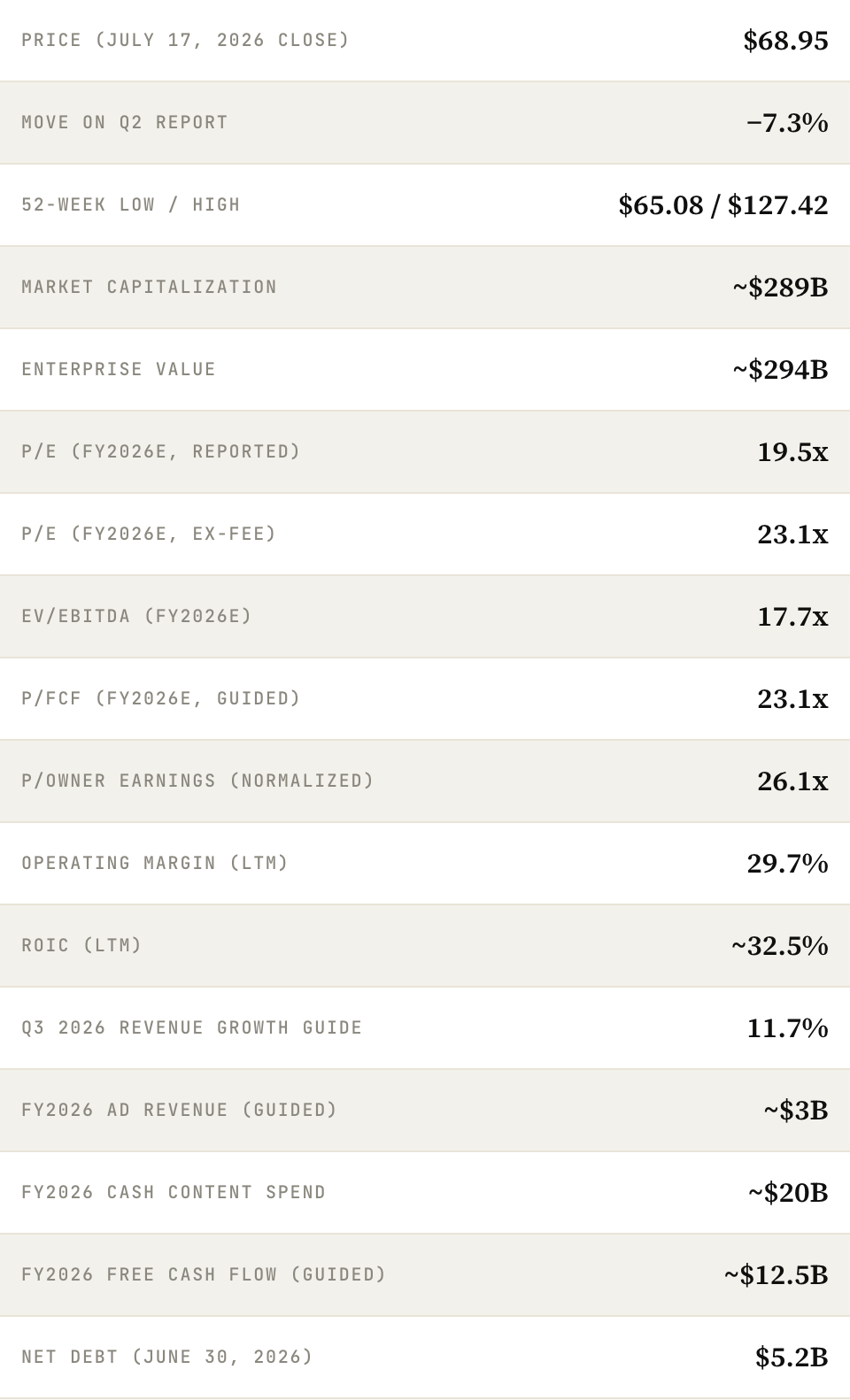
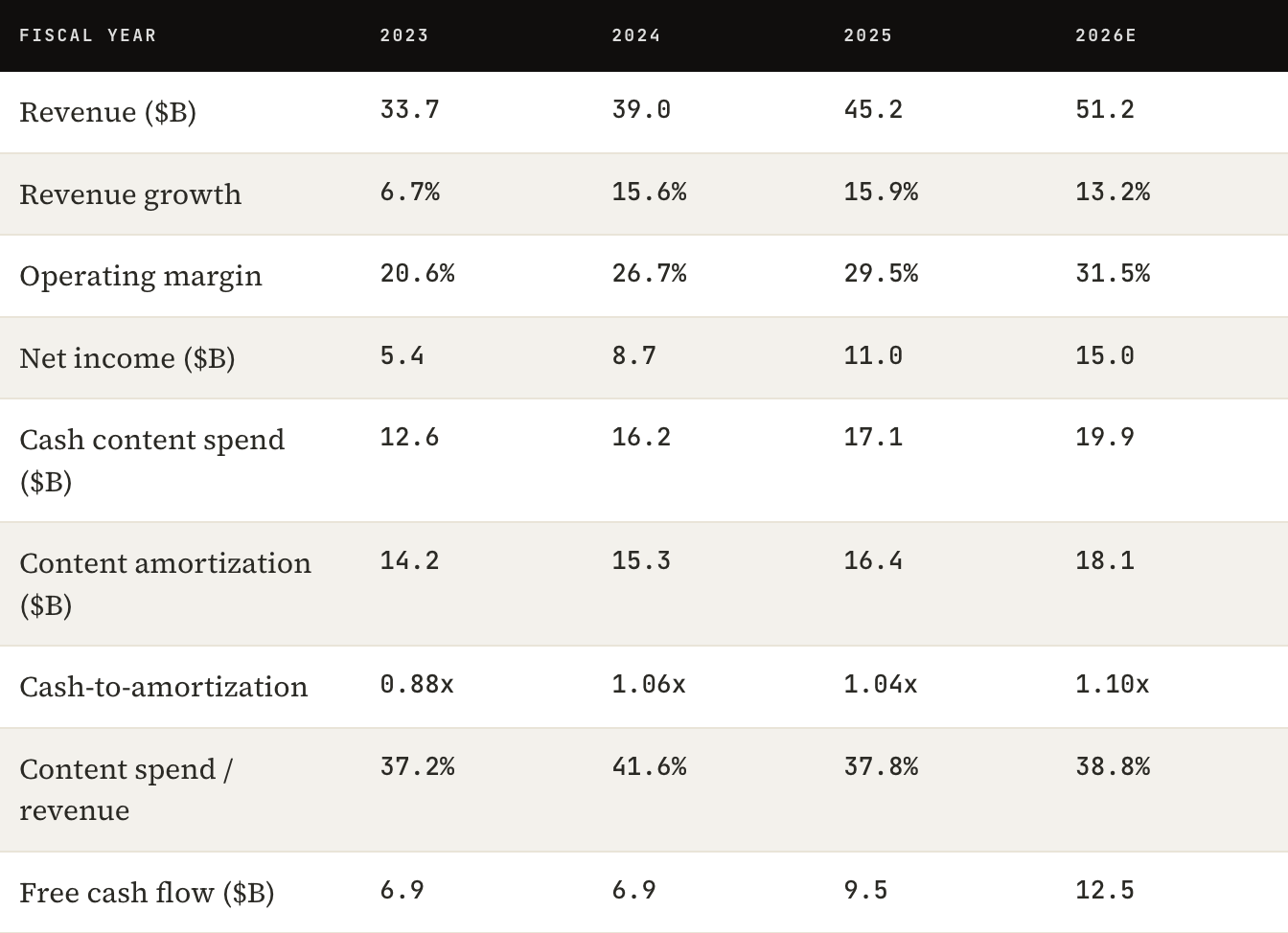
Sources: Netflix FY2025 Form 10-K consolidated statements of cash flows; Q2 2026 shareholder letter (July 16, 2026). FY2026E revenue is the midpoint of the guided $51.0–$51.4 billion range; operating margin is guided. FY2026E content amortization applies the guided ~10% growth; cash content spend applies the guided ~1.1x cash-to-amortization ratio. FY2026E net income and free cash flow both include the $2.8 billion Warner Bros. Discovery termination fee received in Q1 2026 — see Section 5.
Section 3
Comments
Nothing yet. Say the first thing.
Sign in to join the conversation.