
A Form 13F is a useful document. It is also one of the most misread filings in American markets. Most quarterly coverage treats a snapshot as conviction, a dollar change as a trade, and an absence from the table as an absence from the portfolio. All three are unsafe.
The document rewards a reader who knows its edges. Learning them takes about fifteen minutes.
The Form
Section 13(f) of the Securities Exchange Act of 1934 requires large institutional managers to disclose certain holdings every quarter. The rule is short. A manager with investment discretion over at least $100,000,000 of Section 13(f) securities, measured on the last trading day of any month, must file within 45 days of each quarter end.
Two details get lost. The threshold counts Section 13(f) securities only, so total assets under management do not decide whether a manager files. And measuring on any month makes the test a high-water mark. Cross the line once and the obligation follows into the next year, even if the portfolio shrinks.
Domicile is no escape. A foreign manager using US interstate commerce files the same form on the same schedule. That is why European and UK firms appear in EDGAR.
The covered list is narrower than “stocks.” It runs to US exchange-traded equities, closed-end fund shares, ETF shares, and certain convertible debt, equity options, and warrants. The SEC publishes the official list each quarter.
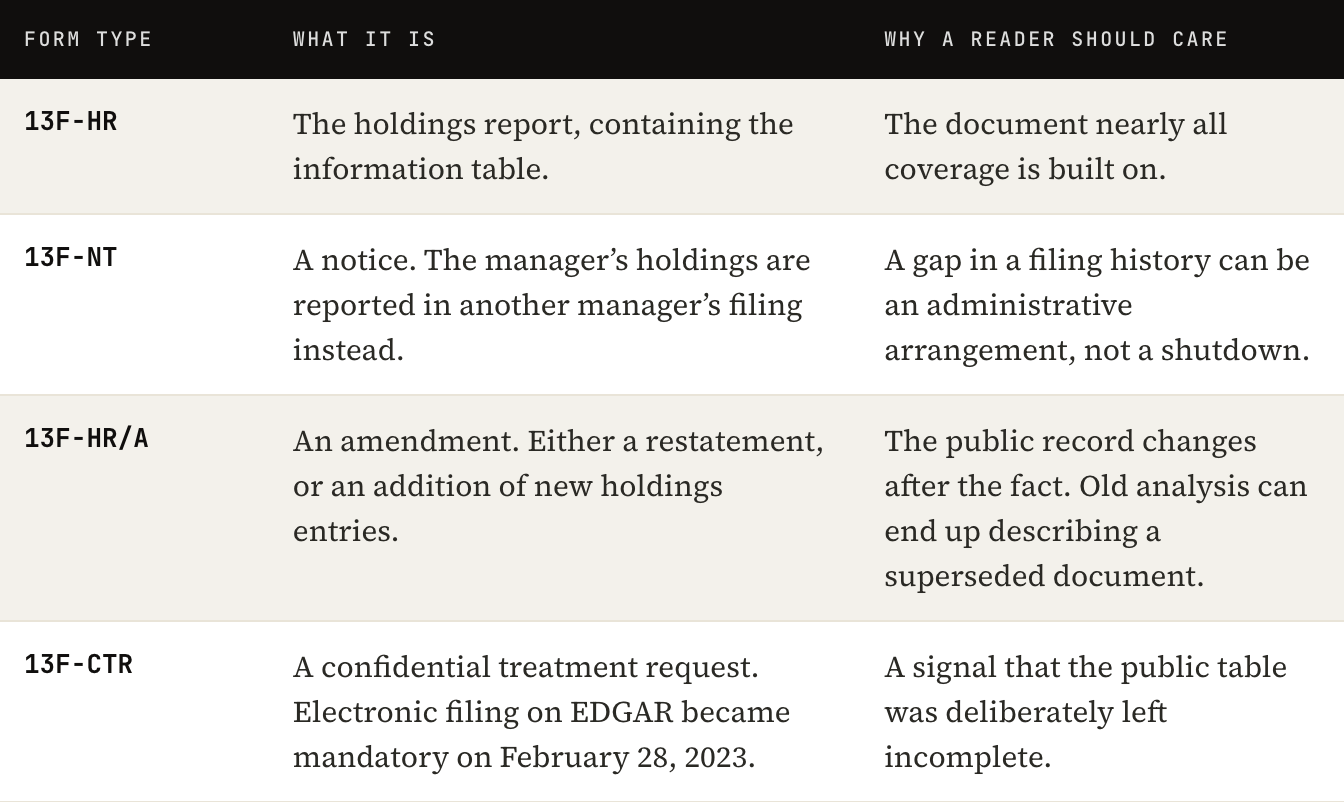
The Commission grants no extensions. A late filer is simply told to file as soon as possible. One practical result is that filings arrive across the whole 45-day window. Some managers file within a week of quarter end. Others use every available hour.
Pulling One Yourself
Every filing is free on EDGAR. Search the manager by name, find its Central Index Key, then filter the filing history by form type. Berkshire Hathaway files under CIK 0001067983. Valley Forge Capital Management files under 0001697868. The process is the same for anyone.
Open the information table, not a summary of it. The XML version carries the CUSIP, share count, and reported value for every position. It is the only version guaranteed to match what the manager submitted. Aggregators are useful for speed. They sit downstream of this document and inherit anything they get wrong.
The Omissions
The form captures long positions in covered US securities. Everything else in a manager’s book is invisible. That list is longer than most readers assume.
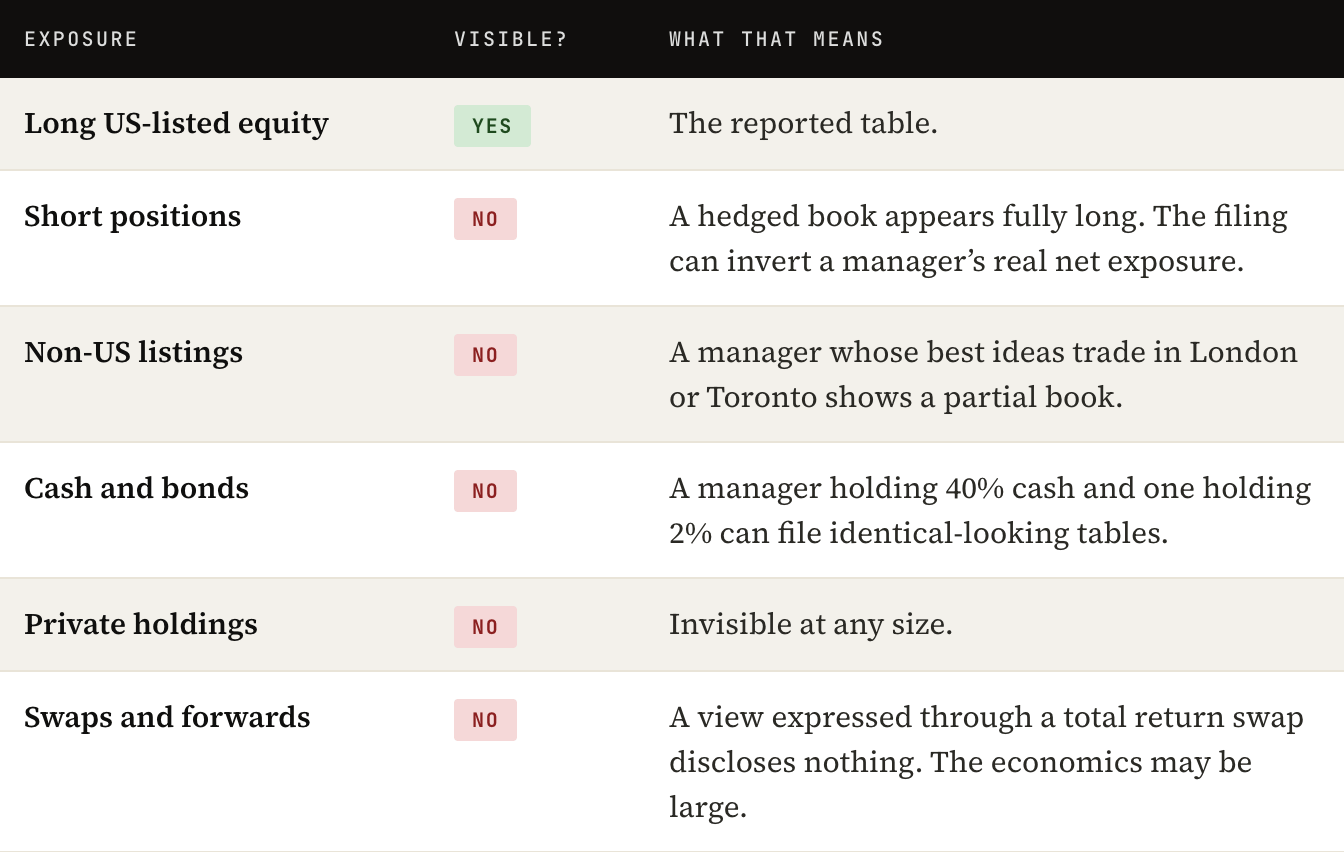
The derivatives gap matters most for the managers who draw the most attention. An activist can build a stake through swaps, then convert to common stock later. The accumulation is invisible. Only the result shows up. The filing is accurate and still misleading as a portrait of the portfolio.
Options sit in between. The table has put and call fields, so some options exposure does surface. The catch is valuation. An option line is reported at the market value of the underlying shares, not the premium paid.
What an Option Line Looks Like
Akre Capital Management’s June 2026 filing lists Salesforce twice. One line is common stock: 717,799 shares, valued at $112,450,391. The other is a call position on 100,000 shares, valued at $15,666,000. Divide each by its share count and both give $156.66, because the option line is measured against the underlying stock rather than the premium.
The filing therefore reports 20 entries and a total of $5,122,536,308. Screens that drop option lines show 19 positions and about $5.11 billion instead. Same manager, same quarter, two different portfolios.
Dual listings cause the opposite confusion. Ticker labels are added downstream by data vendors, so a Toronto symbol can appear against a US-registered security without meaning the form has started capturing foreign markets. Constellation Software trades on the Toronto exchange alone. It will never appear in any 13F, whoever owns it. That absence carries no information at all.
A Misreading, Documented
The Q2 2026 filings supply a clean example. Pershing Square Capital Management reported 18,852,064 shares of Howard Hughes Holdings for the quarter ended March 31, 2026. Three months later the consolidated Pershing Square Inc. filing shows 27,852,064 shares of the same company, split across two lines. Read the totals and a manager added 47.7% to a large position.
Read the lines instead. One of them is 18,852,064 shares, matching the prior quarter exactly. The other is 9,000,000 shares attributed to a group that includes Pershing Square HHH Holdings, LLC. The apparent buying is a reporting boundary moving, not capital being deployed.
The same filing contains a real change that looks similar and is not. Alphabet appears in the March filing across two share classes, 344,102 shares in total, and is absent in June. That one is an exit. Distinguishing the two takes both documents and about ten minutes.
Confidential Treatment
This is the least understood feature of the form. It undermines the reader’s most basic assumption: that the table is complete.
A manager may apply to leave specific positions out of the public filing. Where the SEC grants the request, the public document carries a line saying confidential information has been omitted and filed separately with the Commission. The table looks ordinary. Entries are missing, and the reader cannot tell which ones or how large.
Confidentiality is temporary. When it expires or is denied, the manager must file an amendment adding the hidden holdings back, within six business days. The record eventually corrects itself. It corrects itself late.
Berkshire Hathaway is the instructive case, because the record runs both ways. The Division of Investment Management denied Berkshire’s request covering the quarter ended September 30, 2002, and the Commission affirmed that denial on review in August 2003. Berkshire has also been granted confidentiality more than once. Amendments filed in 2000, 2003, and 2006 exist purely to add holdings back once protection lapsed. Each one is a retroactive admission that the original public filing was incomplete.
The Phillips 66 episode showed the mechanism in public. Berkshire built a stake past the 5% threshold, and the position stayed undisclosed well after the fact, shielded on the intervening filing.
How Often This Happens
Confidential treatment is not exotic. The most recent published figures come from a Freedom of Information Act request covering 2011 through 2014. The SEC received 116 requests in 2011 and granted 99. In 2012 it received 127 and granted 110. In 2013 it granted 119 of 138. In 2014 it received 172 and granted 143. The approval rate held near 85% throughout.
The Division has separately warned that filers wrongly assume approval is automatic on a thin showing, and that the standard demands a substantiated case. Both things hold at once. The bar is real, and most applicants clear it.
For a reader, the rule is short. Check the cover page before trusting the table.
Whether the regime is defensible depends on which half of it is under discussion. The principle is sound. A manager accumulating a large stake over several quarters has a real interest in not broadcasting the program mid-execution, and that interest belongs to the end investors, who pay the higher prices that front-running produces. Temporary confidentiality with a mandatory catch-up amendment is a reasonable way to balance that against disclosure. The record does correct itself.
The administration is harder to defend. An approval rate near 85%, sustained across four years, sits awkwardly beside a standard the Division describes as demanding and non-automatic. A bar that four applicants in five clear is not obviously filtering anything. The Berkshire denial is instructive precisely because it is unusual enough to have generated a published order.
The consequence for a reader is unchanged. A 13F is a document whose completeness is a variable. Treat the table as a disclosure. An inventory is a different thing.
Silence
Three absences do most of the damage. None of them involves a missing holding.
No Cost Basis
The form reports market value at quarter end and share count. Nothing shows what was paid. A position called a “new buy” everywhere may have been bought at a price that no longer exists. The manager’s decision and a reader’s decision to copy it are then different acts.
No Timing Within The Quarter
A holding that appears was owned on the last day. That is all. It says nothing about whether the buying happened in April or in the final week of June. A holding that vanishes was sold somewhere across three months, and the difference between the first day and the last can be very large.
No Reasoning
Position changes carry no stated cause, and the likely causes are not all analytical. Redemptions force selling. Risk limits force trimming. Tax treatment, mandate rules, and index requirements all move share counts without any change of view. A manager who cut a position by a fifth may have lost confidence. He may have met a withdrawal request.
So the safe sentence is the dull one. The position was cut by a fifth. Anything added to that is inference, and whoever writes it should label it as such.
Mechanics
These errors show up in aggregator tables and in the coverage built on them. Each is avoidable by anyone who opens the filing.
Thousands versus dollars
Older filings report value in thousands. Form amendments effective January 3, 2023 changed rounding to whole dollars. Pershing Square’s June 2012 filing states a table value of $7,588,756 in thousands. Its June 2026 filing states 19,465,692,772 in dollars. A time series crossing that change without normalizing is wrong by a factor of a thousand.
Who is actually filing
Where several affiliated managers share discretion, only one needs to report the securities, and the others point to it. The reporting entity can change. Pershing Square Capital Management, L.P. filed 11 holdings worth $13.71 billion for Q1 2026 under its own CIK. For Q2 2026 those holdings moved into a consolidated filing by Pershing Square Inc., covering six affiliated entities and reporting 15 entries worth $19.47 billion. Tracking the old CIK alone shows a manager who appears to have stopped filing.
Entries are not issuers
The table identifies securities by CUSIP, and one issuer can occupy several lines. Separate share classes carry separate CUSIPs. Options sit on their own line. Holdings attributed to different affiliated managers are also split out. A “15 position” filing can hold fewer than 15 companies.
Amendments and restatements
The record is revisable. A restatement can change reported figures after the original has been analyzed and written up, and holdings released from confidential treatment can appear quarters later.
The Signal
Piling up caveats can tip into a claim the evidence will not support, which is that the filing is worthless. It plainly is not. Inside its boundaries the document is reliable, and the boundaries are knowable.
A 13F establishes three things with confidence. It shows what a manager held in covered US securities on a specific date. It shows how those position sizes changed against the prior filing. And it shows where incremental capital went, allowing that flows and mandates can drive changes that look like decisions.
Concentration is what turns that into signal. A filing listing two hundred names says little about any one of them. The manager may hold most of them for reasons unconnected to individual conviction. A filing listing seven names is a different document. Every position in it survived a decision to hold seven things instead of eight.
The same logic limits how much one quarter should move a view. Managers who hold businesses for a decade produce quarters where nothing happens. A filing showing no change from a long-term owner is itself a data point. A quiet filing is often the most consistent one.
The arithmetic makes the case better than any preference could. Valley Forge Capital Management reported seven positions in June 2026, an average weight above 14%, with the largest three accounting for 64.8% of the book. Nothing in that portfolio is incidental. Every share-count change is a decision somebody had to defend.
Set that against a filer holding two hundred names at an average weight of half a percent. Most of those lines exist because a model, a mandate, or an index put them there. The information per position collapses. The two filings are the same form and not remotely the same document.
Concentration should set the reading order. A $3 billion book holding seven things says more per line than a $300 billion book holding two thousand.
Worked Example
Valley Forge Capital Management filed its Q2 2026 report on August 14, 2026. Seven positions. Small enough to check by hand.
The reported value fell 7.68%, from $3.38 billion to $3.12 billion. The position count held at seven. Nothing was bought new and nothing was sold out. A quick read calls that a quiet quarter and moves on.
The share counts say otherwise.
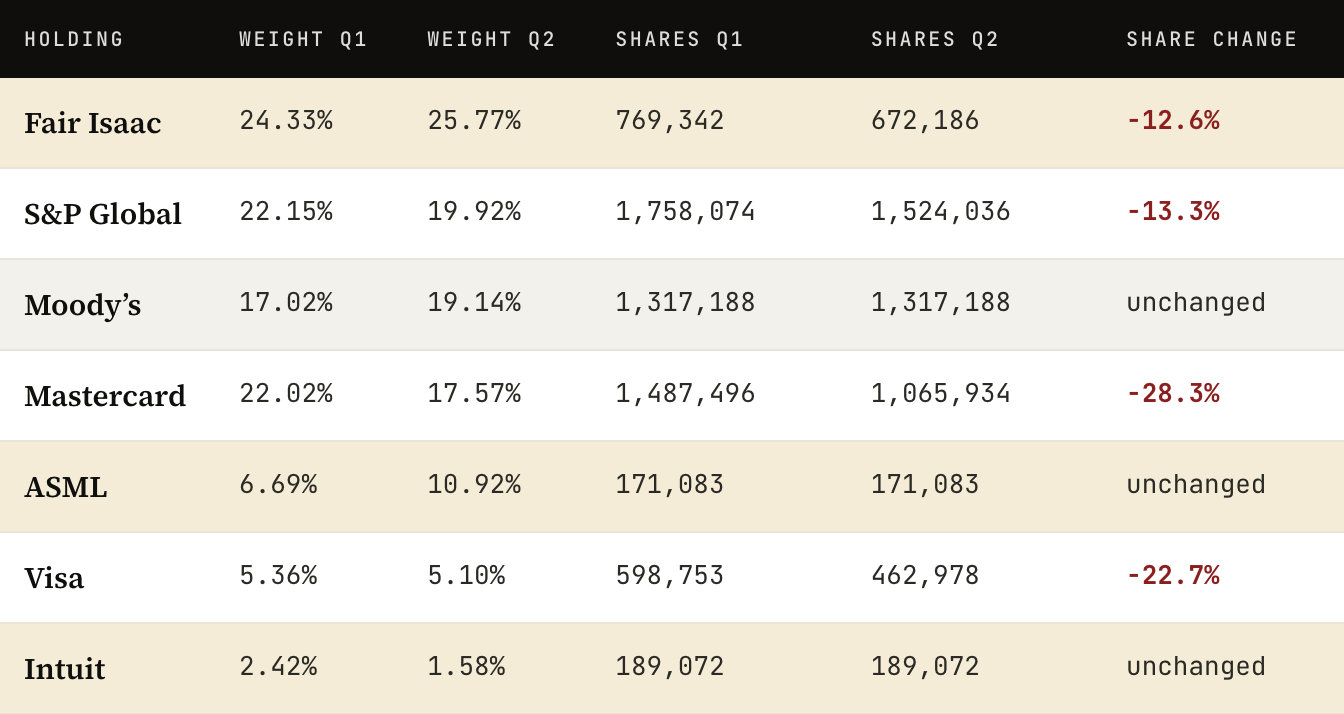
Three lines carry the whole lesson.
ASML. Not one share traded. The weight climbed from 6.69% to 10.92%, a jump of more than four points. On a weights-only screen this looks like a major new commitment. The manager did nothing. The stock rose roughly 51%.
Intuit. Also untouched. The weight fell from 2.42% to 1.58%. On the same screen that reads as a trim. The stock fell roughly 40%.
Fair Isaac. Here the trap shuts from both sides. Valley Forge cut the position by 12.6%, and the weight still rose, from 24.33% to 25.77%. Selling and a rising weight, same quarter, same name.
The rank order shifted as well. Moody’s passed Mastercard into third place. That was not the market doing the work. Mastercard was cut by 28.3% while Moody’s was left alone.
Every one of those readings needs share counts. Weights alone produce three wrong answers out of three.
Where This Disagrees With Published Work
Fair Isaac is the largest position in this portfolio. A Quality Equities deep-dive published on August 4 reached a Watch rating, on a base intrinsic value near $1,007 and a buy-below near $805 after the standard 20% margin of safety.
The filing implies a June 30 price of $1,194.78. That sits 18.6% above the base fair value estimate and 48.4% above the buy-below. A manager holding the name at 25.77% of a seven-stock book is taking the other side of that call, and the position sizing says he is doing it with conviction.
Akre Capital reached the same conclusion by a different route. Its June filing cut twelve of twenty positions harder than Fair Isaac, against a median share reduction of 5.2% across the book. Fair Isaac was cut 0.5%. In a quarter when the reported portfolio shrank 16.5%, that name was left almost untouched.
Two responses are available. The first is that these managers are paying up for quality and accepting a lower forward return. That is a coherent position, and it is not the one this publication runs. The second is that the valuation work is wrong. If so the error sits in the growth assumption, since the discount rate and the margin of safety are both house policy and neither is in dispute. Valley Forge did trim 12.6%, which is a valuation-sensitive owner acting like one. The gap between that trim and a 48.4% premium to buy-below is the whole of the disagreement.
Reading Rules
Share counts before weights. Weights move on price. Only share counts prove a trade happened.
Changes over levels. Where new capital went matters more than which holding is largest. The largest holding is often just the oldest.
Concentration as the conviction filter. Read the ten-name filers closely. Treat the two-hundred-name filers as background.
Facts as facts, reasoning as inference. Where a manager has explained a position in a letter or an interview, cite it and date it. Everything else is a hypothesis and should look like one.
One discipline governs all four. A 13F generates research questions, and copying one is not a strategy. By the time it is public the data is at least six weeks old, the cost basis is unknown, the horizon may be measured in decades, and the position may already be gone.
What the filing can do is point at a business worth a week of work. That is a considerable thing for a public document to do. It is also the whole of what it does.
Quality Equities publishes independent research for informational purposes only. Nothing published constitutes investment advice or a recommendation to buy or sell any security. The author may hold positions in securities discussed.
Thanks for reading! This post is public so feel free to share it.
No posts
Comments
Nothing yet. Say the first thing.
Sign in to join the conversation.