
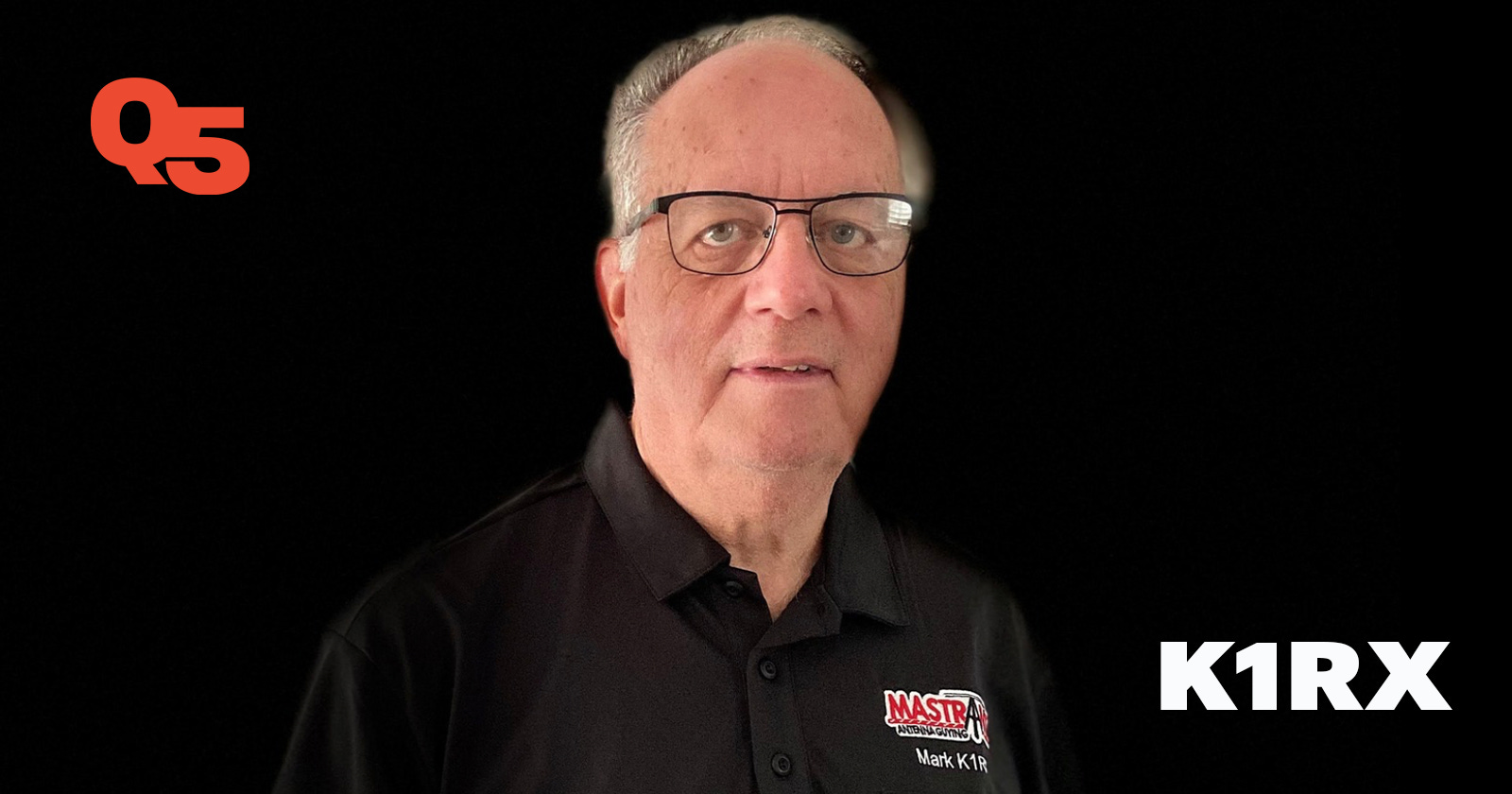
There are only 94 names in the CQ Contest Hall of Fame.
That number alone tells you this is not a casual honor. The list includes some of the most accomplished amateur radio operators in the world, people who helped shape modern contesting through operating skill, technical innovation, station building, and mentorship. This past weekend at the annual Contest Dinner during the Dayton Hamvention, Mark Pride K1RX joined that group.
And even if you have never entered a contest in your life, operators like Mark matter to you.
Contesters are often the people pushing amateur radio furthest. They stress-test radios, antennas, propagation theories, software, ergonomics, operating techniques, remote stations, and human performance under pressure. They discover what actually works. The rest of the hobby eventually benefits from it.
Want to learn how to hear weak signals in noise? Build a better antenna system? Understand propagation? Improve your operating efficiency? Manage a pileup? Spend time with serious contesters.
That reality became obvious to me after interviewing many of the best operators in the world over the past several years. Again and again, I found that contesters weren’t simply competitive operators. They were extraordinary teachers, experimenters, and problem solvers.
Few embody that better than Mark Pride K1RX.
During the Hall of Fame induction ceremony, Doug Grant K1DG described Mark not just as an elite operator, but as a mentor who consistently opened his station to newer contesters and patiently taught them the fundamentals of the craft. That mentorship theme surfaced repeatedly throughout the nomination process and became one of the defining reasons for his induction.
For me, that story really began in March 2025.
Mark and I recorded a video called Don’t Touch the Mouse! Contesting Tricks from K1RX. I expected it to appeal primarily to experienced contesters. Instead, operators from every corner of amateur radio responded. POTA activators. Casual DXers. Newly licensed hams. Operators returning to the hobby after decades away. They weren’t necessarily interested in winning contests. They wanted to understand how top operators think.
That single conversation eventually grew into a seven-part Q5 Worldwide Ham Radio series on contesting fundamentals. But almost immediately, it became clear the real subject was not contesting itself. It was accelerated learning.
Mark repeatedly returned to the idea that contesting compresses experience. A single contest weekend can teach lessons that might otherwise take months or years of casual operating to discover. As he explained during the series, “Contesting just makes it happen a whole lot faster.”
That line became the backbone of the entire project.
The first episode deliberately started broad, because one of the biggest misconceptions in amateur radio is that contesting exists separately from the rest of the hobby. Mark argued the opposite. Contesting accelerates nearly every important skill in amateur radio: propagation awareness, operating discipline, antenna understanding, software fluency, station design, and decision making under pressure. Rather than presenting contesting as an isolated niche, he framed it as one of the fastest learning environments in the hobby itself.
From there, the conversation became more practical. One reason Mark resonates so strongly with newer operators is that he rarely romanticizes contesting. He breaks it down into fundamentals: receiving capability, station noise, ergonomics, propagation awareness, operating rhythm, pileup management, and realistic expectations. He emphasizes that casual operating often hides station weaknesses. A quiet Wednesday afternoon can convince you your setup is excellent. Contest weekend tells the truth.
That lesson hit home for me personally.
After returning to amateur radio through Parks on the Air, I quickly realized that contesting forces you to evaluate your station and operating in a completely different way. It is no longer simply about making contacts. Suddenly, you are thinking deeply about antennas, receive performance, propagation, timing, ergonomics, and efficiency under pressure. The process can be humbling, but it is also incredibly educational.
That naturally led into one of the central ideas of the series: learning how to evaluate your own station honestly, without ego and without discouragement. Mark repeatedly stressed that improvement starts with understanding where you are right now, not where you wish you were.
Once operators begin seeing their stations more clearly, the next challenge becomes expectations. This may have been one of the most important episodes in the entire series because contesting can quickly become discouraging if goals are disconnected from reality. Mark talked openly about geography, propagation, antenna limitations, category selection, and time constraints. He emphasized that smart contesting is not necessarily about trying to beat the world champion. Sometimes it is about beating your own previous effort, improving your operating consistency, or simply learning how your station behaves under pressure.
That perspective matters because it keeps contesting enjoyable and sustainable instead of intimidating.
As the series progressed, Mark began focusing less on equipment and more on awareness. One of his recurring themes was what he called “situational awareness,” the ability to constantly process what is happening around you while operating. Who is hearing you? Which bands are opening? Is your rate slowing down? Is your receive antenna helping or hurting? Are you creating unnecessary friction in the exchange? That awareness, he explained, separates operators who simply make contacts from operators who truly control a frequency and manage a pileup efficiently.
This was also the point in the series where the deeper psychology of contesting started to emerge. Contesting is not simply about transmitting faster. It is about recognizing patterns, adapting quickly, and making hundreds of tiny decisions correctly over long periods of time.
What separates Mark from many elite operators is his patience with people at the beginning of that learning curve.
During his Hall of Fame acceptance speech, he talked about how intimidating a serious contest station can feel to newcomers. Then he described watching operators arrive at his station barely able to manage a handful of contacts per hour before eventually leaving capable of running rates they never thought possible.
That transformation matters because confidence matters.
By Episode Five, the focus shifted directly onto operating skill development itself. Mark encouraged operators to stop waiting for the “perfect station” and instead begin practicing deliberately with whatever they already have. He talked about short contests, CW Ops sessions, stress-testing your station during special events, improving keyboard discipline, eliminating bad habits, and learning to think ahead while operating. One of the most fascinating concepts he introduced was “parallel play,” listening to skilled contesters and mentally logging contacts alongside them simply to train your ear and operating rhythm.
The message was consistent throughout: operating skill is developed intentionally, not magically.
From there, the series moved into one of the most important accelerators in contesting: multi-operator stations. Mark strongly emphasized the value of operating alongside experienced contesters, particularly for operators limited by HOAs, apartments, budgets, or noise. Multi-ops, he argued, compress learning even further because tribal knowledge gets transferred naturally through shared experience. You hear how elite operators think. You see how stations are organized. You learn strategy, pacing, teamwork, and discipline in real time.
Perhaps most importantly, he reminded viewers that they do not need to arrive as superstar operators. Curiosity, enthusiasm, and willingness to learn are often enough.
One of the most interesting parts of our series explored the overlap between Parks on the Air and contesting. Mark immediately recognized that many POTA activators already possess core contesting skills: pileup management, portable operating, fast decision-making, efficient logging, and improvisation under real-world constraints. The difference is often scale and duration, not ability.
That observation feels increasingly important as POTA continues to grow worldwide. Many operators who currently identify as activators may eventually discover they already possess much of the operating foundation contesting requires.
The final episode brought the series full circle by directly connecting those two worlds. Rather than viewing POTA and contesting as separate cultures, Mark described them as deeply related operating experiences. Both reward efficiency, adaptability, technical problem solving, and composure under pressure. For many operators, POTA may ultimately become the gateway into contesting rather than an alternative to it.
It was a fitting conclusion because the entire series consistently emphasized growth rather than labels.
That theme carried directly into Mark’s Hall of Fame speech, where he encouraged station owners to actively bring new people into their shacks, teach patiently, and help newer operators overcome intimidation. In many ways, that may ultimately become Mark’s most lasting contribution to contesting.
For all the discussion about optimization, strategy, antennas, logging software, and operating rate, Mark continually returns to one word: fun.
“The first word that comes to mind is fun,” he said during his acceptance speech.
That line matters because contesting is often misunderstood from the outside. People hear rapid-fire exchanges and assume it is cold or mechanical. Spend time around serious contesters, however, and you discover something very different: adrenaline, camaraderie, problem solving, teamwork, exhaustion, humor, creativity, and lifelong friendships built around shared experiences on the air.
That is ultimately what the CQ Contest Hall of Fame recognized this weekend.
Not simply Mark Pride K1RX’s operating accomplishments, but his willingness to shorten the learning curve for everyone behind him.
And amateur radio is better because of it.
This entire contesting fundamentals series with Mark K1RX was proudly supported by DX Engineering, a company that has long understood that amateur radio grows when operators have access to better tools, better stations, and better mentorship. Whether you are building your first HF station, improving a contest setup, or simply trying to hear one more weak signal through the noise, DX Engineering continues to support operators at every stage of the journey.
If you found this story valuable, consider subscribing to Q5 Worldwide Ham Radio and sharing this piece with another operator who might benefit from it, especially someone newer to contesting or still figuring out where they fit within amateur radio.
One of the goals of Q5 has always been to shorten the learning curve by bringing experienced operators, builders, mentors, and innovators into the conversation. The more people who join that conversation, the stronger the hobby becomes.

Comments
Nothing yet. Say the first thing.
Sign in to join the conversation.