
There are contests where the outcome feels inevitable by Sunday morning, when the scoreboard has settled into a familiar shape and the last few hours are little more than confirmation. And then there are contests like CQ WPX SSB 2026, where the result is forged in quieter ways—through small decisions, unexpected problems, and fleeting openings that only one operator fully exploits.
At the top of the North America Single-Operator All-Band High Power category, the margin between first and second would be less than a million points. But the story of how that margin emerged is less about the final numbers than about everything surrounding them: a station nearly compromised by something as improbable as a kite string, another held together through a cascade of amplifier failures, and two operators who understand each other well enough to recognize, even from different islands, when the balance has shifted.
What follows is drawn heavily from their own 3830 write-ups—two parallel accounts that, when read together, reveal not just what happened, but how it unfolded in real time.
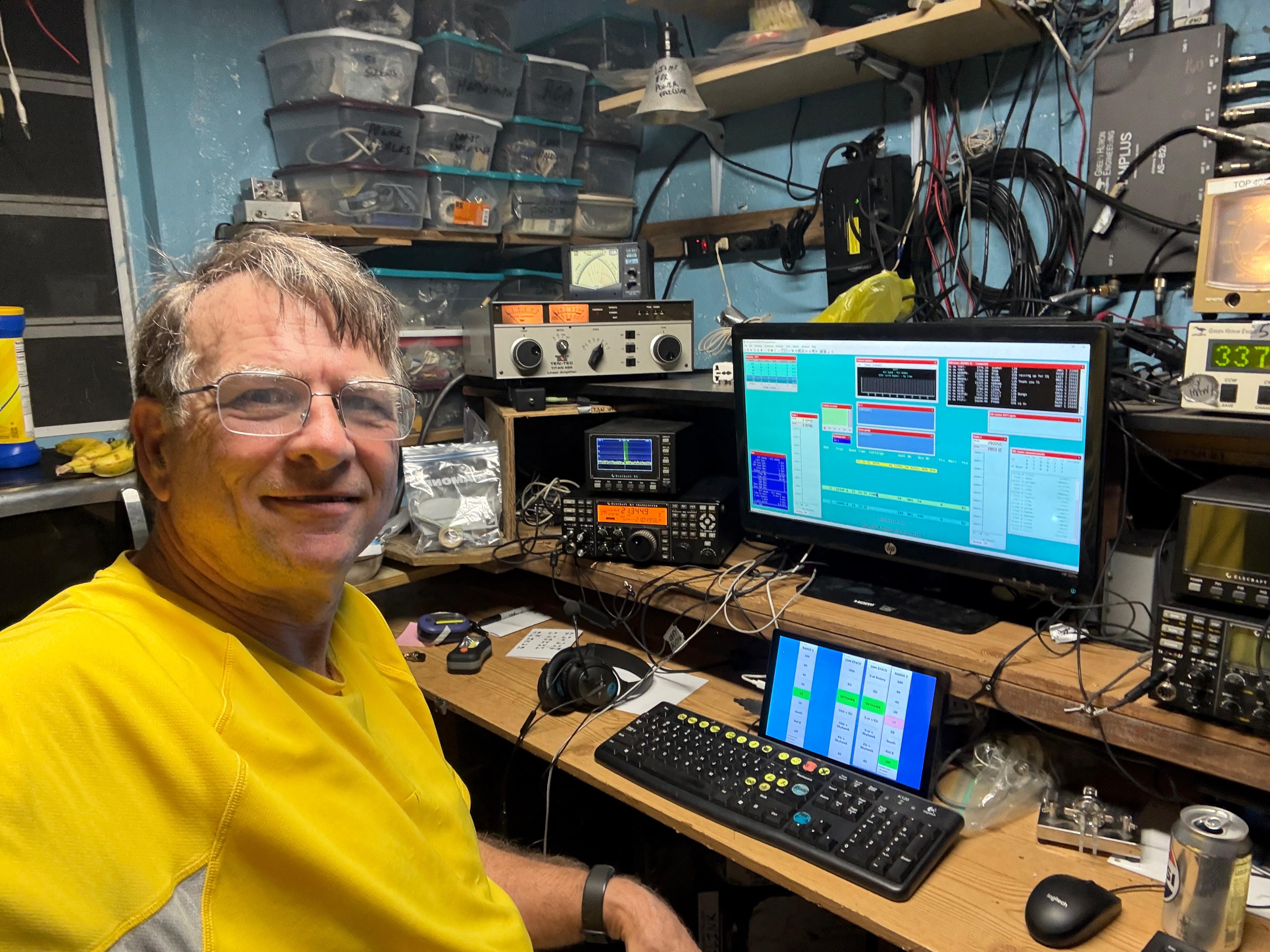
Randy Thompson K5ZD operating as V47T and Tom Georgens W2SC as 8P5A, have spent decades refining the craft of contesting to a level where results are rarely accidental. Both are fixtures at the top of major competitions, and both bring distinctly different operating styles to the same objective.
Randy’s approach is “let’s go and see where it takes us.” From his previous home station in Massachusetts (now Ohio) and from top-tier contest locations around the world, he has built a reputation for precision—maximizing multipliers, minimizing wasted motion, and making decisions that hold up not just in the moment but across an entire contest. A perennial WRTC contender and the vice chair of WRTC 2014, he operates with quiet control.
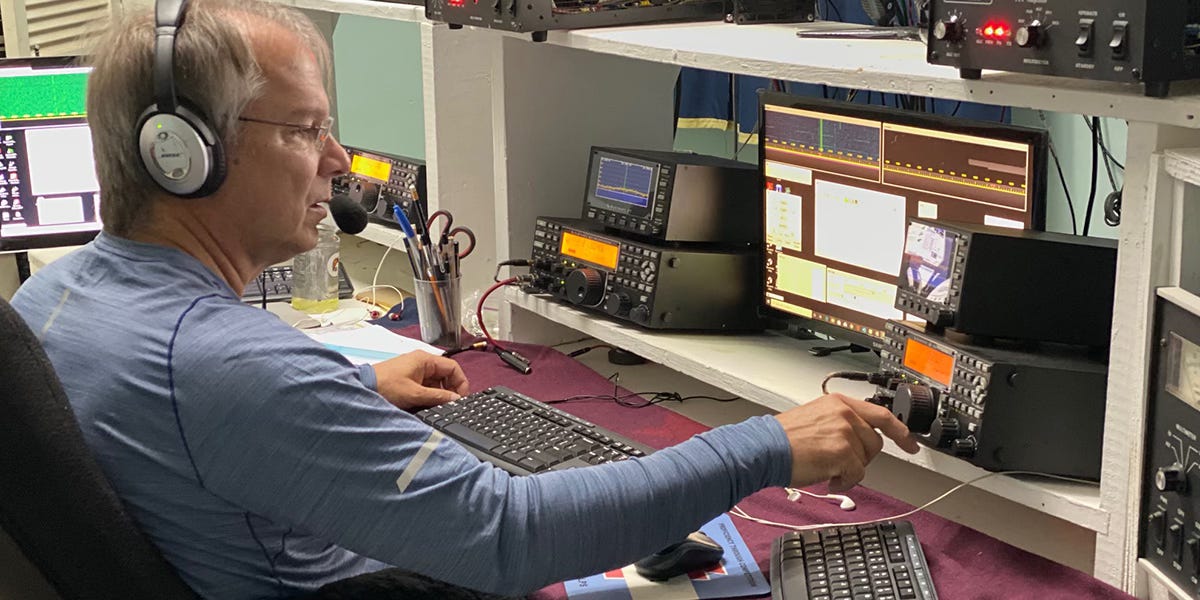
Tom, operating from Barbados as 8P5A, represents a different kind of mastery. His style is deliberate and systematic. He is as comfortable sustaining high-rate runs on the upper bands as he is leaning into the low bands for six-point opportunities, and his use of SO2R and 2BSIQ techniques allows him to layer contacts in ways that amplify strong conditions into dominant ones.
Both are very focused, skilled and experienced enough to deal with the variables of station and propagation.
They are not simply competitors. They have been teammates at WRTC and will be again in 2026. That familiarity sharpens rather than softens the competition. Each knows how the other thinks, how the other reacts, and how dangerous the other becomes when conditions align.
By the end of the weekend, the results (submitted) were clear:
8P5A (W2SC) — 6,315 QSOs, 1,356 prefixes, 23,858,820 points
V47T (K5ZD) — 6,087 QSOs, 1,400 prefixes, 23,002,000 points
Tom’s advantage came from volume, particularly on the higher bands. Randy’s edge in multipliers kept the contest close. But those numbers, on their own, don’t explain why the gap opened—or why it never fully closed.
To understand that, you have to begin before the first CQ.
In the days leading up to the contest, Tom nearly chose not to travel at all. The accumulated fatigue of multiple trips, combined with obligations at home, made staying back and operating remotely an attractive alternative. The station in Barbados had been in good condition just weeks earlier, and preliminary testing suggested that remote operation would work.
But the decision to go, driven in part by personal considerations, proved consequential in a way that only became clear upon arrival.
Approaching the station just before dark, Tom noticed what appeared to be a loose wire near the top of the tower. Closer inspection revealed something stranger: a length of blue rope wrapped around the 40-meter beam. In Barbados, kite flying is a seasonal pastime, and the most plausible explanation was that a kite line had become entangled in the antenna. More troubling was what had happened next. In attempting to free it, someone had pulled hard enough on the line to rotate the beam approximately 45 degrees within its clamp.
The antenna was still functioning, but compromised. The rope itself was beyond reach from the tower.
What followed was a rapid, improvised repair: a call to the tower crew, the arrival of a 120-foot manlift, and a same-day fix that freed the line and restored the antenna’s alignment. By midday, the station was back in proper operating condition. Had Tom remained at home, the issue would have gone undetected, and the contest would have been run with a subtle but significant handicap.
It is the kind of problem that rarely appears in post-contest statistics, but one that can shape them all the same.
Randy’s preparation, alongside station owner Andy N2NT, in St. Kitts followed a more familiar arc for Caribbean contesting: a blend of routine maintenance and the kind of unexpected technical challenges that seem to arrive on their own schedule. As he notes, keeping a station operational in that environment requires constant attention, and even well-prepared setups can become fragile under pressure.
There was an early breakthrough. A persistent noise issue on 20 meters, traced to a nearby FM transmitter, was finally resolved when the faulty unit was taken offline. For the first time in years, the band was quiet, opening up operating possibilities that had long been constrained.
But the gain was offset by a more immediate problem. The station’s amplifiers—aging but serviceable TenTec Titan 425 units—began failing in succession. Components blew. Power supplies failed. At one point, smoke emerged from a unit during testing. By the eve of the contest, the available equipment had effectively been reduced to a collection of partially functional parts.
Attempts to assemble a reliable second amplifier failed just hours before the start. Faced with diminishing options, Randy made a pragmatic decision: he would operate with a single radio and a single working amplifier, carefully managed to avoid further failures. Output power would be reduced, and band changes would be approached cautiously.
In a category where his primary competitor would be leveraging full SO2R capability, the constraint was significant. It did not eliminate his chances, but it altered the shape of the contest he would be able to run.
The contest did not begin with momentum. It began with uncertainty.
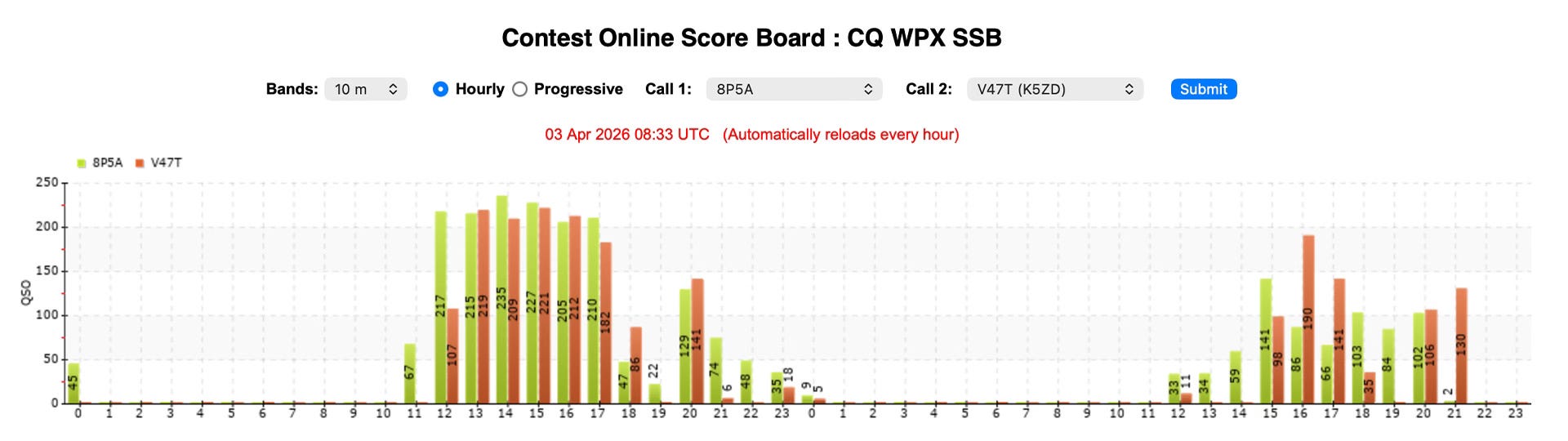
Tom started where the script said he should—on 10 meters, where conditions had been strong just weeks earlier—but almost immediately, something felt off. The signals were there, but the rate wasn’t. “I made some Q’s on 10, but it was slow,” he writes, a simple line that captures the early discomfort of a band that looks right but doesn’t behave.
The move to 15 meters offered no relief. “Could not get anything to happen there either,” he recalls.
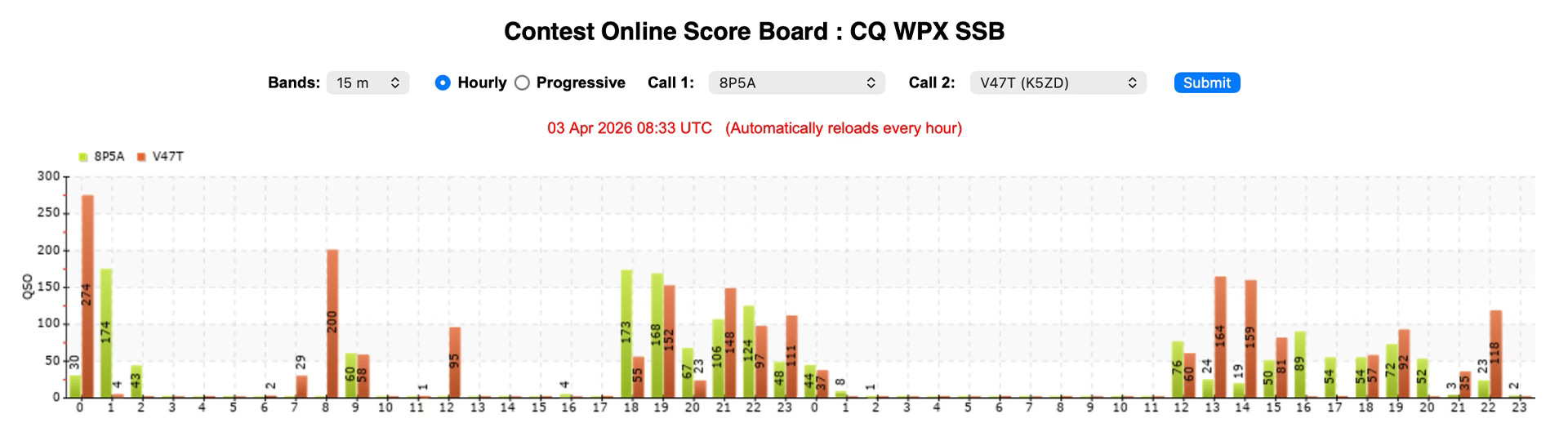
At that point, the contest stops being procedural and starts becoming reactive. There’s no clean plan—only decisions made in real time. “Not knowing what to do, I went to 20,” he writes, and it’s there, finally, that the contest begins to take shape, with callers answering and a run beginning to form.
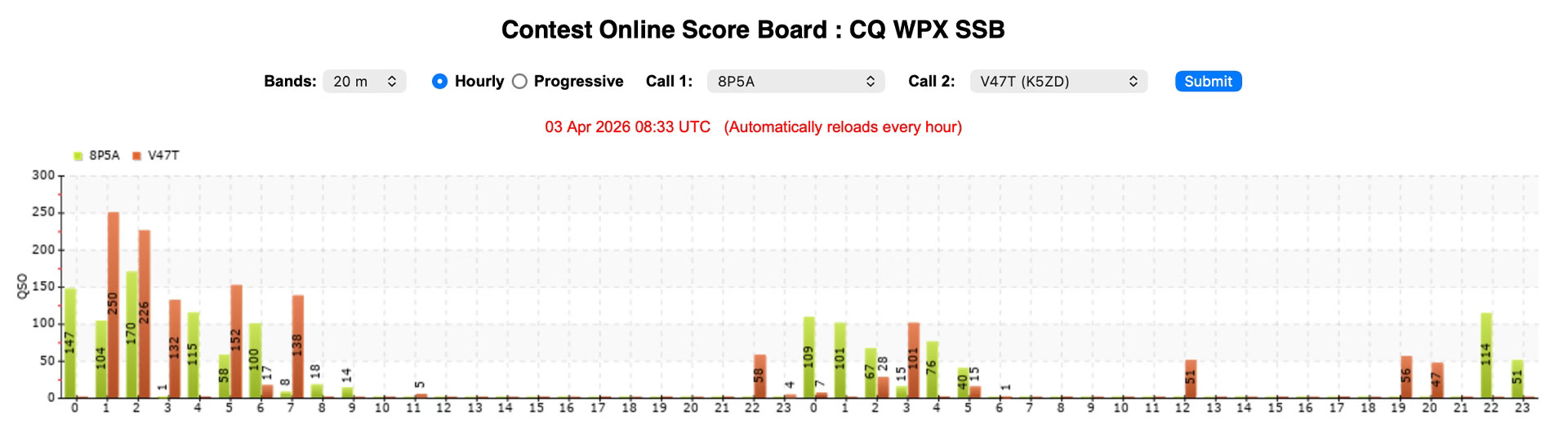
Even then, the instability didn’t disappear. It lingered. “I do not recall ever being on three bands in the first hour,” he notes, and the next stretch was spent not settling in, but bouncing—back and forth between 15 and 20, trying to hold onto rate as conditions refused to cooperate.
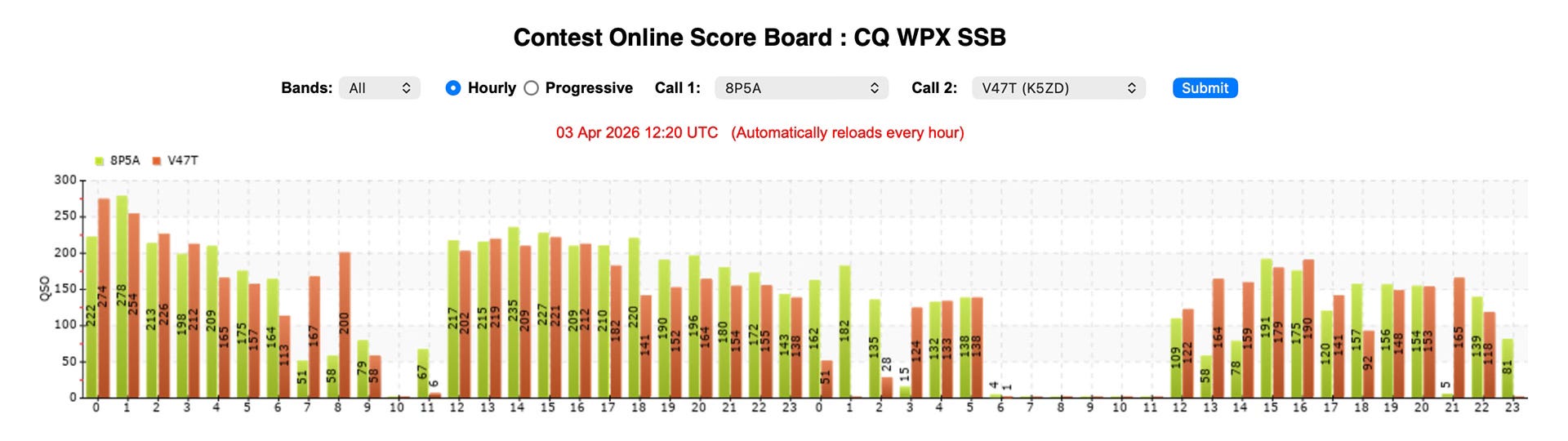
Randy experienced a similarly tentative start. With only one radio available, each band change carried additional risk; the decision to leave a productive frequency was no longer easily reversible, and uncertainty about what lay on the next band added a layer of strategic friction. He began on 15 meters, but as conditions settled, moved to 20 early in the second hour, establishing it as a more reliable foundation and reducing the need for constant transitions.
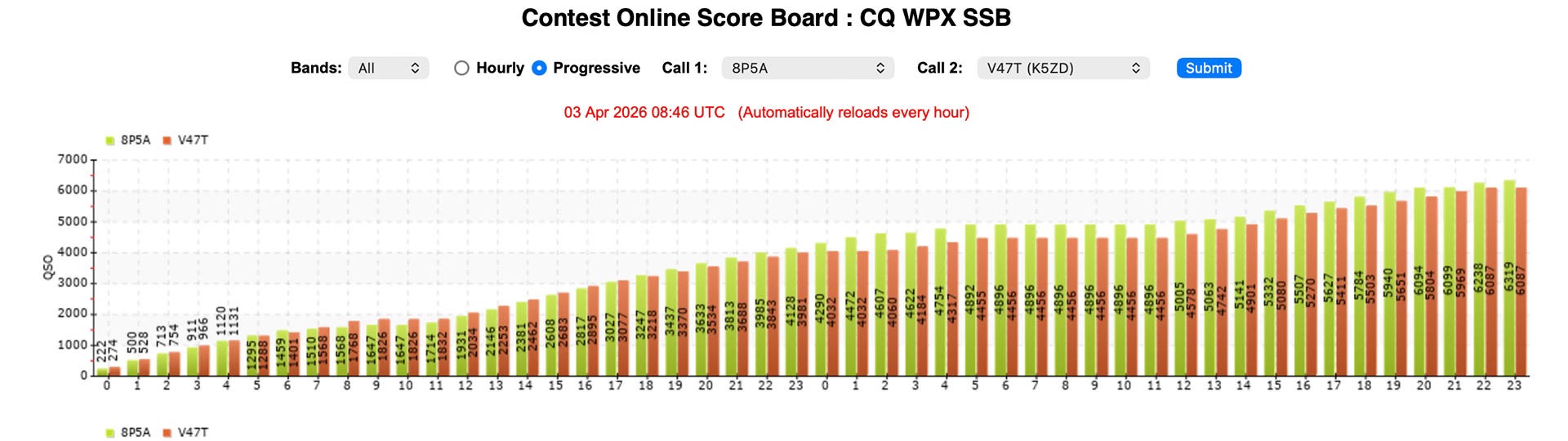
At this stage, neither operator had established a decisive advantage. The contest remained open, its outcome dependent on how each would navigate the opportunities—and limitations—that followed.
The first meaningful separation emerged on the low bands, where conditions diverged sharply between the two stations.
From Barbados, Tom encountered a strong opening on 80 meters into Europe, producing high-value six-point contacts at a sustained rate. It was, by his account, the highlight of the contest—a period where the combination of propagation and positioning aligned perfectly.
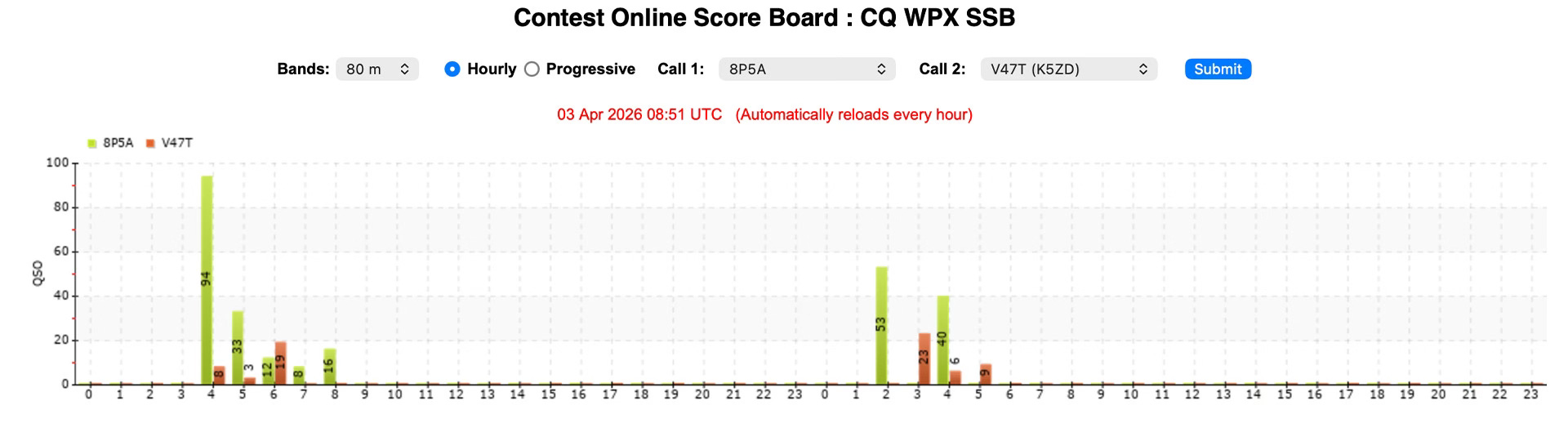
In St. Kitts, Randy found far less opportunity on 75/80 meters during the same period. The band produced little, and the gap in low-band output began to widen. It was not the result of a strategic misstep, but of conditions that favored one location over another at a critical moment.
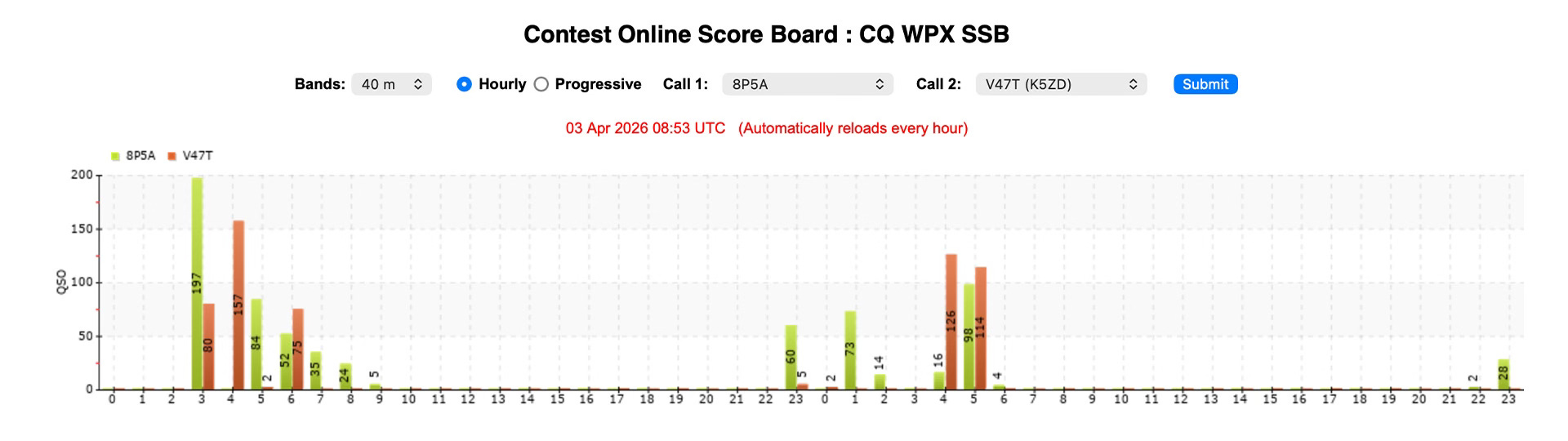
Such differences are not unusual in Caribbean contesting, where small geographic separations can produce meaningful variations in propagation. But in a contest decided by margins, their impact can be decisive.
By Saturday, the contest had become a direct contest between the two operators, each aware of the other’s progress.
Randy describes watching the scoreboard as the shift occurred. Over the course of several hours, 8P5A began to gain steadily—ten, then twenty QSOs per hour—until the lead changed hands. Unable to secure a strong running frequency and facing the limitations of his single-radio setup, he saw the gap open in real time.
A brief break for rest only reinforced the trend. Upon returning to the radio, he found himself more than 200 QSOs behind, a deficit that reflected not a single mistake, but a series of small advantages accumulating on the other side.
Tom’s account is more restrained when it comes to the scoreboard. He notes that he only checked it briefly in the evenings, not watching it continuously until Sunday morning—a reflection of the balance many operators try to strike between awareness and distraction. The intensity of his operating during this period came less from reacting in real time and more from managing conditions as they unfolded, moving between bands and working to maintain rate as opportunities appeared.
The second night gave both operators a chance to recover ground.
Randy found success on 40 meters, carving out a productive run despite heavy congestion. It was physically and mentally demanding operating, but it produced the kind of sustained output needed to remain competitive.
Tom, meanwhile, continued to extract value from the low bands, where conditions remained favorable. His willingness to stay longer, even as it complicated his off-time strategy, reflected a clear assessment of where the highest returns lay.
As the contest moved into its final phase, both operators were still within reach. The outcome would depend on how effectively each could navigate the diminishing returns of Sunday.
Sunday brought softer conditions and harder decisions. The high bands, particularly 10 meters, failed to match their Saturday performance, and rates became uneven.
For Tom, the challenge wasn’t just rate—it was time. In CQ WPX, single operators are limited to 36 hours of operating within the 48-hour contest window, and how those off hours are used can be as decisive as anything that happens on the air. The strong low-band conditions earlier in the weekend had already complicated his plan, pulling him deeper into the night and forcing a more careful accounting of what remained. By Sunday, every decision carried trade-offs: when to step away, when to stay, and whether to preserve time for one last push on 40 meters into Europe.
For Randy, those same constraints collided with a different reality. The limitations of a single radio became more pronounced as the contest slowed. Without the ability to search and run simultaneously, each lull carried greater consequence, and the cost of staying on the air during marginal conditions was higher. Off-time, in that context, became less about optimization and more about preservation—an opportunity to reset rather than to reposition.
In the end, their strategies diverged. Randy used his remaining off time to conclude his effort slightly early, a decision grounded in what the bands—and his station—were giving him in that moment. Tom continued through to the end, managing his remaining hours carefully and preserving the flexibility for one last attempt to extract value from the low bands.
When the logs were submitted, the result reflected the accumulation of everything that had come before: Tom’s higher QSO total securing the win, Randy’s multiplier advantage keeping the contest close but not enough to overcome the difference in volume.
Randy’s own assessment on 3830Scores.com was direct, crediting both station differences and operating approach. Tom’s reflection was more personal, framed as much by the events surrounding the contest as by the contest itself.
In isolation, the difference between first and second can be reduced to numbers. But contests like this resist that simplification.
A kite string that forces a last-minute repair. A set of amplifiers that never fully hold together. A low-band opening that appears for one station and not another. A decision to sleep—or not—at a particular hour.
Individually, each is minor. Together, they define the outcome.
This time, that story didn’t unfold in private. Both operators chose to be visible, their progress tracked in real time on the online scoreboard. Hour by hour, anyone paying attention could watch the gap open, close, and shift again—could see when one found rate, when the other answered, and when momentum changed hands.
What once would have lived only in post-contest write-ups became something shared. A contest within the contest, not just for those behind the radios, but for those following along—learning, studying, and, for many, feeling the pull to be part of it themselves.
In a few months, Randy Thompson K5ZD and Tom Georgens W2SC will sit on the same side of the table at WRTC 2026, working together rather than against each other. But this contest serves as a reminder of what each brings to that partnership: discipline, adaptability, and an ability to extract performance from imperfect conditions.
Over 36 hours, from two islands separated by only a few hundred miles, they pushed each other without speaking—through rate, through timing, through instinct. And, this time, they allowed the rest of the community to watch it happen.
In the end, the margin between them was not the result of a single moment, but of many—each one small enough to miss unless you know where to look, and now, increasingly, visible to anyone who wants to learn how it’s done.
Watch past interviews with Tom 8P5A and Randy K5ZD:
Contests like this are decided in moments, but built long before the first CQ—on towers, in shacks, and in the quiet work of making a station ready for whatever the weekend brings. From replacing hardware on a tribander to chasing down noise sources and keeping aging amplifiers alive, the difference between frustration and performance often comes down to preparation.
That’s the part of the story companies like DX Engineering have quietly supported for years—providing the components, tools, and infrastructure that make stations like 8P5A and V47T possible in the first place. When everything is working, you don’t think about it. When it isn’t, it’s all you think about.

Comments
Nothing yet. Say the first thing.
Sign in to join the conversation.