
Throughout the centuries, a vast majority of us were introduced to life in the world by our family. They are the ones who not only cared for our physical needs, but they also witnessed our first smile, guided our first steps, and listened to our first words. They are the first ones to truly see…us.
We know very little about creation’s first family. We are told that the first children born to the first parents, Adam and Eve, were brothers. Cain, the elder, became a farmer, while Abel focused his talents on shepherding. And unfortunately, these brothers reveal another first that has been passed down through the generations.
One day, after tending to their crops and herds, the brothers decided to thank God by offering gifts from their flocks and fields. This was also the first act of worship recorded in the Bible. According to the story recounted in Genesis 4, Cain brought an offering from his fields, and Abel offered God the firstborn of his flock.
In the course of time, Cain brought to the Lord an offering from the fruit of the land, and Abel also brought his (offering) from the firstborn of his flock, and from their fat portions. ~Genesis 4:3-4a
Abel and his offering caught God’s attention. According to Genesis, Abel brought the very best of his flock and the very best portions from his flock to God. The hours he spent shepherding, feeding, cleaning, and protecting his flock were offered to God as a tangible reflection of his gratitude. Abel saw his work as a shepherd to be a blessing from God.
When God considered Cain’s offering, the reaction was not as favorable, and this angered Cain. The Hebrew phrase used here tells us that Cain’s anger burned inside him like a raging fire. Now, anger, like fire, cannot exist in a vacuum. Fire needs fuel, and anger needs an object. So, where is Cain’s fiery anger directed? Our first assumption would likely be God. After all, God was the One rejecting Cain’s offering. Or perhaps Cain was angry with himself. After all, Cain is the one who decided what he would offer to God. And when we take a closer look at the description of the offering Abel prepared, we find a noticeable difference. Abel had offered God the very best, the fat portions from the firstborn of his flock. Cain, it seems, simply brought an offering, not necessarily the best or the worst, but some. Perhaps Cain viewed his work in preparing the harvest selfishly. After all, Cain was the one who planted the seeds (that God designed) in the ground (that God created), watered them (with water God provided), and harvested the grain (which grew according to God’s intricate plans). So, if Cain did all the hard work in the field, why should God get the best of his crops? In essence, Cain’s offering was a mirror reflecting his relationship with God. And, like many of us, when our self-serving motives are exposed, defensiveness and anger are dangerous byproducts.
God knows Cain is upset and angry. And like a flame exposed to oxygen, Cain’s anger quickly and aggressively spreads to engulf the innocent. But rather than turning His back on Cain, God offers Cain a warning. God tells Cain that he needs to ask himself why he is angry because anger is the first stop along a deadly journey and a fire that can suddenly burn out of control. So, despite being the One who was wronged, God takes the initiative to help Cain.
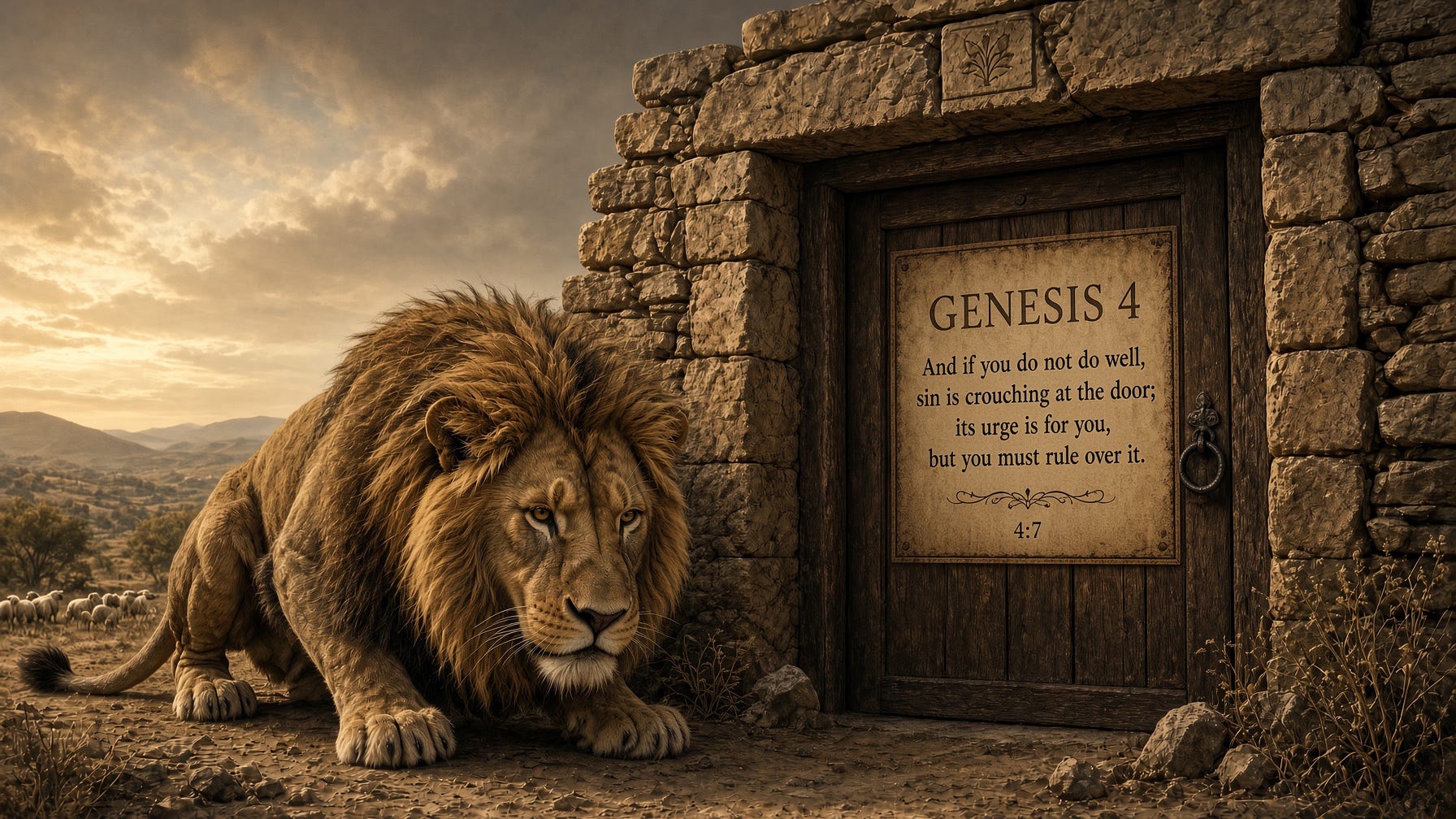
The Lord said to Cain, “Why are you angry? And why has your face fallen? Is it not the case that if you do well, (you will be) lifted up? And if you do not do well, sin is crouching at the door; its urge is for you, but you must rule over it.”
~Genesis 4:6-7
The real problem is not getting angry. No matter how hard we try to avoid anger, we will fail, repeatedly. We all get angry from time to time. However, what we choose to do with our anger is the real test. Anger, like a slow, kindling fire, must be dealt with immediately before it consumes the entire forest. In his letter to the earliest Christians living in the city of Ephesus, Paul offers two simple insights regarding anger. First, anger is not a sin. But anger carves a path in our soul that leads directly to sin. Second, anger is so volatile and sinister that it needs to be dealt with today, before the sun sets. Anger’s ticking clock is measured in minutes and hours, not days or weeks. If we fail to deal with our anger immediately, anger has a way of dealing with us and those around us in unimaginable ways.
Despite God’s warning, Cain allows his anger to burn deep inside him. And soon, that raging fire searches for more innocent kindling to consume. Cain’s anger turns into jealousy and hatred for his brother. Abel agrees to follow his brother in a field where, with one swift blow, Cain waters the ground with the blood of his own brother.
The first brothers.
The first family.
The first murder.
Up to this point in the story, Cain has not spoken a word to God. God has spoken to Cain. God has warned Cain. God has reached out to Cain. But Cain has not uttered a single word to God, until God asks him to locate his brother.
Then the Lord said to Cain, “Where is Abel, your brother?” He said, “I do not know. Am I my brother’s keeper?”
~Genesis 4:9
The first words Cain speaks to God are a lie. “I don’t know. How is that my problem?” And I wonder if Cain was also thinking, “I saw how much You liked his offering! If You wanted to protect him, You should have watched out for him! It is Your job to watch him, not mine!”
God’s response to Cain is heart-wrenching.
“What have you done? Listen, your brother’s blood is crying out to me from the land!” ~Genesis 4:10
“Can you hear that, Cain? I can. It is the sound of your brother’s blood, My creation, crying out to Me from the ground! Listen, can you hear it reverberating throughout history? Listen to what you have done!” Cain’s anger is burning out of control and consuming everything in its path. In Genesis 4:10, the Hebrew word that is translated “blood” is actually plural. Abel’s “bloods” are crying out to God from the ground. While this might sound a bit strange, it captures the real impact of Cain’s sin. With the death of Abel, all of his potential, his future, his children, and his children’s children have also perished.
Today, we search for ways to quell the violence, end oppression, stop hatred, eliminate jealousy, and so on. However, in our search, we often forget, or perhaps choose to forget, one foundational truth: how we see God and how we see others can never be separated. If we do not see others as our brothers and sisters in the great human family created by God, we are choosing to ignore our core, fundamental identity. We are, and always have been, created in the image of God. Therefore, our life’s journey should explore how we can best honor that image in ourselves and others. If we don’t, the consequences are catastrophic.
Jesus told us that loving God and loving others are the two greatest commandments we have been given. As we see in the tragic story of Cain and Abel, how we honor God and how we act toward others are not independent. The further God is pushed out of our social discourse and communities, the hotter the sinister flames of anger and hatred will grow.
In his anger, Cain asked God, “Am I my brother’s keeper?”
I think he knew the answer, and so do we.
We hope you will join us for our upcoming episode of The Trail: Encounters. In Episode 20 we will explore an question that was once asked by Pontius Pilate, and continues to echo throughout the centuries, “What is truth?”
To receive our latest posts right to your inbox, please subscribe below:
No posts
Comments
Nothing yet. Say the first thing.
Sign in to join the conversation.