
You don’t go to the stadium looking for entertainment. If you want pure, seamless entertainment, you buy a ticket to the theater, where you know in advance that the actors will remember their lines and the set won’t collapse. But football is something else, an alternate universe, as serious and stressful as work, full of the same worries, hopes, disappointments, and, every once in a great while, glories. You go to the stadium to suffer, to shiver in the cold, to curse out the referee, and to find a place that can hold your unhappiness and your neuroses. And, curiously enough, if you ask Campino, the longtime frontman of Die Toten Hosen, he’ll tell you that going to a punk rock show is exactly the same experience.
(Artículo en español aquí)
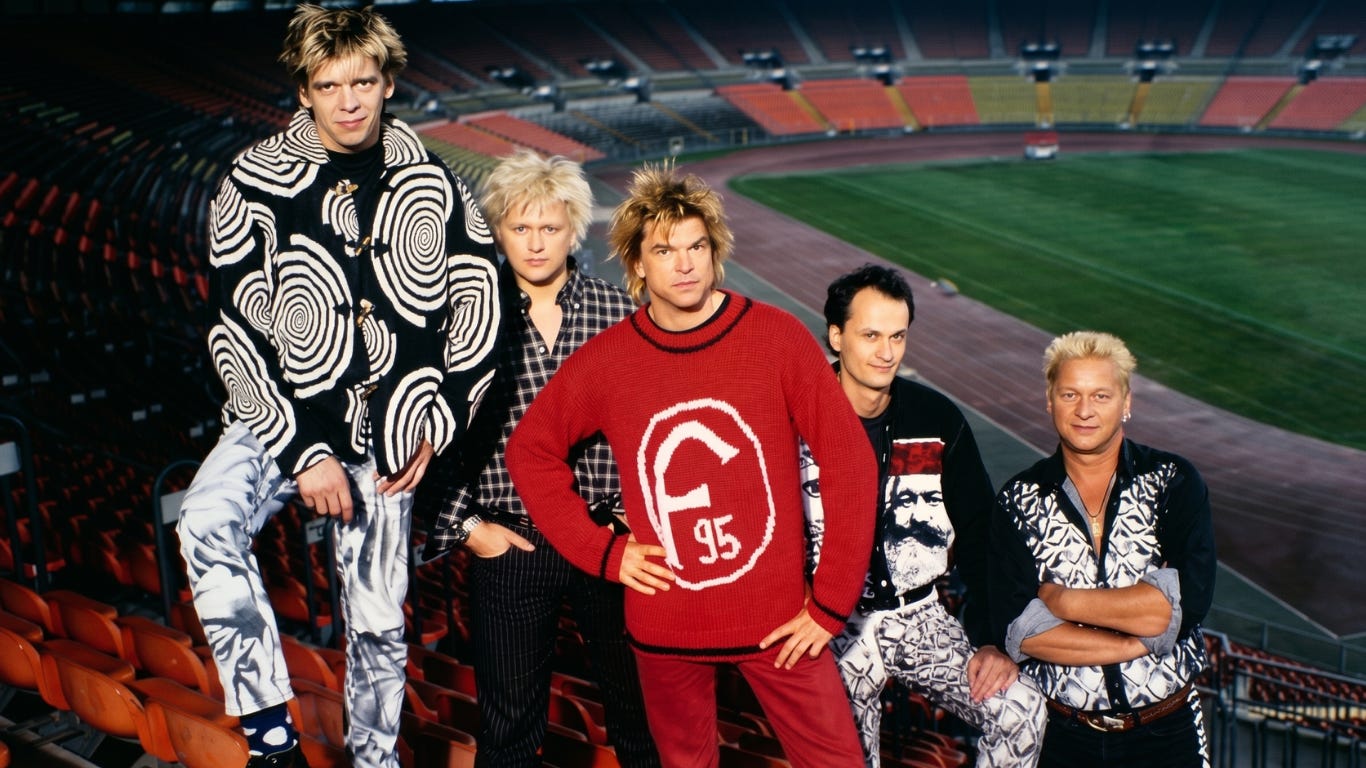
If you’ve spent half your life following a band or a football club, you know that deep down there’s no difference between the liturgy of the terraces and the liturgy of the pogo. In both, the crowd compresses, the smell of smoke and sweat envelops everything, and the collective roar swallows you whole. The players and the musicians are only our representatives; the real joy or the real tragedy belongs to us, the ones at the bottom, the ones who’ve been investing time, money, and ulcers for decades. Die Toten Hosen, those five lanky German punks, understood this dynamic better than anyone else in their country. And their relationship with Fortuna Düsseldorf, their hometown club, is the definitive testament to how irrational loyalty shapes a fan’s identity.
In the late seventies and early eighties, the streets of Düsseldorf were not a friendly place for a kid with dyed hair, a leather jacket, and safety pins. Campino, Andi, Breiti, and Kuddel, before they were Die Toten Hosen, were the outcasts of their own city. Back then, punk culture and football culture collided like two tectonic plates. On weekends, when Fortuna fans got off the trains from the suburbs of Mettmann or Velbert, the tactical order for any punk was simple: run. Campino remembers being chased through the city, scissors in hand, by fans who had no idea what this new British fashion was about and just wanted to cut off their mohawks and colored hair, or simply bash their heads in. The punks would dig in at bars like Domino, on Bolkerstraße, waiting for the wave of hooligans to pass.
Back then, Campino kept local football at arm’s length. Being half English on his mother’s side, he spent his summers in Cornwall and had given his soul to Liverpool FC ever since a match against Borussia Mönchengladbach in 1978. For him, serious football happened at Anfield, not at the Rheinstadion. Besides, how the hell were you supposed to back a team whose fans wanted to beat the shit out of you every Saturday?
Fate, however, with its perverse sense of humor, began weaving a truce. By 1984, the Die Toten Hosen had already released their first record, Opel-Gang, and were starting to gain some recognition. Campino was walking near Düsseldorf’s central station when he ran straight into a group of six Fortuna fans. Survival instinct screamed at him to turn around and run for his life, but suddenly he heard the guys were singing. And they weren’t singing a war chant; they were singing “Eisgekühlter Bommerlunder,” the alcohol-soaked, destructive anthem the Hosen themselves had released a year earlier. Campino froze, the guys laughed and greeted him: “Hey, Campino!”
That was the epiphany. Suddenly, the barrier between the punk and the working-class fan dissolved. Both groups were the same disgrace to the city. Both shared the same rejection of bourgeois German society, the postwar petty bourgeoisie that demanded tidy gardens, silence, and obedience. The kid who cut his own skin with a razor blade in some dark dive and the steelworker who got drunk in the stands to forget that his life was misery from Monday to Friday belonged to the same tribe: the “Armee der Verlierer” (the Army of Losers), as one of the band’s earliest songs puts it. From that moment on, the band accepted its geographic destiny. A sign in a London punk dive summed it up perfectly: “Support your local hero.” Campino understood that cheering for the team from your neighborhood didn’t betray his love for Liverpool; it was a matter of belonging.
And boy, did Fortuna Düsseldorf need support. If there’s one thing that defines a true fan, it’s the capacity to embrace failure. Fortuna had touched the sky, winning the German Cup in 1979 and 1980, and had even reached the final of the European Cup Winners’ Cup against Barcelona. But by the late eighties, the glory had faded to a sepia photograph, and the team had gone down, dropping to the Second Division in 1987.
On October 3, 1987, Die Toten Hosen were driving to Berlin when they heard on the radio that Fortuna had lost at home to Union Solingen. It was the last straw. “We couldn’t be a band from a Second Division city!” the band’s internal mythology recounts. So they did what any sick fan with a microphone would do: they decided to buy a player. During their 1988 and 1989 tour, the band introduced the “Eine Mark für Fortuna” (One mark for Fortuna). For every ticket sold across their 37 shows, one German mark went into a fund for the club. Every night, Campino grabbed the mic and thanked the crowd for helping fund the Düsseldorf team. In Cologne, Düsseldorf’s historic rivals, the band got booed and cursed out on a biblical scale. It was a beautiful act of provocation.
They raised 150,000 marks. By the time they were done, Fortuna had already gone back up on their own merits, but the money helped buy Oliver Gensch and, above all, the Ghanaian midfielder Anthony Baffoe. Baffoe understood the poetry of the gesture perfectly and declared: “My right leg belongs to the Toten Hosen.” Imagine the madness: you’re in the stands, you watch your midfielder send in a cross with his right foot, and you know that muscle, that tendon, was financed with the money you and your friends raised by playing distorted chords and spitting beer. It’s the climax of civic participation.
But football is cruel. As the melancholic’s handbook puts it, joy lasts as long as a sigh, and suffering is the fan’s natural condition. By the late nineties, Fortuna had become an “elevator club,” going up and down between divisions, until the cable snapped entirely. By 2001, the club was sunk in the Fourth Division (the Regionalliga), on the verge of total bankruptcy and at risk of losing its license. Nobody wanted to put up a dime. The city was turning its back on this comatose giant.
It’s in moments of absolute misery that true loyalty is measured. Die Toten Hosen, who by then were already Germany’s biggest rock band, millionaires, owners of their own record label (JKP) and of their own destiny, decided to sink into the mud alongside their club. For two seasons, from 2001 to 2003, the Hosen became the team’s main sponsor. The skull and star, the band’s logo, gleamed on the chest of Fortuna’s jersey. To fund this romantic delirium, the band, which had historically refused corporate sponsorship on their tours, made a pact with the devil: they let the Diebels brewery sponsor their tour, pocketed a million marks (or euros, depending on how you reckon the conversion for that era), and injected that money straight into the veins of the dying club. “Egal ob dritte oder vierte Liga - Fortuna gehört zu Düsseldorf wie Altbier oder der Rhein” (No matter if it’s the Third or Fourth Division, Fortuna belongs to Düsseldorf like Altbier or the Rhine), Campino declared.
This is where the fan becomes immortal. They saved the club. Not with a blank check from a Qatari sheikh, but with the sweat of punk rock. This injection of capital allowed the team to get its finances in order, and in 2004 it began its long, slow, agonizing climb back to professional life. Today, that Fortuna jersey with the Die Toten Hosen skull is the Holy Grail for football jersey collectors.
Now, to understand what you’re made of, you need to know not only who you love, but who you hate. The yin and yang of football. And if you’re a Fortuna fan, a fan of small clubs, of the mud and of defeat, your natural, genetic, and moral enemy is FC Bayern Munich. Bayern represents everything punk despises: predictable success, institutional arrogance, the cold and calculating corporation where winning isn’t a joy but a contractual and financial obligation.
In December 1999, wielding the sharp pen of singer-songwriter Funny van Dannen, Die Toten Hosen released “Bayern.” The song is a manifesto of proletarian contempt for the Bavarian giant: “Es kann so viel passieren / Es kann so viel geschehen / Nur eins weiß ich hundertprozentig / Nie im Leben würde ich zu Bayern gehen” — four lines that boil down to one flat, lifelong vow: whatever else might happen, signing with Bayern is simply never going to happen. The lyrics mock the club’s arrogance and the moral low point that a contract with them would represent.
The establishment’s response wasn’t long in coming. Uli Hoeneß, Bayern’s all-powerful, perpetually furious manager, exploded in front of the microphones: “Die Toten Hosen! That’s the trash our society is going to choke on someday.” In Munich, some players were filmed throwing the band’s records in the trash. Radio stations across southern Germany blacklisted the band, and sales in the region plummeted. And what did the Hosen do? They laughed their asses off. Campino went so far as to declare, with his finest cynicism, that he and Hoeneß had a lot in common, since neither of them would ever forget the penalty Hoeneß missed in 1976. It was the revenge of the kid from the back of the classroom against the unbearable star pupil. In 2000, when Bayern was about to lose the title on the final matchday against Leverkusen, the band rented a small plane to fly over the Munich stadium with a banner reading: “Die Toten Hosen congratulate FC Bayern.” In the end, Bayern won the title by some miracle, with Leverkusen choking, but the Hosen let the banner fly anyway. They weren’t about to let reality ruin a good joke.
But the stadium is also the site of unspeakable pain. Stadiums have always been the Die Toten Hosen’s “living room.” And on June 28, 1997, the Rheinstadion, Fortuna’s home, was the stage for the greatest tragedy in the band’s history. That day they were playing their 1000th show. 60,000 people celebrating the pinnacle of the career of the friends from Flingern. During the show, the crush of the crowd on the field became unbearable, and a young Dutch woman, Rieke Lax, died of suffocation. The band, informed of the horror backstage during a break, was forced by security officials to keep playing, pretending nothing had happened, to avoid a mass panic that could leave more people dead. They had to go back out and sing their party anthems while their blood ran cold in their veins. It was “the end of innocence” for the band. The stadium gives you everything, but it also brutally reminds you of the fragility of life. It reminds you that the pogo, just like a crush in the stands, walks the razor’s edge between ecstasy and death.
If you survive those traumas, your bond with the place becomes eternal. Let’s jump ahead to 2012. Fortuna, after decades of eating shit, had reached the relegation playoff against Hertha BSC, with a chance to finally return to the coveted Bundesliga first division. The club’s masseur, Bernd Restle, called Campino. The night before the second leg in Düsseldorf, the entire band sneaked into the team’s hotel. In a dull conference room, surrounded by bottles of mineral water, the five punks pulled out their instruments and told the players they weren’t alone, that the whole city was breathing for them. They played “You’ll Never Walk Alone” and their brand-new mass anthem “Tage wie diese“ (Days Like These). The next day, in a chaotic match full of flares and a pitch invasion, Fortuna drew 2-2 and sealed their promotion. That night, the players sang the Hosen’s song until dawn. That same year, the club made the band members honorary members. The circle closed. The outcasts, the Opel-Gang kids who’d had to run from hooligans in 1980, were now the institution’s spiritual soul.
This is the final thesis on what it means to be a fan. You win nothing tangible. Victory brushes past you for a second, and failure is your bedmate. In 2019, to celebrate that unconditional love, the club and the band released a special jersey, “Alles aus Liebe” (All for Love), which Fortuna wore in an official match. The opponent, of course, was Bayern Munich. The result? Fortuna lost 4-0. It’s pure poetry. You can put your rock band’s crest on your chest, you can sell out every jersey in record time, you can sing until you lose your voice, but the crushing logic of capitalist football dictates that the millionaire is going to run you over on the pitch.
And you know what? It doesn’t matter. None of it matters at all. Real fans don’t care about the quality of the product. The consumption of suffering is everything. What matters is the train ride, the cold in your feet, the cheap beer, and the camaraderie of knowing that the guy standing next to you chose to ruin his weekend for the same colors as you. Fortuna can get relegated a hundred more times. Die Toten Hosen can keep playing “Hier kommt Alex” until they’re eighty, with arthritis and knee problems (Campino already has his doctor operating on him regularly). But the organic connection is already made. Football, like punk, is the last great analog, collective ritual we have left to keep from going crazy with loneliness in front of a screen.
Look, at the end of the day, the colors of the club and the riffs serve the same sacred function. They transform you. You leave work, the office, a job interview that didn’t go well, you put on the cap with your team’s colors, and for a couple of hours, you stop being just one more person and become part of something immense, a tribal chorus that defies silence and death. Die Toten Hosen saved Fortuna Düsseldorf with money, yes, but they also saved it with something far more valuable: they reminded an entire city that defeats are sung at the top of your lungs, arm in arm with the person next to you, and that, if things go wrong, whether on the terraces or in the pogo, the only unforgivable thing is half-heartedness. If we’re going down, let it be on our own terms, singing until the bitter end.
If you like what I do and want to support me, subscribe to my Ko-fi.
No posts
Comments
Nothing yet. Say the first thing.
Sign in to join the conversation.