
One day, I started college. Suddenly, my context was no longer my context: I was surrounded by hippies and hipsters. I don’t say it pejoratively; they were good friends during that stage of life. In one of those bohemian gatherings that would end in philosophical discussions and quotes from Beatnik poets, the host put on a record called The Heart of Saturday Night. The singer at times sounded like a cat in heat meowing on the neighbor’s wall at 3:00 AM, and other times he sounded like a session musician. I decided to try another record from her collection, one called Bone Machine; to my surprise, he sounded like a totally different person, but what surprised me most was track 14, and right then I remembered where I knew the name of this melancholy man from.
(Artículo en español aquí)
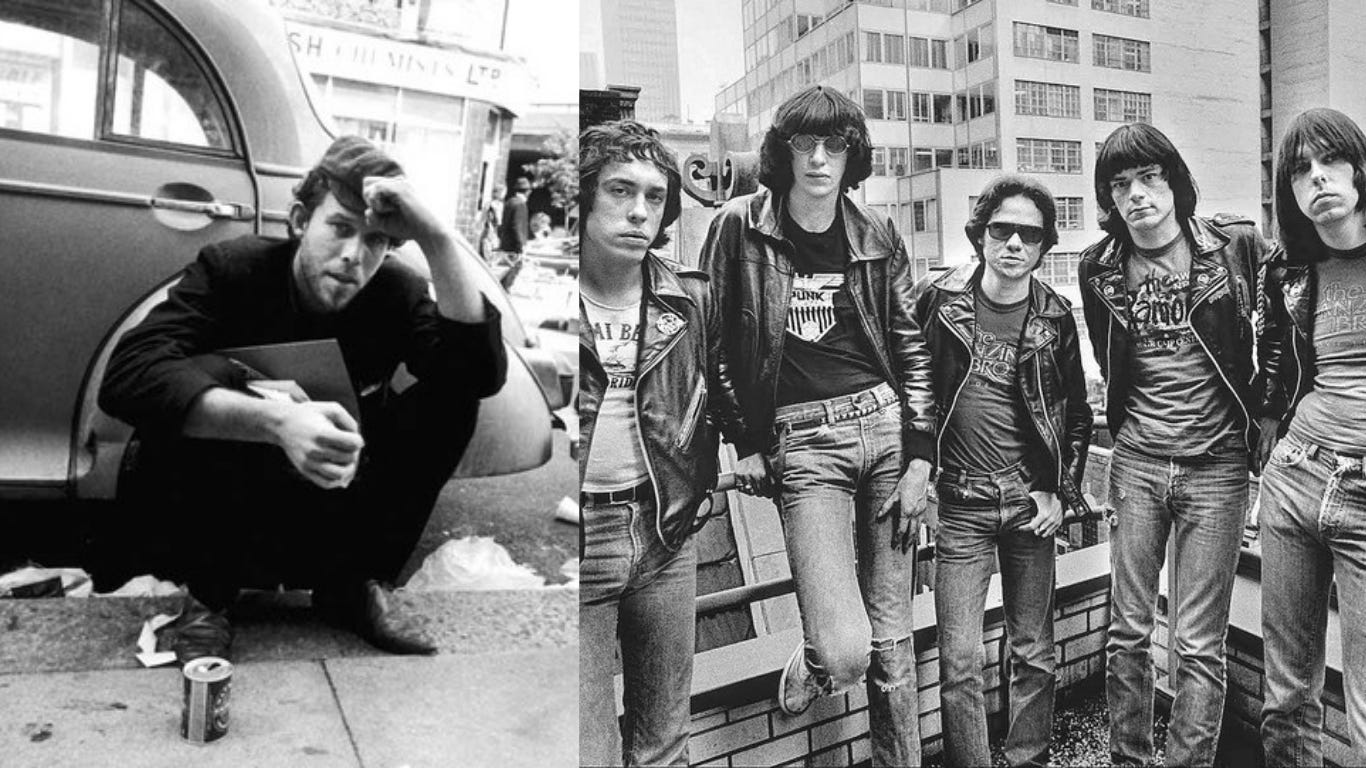
I tell this story because I need you to understand where I am coming from when I say, with all the seriousness I am capable of maintaining, that Tom Waits and the Ramones are essentially the same thing. Not technically, nor aesthetically—not in any sense that you could successfully explain to someone at a dinner party without them giving you that “oof, here he goes again” look while pulling the wine bottle away from you. Both—and I am getting serious here—are music for people who don’t fit in, made by people who didn’t fit in, about an America that never existed for them, and so they invented it in their own way and by their own rules. The Ramones were children of the sidewalks and glue-sniffing of Queens, and Waits came from Pomona, California, more or less, and both grew up looking at the American dream from the outside with their noses pressed against the glass, watching how others lived their lives inside the box. Waits processed it with greasy pizza and cheap cigarettes and a voice that sounded like a city wolf howling at the moon while gargling with bourbon. The Ramones processed it with speed and three chords and a guitar that sounded like a chainsaw with missing parts, and they made technical limitations their safe place. But the feeling beneath all of that, the feeling that is the true raw material of everything they do, was the same in both worlds. It was the same suburban portrait, the same misshapen characters, the same philosophy of life: surviving your own way, with whatever is there.
The Ramones were incredibly weird. A strangeness that goes far beyond long hair and leather clothes. Four kids from Queens who decided to take the same last name as if they were a chosen family, dress identically forever as if the uniform were the only honest way to tell the world who you are, and play two-minute songs because two minutes was all the time the world deserved from them. They didn’t make long songs because long songs imply that you have time, that you can relax. The Ramones knew that wasn’t the case—that the world didn’t deserve that condescension—and therefore speed was not a technique but a moral stance (well, a bit of laziness too). Waits, on the other hand, took all the time in the world, and his songs sometimes seem to last until you can hear the broom sweeping and the chairs being placed on top of the tables, with a piano hitting the keys like someone exhausted from being so angry, where the instrument is the only thing listening and responding to him. Yet beneath all that slowness, beneath all that accumulation of filth and time, there is exactly the same anxiety as in the Ramones—the same feeling that, if the music stops, something breaks and there is no other place left in the world to inhabit.
But there is a specific moment where all of this stops being a theory I tell myself and becomes something irrefutable, something that can be proven with two songs, with two versions, with two worlds recognizing each other in the mirror. The first is what happens when the Ramones grab Waits’s I Don’t Wanna Grow Up, a song that in the original sounds like a waltz a drunk stumbled over and tumbled down the stairs—melancholic in a way, but physically heavy, the voice of a man looking at adulthood from the outside and deciding no, thanks, that growing up means becoming someone who lies out of habit and makes the decisions that lead the world to be the way it is. And then the Ramones re-record it, speeding it up until you can barely recognize the melody underneath, and to everyone’s surprise, the lyrics didn’t need to be modified; it was so punk rock, so Joey, that your bohemian friend had to remind you it was a cover. It didn’t clash in the slightest with the band’s aesthetic and idiosyncrasy. To top it off, there was the music video, where you watched the band move within the graphic universe of Daniel Clowes, a cartoonist whose works also portray the same worlds as Waits and the Ramones with a more pop but no less underground gaze.
The second is the movement in the opposite direction. And here is where practically everything turns into characters from a vaudeville of different generations and styles. In 2003, Johnny Ramone was offered the chance to produce We’re a Happy Family: A Tribute to Ramones (2003). His condition? To have absolute control, as was to be expected. So he brought in Rob Zombie. Obviously, the result was strange, strange good and strange bad, there was no intention of pleasing fans or attracting new ones, it was about locking all the monsters they knew how to create with their influence into the same room. But let’s get back to the point. When Waits takes The Return of Jackie & Judy from the album End of the Century (1980)—a song that in the Ramones‘ original has a strange, accelerated joy but at the same time connected narratively with Judy Is a Punk from the debut album, with the two title characters returning to the neighborhood and someone glad to see them—when Waits brings it to his planet, it seems that same drunk also threw the song down the stairs along with a toolbox. Tom converts the punk joy into bluesy tenderness perfect for dancing in a bar lost on the highway. When he sings about Jackie and Judy, about these two characters from Queens, he treats them exactly as he treats all his characters: as real people with real stories, glorified through that lysergic, rusty filter through which Waits looks at the world.
What happens when a barroom poet sings the punks is that he finds the soul they themselves sometimes pretended not to have. He takes those songs from among the scrap metal and tells them: look, there’s something beautiful here. He blows the dust off them, wipes them with his shirt, and places them as a centerpiece. And the result is that the two movements together—the punk that speeds up the poet and the poet who elevates the punk—become something more than a curiosity or a gesture of mutual appreciation: they become proof that they were always talking about the exact same subject from the very beginning. Waits populated his world with philosopher drunks and late-night people who talk to ghosts in bars run by cockroaches. The Ramones populated theirs with street-corner kids who found their tribe in punk.
During that same college era, I also bought two books on Tom Waits. One was a compilation of interviews and journalistic articles about him. Waits used to clarify that not everything he says in interviews is true, that sometimes he can end up pulling the journalists’ legs. The other book was garbage: a compilation of quotes pulled from the internet without any sources, printed on cheap paper with a shoddy design. But I liked it. And I remember there was a loose sentence that said something like this: Punk rock? I prefer that to all those dull groups like Crosby, Steals, the Cash and Young. I’d rather see a kid in leather and safety pins screaming about eating his mother than some of that stuff.
I loved that phrase. It was ridiculous and bizarre. On certain bohemian nights at college, while we chatted about aesthetic movements throughout history and the importance of cultural products in modern societies, I would rasp my voice a little, look at my glass, and paraphrase that quote. I would cover it in my own way of seeing the world.
If you like what I do and want to support me, subscribe to my Ko-fi.
No posts
Comments
Nothing yet. Say the first thing.
Sign in to join the conversation.