
Public Discourse is the Witherspoon Institute’s online journal of religion, education, and culture. If you enjoy our work, please subscribe to receive our (free) daily and/or weekly essay drops, or better yet, share this newsletter with a friend.
Returning PD author Beatrice Scudeler examines the specific kind of romantic storytelling that is appealing to Gen Z women:
The most cited examples of fictional “men who yearn” are not always obvious. Some fit the brooding stereotype that one also finds in romantasy. For example, TikTok is full of edits of Pride and Prejudice’s Mr. Darcy—as played by Matthew MacFadyen in the 2005 film adaptation—“flexing” his hand in frustration as he silently yearns for Elizabeth Bennet. And of course, the internet went absolutely crazy last year over the character of Conrad Fisher when season three of the adaptation of Jenny Han’s The Summer I Turned Pretty was released. Emotionally withdrawn in his longing, Conrad has often been described by fans of the show as the young adult novel version of Jane Austen’s Mr. Darcy. Yet other yearning men don’t brood. Loyal to a fault and notoriously good with kids, Steve “always the babysitter” Harrington from the popular sci-fi show Stranger Things has become the object of admiration in hundreds of thousands of videos and posts made by young women.
To be clear, I’m not praising women of my generation for publicly fawning over a man, real or fictional. Some of this content borders on objectification, the very objectification of which we so often—and rightly—accuse men. This phenomenon is, nonetheless, a sign of a much healthier kind of desire than what we find in the discourse around romantasy.
You can read Beatrice’s full essay here.
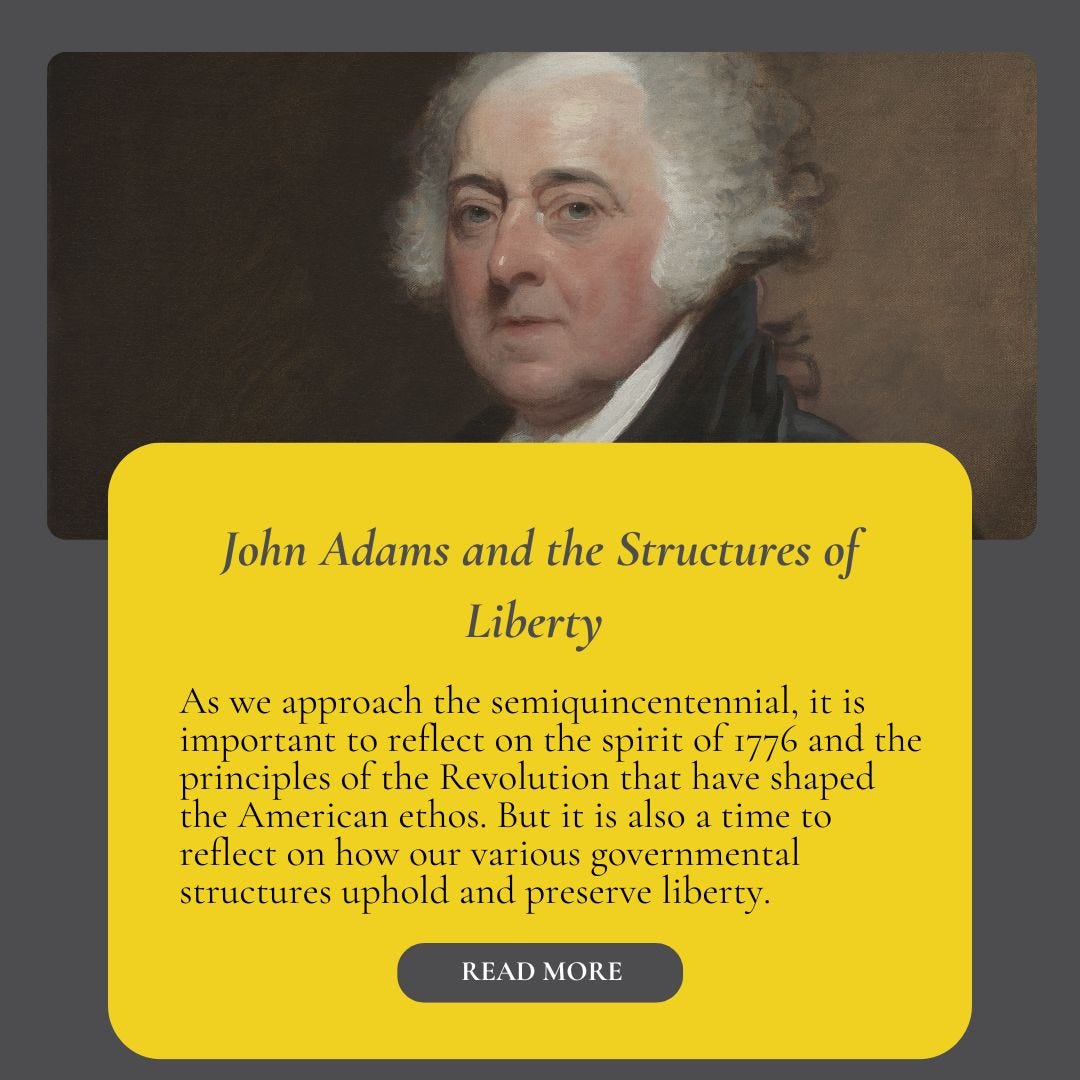
As we approach the our nation’s 250th birthday, it’s vital to reflect on the spirit of our founding and the principles that have, since then, formed the American imagination. Aaron Walayat speaks about why it is also a time to reflect on how our governmental systems and structures uphold and preserve liberty.
On the theme of constitutionalism, the year 2026 also marks the 250th anniversary of John Adams’s pamphlet, Thoughts on Government (“Thoughts”), a work that proved to be influential on American constitutionalism. The claim that John Adams was influential on American constitutionalism seems strange, given that Adams was not even present at the 1787 Constitutional Convention in Philadelphia. Nevertheless, Adams had a tremendous influence on the governmental structures of several state constitutions, many of which, in turn, influenced the federal Constitution. Adams’s influence can be traced to two documents: Thoughts, published in 1776, and the Massachusetts Constitution of 1780, of which he was the principal drafter. Political theorist Brad Thompson writes that Adams had a demonstrable influence on the state constitutions of North Carolina, Virginia, New Jersey, New York, and Massachusetts.
You can read Aaron’s full essay here.
In light of our many incredible advances in space exploration, it’s worth asking why we desire to do so in the first place. Daniel Ross Goodman challenges us to think about why a civilization that presses for more advancement without knowing why is a lost one.
[B]uried beneath the headlines about rocket launches and lunar orbits was a quieter story—one that should unsettle anyone who cares about the long-term future of our civilization. Syracuse University recently announced that it plans to eliminate a sweeping range of academic programs, including classics, Italian, French, and German. The justification, as it almost always is in these cases, is financial. The programs don’t generate enough revenue. They don’t produce enough majors. In the cold arithmetic of twenty-first-century higher education, they don’t justify their own existence.
You can read Daniel’s full essay here.
Last month, PD was cited in both The Wall Street Journal and The New York Times — In the former, Elizabeth Corey cites her essay “Beautiful Losers” and in the latter, David French references Ed Feser’s popular recent essay on the Iran War. This month, we were cited again in the Times, this time, in a Q&A between Elizabeth Corey and John Guida.
Until next time, thanks for reading!
If you enjoy this newsletter, subscribe to receive our (free) daily and weekly essay drops!
No posts
Comments
Nothing yet. Say the first thing.
Sign in to join the conversation.