
Before we begin, if you appreciate independent writing about mental health, politics, war, trauma, and moral accountability, please subscribe to PsychiatRick. I know your time is precious, and I appreciate that you chose to spend some of it with me. New articles are always free. Paid subscriptions help keep this work independent.
Now, let’s get into it.
One question changed the room
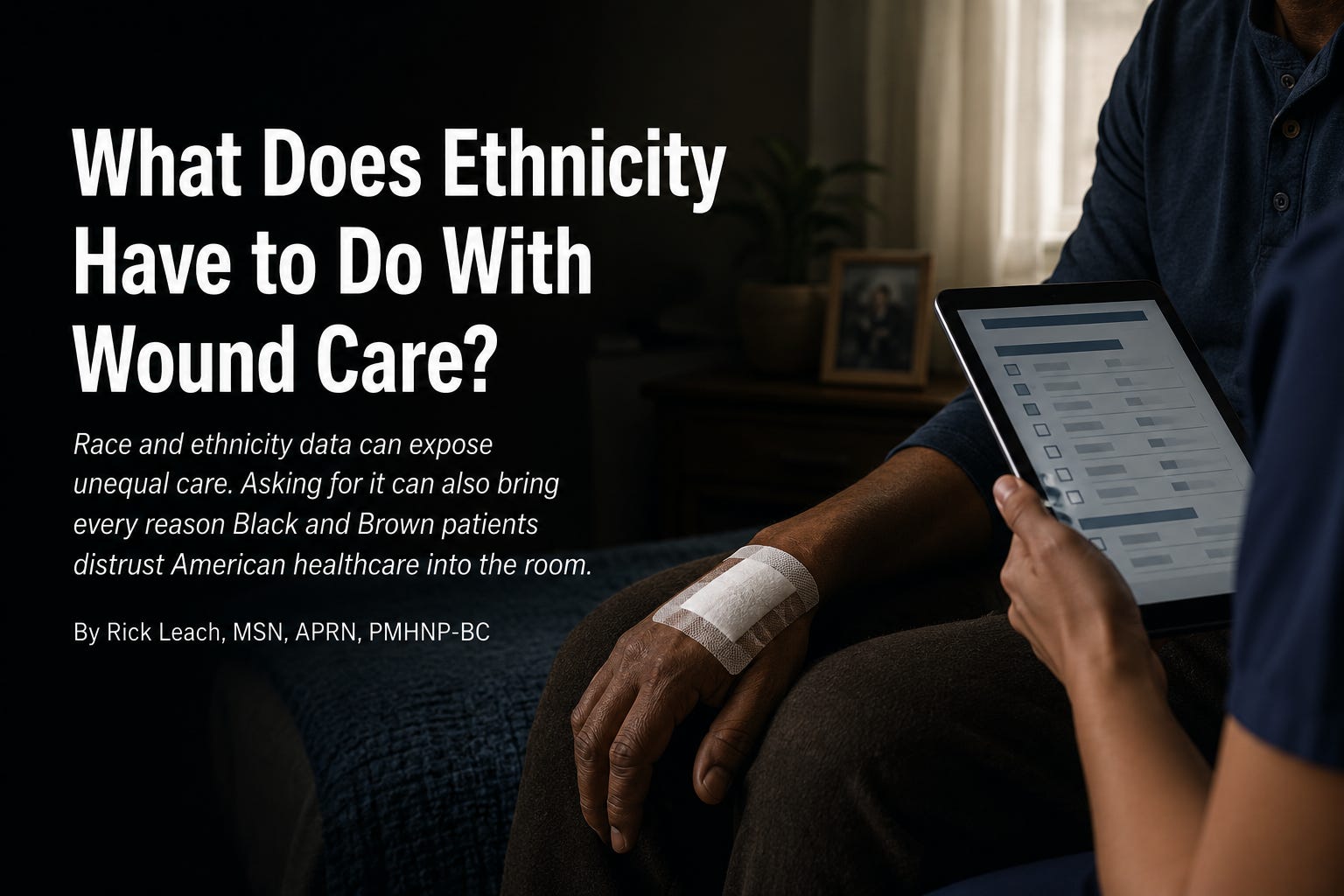
A while back, I entered a patient’s home for what should’ve been a normal, run-of-the-mill admission. She was pleasant, the home was clean, and she looked well nourished and cared for. She was using a walker after falling and injuring her hip. She’d had surgery and was home recovering. I was there to figure out what she needed from nursing, physical therapy and occupational therapy.
Most of the admission made sense. Did she have working smoke detectors? Was there a clear path through the home so she wouldn’t fall again? Could she get to the bathroom with the walker? Did she understand her medications? Who would help her if her condition changed?
Then came the code-status question. If she collapsed during a visit and I found her without a pulse and not breathing, did she want me to start CPR and call 911? Or did she want a natural death without resuscitation?
Those questions were personal, but I could explain why I was asking them. They had something to do with the care she might need.
Then I got to the ethnicity question.
I felt the drop in my stomach before I asked it. Nothing about her incision, pain, medications, mobility or safety had led us there. The computer wanted an answer, and I was the person expected to get it.
Against my better judgment, I asked.
She looked at me and said, “Why would you ask a question like that?”
She declined to answer. Then she said, “Only in America.”
I apologized and told her I thought the question was ridiculous. She accepted my apology, and we finished the admission, but the energy in the room had changed. She became less open. The visit was not the same after that.
Nurses need trust for care to move in the right direction. A patient needs to be able to say that the pain is worse, that a medication was missed or that an instruction didn’t make sense. None of that works well if the patient is now wondering whether the clinician is judging or categorizing them.
That moment started this article, but one awkward field in one admission is not the whole story. A question about race can bring the entire history and present reality of racism in American healthcare into the room, whether the clinician is ready for it or not.
The question felt disconnected from wound care. Racism is not.
The wound-care question has an ugly answer
What does ethnicity have to do with wound care?
If healthcare were equal, the answer would be very little. A patient’s wound should be assessed, cleaned, dressed and treated according to what is happening in the tissue. Skin tone should affect how I perform the assessment, not how much effort the patient receives. Race should never determine whose pain I believe, whose circulation gets evaluated or whose leg is considered worth saving.
American healthcare has not met that standard.
Pressure injuries are one of the clearest examples because nurses are taught to look for changes in color, including redness that does not blanch. Those visual signs can be harder to recognize on darker skin. A New Jersey hospital-data study found that Black patients with pressure injuries had a lower proportion of stage 1 injuries but a higher proportion of stage 4 injuries. That does not mean Black skin somehow skips the early stages. It raises the much more disturbing possibility that the damage is being recognized later, after it has become deeper and harder to treat.
A wound does not wait for the clinician’s eye to catch up.
Early pressure damage can be present even when the familiar red warning sign is difficult to see. Research on pressure-induced erythema found meaningful differences across skin pigmentation and concluded that dark skin needs to be assessed differently. A patient’s skin can feel warmer, firmer, boggy or painful before the damage becomes obvious. If generations of nurses were primarily trained on examples from light skin, then calling the missed injury an unfortunate accident is not good enough. The teaching was incomplete, the assessment standard was incomplete, and the patient absorbed the harm.
Then there are diabetic foot wounds and peripheral artery disease. These are not minor disparities around the edge of care. They end with people losing legs.
Among more than 124,000 Medicare patients hospitalized with diabetic foot ulcers, 21.9 percent of Black patients experienced major leg amputation or death during the hospitalization or within thirty days, compared with 17.6 percent in the full cohort. Another Medicare study found that Black beneficiaries with diabetic foot ulcers had almost twice the odds of receiving a lower-extremity amputation within one year of diagnosis compared with White beneficiaries.
The disparity continues even when researchers account for how sick the limb was. In a large vascular-quality study, Black and Hispanic patients had worse limb outcomes after revascularization than White patients with similar disease severity at presentation. The adjusted hazard of major amputation was 52 percent higher for Black patients and 45 percent higher for Hispanic patients.
An older Medicare analysis found that Black patients who eventually underwent amputation were less likely than White patients to have received revascularization, a limb-related hospital admission or wound debridement beforehand. Those are attempts to save a limb. The unequal ending was preceded by unequal opportunities to avoid it.
That is what ethnicity has to do with wound care in America. The category does not explain the biology of an individual wound. It helps reveal who is more likely to have early damage missed, who reaches specialty care later, who receives fewer limb-salvage attempts and who leaves the healthcare system without part of a leg.
We should be angry about that. A spreadsheet can document the difference, but the patient has to live with it.
Racism can hide inside ordinary care
People hear the word racism and imagine that somebody must have used a slur, admitted hatred or consciously decided to harm a Black patient. That is a child’s understanding of how racism works.
Racism inside healthcare is often quieter. It can be embedded in the device, the clinical training, the research population, the pain scale, the referral pattern, the neighborhood a hospital serves and the assumptions a clinician makes in a few seconds without ever saying them out loud.
The patient still gets hurt.
A systematic review found that Black patients were less likely than White patients to receive pain medication for acute pain in American emergency departments. Another study found that some medical trainees believed false statements such as Black people having thicker skin or feeling less pain. Those beliefs affected their pain ratings and treatment recommendations.
That is not a communication problem. It is racist fiction entering a clinical decision and changing what medication a patient receives.
It also creates a trap for the patient. Show pain and risk being called dramatic, demanding or drug-seeking. Stay quiet and risk having the severity underestimated. Become angry after being ignored and the anger itself may be treated as proof that the clinician’s suspicion was justified. The patient is expected to remain calm while trying to convince a professional that their own body is telling the truth.
Black women are about three times more likely than White women to die from a pregnancy-related cause, according to the CDC. A separate CDC report found that about one in five women experienced mistreatment during maternity care, with higher reported mistreatment among Black, Hispanic and multiracial women. Nearly half of the women surveyed said they held back a question or concern.
That last number should stop every clinician for a minute.
A patient can answer every question, smile, nod and appear completely cooperative while deciding that one symptom is safer not to mention. The chart will say the assessment was completed. It will not say what the patient kept to herself because the room did not feel safe enough for the truth.
Even the numbers we call objective are not automatically neutral. Pulse oximeters missed occult hypoxemia almost three times as often in Black patients as in White patients in a New England Journal of Medicine study. The monitor can display a reassuring oxygen saturation while the oxygen level measured in the blood is dangerously lower.
Clinicians trust numbers. We are trained to. A blood pressure, pulse or oxygen saturation feels cleaner than somebody saying, “Something is wrong.” But a device does not become objective simply because it produces digits. Somebody designed it, selected the people on whom it was tested, decided what counted as acceptable accuracy and sold it into a healthcare system that was eager to trust the result.
When that device works less reliably on darker skin, the patient’s skin is not the failure. American healthcare treated White skin as the default and everybody else as a variation.
Distrust was earned
When my patient said, “Only in America,” I do not think she was responding to one line of paperwork. A demographic question can sound simple to the person asking it and threatening to the person answering it.
Why do you need to know this before you treat me? Who can see it? Will you believe my pain if I answer a certain way? Can the insurance company use it? What happens if I refuse?
Those are reasonable questions. Research has found that patients can support collecting race and ethnicity data to identify disparities while still fearing that the information could be used to discriminate against them. One study found both reactions at the same time. Another study found greater concern among people who had already experienced discrimination in healthcare. A rapid review identified concerns about privacy, stigma and damage to the patient-clinician relationship.
Healthcare keeps talking about mistrust as if Black and Brown patients woke up one morning and became irrationally suspicious of nice people in scrubs.
They did not.
The untreated syphilis study at Tuskegee continued until 1972. Federal researchers followed hundreds of Black men, failed to obtain informed consent and withheld the truth about the study. Penicillin became the accepted treatment, and the study continued anyway.
The men did not simply fall through the cracks of an imperfect system. The government wanted to observe what untreated disease did to their bodies. Treating them would have interfered with the study. That is a much uglier truth than the sanitized version many Americans learned, and it belongs in any conversation about why a Black patient may hesitate when the government asks for personal information in the name of better health.
Henrietta Lacks went to Johns Hopkins Hospital for cervical cancer treatment in 1951. Tissue taken from her tumor became HeLa, the first human cell line capable of continuing to grow in a laboratory. Those cells contributed to major medical advances and appeared in more than 110,000 scientific publications between 1953 and 2018.
Henrietta did not know her cells had been taken and distributed. Her family found out later. Medicine benefited from her body on a massive scale while denying her the basic respect of being asked.
The birth-control trials in Puerto Rico are personal for me because I am Puerto Rican. During the 1950s, poor Puerto Rican women were recruited to test a high-dose version of the pill. They knew it was intended to prevent pregnancy, but they were not properly told that the drug was experimental or that they were participating in a clinical trial. Many reported serious side effects. Three women died, and no autopsies were performed to determine whether the pill played a role.
Asking a patient’s ethnicity is not the same as Tuskegee, taking Henrietta Lacks’s cells or experimenting on Puerto Rican women. Nobody needs a lazy comparison that pretends those acts are equal.
The point is that distrust has a history.
Medical and government institutions have collected information, tissue and cooperation from Black and Brown communities without giving those communities equal knowledge, equal power or equal protection. That history places the burden on the institution to prove what it is doing now. It does not place the burden on the patient to trust first and ask questions later.
Race is not biology, but racism gets under the skin
Why does checking Puerto Rican tell a clinician almost nothing about me? Because looking at me, I am very White-passing. One of my parents is White and one is fully Puerto Rican. I identify as Puerto Rican, but the rest of the world may not know that unless I tell them.
People have probably entered “White male” into my medical record more than once. I can picture the opening sentence: Rick is a White male who presents today for whatever brought him into the office. Nobody asked. Somebody looked at me, selected a category and moved on because there were twenty more questions waiting.
That is why the boxes feel absurd when they are treated as an explanation of the individual patient.
I have been in situations where White people thought they were in a safe space and said racist things in front of me. Patients have made comments about Mexican people or Puerto Ricans and assumed I would agree. People see a White-passing male combat veteran in a conservative part of California and invent the rest of my identity and politics for me. Then I have to confront what was said, and the relationship is uncomfortable from that point forward.
Appearance did not tell them who I was. The category does not explain it either.
Puerto Rican is one part of how I describe myself. It does not tell you that I enjoy writing or that I play guitar. It does not tell you that I love being with my dogs and they give me a ridiculous amount of joy. It does not tell you that I have a wonderful, beautiful wife who is brilliant and is my whole world.
It also does not tell a clinician whether my wound is infected, whether I can afford the dressing supplies or whether I understand how to take my medication.
Race is a social category, not a precise genetic diagnosis. Human genetic variation does not divide neatly into the racial boxes used on American forms, and using race as a substitute for ancestry can distort clinical reasoning. When ancestry matters for a specific condition, clinicians should explain why and ask the specific question that matters.
If the concern is family history, ask about family history. If the patient has a pressure injury, assess the skin in a way that works on that patient’s skin tone. If the pulse oximeter may be inaccurate, verify the reading. If culture, religion or family practice could affect care, ask, “Is there anything about your culture, religion or family that would help me care for you better?”
Acknowledging difference is not the problem. The failure comes when a broad racial label becomes a shortcut and the shortcut is treated as an explanation of the person.
At the same time, pretending not to see race does not make racism disappear. A clinician can say, “I treat everyone the same,” while working inside a system where the devices, evidence, access and outcomes are not the same. Colorblindness becomes another way to avoid looking at who is being harmed.
Race may not be biological destiny, but racism changes exposure, access, stress, treatment and outcomes. It gets into the body because systems shape what happens to bodies.
Data can expose racism, but it cannot substitute for action
This is where the conversation gets uncomfortable in both directions.
I hated asking my patient about ethnicity because I could not explain what that answer had to do with her care that day. I still understand why race and ethnicity data are collected. If healthcare organizations stop measuring outcomes by race, the disparities do not disappear. They become easier to hide.
A hospital can average everybody together and report a respectable outcome while Black patients inside that average are losing limbs more often, receiving less pain treatment or having dangerous hypoxemia missed. The average can look fine because the people receiving better care pull the number upward.
Race and ethnicity data can expose where the damage lands. That is useful. It is also only the beginning.
The healthcare system has become very good at describing disparities. It can publish a report, hold an equity meeting, create a dashboard and congratulate itself for identifying a problem that Black and Brown patients have been describing for generations.
Then what?
If the data show that Black patients with diabetic foot wounds are more likely to undergo amputation, where is the limb-salvage program? Who is reviewing referral delays? Who is checking whether vascular studies and podiatry appointments happen early enough? Who is comparing debridement, revascularization and specialty-care rates? Who owns the result next year if nothing changes?
If the data show more advanced pressure injuries in Black patients, where are the changes in nursing education, skin-assessment standards and equipment? If pulse oximeters are less reliable on darker skin, who is changing the protocol for confirming oxygenation? If Black patients receive less pain medication, who is examining orders, reassessments and prescribing decisions instead of blaming “implicit bias” as though bias were weather nobody controls?
Collecting racial data without changing care can become its own kind of performance. The institution gets the information. The patient carries the risk. A report is produced. The disparity survives.
Patients deserve a plain explanation when the information is requested: We collect this because people from different racial and ethnic groups have not received equal care. You may decline. Your decision will not affect your treatment. Here is who can see the answer, how it is protected and what we are doing with the results.
That explanation will not erase the history. It at least treats the patient like an adult instead of a source of data.
More importantly, healthcare organizations should publish what changed because of the information. Name the disparity. Name the intervention. Name who was responsible. Show whether the gap narrowed. If the organization cannot point to action, then it is documenting racism more carefully, not correcting it.
What healthcare owes the patient
The burden of fixing structural racism cannot be dumped onto the individual nurse, physician or patient standing in one room. Still, every clinician participates in the system, and participation comes with responsibility.
For clinicians, the first obligation is to believe that unequal care can happen even when we believe we are good people. Intent does not rescue a patient from an untreated pain crisis, a missed pressure injury, a false oxygen reading or an amputation that might have been prevented.
We have to assess what is actually in front of us. We need to learn how injury appears across skin tones rather than expecting every body to resemble the textbook image used in school, question a reassuring pulse-oximeter reading when the rest of the clinical picture says the patient is hypoxic, and treat pain according to the assessment instead of a racial myth about tolerance. When a patient has a worsening foot wound, somebody needs to ask why vascular surgery or podiatry was not involved before infection and ischemia took the decision away.
It also means noticing what happens after trust is damaged. A quiet patient is not necessarily a comfortable patient. Agreement is not always understanding. A completed assessment is not proof that the patient disclosed everything that mattered.
Healthcare organizations owe more than another annual module about cultural competence. They need equipment validated across skin tones, training materials that show disease on more than White bodies, referral systems that do not reserve limb salvage for patients with the easiest transportation and best insurance, and accountability when outcomes remain unequal.
The government owes patients transparency about what demographic information is collected and how it is used. Researchers owe communities more than extraction. Medical schools owe future clinicians an honest account of how racism shaped the evidence, institutions and myths they inherited. Insurers owe patients decisions based on clinical need rather than barriers that become easier to overcome when a person has money, time and somebody who knows how to fight.
None of this requires pretending that every difference in outcome comes from one hateful clinician making one hateful choice. Structural racism is more durable than that. It can keep producing unequal outcomes while everyone inside the system insists they personally meant well.
That is why the answer cannot stop at individual kindness. Kindness matters. So do protocols, staffing, equipment, access, follow-up, payment, education and the authority to change what keeps hurting people.
The question was never the whole story
My patient asked why I needed to know her ethnicity. In that moment, I could not give her a meaningful answer.
The answer I can give now is more complicated.
Her ethnicity did not tell me how to care for her wound. It did not tell me whether her incision was infected, whether the walker fit through the bathroom door or whether she understood her medications. A category could not explain the woman sitting in front of me.
Across a healthcare system, however, race and ethnicity data can show whose wounds are recognized late, whose pain is discounted, whose oxygen reading is falsely reassuring and whose leg is amputated after fewer attempts to save it. We need to know that because racism loves an average. It survives when the people being harmed disappear inside a number that looks acceptable.
The question is not the story. The unequal care is the story.
American healthcare has collected enough evidence to know the problem is real. Black and Brown patients do not need another institution to discover that racism affects their care. They need institutions willing to change the care.
We need better questions, honest explanations and an absolute refusal to confuse data collection with progress. Follow the disparity all the way from the dashboard back to the bedside, the wound, the device, the referral and the decision about whose body receives every available chance to heal.
My patient said, “Only in America.”
She was right to question what the system wanted from her.
The system should be far more worried about what it has failed to give her in return.
Comments
Nothing yet. Say the first thing.
Sign in to join the conversation.