
Before we begin, if you appreciate independent writing that takes mental health, politics, war, trauma, and moral accountability head-on, please subscribe to PsychiatRick. New articles are always free to read, but a paid subscription helps support the work and keeps this publication independent.
Now, let’s get into it.
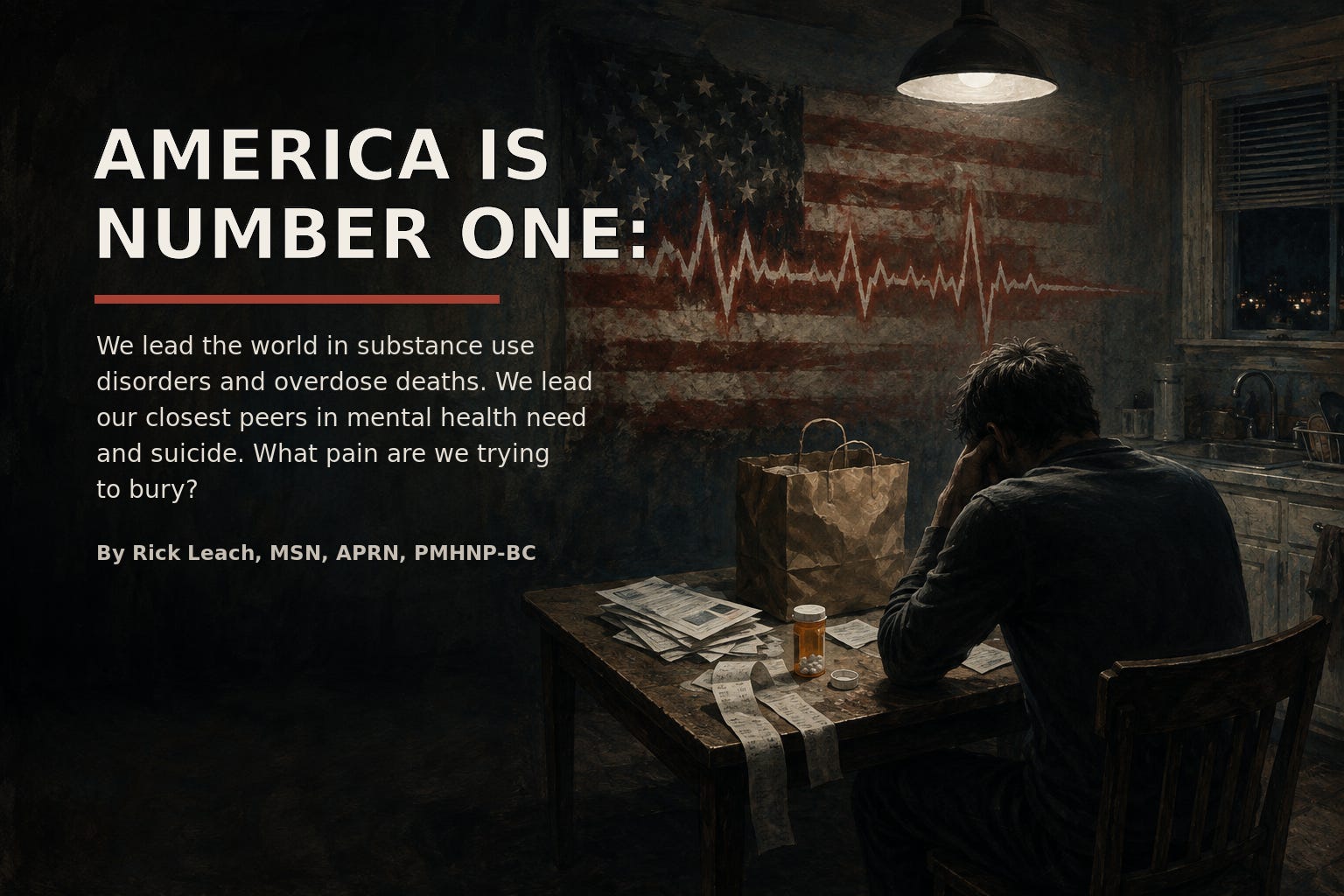
America is number one.
In 2023, the United States had the highest prevalence of substance use disorders in the world, with 6,430 cases for every 100,000 people, which is one hell of a number for a country that spends as much money as we do talking about treatment, recovery, personal responsibility, and the supposed importance of mental health.
That number comes from a Global Burden of Disease study published in June 2026 using data through 2023.
The United States also had the highest overdose death rate in a comparison of dozens of countries, reaching 324 deaths per million people in 2022, the same year nearly 108,000 Americans died from overdoses, and there’s no honest way to make a number like that sound normal.
In a Commonwealth Fund comparison of ten wealthy countries, American adults ranked first in mental health need, and the United States had the highest suicide rate among those same close peers, which means this isn’t a comparison between America and countries without money, hospitals, medications, or trained clinicians.
In 2024, 48,824 Americans died by suicide, another 79,384 died from drug overdoses, and 27,593 of those suicide deaths involved a firearm.
Those people had names and families. Somebody found them and had to make the phone call. Somebody still has their last text message saved and probably reads it more often than anyone knows.
We talk constantly about the drugs, the diagnoses, the guns, and the deaths, and we argue over personal responsibility while blaming parents, doctors, pharmaceutical companies, cartels, social media, the border, or whichever political enemy is most useful that week, but the most obvious question stays buried underneath all of it.
What pain are Americans trying so hard to bury?
Americans aren’t uniquely broken, and our nervous systems aren’t fundamentally different from the nervous systems of people in Canada, France, Australia, Germany, or the United Kingdom, but we’re living inside a collection of pressures that those countries don’t combine in quite the same way, and then we’re told that struggling under them says something shameful about our character.
We’re trying to numb pain created or intensified by systems that are distinctly American, and then we punish people for the ways they survive it.
Let’s Be Honest About the Rankings
The OECD approached the issue through national drug-use surveys and found that 25 percent of Americans ages 15 to 64 had used an illicit drug during the previous year, compared with an OECD average of about 9 percent, while past-year illicit opioid use in the United States was more than five times the average.
There is some good news in the overdose numbers because deaths fell 26.2 percent from 2023 to 2024, and preliminary CDC data show that the decline continued into 2026.
That drop is real, and it happened because naloxone was in more hands, medications for opioid use disorder kept more people alive, treatment became available to some people who had been locked out of it, and families, peer workers, first responders, nurses, and clinicians kept showing up, answering phones, driving people to appointments, and staying close enough to notice when somebody stopped breathing.
Good. Keep going.
Nearly 80,000 Americans still died in 2024, even after the largest one-year decline ever recorded in this country, and we owe those families more than a congratulatory press release about the direction of the trend, because a falling death count doesn’t explain why it climbed so high or why relief became easier to find than care.
American Children Are Learning Fear Early
A child doesn’t know the word hypervigilance, but he knows which footsteps mean he should go to his room, whether a cabinet closing means dinner is coming or somebody has been drinking, and how angry his father is by the way a key turns in the front door, because children living around chaos become very good at reading a room long before they’re old enough to understand why they need that skill.
The CDC calls abuse, neglect, household violence, parental incarceration, substance use in the home, and other potentially traumatic childhood events adverse childhood experiences, or ACEs, and about 64 percent of American adults report at least one while more than one in six report four or more; among high school students, three in four have experienced at least one ACE and one in five have experienced four or more.
Years later, the house may be gone and the person who caused the fear may be dead or living somewhere else, but the body can keep reacting as though the threat is still standing outside the door, which is how an adult ends up drinking enough to sleep, reaching for opioids because they’re the first thing that ever made him feel calm, or sitting in my office describing panic, anger, numbness, insomnia, and relationships he can’t seem to keep together while we act as though his story began when the symptoms became inconvenient.
Then America adds another layer of fear that children in comparable countries don’t carry at anything close to the same scale, because firearm injuries are the leading cause of death among American children and teenagers ages one through nineteen, and that sentence should stop every political conversation in the country until we decide we’re no longer willing to accept it.
A child can live in a loving home, have attentive parents, and still learn where to hide during a school shooting, still hear adults debate whether a classroom door will stop a rifle round, still see another child’s face on the news, and still understand that the people governing the country have accepted a level of danger that would be treated as a national emergency almost anywhere else.
You Can Work Full Time and Still Be Drowning
The financial pressure is no longer limited to people who aren’t working, because millions of Americans are doing exactly what they were told to do, showing up every day, working overtime, picking up side jobs, sharing housing, delaying retirement, and still watching ordinary life move farther out of reach.
By June 2026, consumer prices were 3.5 percent higher than a year earlier, food was up 3 percent, energy was up 15.7 percent, and gasoline was up 26.7 percent, according to the Bureau of Labor Statistics, which is why a politician celebrating a headline economic number can sound completely detached from the person standing at the pump and wondering which grocery item is going back on the shelf.
Nearly nine million Americans held more than one job during 2025, about 5.5 percent of everyone employed, and that doesn’t count the people driving deliveries, taking cash work, selling things online, working overtime whenever it appears, or relying on another adult’s income because one full-time paycheck no longer carries the household.
Financial fear gets into the body, tightening the chest when an unknown number appears on the phone, keeping people awake while they calculate which bill can wait, and turning a broken transmission into a threat to the entire household because the car gets them to work, the job provides the insurance, and the paycheck keeps the rent from falling behind.
That survey also found that 28 percent of adults skipped some form of medical treatment because of cost, 9 percent skipped mental health care or counseling, and 17 percent had medical debt, while 41 percent of adults earning less than $25,000 went without some type of care because they couldn’t afford it.
Then somebody recommends resilience, and I’m tired of watching that word get used as an excuse to leave people in conditions nobody should have to tolerate, because surviving an impossible situation doesn’t make the situation acceptable and it sure as hell doesn’t mean we should keep creating more of it.
We’re told that complaining makes us weak, that exhaustion means we need better discipline, that anxiety means we should stop watching the news, and that the person working sixty hours who still can’t get ahead should learn to budget, which is a convenient way to make structural failure feel like an individual defect.
We Tell People to Get Help and Then Send Them a Bill
A 2024 JAMA Psychiatry study found that medical debt was associated with more than twice the odds of delaying or skipping mental health treatment among adults with current depression or anxiety, which leaves the person needing care while becoming more afraid of what the care itself is going to cost.
Here’s the part that gets lost whenever politicians brag about coverage numbers: an insurance card isn’t care, it’s permission to begin looking for care, and that search can turn into a second job for somebody whose depression has already made showering, eating, answering messages, and getting through a shift feel almost impossible.
We’ve turned care coordination into something patients and families are supposed to perform for themselves, which is how a mother can spend every lunch break calling programs, repeat the same painful history to a dozen strangers, wait for promised callbacks that never come, and still reach Friday without an appointment for her child, all while everybody keeps telling her help is available.
In the Commonwealth Fund comparison, 18 percent of Americans who needed mental health services said they went without them because of cost, the highest rate among the countries studied, while more than half of U.S. mental health spending and nearly three-quarters of substance use treatment funding come from Medicare and Medicaid.
Then, in July 2025, President Trump signed a law cutting federal Medicaid spending and adding work and reporting requirements, and the Congressional Budget Office estimated that the changes would reduce Medicaid enrollment by 12.9 million and increase the number of uninsured people by 7.5 million in 2034.
Now think about the people being asked to manage all the paperwork tied to public coverage: somebody with severe depression who can barely get out of bed, a person with schizophrenia who may be paranoid or disorganized, or somebody with opioid use disorder arranging the entire day around avoiding withdrawal, and somehow continued access to treatment may depend on deadlines, verification notices, changing eligibility rules, and documents they may not even possess.
Women Are Being Told Their Bodies Belong to the State
As of April 2026, twenty states had abortion bans or early gestational limits in effect, five had no health exception, nine had no exception for rape or incest, and twelve had no exception for a fatal fetal anomaly, according to a current tracker from KFF.
A woman carrying a wanted pregnancy with a fatal fetal diagnosis can be forced to remain pregnant, travel hundreds of miles, or wait while physicians speak with lawyers, and the grief is already overwhelming before the state adds humiliation, delay, fear, and a bill the family may not be able to pay.
A survivor of rape can live in a state where the government denies her the ability to end the pregnancy caused by that assault, and there is nothing clinically neutral about telling somebody that the loss of control over her own body must continue because lawmakers decided her trauma wasn’t a sufficient exception.
This doesn’t become a men’s mental health issue because unhappy women somehow make men unhappy, and women aren’t responsible for maintaining the emotional comfort of the men around them. It becomes a family mental health issue because fear, coerced pregnancy, medical danger, grief, financial pressure, and the loss of bodily autonomy move through households, relationships, and generations.
Taking rights away from women creates distress on purpose, because the fear is part of how the law controls behavior, and then America acts surprised when women report anxiety, anger, hopelessness, or the sense that their future is no longer theirs to plan.
A Government Can Become a Source of Trauma
A government is supposed to create enough stability that people can build a life, but ours is being run through threat, grievance, humiliation, and constant chaos, and living beneath that kind of leadership creates its own form of chronic uncertainty even for people who never watch a political rally.
Donald Trump is not a diagnosis, and I don’t need to pretend I performed a psychiatric evaluation to describe what is sitting in the public record: a jury found him liable for sexually abusing E. Jean Carroll, the presiding judge explained that the conduct established by the verdict amounted to rape in the ordinary meaning of the word, and the verdicts against him survived repeated appeals.
That is psychological stress produced by policy, and calling it political doesn’t make the insomnia, panic, anger, or dread any less real.
ICE enforcement makes the connection impossible to ignore because an estimated 4.6 million American-born children live with an undocumented parent, which means millions of children who are citizens of this country can wake up every morning wondering whether somebody they love will disappear before they come home from school.
A 2025 KFF survey found that 32 percent of immigrants reported negative health consequences from worrying about their own or a family member’s immigration status, while about one in five immigrant parents said those worries had already affected a child’s well-being through problems with sleep, eating, behavior, attendance, or school performance; among likely undocumented parents, the share reached 46 percent.
Detention itself is associated with depression, anxiety, and post-traumatic stress, but the damage begins before anybody is detained, when a child memorizes a backup phone number, a parent signs guardianship papers, a family stops seeking medical care, or somebody becomes afraid to drive to work because a traffic stop could separate the household.
We already call parental incarceration and abrupt caregiver loss adverse childhood experiences, so we don’t get to pretend the nervous system distinguishes between a parent taken away by one uniformed agency and a parent taken away by another.
America is manufacturing hypervigilance in millions of families and then asking why anxiety is so common.
Even the Future Feels Unsafe
Climate change is also becoming a mental health crisis, because extreme heat interferes with sleep, worsens existing psychiatric illness, and is associated with suicide and psychiatric emergencies, while fires, floods, smoke, displacement, and the fear of losing a home create anxiety that doesn’t disappear when the weather clears.
Then there is the trauma that follows disaster, when a family loses a house, an entire town smells like smoke, an insurance company refuses to renew a policy, or a person who spent decades building a life learns that the place they call home may no longer be safe or affordable.
Eco-anxiety is also real, and a 2024 systematic review of 35 studies involving more than 45,000 adults found that climate-related anxiety was consistently associated with psychological distress, depressive symptoms, anxiety symptoms, and stress, which doesn’t mean every person worried about climate change has a disorder; it means a rational fear can still become exhausting, impairing, and difficult to carry alone.
This isn’t quite the same as seasonal affective disorder, because winter-pattern SAD is more closely connected to changing daylight, circadian rhythm, melatonin, and serotonin regulation, and global warming doesn’t stop winter days from getting shorter.
The NIMH also recognizes a less common summer pattern, and longer days, high temperatures, and sleep disruption may contribute, although those mechanisms haven’t been studied well enough to claim that climate change is directly causing more SAD, so the honest argument is that climate change adds heat-related depression, anxiety, trauma, grief, and disrupted sleep rather than simply extending winter depression into another season.
The American part of this crisis is the way danger is intensified by political denial and economic inequality, because a wealthy family can install better air conditioning, relocate, replace a roof, absorb an insurance increase, or leave before a hurricane, while a low-income family may remain in an overheated apartment, breathe wildfire smoke through a leaking window, lose hourly wages during an evacuation, and return to a home they can’t afford to repair.
Then data centers arrive as another reminder that corporate growth often gets treated as more urgent than the security of the people already living in a community, because these facilities require enormous amounts of electricity, continuous cooling, land, transmission capacity, and in many cases substantial water, while offering far fewer permanent jobs than their physical size suggests.
Data centers consumed about 4.4 percent of all American electricity in 2023, and the Department of Energy projects that their share could rise to between 6.7 and 12 percent by 2028 as artificial intelligence expands.
The projection doesn’t prove that data centers are causing a national mental health epidemic, but it explains why communities become distressed when a project appears near their homes and residents start worrying about around-the-clock noise, diesel backup generators, water demand, grid reliability, electricity prices, property values, and whether any local objection will matter once a technology company has chosen the site.
We’re More Alone Than We Admit
In 2023, the U.S. surgeon general reported that about half of American adults had experienced measurable loneliness even before the pandemic, and when I talk about social connection, I’m talking about having somebody who notices when you haven’t shown up, somebody you trust enough to call at two in the morning, and somewhere safe to go before being alone becomes dangerous.
We love independence in this country, but we’ve pushed it so far that needing another person can start to feel like a character flaw, and we praise people for working through pain, covering the shift, paying their own way, and handling their problems privately right up until that private problem becomes an overdose, a psychiatric emergency, or a suicide, which is when everybody suddenly wants to know why they didn’t say something sooner.
That’s why belonging isn’t some sentimental reward waiting at the end of treatment; it’s part of the treatment, whether it comes from a recovery meeting where somebody remembers your name, a neighbor who knocks when the blinds haven’t opened, a parent group where nobody has to pretend the family is doing fine, or a community center where a teenager can spend an afternoon around adults who know who they are.
Isolation also makes drug use more lethal because naloxone sitting in a cabinet can’t reverse an overdose when nobody else is in the room, and the person who loses consciousness alone may never get the second chance that somebody using near another human being might receive, while our advice not to use alone lands in a country where many people are using precisely because they’re alone.
American Men Are Dying Without Saying What’s Wrong
In 2024, the suicide rate among American men was nearly four times the rate among women, firearms were used in 27,593 suicides, and nearly 88 percent of the people who died by firearm suicide in a recent multistate CDC study were male.
Roughly nine out of ten suicide attempts involving a firearm end in death, which is why I ask about the gun when I assess suicide risk, including where it is, whether it’s loaded, who else can reach it, and whether somebody can move or secure it long enough for the worst few minutes to pass.
Many boys learn early that sadness needs to be hidden, fear should be swallowed, and asking for comfort risks humiliation, while anger remains acceptable because anger can still be mistaken for strength, so years later grief comes out as rage, reckless driving, another drink, an argument that keeps escalating, or a silence that lasts so long everyone in the house starts arranging their life around it.
A man may know how to work injured, repair what breaks, protect other people, and keep moving through an emergency, but he may have no idea how to say that losing his job made him feel useless or that the divorce left him staring at the ceiling every night, and when his entire sense of worth has been built around providing, fixing, defending, and enduring, he can start wondering what’s left of him when he can’t do those things anymore.
The gun changes everything because suicidal intensity can rise quickly and begin to loosen just as quickly, but a firearm leaves almost no room for the mind to change, and the distance between an unbearable thought and an irreversible act may be measured in seconds, which makes secure storage and temporary separation from a firearm during a crisis basic suicide prevention rather than an insult to the person who owns it.
The country can’t spend decades teaching men that fear is weakness, tie their worth to a paycheck they can no longer count on, flood their communities with firearms, make treatment unaffordable, and then reduce male suicide to a slogan about men refusing to ask for help.
I don’t care whether the first honest conversation happens in an office, a garage, a gym, a truck, or on a walk around the block; I care that somebody asks the second question, listens to the real answer, and keeps a loaded firearm out of reach while the man is living through the worst hour of his life.
Ask What the Drug Is Doing for the Person
I don’t like starting with, ‘Why won’t this person stop?’ because I want to know what the substance is doing for them, whether alcohol is quieting fear, opioids are producing warmth and relief, stimulants are helping an exhausted person work another shift, cannabis is slowing a mind that never seems to stop, or benzodiazepines are stopping panic long enough for them to leave the house, because taking away the substance brings back whatever it was covering.
A person using alcohol to sleep still needs treatment for the insomnia, the woman using pills to survive memories of an assault still needs safety and trauma treatment, the man using stimulants to work two jobs still needs enough income to stop grinding his body into the ground, and the teenager getting high because home doesn’t feel safe still needs adults willing to change what is happening at home.
Only 11 percent of Americans with opioid use disorder received opioid substitution treatment in 2020, compared with 87 percent in France and 86 percent in Norway, according to the international overdose analysis, and that difference is outrageous because the medications already exist.
Methadone and buprenorphine reduce overdose mortality, naloxone reverses an opioid overdose, and we know how to keep more people alive, but we still bury care behind phone calls, prior authorizations, transportation problems, urine screens, rules that treat recurrence like disobedience, and intake appointments scheduled weeks away.
The drug dealer answers the phone immediately.
The person who can’t navigate the treatment system gets called noncompliant.
That’s bullshit.
What Pain Are We Trying to Bury?
America isn’t number one because Americans are weaker than everyone else. We’re trying to survive a country where children practice hiding from gunmen, immigrant families prepare for a parent to disappear, women are losing control over their own bodies, working people need overtime and side jobs to afford ordinary life, medical treatment can bankrupt the person seeking it, the climate is becoming more dangerous, corporations are consuming entire communities’ resources, and the government responds to the resulting distress by telling people to become more resilient.
The drugs aren’t the beginning of the story. The suicide isn’t the beginning either. They’re where a much longer American story sometimes ends.
America is number one.
We should be ashamed that it ever got this bad, but shame by itself won’t save anybody, and the recent decline in overdose deaths already showed us what happens when naloxone is available, medications are easier to reach, barriers come down, and people stay connected; we know how to keep more people alive, and the question is whether this country will stop producing so much pain before another child finds a parent and another family has to plan a funeral.
If you or someone you know is in immediate danger or considering suicide in the United States, call or text 988 for the Suicide & Crisis Lifeline. If there is an immediate life-threatening emergency, call 911.
Comments
Nothing yet. Say the first thing.
Sign in to join the conversation.