
I’ll call him Jim.
That wasn’t his real name. I’m using “Jim” for HIPAA reasons. He was 26 years old.
He was struggling to breathe, and we already had him maxed out on BiPAP. He was tachypneic, using accessory muscles, shoulders heaving with every inhale, and you could see the intercostal retractions with every breath. He was in obvious respiratory distress, overbreathing the BiPAP despite maximum support. We needed to intubate him.
Jim was a very large man, and the doctor was having trouble finding his airway. We went from trying to intubate him to an emergency tracheostomy pretty damn fast.
He was only under conscious sedation, meaning he was given medication to reduce anxiety, pain, and awareness while still maintaining some level of responsiveness and spontaneous breathing. In the middle of all of it, he looked at me and said, “I’m okay, Rick. I’m okay.”
He wasn’t okay. We got him on the ventilator, and he died later that night.
I remember hearing his mother scream right there in front of the nurse’s station.
Before I became a nurse, I was an infantryman in Iraq. We spent time in the Sunni Triangle, and after my battle buddies and I killed an insurgent I would sometimes hear the women around him scream, pull at their hair, and look toward the sky yelling “wayh” or “wayh Allah,” like “why” or “oh God” in Arabic. It wasn’t a chant. It was grief. Raw, immediate, human.
That was the sound I started hearing in the ICU during COVID. Nearly every shift, somebody’s family was getting the worst phone call of their life. I’ve worked in healthcare for about 16 years and I have never heard that kind of grief that often before or since.
COVID was fucking different.
I was more terrified in that ICU than I was in the middle of the Sunni Triangle. I saw more people die. I saw more families destroyed. It felt like I had ended up in another war zone.
We Forgot What COVID Was
I think people forget what COVID was because it isn’t ubiquitous anymore.
I get why.
The CDC reported that COVID-19 was the third-leading cause of death in the United States in 2020, only behind heart disease and cancer. It was third again in 2021.
Those are the facts.
I personally remember the iPads.
Most families couldn’t come into the patient’s hospital room.
A lot of final goodbyes happened over FaceTime, with a nurse holding an iPad facing someone who was dying.
Occasionally, for whatever reason, only one family member was allowed up to the unit. Even then, they couldn’t enter the room.
They would stand outside the glass doors and look at their husband, wife, mother, father, son, or daughter through the glass.
They could see them they just couldn’t touch them.
I remember family members just standing there crying while their loved one was on the other side of that door, surrounded by IV pumps, oxygen tubing, BiPAP masks, ventilators, and vital sign monitors.
Sometimes we were the only people inside the room holding a patient’s hand while the person who actually loved them had to stand on the other side of the glass. Sometimes we were the only ones who could hold their hand because COVID took everyone else in their family.
And when families couldn’t come up at all, we brought out the old iPad.
That is what I remember when people talk about COVID now like it was just a shitty couple of years when everybody wore masks, worked from home, argued about toilet paper and complained there was nothing on TV.
I remember walking out after one patient died and immediately having to deal with the next patient who was getting worse.
The National Council of State Boards of Nursing found that around 100,000 registered nurses left the nursing profession (and it is a fucking profession) during the pandemic because of stress, burnout, and retirement, with hundreds of thousands more saying they intended to leave bedside. That’s insane.
One study found severe post-traumatic stress disorder symptoms in about 14% of healthcare workers during early COVID.
I can’t say I’m surprised. I lived through what that pandemic did to people working inside those hospitals.
COVID didn’t invent burnout. It took a profession that already had a problem and made it much worse.
Some nurses left. Some stayed and brought the shit home with them.
I stayed.
Then I became the patient.
Then I Was the One on BiPAP
I caught COVID about a week before I was scheduled to receive the newly available vaccine. The timing still pisses me off.
Eventually I ended up in the ICU on BiPAP, where I spent about 10 days before I improved enough to downgrade.
Much of that time I was alone because everyone was trying to limit exposure, and I didn’t blame them for it.
I remember being in that room alone for days because everyone was afraid to catch COVID. I didn’t blame them. The shitty part about being an ICU nurse was that I knew what the numbers meant and I knew what usually came next when BiPAP stopped being enough.
My nurse knew I had critical-care experience and would leave extra albuterol treatments in the room for me to use as needed. I would put the nebulizer inline with the BiPAP and adjust the pressure when my breathing started getting worse.
I would sit there for hours listening to the bilevel air whistle in and out with my breathing.
I couldn’t watch TV.
I was too worried I was going to die to care what the hell was on TV.
I remember almost hearing ominous music in the background of my mind, feeling like at any minute I was going to take a turn for the worse.
Maybe my oxygen would drop.
Maybe I would get more short of breath.
Maybe BiPAP would stop being enough.
I fully believe that because I essentially had an ICU nurse in the room 24 hours a day, myself, I was able to recognize changes early, adjust my BiPAP, and use breathing treatments aggressively enough to help stave off intubation.
I had already watched too many people get intubated and never extubated, so by the time I became the patient I understood exactly why a tube terrified me.
I made it out.
Jim didn’t.
Then Erica Schwartz Started Talking About Abortion
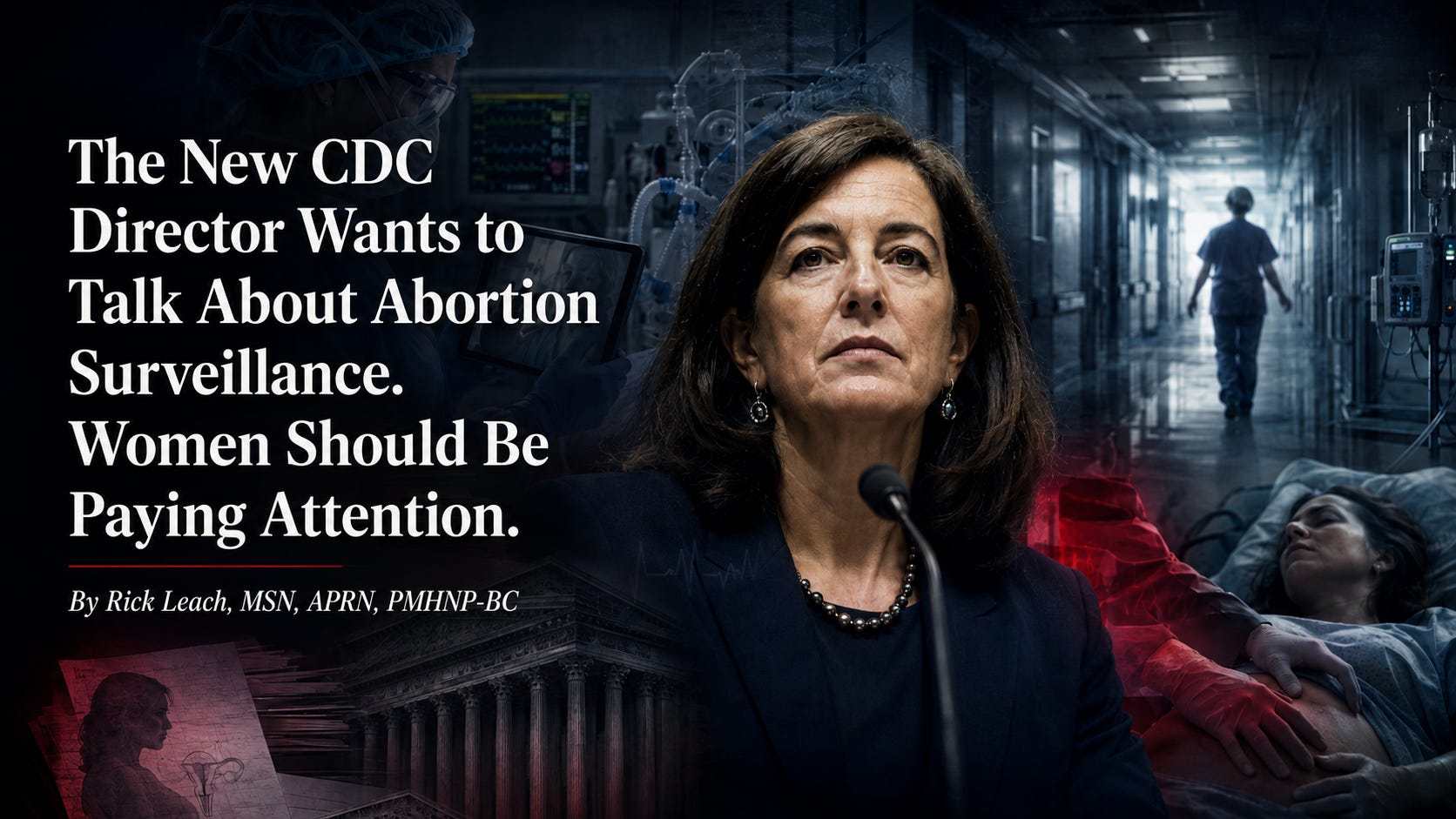
Dr. Erica Schwartz was confirmed as CDC director on August 5 by a 51-44 Senate vote.
She is a preventive medicine physician, has public-health training and a law degree, served as deputy U.S. surgeon general, and held senior medical leadership roles in the Coast Guard.
I’m not impressed by the résumé for the sake of being impressed.
The résumé matters because she knows better.
During her confirmation hearing, Sen. Josh Hawley asked Schwartz about abortion reporting.
She said abortion surveillance is “absolutely a critical component” of what the CDC does.
The CDC has been collecting abortion data since 1969.
States and jurisdictions voluntarily send this information so that public-health researchers can follow rates, methods, characteristics, and trends.
Obviously, that part doesn’t bother me.
What matters is what she said next. She wants to ensure states are not “conflating emergency services and hiding abortions” inside emergency-care reporting.
That is a deadly serious claim, and it is not all that clear what it refers to.
I still want to know, exactly, what the fuck she means.
What states?
Which emergency services?
What cases are you talking about?
I looked for evidence that states are deliberately disguising abortions as emergency treatment. I couldn’t find any.
If she has that evidence, she needs to make that shit public.
The CDC Already Has a Definition
The CDC’s abortion-surveillance definition excludes tragedies such as ectopic pregnancy, early pregnancy loss, intrauterine fetal death, and retained products of conception.
The CDC knows the difference between an induced abortion and the other previously mentioned potential pregnancy outcomes.
How Sick Does She Have to Get?
Schwartz is a physician, which is exactly why this pisses me off.
She knows damn well an ectopic pregnancy can kill a woman before it ruptures.
She knows somebody can have a serious infection before they are in septic shock.
She knows a woman can be hemorrhaging before her blood pressure finally tanks.
And then there’s the “life of the mother” exception politicians love to point at like it solves the problem. It doesn’t. Now the doctor is standing there asking a ridiculous question: how close to dying does this woman have to get before I’m allowed to treat her?
How sick does a patient have to be before treatment is clearly allowed?
Does the ectopic pregnancy have to actually rupture?
Does the woman have to become hypotensive?
Does infection have to develop into sepsis?
Do we have to be performing chest compressions?
One study found doctors in states with abortion bans describing delays and changes in care involving ectopic pregnancy, early pregnancy loss, molar pregnancy, preterm rupture of membranes, and other serious maternal medical conditions.
Often it was because they had to delay treatment for a woman while they waited on the hospital lawyer to give medical advice to a fucking doctor.
Another study involving 864 OB-GYNs found more restrictions on counseling and care in states with restrictive abortion laws, including care for potentially life-threatening pregnancy complications.
So What Exactly Does She Want Changed?
These concerns aren’t hypothetical. Doctors are already saying these laws are changing what happens when an actual patient shows up needing care.
The CDC gets abortion data voluntarily from states and other jurisdictions.
That leaves me with a pretty basic question: what the hell does Schwartz actually want changed?
I Already Watched Trump Play Doctor
I have a hard time giving this administration the most reassuring interpretation because I already lived through COVID under Donald Trump.
On April 23, 2020, Trump speculated about whether disinfectants could be used “by injection inside or almost a cleaning.”
I was in the ICU taking care of critically ill patients while that was happening.
We had infectious-disease physicians, epidemiologists, and critical-care teams.
The experts were already there. Whether anyone in power listened to them was another story.
And Schwartz Works for RFK Jr.
Schwartz’s predecessor, Susan Monarez, lasted less than a month as CDC director before being removed after a conflict with HHS leadership over vaccine policy.
And Schwartz took the job anyway.
At her hearing she promised “unwavering scientific integrity.”
That’ll be tested when it conflicts with political pressure.
Women Are Patients
In the end, it’s pretty simple.
A woman shows up in the ER bleeding, infected, or with an ectopic pregnancy. At that point, what the hell does she need? That’s what the doctor should be thinking about.
I Know How Fast Washington Reaches a Bedside
People in Washington can argue over definitions all damn day.
At the bedside, I don’t have that luxury.
Jim was 26.
He looked at me and said, “I’m okay, Rick. I’m okay.”
Then he died.
I don’t ever want to see it happen again through women’s bodies.
References
Andhavarapu, S., Yardi, I., Bzhilyanskaya, V., Lurie, T., Bhinder, M., Patel, P., Pourmand, A., & Tran, Q. K. (2022). Post-traumatic stress in healthcare workers during the COVID-19 pandemic: A systematic review and meta-analysis. Psychiatry Research, 317, 114890.
Centers for Disease Control and Prevention. (n.d.). CDC’s abortion surveillance system FAQs.
Centers for Disease Control and Prevention. (2021). Provisional mortality data - United States, 2020. Morbidity and Mortality Weekly Report, 70.
Centers for Disease Control and Prevention. (2022). Provisional mortality data - United States, 2021. Morbidity and Mortality Weekly Report, 71.
Landay, S., Newton-Hoe, E., Narasimhan, S., Beasley, A., Adkins, J., & Neill, S. (2026). Abortion bans and pregnancy-related care across physician specialties: A qualitative study. JAMA Network Open, 9(6), e2619644.
National Council of State Boards of Nursing. (2023, April 13). NCSBN research projects significant nursing workforce shortages and crisis.
Reuters. (2026, August 5). U.S. Senate confirms Schwartz as CDC director.
Sabbath, E. L., Brennan, T. P., Chalem, A., McTernan, M. L., Arora, K. S., & Buchbinder, M. (2026). State abortion laws and moral distress in a national sample of obstetrician-gynecologists. JAMA Network Open, 9(7), e2626232.
Shutt, J. (2026, July 15). CDC nominee faces questions over whether she can lead the agency independently. Government Executive.
The White House. (2020, April 23). Remarks by President Trump, Vice President Pence, and members of the Coronavirus Task Force in press briefing.
Comments
Nothing yet. Say the first thing.
Sign in to join the conversation.