
Before we begin, if you appreciate independent writing that takes mental health, politics, war, trauma, and moral accountability head-on, please subscribe to PsychiatRick. New articles are always free to read, but a paid subscription helps support the work and keeps this publication independent. Now, let’s get into it.
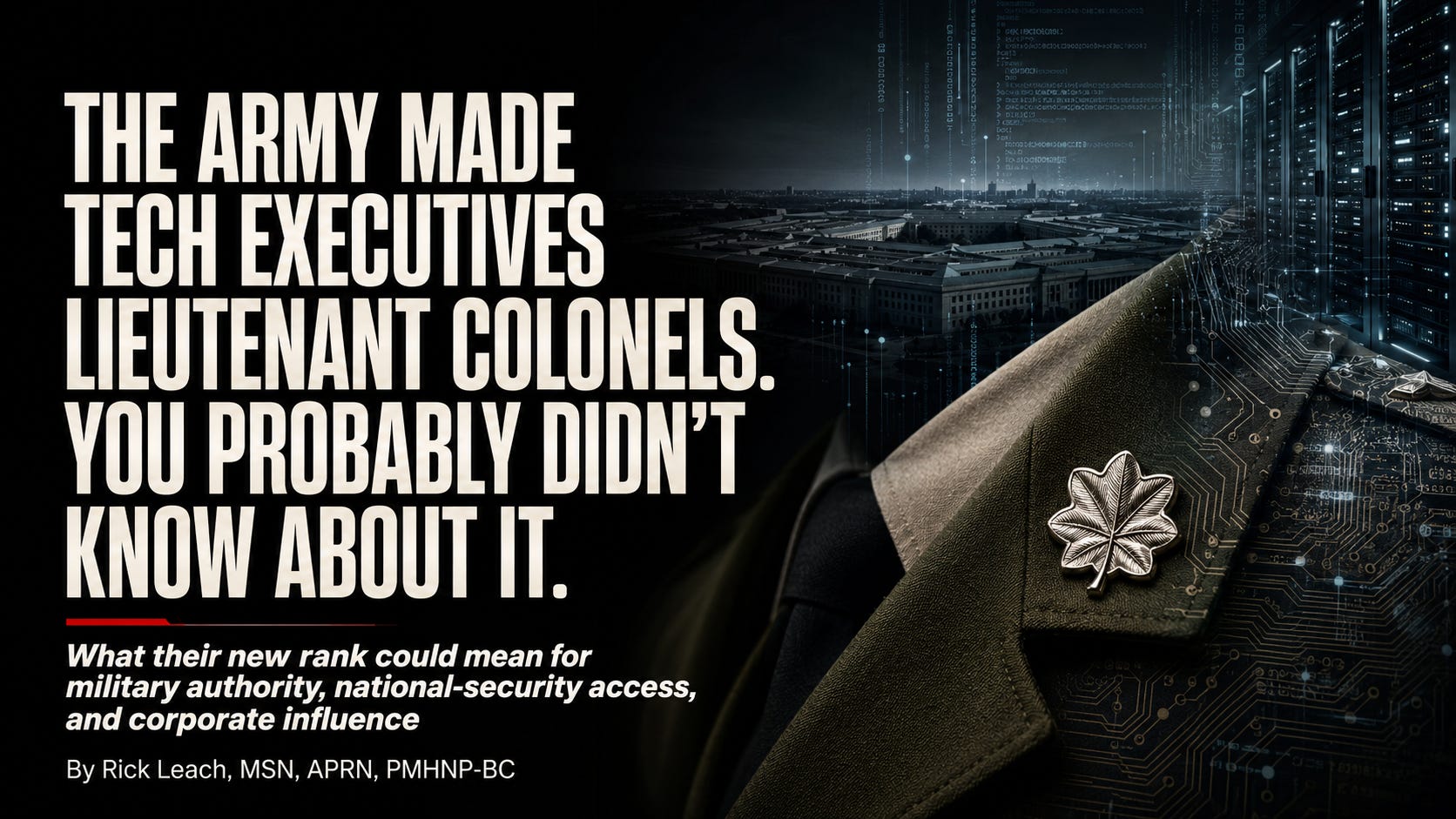
The Army has now made seven civilian technology executives lieutenant colonels in the Army Reserve. The first four were commissioned in June 2025. Three more followed in June 2026. All seven joined Detachment 201, which the Army calls the Executive Innovation Corps.
My immediate reaction was that this is bullshit. Rank isn’t just about putting a shiny piece of metal on your collar. It means you have earned a certain level of respect. Leadership means so much more than just going through the motions. You have to prove to the Joes that you have their wellbeing at heart. You care about what happens to them.
You prove this by going through basic training or OCS. You prove this by being a butter bar and getting chewed out by your higher-ups over your littlest fuckups. You learn from your mistakes. These executives have done none of this. They are Silicon Valley executives with enormous corporate power. They haven’t spent their careers learning the Army. Part of basic training means you have learned about its great history and why listening to your NCOs will save your life. You don’t get to just jump into a rank only two promotions away from a general.
They didn’t earn shit. Rank means something to those of us in the military or veterans. They haven’t spent years as junior officers being corrected by NCOs and senior officers. That’s part of earning a leadership role. What have they done in the Army to think they earned that rank?
At the end of the day, being a lieutenant colonel means something. It means you have leadership experience. You have earned the trust of at least some of your Joes. You paid your dues. You understand something about warfare. You understand what your orders will mean to a private way down the chain from you.
The Army’s pitch
The U.S. Army commissioned its second cohort of senior technology leaders into the Executive Innovation Corps, known as Detachment 201, during a ceremony June 10 at Joint Base Myer-Henderson Hall.
Detachment 201 is a specialized Army Reserve unit designed to bridge the gap between private-sector innovation and military modernization. It reflects the Defense Department’s broader push to leverage private-sector technical capabilities to address complex national security and defense challenges.
The program selects applicants who are highly skilled civilian technology professionals at the executive or C-suite level to serve as part-time strategic advisers. These officers use their advanced expertise in commercial tech and private industry to offer a different perspective and advise senior Army leaders on solving military problems.
The three newly commissioned officers of Cohort 2 are Dane Knecht, chief technology officer of Cloudflare; Sam Pullara, managing director and chief technology officer of Sutter Hill Ventures; and Serkan Piantino, co-founder of Facebook AI Research and former vice president of products at Reddit.
The four new Army Reserve lieutenant colonels are Shyam Sankar, chief technology officer for Palantir; Andrew Bosworth, chief technology officer of Meta; Kevin Weil, chief product officer of OpenAI; and Bob McGrew, advisor at Thinking Machines Lab and former chief research officer for OpenAI.
The Army expects people to accept the answer because these men are successful.
I don’t.
I was drawn to Detachment 201 because it’s a unique opportunity to apply private-sector technical expertise to national defense challenges, Knecht said. I’m excited to contribute to helping the Army innovate and maintain a strategic advantage.
Pullara, whose father served in the US military, pointed to his desire to help solve some of the Army’s most critical problems. The Army’s most pressing technology challenges in AI, cyber defense, and large-scale distributed systems require leaders who can evaluate a technical architecture in the morning and advise a general in the afternoon, he said.
Piantino noted the shifting nature of global conflict. As the character of warfare evolves, the armed forces must rapidly adapt to new domains and prepare for continued technological change, he said. Those who have the experience to contribute to that mission have a duty to offer their service.
Two weeks cannot replace years in the Army
The original four executives were expected to complete an accelerated two-week familiarization course, with some training online and the rest at Fort Benning. The Army didn’t clearly explain whether they would meet the fitness, weapons, leadership, and professional-education requirements applied to other officers.
Two weeks can teach customs, rank structure, basic regulations, and how to wear a uniform without embarrassing the Army. It cannot teach military culture. It cannot replace years of being corrected by NCOs, evaluated by commanders, and held accountable for soldiers.
The program was built around exceptions
Detachment 201 is an effort to recruit senior tech executives to serve part-time in the Army Reserve as senior advisors. In this role they will work on targeted projects to help guide rapid and scalable tech solutions to complex problems. By bringing private-sector know-how into uniform, Detachment 201 is supercharging efforts like the Army Transformation Initiative, which aims to make the force leaner, smarter, and more lethal.
The Army’s acquisition pipeline for highly skilled talent is managed through the modernized Direct Commissioning Program, which has been overhauled to compete more effectively with the private sector for technical talent. By streamlining the centralized application process, the military has reduced the onboarding timeline from more than 18 months to approximately six months. This pathway allows senior corporate leaders to serve in uniform part-time without abandoning their civilian careers.
The uniform is part of the access
Rank in Iraq meant that the soldier proved something to someone that I trust. If I got a new sergeant first class or first sergeant, I would think, well damn, he must be squared away. You don’t just get that rank every day. It meant that I trusted them with my literal life and the lives of my battle buddies.
Then I looked at the dates.
Meta and Anduril announced a military extended-reality partnership on May 29, 2025. Andrew Bosworth became a lieutenant colonel in the Army Reserve about two weeks later. OpenAI announced OpenAI for Government on June 16. Kevin Weil became a lieutenant colonel on June 13. The Defense Department agreement tied to the OpenAI announcement had a $200 million ceiling. On July 31, 2025, the Army gave Palantir an enterprise agreement.
I believe the Army and these executives don’t want the presumption of impropriety. They don’t want this to become another example of the rich and powerful using the U.S. government and taxpayer money to enrich themselves. They don’t want people looking into whether they have used prestigious military rank to gain an advantage or used inside information to make themselves richer.
That agreement folded 75 contracts into one vehicle with a ceiling of $10 billion over ten years. Shyam Sankar was already a lieutenant colonel.
Did Bosworth use his rank to help Meta? I don’t know. Did Weil use anything he heard to help OpenAI? I don’t know that either. I could not find enough public information to answer those questions.
Military.com reported that the executives would not categorically recuse themselves from Defense Department business involving their civilian employers. The Army said they could not make acquisition decisions and had to follow military ethics rules.
Who is in the room when the Army decides what problem needs to be solved?
Over the past year, the pilot cohort of Detachment 201 has provided strategic counsel on the Army’s critical challenges. Their work has influenced key initiatives, including munitions supply chain data analysis, Organic Industrial Base investments, and foundational strategies for autonomous systems and counter-drone technologies.
The commission itself is not a Top Secret clearance. The officer still has to be investigated and approved.
TOP SECRET is not the only kind of information a company can use.
As a soldier, you have to understand that you’re fighting for your country, not for stronger fourth-quarter earnings and billions of dollars for shareholders.
What does the Army plan to fund next? Which system failed during testing? What do commanders keep asking for? A technology company could make money from those answers.
The executives chose this too
They are not naive men who wandered into a recruiting office and misunderstood the paperwork. Nobody had to explain what Lieutenant Colonel would mean when they walked into a room. These men run major technology companies. They know people treat a man in uniform differently than another civilian adviser.
They wanted to serve in uniform. Fine. Start lower. Go through training. Listen to the NCOs. Learn the Army. Take the shit that comes with being new. Prove to the Joes that you care about what happens to them. Earn the next rank.
The Army hasn’t given the public enough answers.
I think these executives could get inside information about what the government or military needs, which could translate into enough information to increase their companies’ profits. I don’t trust that their first loyalty will be to the country. Their civilian responsibilities are tied to their companies’ bottom lines and shareholders.
This administration has earned suspicion
Fuck this administration. I am not giving it any leeway.
Trump has not earned the benefit of the doubt. He fired independent inspectors general without following the notice and waiting requirements Congress put in place. He treats federal agencies like they belong to him.
Your civilian experience doesn’t translate into military culture. You don’t get the whole battle-buddy concept. It’s not just a close coworker. It’s a person you would literally die for, and they would die for you. These tech executives haven’t lived that. It’s not a thing we take lightly at all.
The Army published press releases. Most people still had no idea this happened. Where was the public debate?
I have seen what weak oversight costs
A disagreement between the LOGCAP contractor and the Defense Contract Audit Agency involving at least $88 million in food services charges to feed soldiers in Iraq might have been avoided had there been more careful government oversight. The statement of work prepared by the Army required that the LOGCAP contractor provide food service and food service facilities at bases throughout Iraq. It directed that the contractor build, equip, and operate the dining facilities at the base camps and provide four meals a day for the base camp populations. The populations were specified in the statement of work.
In a review of dining facility billings, the contractor analyzed selected invoices from a number of dining facilities throughout Iraq for a four-month period and found that by billing the government for the base camp population instead of the actual personnel served, it had billed the government for food service for more than 15.9 million soldiers when only 12.5 million, more than 3.4 million fewer, had passed through the dining facilities. The contractor estimated the cost of serving the additional personnel who did not use the dining facilities at approximately $88 million.
The contractor and the Defense Contract Audit Agency disagree over the appropriate billing procedures for this service. The Defense Contract Audit Agency’s interpretation requires billings based on actual head counts while the contractor’s interpretation authorizes billings based on the number of soldiers at each base camp as established in the task order statement of work.
Reconstruction and support contracts were often cost-reimbursement contracts, which allowed the contractor to be reimbursed for reasonable, allowable, and allocable costs to the extent prescribed in the contracts. These contracts also often contained award fee provisions intended to encourage more efficient and effective performance. If contracts are not effectively managed and given sufficient oversight, the government’s risk is likely to increase.
The Defense Department did not have sufficient numbers of contractor oversight personnel at deployed locations, limiting its ability to obtain reasonable assurance that contractors were meeting requirements efficiently and effectively. An Army official acknowledged that the Army was struggling to find the capacity and expertise needed for contracting support in Iraq. A Defense Contract Management Agency official responsible for overseeing contractor performance at 27 locations said he was unable to visit all of them during his six-month tour to determine whether contract requirements were being met.
Forces in Iraq used contractors to a far greater extent than in prior operations to provide interpreters and intelligence analysts, as well as more traditional services such as weapon systems maintenance and base operations support. The Army estimated that almost 60,000 contractor employees supported ongoing military operations in Southwest Asia and that it spent about $15.4 billion on the Logistics Civil Augmentation Program between 2001 and 2004.
A Government Accountability Office review found that the lack of government personnel to provide oversight may have allowed one contractor to purchase $7 million in equipment and services that were not specifically authorized under the contract. On another contract, Defense Department officials said some experts failed to report for duty or did not perform as expected. Officials attributed those performance problems to the lack of personnel available to provide oversight when the experts arrived in Iraq.
Military personnel continued to receive limited or no training on contractor support issues before deployment. Many commanders from combat units deployed to Iraq told investigators that it was their first experience working with contractors and that they had little or no prior training or exposure to contract management.
The Government Accountability Office later reported that the Defense Department relied extensively on logistics contractors in Iraq while struggling with oversight. As of November 2004, only 46 Defense Contract Management Agency employees in Iraq were monitoring multiple contracts. The government and contractor also disputed at least $88 million in food-service charges.
I am asking those questions again. Detachment 201 brings corporate leaders even farther inside the military. These men don’t just have contracts or meetings with Army officials. They wear the uniform. They hold field-grade rank. The Army gave them authority because it wanted their voices to carry more weight.
The Army changed the accession system
The overhaul, formalized in a recent execution order, centralizes the recruiting, screening, and selection process under the U.S. Army Recruiting Command. This move seeks to create a more unified and standardized approach to accessing talent, replacing a previously fragmented system where procedures varied by branch or component.
The Direct Commissioning Program fundamentally changes how we bring specialized talent into the Army, said Brig. Gen. Gregory Johnson, U.S. Army, Director of Military Personnel Management. By reducing commissioning timelines across a wide range of emerging skills, cyber, technology, logistics, and beyond, the program directly enhances warfighting readiness and ensures we remain competitive in an evolving operational environment.
The U.S. Army announced updates to its Direct Commissioning Program, DCP, aimed at attracting top-tier professionals with specialized skills directly into its officer corps. The program offers qualified civilians and former service members the opportunity to be appointed as officers, potentially entering at ranks from second lieutenant to colonel, depending on their qualifications.
The revamped DCP provides an alternative accession pathway beyond traditional routes like Reserve Officers’ Training Corps, the U.S. Military Academy and Officer Candidate School. It helps align civilian expertise with critical mission needs and potentially reduce costs associated with scholarships, permanent change of station moves, and training requirements.
Congress needs to drag Detachment 201 into daylight
A physician does not need to spend years as a second lieutenant before the Army allows him to practice medicine. A nurse, attorney, or chaplain may enter at a higher grade because the military is recognizing professional training required for a specific job.
The executives do not get a pass because the Army offered them the rank. They could have helped as civilians. They agreed to become lieutenant colonels before learning the Army from the bottom.
Congress should make the Army report what Detachment 201 is doing. What training did these men complete? What was waived? What clearances do the positions require? What work are they prohibited from doing? Can they command conventional soldiers? Have any recommendations created an opportunity for their civilian employers? These questions can be answered without publishing classified information or somebody’s private background investigation.
References
Anduril Industries. (2025, May 29). Anduril and Meta team up to transform XR for the American military.
Congressional Research Service. (2025). Removal of inspectors general: Rules, practice, and considerations for Congress.
Defense Counterintelligence and Security Agency. (n.d.). Background investigations for applicants.
Government Accountability Office. (2004, July). Military operations: DOD’s extensive use of logistics support contracts requires strengthened oversight (GAO-04-854).
Government Accountability Office. (2006, December). Military operations: High-level DOD action needed to address long-standing problems with management and oversight of contractors supporting deployed forces (GAO-07-145).
Military.com. (2025, June 27). Tech executives commissioned as senior Army officers won’t recuse themselves from DoD business dealings.
OpenAI. (2025, June 16). Introducing OpenAI for Government.
U.S. Army. (n.d.). Direct Commission Program.
U.S. Army. (2025, July 31). U.S. Army awards enterprise service agreement to enhance military readiness and drive operational efficiency.
U.S. Army. (2025, November 21). Army revamps direct commissioning program to accelerate recruitment of applicants with specialized skills.
U.S. Army. (2026, June 10). Army commissions second cohort of tech executives into Executive Innovation Corps.
U.S. Army Reserve. (2025, June 13). Army Reserve Soldiers front and center of Army’s new Detachment 201: Executive Innovation Corps.
Comments
Nothing yet. Say the first thing.
Sign in to join the conversation.