
Dr. Joshua Coleman is a family estrangement expert and author who runs a private practice in the San Francisco Bay Area and serves as a senior fellow with the Council on Contemporary Families. He has written for the Washington Post’s “Ask a Therapist” and recently appeared on Oprah’s podcast. What follows is our recorded conversation, lightly edited for readability. Here is the video version of the podcast.
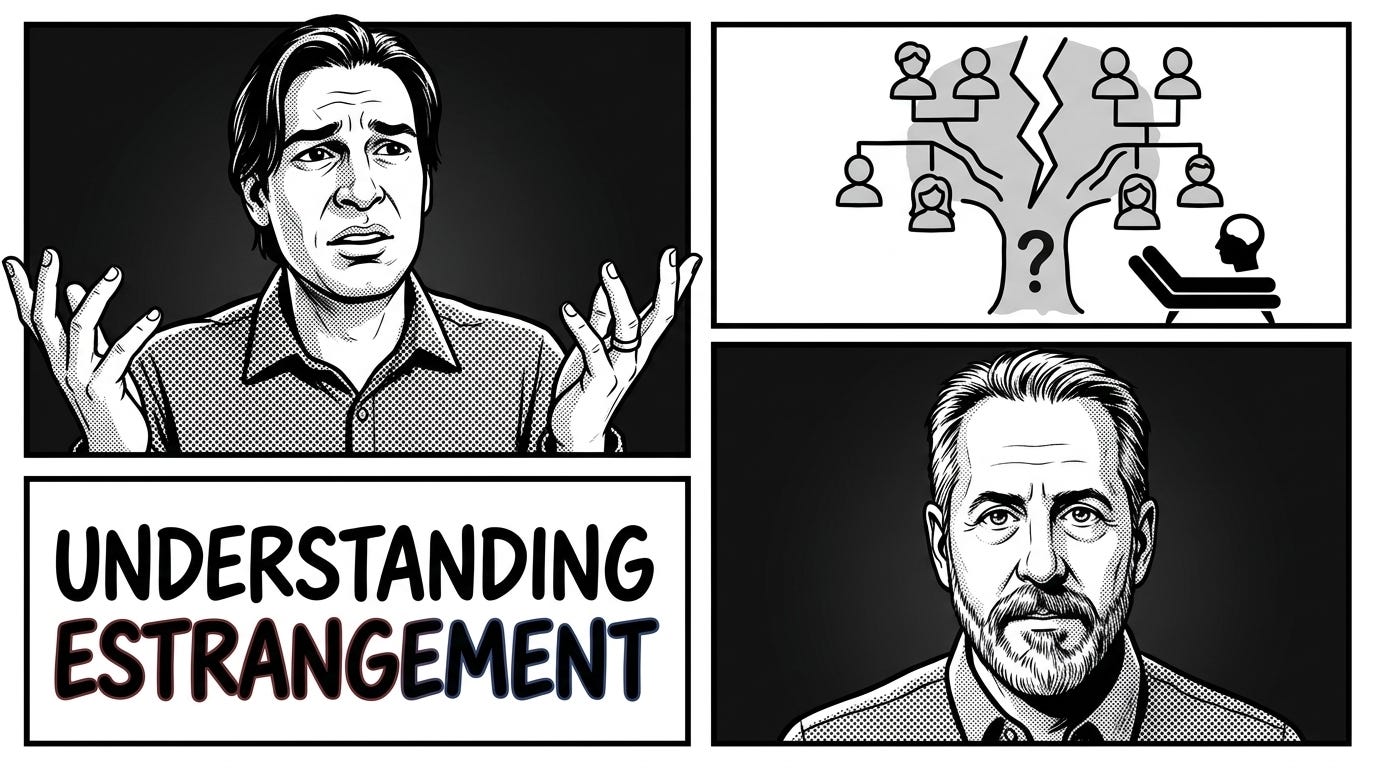
Jeremy Fox: I wanted to start with a question that’s important to me from some of the work I’ve done with clients. How does estrangement differ in biological families versus families who have adopted a child, where maybe the adopted child decides to step away and estrange themselves?
Dr. Coleman: Yeah, we don’t have great statistics on that yet, although I have seen a lot of it in my practice, that parents of adopted children do seem to be more at risk of it. And I think there’s a few different reasons. One is if there was an attachment disruption, which there often is with adoption, particularly if it’s a later-in-life adoption. But even then there may still be an attachment disruption that may weaken that child’s attachment to the parents. I found that if there’s cultural differences, if it’s white parents who adopt a Chinese or a Vietnamese kid, later in life, particularly when the kid gets into college and becomes more identified with their culture, there may be more anger about that. They may identify their parents more as colonialists, that you stole me from my culture, and that can be a part of it. So I do think that there’s a greater risk, but I don’t think yet there’s any good statistics about it.
Jeremy Fox: That would be an interesting subject. I do know that there’s a lot of reactive attachment disorder that can happen when there’s early preverbal trauma with kids and then they’re adopted. And the parents don’t know what happened in the orphanage, right? We know that early attachment window is so important. Sometimes you just don’t know what’s happening.
Dr. Coleman: Right, exactly. And some adoption centers are much less well supervised. So the child just may have been neglected, and that may have messed with their whole attachment system neurologically. So it certainly seems like you could set up the possibility of a later estrangement.
Jeremy Fox: One of my favorite things you’ve discussed is this idea of therapists as “detachment brokers.” For our listeners: those are therapists who subscribe to the model that when something’s really wrong in your family, if the communication isn’t going great or a boundary isn’t being respected, you need to estrange your parents, go no contact. In one of your recent articles you discussed the fact that therapy is not value neutral. A therapist is going to have values and guiding virtues, and they’re going to communicate those, maybe without explicitly instructing. I was curious, given your work, whether fellow therapists have seemed open to the idea that they’re causing harm.
Dr. Coleman: I haven’t gotten any correspondence from therapists where they said, “hey, I’m really rethinking this now and realizing that I was covertly or overtly encouraging estrangement.” So I think the people who are probably not doing it in the first place are probably much more receptive to that idea than those who are. I’ve seen articles in Psychology Today or other places where therapists say, “well, no therapist encourages estrangement.” And I just feel like, first of all, you’re wrong, because every day I get letters from estranged adult children who say “my therapist said that I shouldn’t engage in family therapy, or I’m not ready, because my parent isn’t ready to do it.” And I’m working with your parent. They actually are ready to do it. Your therapist has never met your parent. So I think I’m in a little bit better of a place to do it. And therapists, even if they’re not actively advocating estrangement, as soon as you call a parent “abusive” (I mean if they’re abusive, let’s call a spade a spade), but calling them emotionally immature or a narcissist or a borderline or a sociopath or a gaslighter, you’ve already participated in that detachment.
And that term, detachment brokers, comes from the sociologist Allison Pugh in her book The Tumbleweed Society. What Pugh was trying to point out was that in the past three or four decades, and the political scientist Yascha Mounk also talks about this, our sense of responsibility for others has given way from a more communitarian perspective (the idea that we owe people something, our children, our neighbors), to this idea that “no, your fundamental responsibility is to yourself and your own personal happiness.” So when she calls them detachment brokers, it’s like, well, you don’t have to feel guilty about cutting off your parent. Your primary responsibility is to you. You shouldn’t feel worried about them. That’s being codependent, or you’re overly enmeshed, that’s because you were parentified.
I mean, first of all, a lot of that’s just bullshit. But somehow there’s a utility to it. And look, I’ve used those terms before. I’m not going to claim complete innocence. But if it’s in the realm of encouraging or supporting somebody to cut off a parent, you better damn well be cautious, because you’re going to be ruining the parent’s life.
Jeremy Fox: That term “parentified,” I hear that so much. I’m wondering your opinion on whether estrangement is almost a sort of initiational rite of passage, where the child gets a head of steam and they know they need to be independent, but it takes some anger, and that’s the rocket fuel to be more independent. They’re interpreting that frustration as, “I need to go cut off contact,” versus I need to be my own person, like a weird mutation of “failure to launch.”
Dr. Coleman: I think it’s a really good point. A University of Massachusetts sociologist [Amy T Schalet] calls American individualism “adversarial individualism.” The idea is that you become an individual in an adversarial relationship to your parents. She wrote this great book called Not Under My Roof, where she compared Dutch parents to American parents around the idea of drinking with the family during dinner, or having a boyfriend or girlfriend spend the night at the age of 16 or after. And Dutch parents are cool with both. She calls that “interpersonal individualism,” because they’re raising the children into adulthood with the parents’ participation. Whereas in the United States, there’s very few parents who would agree to that. What she says is that in the US, you become an adult through a more adversarial relationship.
Now, that’s beginning to change, because parents have become so conscientious and caretaking and anxious and guilt-ridden and surveilling that a lot of kids don’t have the need to have an adversarial relationship, because they’re getting everything they want. But to your point, I think it’s a really important point that sometimes they don’t know any other way to feel separate from the parent than to either inflate some kind of more minor conflict or personality flaw in the parent, or some other memory, as some huge thing, as an engine to get away from the parent. And it’s harder now than it was. I was raised in Dayton, Ohio. And when I moved out to California when I was twenty-one, there was no way to send my parents pictures. I wasn’t calling them on the phone. I wasn’t giving them updates. We’re just so much more enmeshed in terms of the family environments. And some adult children just don’t know how to feel separate from their parents other than to cut them off.
Jeremy Fox: It makes me think of Erikson’s psychosocial stages. It’s like you’re at a four- or five-year-old level, or a teen level, of disliking your parents and finding them “cringe,” but you’re in your twenties or thirties. Right now, you need to be aware that they’re going to be grandparents to your children. Maybe you’re able to roll your eyes and say, “we don’t really believe that [view or belief], but it’s okay, Mom and Dad, we still love you, we’ll have you over for dinner every month.” I think there’s almost a “cultural alexithymia,” a lack of vocabulary for emotions. There’s shame, cringe, anger, entitlement. We’ve got a few buttons to press on a Fisher-Price emotion machine here.
Dr. Coleman: That’s well said. I think it ties back to your earlier point about the separation-individuation thing, because adolescence is pushed way out. In the 1960s, you knew you were an adult because of the institutional structures. By twenty-four, the average adult in the 1960s had a job, maybe owned a house, could support a family, probably had children, was married. You could put your kids through college with a union job. Whereas today you can’t do any of that into your thirties often, so the institutional structures that would make you feel like an adult have all been removed. One of the ways that people feel like an adult is, well, “I feel like an adult because I’m cutting off my parents. I’m pushing back on them. I’m setting limits for them.”
Jeremy Fox: You’ve spoken before about social contagion as a driver of estrangement, the way online communities normalize cutoff. I want to go a level deeper. I think about splitting a lot as the defense mechanism analytically, where you can’t think of somebody as both good and bad. They’re either good or “I have to cut them off.” Have you considered the social contagion of online communities as the technology itself, not just the content? You can have a bad TikTok with terrible messaging, but even the structure of the technology shows you only stuff that makes you happy or angry. The technology itself is hostile to integrating attachment figures, or integrating the self. It’s like splitting as the mechanism of estrangement.
Dr. Coleman: Yeah, I haven’t thought about it in just that way. And I like that notion that the algorithmic reality created through social media does create these silos of information, which really just amplify the worst and don’t populate the person’s ideas with other contrary ideas. I had somebody who reached out to me recently and said, I went onto a Reddit site and I tried to push back on some of the narratives, and people are like, “you’re wrong, you’ve been gaslit, you don’t belong here.” It’s very cultish. So I do think that’s a problem, and it’s certainly true in the political realm. We know from the Pew Research Center that today political differences are the biggest value signifier over any other way that we ascribe causality to other persons. If I’m a Democrat and my kid’s going to marry a Republican today, I’d be like, “hell no.” But twenty years ago you’d be like, well, as long as they love each other, that’s the most important thing. There’s a negative halo effect. You ascribe all kinds of qualities to that person that they may or may not have just because they’re in that party. So this is huge splitting going on in the political realm, which to your point is part of the mechanism of the algorithms.
Jeremy Fox: On that topic, are you aware of any good that is coming out of those communities, like genuine support? Or is it typically this expulsion of nuance, the true-believer effect?
Dr. Coleman: I think people get support there. The issue is whether they’re getting the right kind of support. I see it on the estranged-parents forums as well, that sometimes people will be so supportive of the parent’s anger that they’re not really encouraging the parent to do the kind of self-analysis, self-reflection, repair work that’s really essential to any potential reconciliation. So people can feel better, but feeling better, as we know as therapists, isn’t necessarily the right pathway to getting better. There’s this saying that opposition is the truest form of friendship. The best therapy I ever had was when therapists would be like, “no, this is part of your larger pattern, you need to change this, you’re causing your own problems.” Early in my marriage (we’ve been married thirty-five years now and we have a great marriage) but early on we didn’t. My friends who would just say, “that’s your wife’s fault, blah blah blah,” I’d feel better walking away, but I wasn’t changing in a way that saved my marriage. Whereas therapists were like, “no, what you’re doing is actually causing your wife to behave in the way you’re saying you don’t want.” So the silos of social media certainly do not provide that kind of confrontation.
Jeremy Fox: That’s very rich. I beat this drum a lot, but I think every profession is having to find a way to get more professionals out there to meet the need. Even with as many therapists as there are now, the tide of need is still overcoming the supply. A lot of therapists don’t want to upset their clients. I have a two-year master’s, and then I did postgraduate research and work on my own because I love traumatology and EMDR. But a lot of therapists could use more practice and training, even analytic training, which isn’t really in grad schools. You get a grab bag of techniques and listening skills. What you don’t really get is the formation of how you build rapport and confront a blind spot. It’s not just coffee with a friend, because I’m going to tell you [the client] stuff that a friend won’t say, because they don’t want to lose the friendship.
Dr. Coleman: It’s not, and it’s a real art. I feel like it took me a long time as a clinician to get good at it. When you’re facing somebody with a hard truth about themselves that they’re not seeing, they are much more at risk to feel rejected or hurt or misunderstood. My consultant to my practice for some twenty years was a master at it. It’s like the velvet glove of confrontation. I use humor a lot, that’s kind of my method. But to your earlier point, you have to have established the rapport and the trust first. Then you can face people with the hard realities about the way they’re causing their own problems. I think people really do want and need that, even if it hurts.
Jeremy Fox: A hundred percent. I think humor takes out the sting, saying it in a way that shows your care. I’ve had people ask me how to communicate something unsavory, and it’s like, you say it in a way that communicates “here’s why I’m thinking this and why I care about you.” Like an intervention. Speaking of splitting and of difficult people, I’m just going to say it. What has been your experience with parents handling and communicating with children who have personality disorders? When somebody with a personality disorder estranges their parent and then starts to spew the therapeutic quasi-religion of estrangement dialogue.
Dr. Coleman: Yeah, it’s not uncommon. There’s a lot in the media about troubled parents getting estranged because the adult child is presumably psychologically healthy and doesn’t deserve it. But there’s not very much about parents who are estranged, who are healthy psychologically, who have troubled adult children. You can (despite popular beliefs) be a great parent and your kids still may, for genetic reasons or otherwise, develop a mental illness. So if your kid has a personality disorder, if they’re borderline or sociopathic or narcissistic, or the dark triad of narcissism, psychopathy, and Machiavellianism, it’s going to be really hard. And if they’re married to someone who has that, all those things are going to make it really hard.
In general, what I tell parents is it’s a matter of love and limits. Love, because it’s not your kid’s fault that they have these issue; but limits, because those people who have that psychology can be really abusive and manipulative. So parents have to be able to set limits. But sometimes those adult children need to blame the parents because of how much shame they feel about how bad their life is. I usually don’t encourage parents to defend themselves or explain it away or push back. I usually encourage them to try to find some kernel of truth. So it may come out like, “if you had been different, I wouldn’t have all these struggles in my relationships.” And the parent wants to say, “well, actually you have those problems because of the provocative behavior you constantly engage in, not because of what I did.” But that’s not going to make the child feel better, and it’s not going to help them disavow some of the shame they feel. So what I tell parents to say is something like, “well, maybe you’re right, maybe if we had done more of X, Y, or Z, maybe if we hadn’t sent you to wilderness camp even though you were suicidal, or to rehab even though you were a serious addict, you would have been fine now. Perhaps that’s true. And I could see why you’d be upset, why you would have wished that we had done it differently.” So parents have to find a way to be in a position of empathy with their adult child. The parent taking some of the responsibility can be both therapeutic and can help toward a potential reconciliation.
Jeremy Fox: That’s teaching people to think like a therapist. Find the kernel of truth, find the hurt, speak to that versus the smoke screen. Because with personality disorders there’s so much smoke screen. Here’s the shame over here, but it’s a shell game: “watch what I’m doing over here. I’m blustery, I’m angry, I’m better than you,” but really it’s the shame down here.
Dr. Coleman: That’s exactly right. Absolutely.
Jeremy Fox: One of your recent Substack articles was really rich about trauma and the ways parents experience estrangement, the whole spectrum of emotions there. When I think about ambiguous loss, which is so rampant in our culture, being ghosted, grief without closure, there’s no body [to grieve] with estrangement, right? When you frame estrangement as ambiguous loss, how does that impact your work? What interventions do you suggest to parents?
Dr. Coleman: Ambiguous loss was a term developed by Pauline Boss, a psychologist, about twenty years ago. I don’t think she was thinking about estrangement at that time, although I have interviewed her and she said she does feel like it is estrangement. An ambiguous loss is a loss that isn’t yet socially identified or constructed. If I were to get divorced tomorrow, or if I was diagnosed with cancer, there’s a rich literature and resource list out there for how to get support. There’s a way to do it. It’s a very well-defined loss, whereas an ambiguous loss is something that’s not yet part of the larger culture. And estrangement is one of those things. So what I often hear from parents is, “my God, I thought I was the only one. I didn’t even know there was a name for this, and I don’t talk about it with anybody, because I figure if I do, they’re going to say, ‘well, you must have done something pretty messed up.’ Adult children don’t cut off their parents for no reason, so you must have done something.”
So it’s an enormous loss, because parents who are going through it feel intense feelings of grief, shame, regret, sadness, worry, fear, anger. But there’s nowhere to put it. And it’s not like the death of a child, not to minimize that in any way. But at least with the death of a child, they’re not still rejecting you in life. Whereas if a parent’s cut off, it’s a day-to-day rejection, and it’s a day-to-day hope that maybe today’s going to be the day my kid reaches out. That’s why holidays and birthdays are so painful, because it’s like, “will they call me this Christmas, will this be the year they recognize my birthday or Father’s Day or Mother’s Day?” So estranged parents are constantly living on the edge.
And I found that the work of Marsha Linehan, the psychologist from University of Washington, radical acceptance, is an essential thing if you’re going through an estrangement. People sometimes write me and say, that’s Tara Brach. It’s actually no, it was Marsha Linehan who developed it, and Tara Brach popularized it. One of Linehan’s quotes that I love is, the pathway out of hell is through misery. The more you fight your misery, the more you stay in hell. That’s the key insight of radical acceptance. Pain plus struggle equals suffering. Acceptance doesn’t mean I’ll never try to work on it. It means there may be nothing else I can do. So I’ll often tell an estranged parent, if I help them write an amends letter, which is one of the key things I help parents do, and the adult child hasn’t responded, and they’ve done one follow-up, and it’s been a year, then you have to just not do anything for a year. You’ve done the big move. Then you have to say, okay, I need to accept that I’ve done everything I can, and I’m going to focus on the good parts of my life, remember the good ways I was a parent, and I’m not going to keep tormenting myself with this.
And a related concept is that anxiety is living in the future, depression is living in the past, and joy and resilience come from living in the present. When you’re an estranged parent, living in the past is when you’re tormenting yourself with guilt, regret, self-hatred, self-criticism. When you’re living in the future, you’re catastrophizing. What if I never see my kid, what if I never see my grandchildren again. Living in the present doesn’t mean you’re always going to feel joyous. It’s just that whatever painful experience you’re having, if you’re attending to it and letting it come and pass, you’re going to be much better off than if you’re constantly rebooting it. And we’re all doing that all the time. Our brains have evolved to be that way, because that helped us survive during our evolution. But it’s an evolutionary mismatch when it’s something we can’t actually solve. It’s like craving fats, if you know what I mean.
Jeremy Fox: I love that. When we have clients who have the unsolvable problems, we just have to help them expand their life in other ways. The meaning-making is so big.
Dr. Coleman: Yeah, absolutely. Without meaning. And that’s the hardest part for estranged parents, because it’s tied to this notion of mattering. We all need to feel like we matter, and once we have children and grandchildren, we really feel like we need to matter to them. I had a mother say to me, nobody calls me Mom anymore. I thought that was the most poignant description of her identity. It’s like, I used to be at least somebody’s mother. Having that stripped away was so fundamentally disorienting and wounding, to not have these feelings that you matter to somebody.
Jeremy Fox: Very well said. The mind really privileges incompletion, like with the Zeigarnik effect. That’s my area of academic research, the memory for incomplete tasks over completed ones, that Bluma Zeigarnik discovered in the twenties.
Dr. Coleman: Can you tell me and the listeners more about that? Because I actually don’t know.
Jeremy Fox: Of course. The Zeigarnik effect is the enhanced memory for something that you have to do. The way she discovered it was that she was one of the Gestalt psychologists, which is a little different than Gestalt therapy. Gestalt psychology is about finding patterns in pictures that are suggested to the brain and not inherently there. Like the three Pac-Man mouths that point and you see a triangle there, because of the angles, even though it’s only implied. When she was at a restaurant, she noticed that waitstaff could remember the orders they hadn’t fulfilled better than the ones they had, because their brain had this tension for completing and attending mentally to the task that hadn’t been done yet. So she studied it. Traumatologists then, especially in the eighties, went on to research how trauma is a form of Zeigarnik effect, where you’re interrupted from escaping, interrupted from closure. Peter Levine has talked about trauma being too much, too quick, all those things of excess, and being trapped and unsafe together is what makes trauma. So you’re interrupted from escape and you encode that. It’s the repetition compulsion too, to put a Freudian frame on it. When I hear ambiguous loss, and I have clients with issues around lack of closure, I kind of walk them through that and we try to make some closure. It’s so fascinating that it’s like a cliffhanger in a movie. So much goes back to the idea of attention in the mind, a drive for completion. I see that in your work with estrangement. There’s a lack of completion there.
Dr. Coleman: Absolutely. That’s really fascinating. One of the ways I’ve been talking about this, and I think it’s tied to what you’re saying, is that to be a good parent, you constantly have to be thinking about what’s in my child’s best interest. And that’s true when our children become adults as well. Part of what makes you a good parent is the ability to constantly be tracking that and tracking their feedback to you. But if your kid’s estranged and they’re not giving you any way to do that, you actually have to disable that part of your brain. You have to close it down, because your mind is constantly searching for, well, what should I be doing, what could I be doing. That’s why I’m at pains to tell parents, you write a good amends letter, you do a follow-up, and if your kid’s still not in contact, you stop, and you feel like project complete for now. If your kid wants to reach out, then great. But there’s nothing else you can do or should do. And that’s a really hard one for mothers, because mothers really feel like there must be something else I can do. Nothing compels an adult child to have a relationship with a parent today beyond that child’s desire in our culture. So once they take those steps, then it’s time to disable that part of your brain that’s telling you, well, you have to do something, you’re being a bad parent not to.
Jeremy Fox: I think that’s where trait neuroticism comes in too. Some people are better able to walk away and turn off that ruminative module.
Dr. Coleman: Well, I think it’s good for our listeners, because not everybody knows about trait neuroticism. It’s part of the big five personality factors, represented by the acronym OCEAN. It’s all on a continuum. Openness to experience, conscientiousness, extroversion, agreeableness, and neuroticism, to your point. Somebody wrote me recently and said, I wish you had a different word than neuroticism. I’m not making it up, but it is how it’s defined, which is more toward rumination, anxiety, guilt, preoccupation, negativity. And if you’re born into the world in that way, you’re probably going to see life through that lens. It takes a lot of work to not see it through that lens.
Jeremy Fox: While we’ve got that thread going of ambiguous loss, have you or your clients ever developed any formal rituals for the ambiguous grief of estrangement? I know the amends letter is spectacular. Have you noticed anything else that helps, like the classic burning of a letter?
Dr. Coleman: There’s nothing like support. When I do my webinar, sometimes there’ll be as many as eight hundred people on it, and so many people will write and say it’s just therapeutic to feel not alone with this. Part of it being an ambiguous loss is the kind of shame it invites. So feeling like, my God, I’m not the only one, and there’s all these other people who look kind of normal to me, so I must not be this monster that my child has made me out to be. Community is probably the biggest antidote. And the value of an amends letter is not only strategic, in the sense that you’re really trying as the parent to acknowledge what your child’s complaints were about you and to build a bridge back. It’s also an exercise in radical acceptance, because what stays in the dark grows in the dark. The more that we can’t really face our flaws, the worse off we’re going to be. That’s often why I cite the fourth step in AA. I have close family members in AA and I’ve been learning a lot through that. The fourth step is to make a fearless and searching moral inventory of your own character flaws. We’ve all got them. Two of my three adult children have talked about how I was impatient when I was raising them, and I was like, no, I wasn’t impatient, I was just irritable. And they’re like, no, you come across much more angry than you realize. And I have to acknowledge that and respect that. Even if that wasn’t how I experienced it, that’s how they experienced it. Facing it and accepting it is also therapeutic.
Jeremy Fox: One thing that fascinated me is your discussion about life being explained backwards now. You quoted a sociologist who said that, that parents’ own failings are found because the child’s not doing as well as they want to now. If someone’s unhappy, it’s able to be blamed on their parent now. And that’s dangerous, because unhappiness is just a state of being. It can be influenced by so much. To then project it onto the parent is a dangerous game.
Dr. Coleman: Yeah, absolutely. The quote was from Eva Illouz, this brilliant Israeli sociologist. The full quote is, today our lives are plotted backwards. What’s a dysfunctional family? It’s a family where your needs weren’t met. How do you know your needs weren’t met? By looking at your present condition. I love that quote, because it summarizes this moment we’re in, where adult children are being invited to assume that the major problems they have in adulthood stem from dysfunctional parenting. And you’re a traumatologist, and certainly in some cases they do. People are in some homes raised by truly traumatizing parents, where there’s molestation, or rampant alcoholism, or physical abuse, or neglect, or horrible emotional abuse. So I’m not here to say nobody is abused, or that there’s not a long tail of trauma that can follow somebody through life. The problem is that we’re now influenced by this culture of the body keeps the score, this idea that every trauma is a permanent part of your psyche, tattooed on you. And the other problem is that if you look at Gen Z, those born between 1995 and 2012, that generation has more anxiety, depression, suicidal ideation, and suicide attempts than any other generation. And is it because parents have suddenly become more traumatizing in that generation? No. Parents who’ve been parenting during that period are the most psychological, sophisticated, wealthiest, intensive, spent more time with their kids than any other generation. So it’s a cohort effect, according to people like Jean Twenge or Jonathan Haidt. But a lot of these kids are going to end up with so-called trauma-informed therapists who are just going to assume, you have significant depression, significant anxiety, let’s look back on your childhood. I’ll always look back on somebody’s childhood, there’s a lot of validity and power to it. But if you’re only looking back, that’s a problem. Certain books, I won’t name names, say, do you have these symptoms? That means you had this kind of parent. And it’s like, that is such a bunch of bullshit. You could be neurotic with the best parents ever. You could develop bipolar disorder or schizophrenia or major depression or an anxiety disorder even in the context of great parenting. So this idea that if you have these issues your parent caused it is not only wrong, it’s immoral, because once you diagnose a parent that way, you’ve green-lit them toward cutting off that parent, because now it’s become a virtuous act. I’m talking back against my traumatizers. I sometimes see correspondence from an estranged adult child who’ll say, I’m cutting you off and cutting off access to your grandchildren, even though you were a good grandparent, because the trauma stops with me. And it’s like, no, the trauma’s not stopping with you. The trauma’s continuing with you, because you’re traumatizing your parent. So you can say you’re doing this to protect yourself, but don’t act like what you’re doing is actually stopping the cycle of trauma. It’s continuing the cycle of trauma.
Jeremy Fox: Very rich. I’m going to shake it up a little bit and say, as a traumatologist, that no matter what, the way out is through. Methodologies like prolonged exposure therapy, EMDR, cognitive processing therapy, whatever acronyms you want to throw out. Even with severe trauma, the pathway is to say this happened, it’s bad, and I’m safe now. So with Gen Z, part of the problem is the lack of life experience. We’ve seen in real time how overprotectedness causes the reverse of the desired effect. Lack of dating, lack of physical intimacy, lack of communication skills. Human beings are born with instincts and capacities and temperament, but they certainly aren’t born with competencies. So much of the anxiety and depression that’s being labeled trauma is really, I haven’t done something, I’m afraid of doing it. Instead of doing it, even if it sucks, taking a step and being proud of it, the replacement is the psychological framing of, I’ll move forward when it feels perfect. And that’s a timeless, pernicious myth, that I have to feel perfect before I practice.
Dr. Coleman: Can you speak to my audience about this, because what you just said is so important? So many parents are being estranged today because their therapists aren’t telling them to do what you just said, which is, okay, let’s say your parents did traumatize you, let’s label it, let’s expose you to that, and then let’s move on. So many adult children are being told, well, if being around your parent triggers you, then you’re not safe around them, and you should just estrange yourself. Can you speak to what that looks like in the office?
Jeremy Fox: Yeah, pivoting through triggers, working through triggers. When people come to me for generalized anxiety disorder, which is what most people just call anxiety, or panic disorder, or trauma, or a phobia like arachnophobia or claustrophobia, the way out is to create a hierarchy. What’s the most upsetting element, like facing a tarantula, and the least upsetting, like looking at a picture of it. And to desensitize that, to take some time, face that fear, look at a picture of a spider, watch a movie of one, and do some bilateral stimulation with EMDR, the eye movement back and forth, and pivot into it. When we hear the word triggers as therapists, the formal definition is a trigger of a memory of what happened. So if it’s PTSD from war exposure, you hear a car backfire, you hear a firework, and you think it’s an IED, that triggers you to feel like you’re there. That’s a real PTSD thing. Now the word trigger has evolved to mean, makes me uncomfortable. So we have to look at the intent of the other person. Can we know it? If you’re around a parent and they’re constantly making snide comments about your weight, actively making you uncomfortable, that’s one thing, and it requires boundaries, interpersonal DBT skills. But if you’re just feeling uneasy around your parent and thinking on times where it didn’t go well, you do have to be around them and create new memories enough to crowd out those triggers. That’s the way through. Like public speaking, or if you’re afraid of doing a group project in college, the answer isn’t to get out of it with a letter. It’s to say, I’m going to do it, and even if it goes badly, I can do it again, and I develop this competency.
Dr. Coleman: Yeah. Because I think so many adult children are being guided to just avoid the parent, and it’s treated like some virtuous act of, well, I’m setting boundaries on toxic, hurtful people. And often the people that are having the boundaries set on them are workable people. The other way I think about this is that to have a close relationship with a parent, in the same way I have a close relationship with an adult child, is a psychological achievement. It requires a certain kind of skill set for both. If you’re the adult child, it requires the ability to hold on to your feelings of selfhood, identity, resilience in the presence of your parent, even if your parent’s behaving badly. If you’re the parent, the task is to be able to tolerate your children’s complaints about you or requests for different behavior and not be completely undone by it. Both things require a whole subset of psychological skills. So a lot of my work with families is making sure they have those things on board if they’re going to try to have a reconciliation.
Jeremy Fox: Absolutely. So I would say, look at the parent’s behavior now toward the estranged adult child. If you’re trying to make amends and they’re trying to make amends with you, and their behavior is different, try to put those triggers behind you. If it’s not different, then you have an answer, that they’re not willing to change and honor what you’re requesting. Is your request reasonable, is it workable? If so, can you meet and create new memories? In one of your recent articles you said people don’t understand enough about memory science, and you linked to an article about false memories. We’re constantly recreating our memory. So with trauma triggers, imagine a snowball going down a hill. It starts small, and then you rehearse it as more upsetting and more upsetting, and develop fear of the memory, then fear of the fear, and you enhance that memory with more and more terror. That’s the least advisable thing to do. You have to demystify the anxiety. You have to walk into it. That’s where therapists can really be helpful, to teach you this and go through it with you in the office, rehearse it, role-play it, EMDR it, and realize, wait a minute, my memory isn’t always a hundred percent accurate, there’s affect that gets attached that builds the snowball of shame and fear. And why should I even do that with my parent? Because that’s the future grandparent of your child, that’s a social connection, that’s someone who’s part of your story.
Dr. Coleman: Right, absolutely. And there’s also the moral issue. These are the people who gave you life, and they deserve for you to spend some time on them. I think there’s an obligation that both generations have to the other. I do think the buck stops with parents. It’s incumbent on us as parents to show empathy, to take responsibility, to find the kernel if not the bushel of truth in our children’s complaints, to be willing to accept their boundaries and have a relationship that’s more in line with their ideals. I don’t think parents have the right to just say, no, I’m your parent, I get to set that, you have to obey me. First of all, it’s not going to work. But from the adult child’s perspective, I think there’s an obligation to say, I wouldn’t be here if it wasn’t for this person, there are probably good memories in addition to the bad, and I can give those greater weight than I currently am. If there are no good memories, if it was just an out-of-control parent throughout your whole life, I get it. But most people who are estranging themselves, that’s not the case. There’s usually good and bad, and they’re privileging the bad memories over the good as a way to justify it. So my ask of adult children is to give your parent time to learn this new language. You are asking them to do something that other generations didn’t have to do, and it’s a tough skill set to develop. If you’re going to approach the parent with your complaints, don’t come in saying, you’re emotionally immature, or you’re a narcissist or a borderline. You’re not going to get what you want from them. It’s just going to be defensive. And you’re going to feel like that’s proof positive that you can’t trust them. So make it easy for them to give you more of what you want.
Jeremy Fox: You’ve made me think of a good metaphor for it. It’s like speaking a different language. Millennials, Gen Z, Gen Alpha can be phone-savvy in a certain way. When you learn a language young, you’re much more fluid in it. So when these younger generations learn the psychological language, the psychobabble, and they expect a parent to come alongside and immediately start talking about identity and selfhood and following your art, it’s like, wait a minute, they’re going to have to Duolingo a little bit of this. They’re going to have to catch up in the language process. Give them a break. I’m kind of bilingual. I can understand the Southern boomer side of things, and I can understand the new-fangled stuff, so I can mediate between it a little. You have to have that empathy, that mentalization. I think that’s been lacking too. Tech makes us the measure of everything because it wants to sell us stuff. But that capacity to mentalize, to say what is the other person probably thinking given what I know about them, is so important.
Dr. Coleman: And that things take time. The other problem with this moment is that we’re so used to instant delivery and instant gratification, and the idea that this relationship may take time to work through, or my parent may need more time to learn how to talk to me in the language where I make sense of the world. So I think it’s a hugely important thing. I’m going to ask you a question as a traumatologist. I’m very critical of the whole recovered memories thing, for a variety of reasons. Is there any science, from what you’ve learned in your trauma research, to support that? How do you think about it?
Jeremy Fox: Great question. I’ll put it this way. There is some truth to suppressed memories. I don’t do hypnosis, so I’m not going to defend that. But when clients repress memories, or don’t think about certain details of a trauma, and we are reprocessing it and they’ve got that distraction of the eye movement or the tapping or the hand buzzers we use in EMDR, sometimes they’re able to play the memory out longer. Like the VHS tape was a clip they were running, but then it extends. So part of it is, this is what we teach, because I help teach EMDR, that whether the memory is a hundred percent true or not, the feeling attached to it is. So we want to desensitize that. We don’t want to take it fully as the gospel truth. I do believe elements of memories can be recovered. Do I believe everything somebody remembers is accurate? No, because I remember learning about Elizabeth Loftus and false memories and suggestibility. So I want my clients to understand, yes, some stuff you remember can be true, and it could be stuff you were blocking out and repressing because it’s painful to think about. But everything isn’t. I’m not someone who’s going to say, if you dream about something, that means it happened. You could get so far into the territory of the ethereal and non-memory-science. So the answer is really, it depends.
Dr. Coleman: Yeah. The reason I feel critical of the whole recovered memories thing is that the idea that once you have a traumatic event it gets repressed comes from Freud’s Civilization and Its Discontents. And there’s all the science around memory, that it isn’t recorded like a videotape. As you put it, every time you go to look at it, it gets embellished or modified. But to me, just from an evolutionary perspective, it doesn’t really make sense that you would repress a dangerous event, because part of the reason we have PTSD is a way to keep ourselves hypervigilant to these traumatic events happening again. So it doesn’t make sense that we would push out of memory something that would really help us survive. But I do believe that people can suppress painful memory. So I agree with that.
Jeremy Fox: Right. This is the interesting point, and you’ll totally ride with me on this. From an evolutionary perspective, you notice that kids who experience severe trauma dissociate it and still love the parent. They attribute the pain to themselves, or they dissociate and go somewhere else mentally, because they have to maintain the attachment to the parent or they’ll die in the wilderness. So a lot of the times where we see dissociation of memories, and putting them aside and repressing them, is in abuse that happened early in childhood, where the child had to push that away in order to keep attachment to that parent and survive, from that evolutionary perspective.
Dr. Coleman: I don’t know if you know Fairbairn, he was a British object relations theorist. He has this great quote. He says, from a child’s vantage point, they’d rather be a sinner in a world ruled by God than a saint in a world ruled by the devil. So whenever I thought about, well, is there any way it could be repressed, it’s through exactly what you’re saying, that in order to maintain the relationship with the parent, the young child has to idealize the parent. They have to see themselves as a sinner in a world ruled by God. Otherwise the world just feels way too dangerous and chaotic. So if I say, it’s my fault that Daddy beats me, it’s not that Daddy’s out of control, a terrible person who’s going to do it again, I just need to figure out how to be better. That gives that child a mechanism of feeling like they’re controlling their outcome. So to me that could certainly cause something to be reorganized in the brain. Whether it would actually be repressed, I’m still not convinced, but I think that’s the important mechanism.
Jeremy Fox: Right, I’m with you. The predictive processing model of cognition that Karl Friston has posited goes that everything is inference. We’re constantly looking to see that things match with what we’re predicting. So when kids adapt to an unpredictable father figure, they’re attributing, okay, it was my fault, so then I have some predictability there. I can infer that if I do something, it matters. So much stuff is downstream of that. And that’s where traumatology comes in. Okay, so now you’re twenty-one years old, outside of that environment, and you have to get some papers in, you have to graduate college, and now what? The and-now-what question cuts through so much. Let’s say all of what you said about your parent is true. It’s not my business to debate you and get into it. But to hear you and say what’s helpful, what’s helpful is to desensitize and move forward. That’s going to be the road for anything. Even DBT, going through misery to get out of hell, is a desensitization.
Dr. Coleman: That is a path through. Desensitization.
Jeremy Fox: So I just want everyone out there in psychology mindland and our listeners to know, we have paths out. We know desensitization works. We know so much about growth and development. And they don’t involve being someone who gets captured by ideology and influencers, to continue to bean-count on what your parent did to you, because you’re actually not going to come out of that with anything anyway.
Dr. Coleman: Right, exactly. You’re just practicing avoidance rather than engagement. And from a CBT perspective, the more we face the things we’re the most scared of or worried about, the more resilient we become.
Note: This conversation has been condensed and lightly edited from the recorded interview.
Want more? Please feel free to suggest future topics, questions, and conversations you want to hear from me, and also in my conversations with Dr. Coleman and other guests.
No posts
Comments
Nothing yet. Say the first thing.
Sign in to join the conversation.