
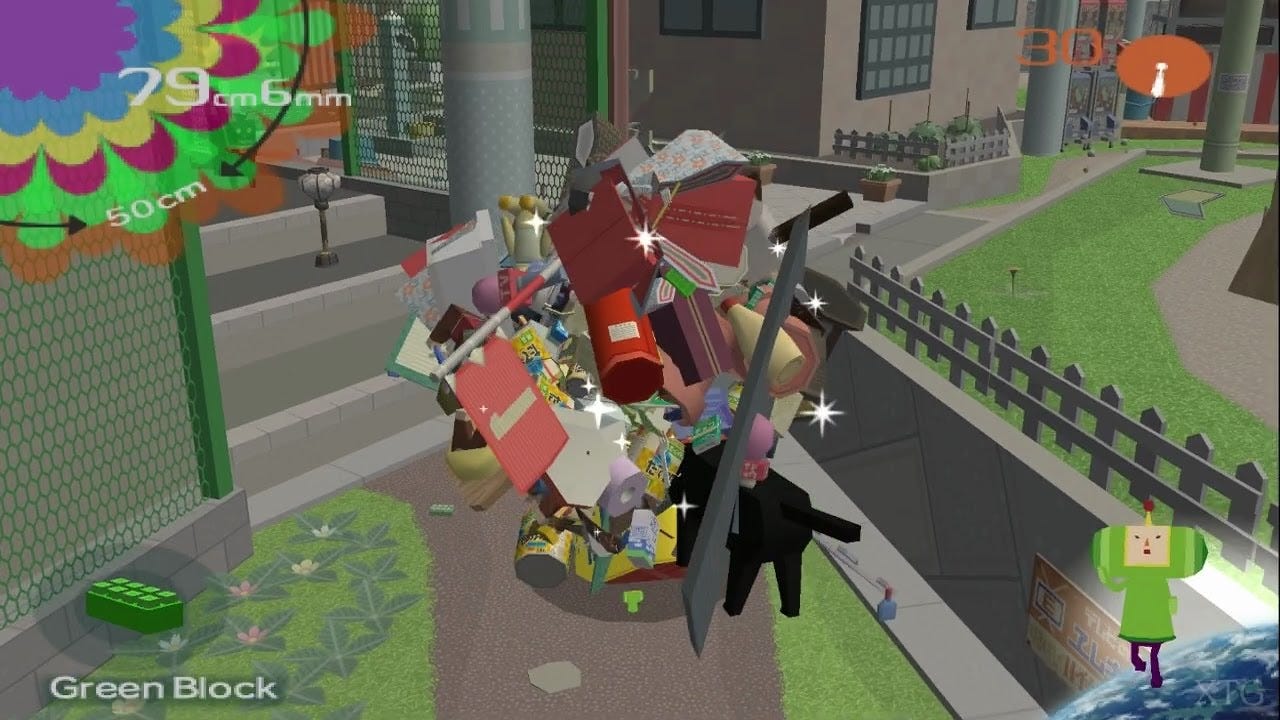
You start small.
A few coins, a thumbtack, a piece of candy. The katamari is the size of a marble and the world is enormous, full of things you can’t yet touch, sofas and dogs and parked cars looming over you like architecture.
The King of All Cosmos has, in a moment of cosmic carelessness, destroyed the stars, and you are his small green son, sent down to earth to gather enough material that the night sky might be rebuilt.
The music is bright, the colours are absurd and everything about the presentation suggests you’ve stumbled into the most cheerful video game ever made.
Are you with me so far? Okay, it’s time to start rolling.
By the second level, the katamari has swelled to the size of a beach ball, and you're already pulling the world into yourself in ways that feel improper. By the fifth, you are eating livestock.
Nothing is off limits it would seem.
By the time you reach the larger stages you are absorbing buildings, mountains, weather systems, and the screen keeps cataloguing every object as it disappears into the mass, a little name tag flashing in the corner each time something is consumed.
Is the game keeping a record?
Everything you’ve taken is logged, alphabetised and available for review in a menu later. Huh. So you’re not just consuming the world, you are inventorying it too.
All this on the same console that offers Gran Turismo, FIFA football and various fist-first brawlers loved by the masses seeking out more conventional forms of entertainment.
Keita Takahashi has been clear, in interviews stretching back to a 2009 GDC talk, about what he intended. He saw his work as a game about consumption society, and he found the experience of making it genuinely upsetting.
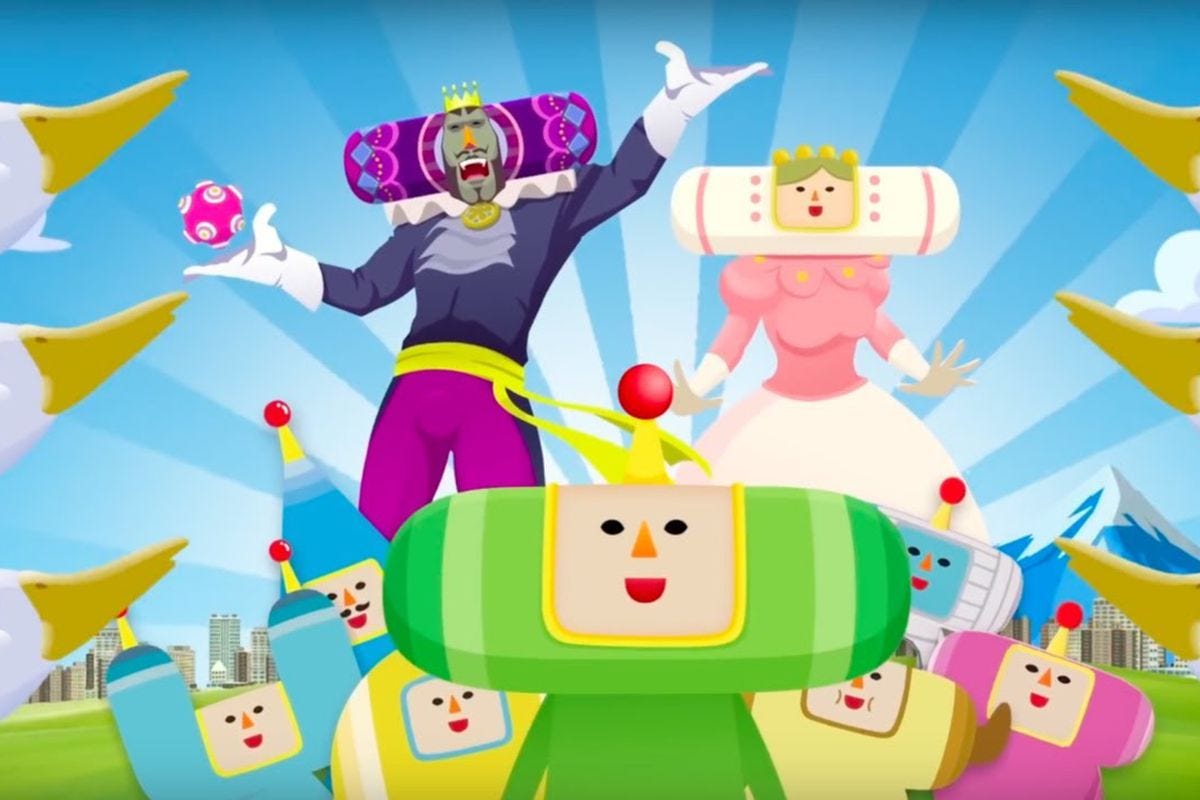
“I wanted to make more objects. If there are few objects, I feel lonely. If there are more objects, they will make things more colourful. But when they’re rolled up, they’re gone.” He kept wanting to fill the world with more things and then watching the player erase them.
The melancholy was structural.
But this is not how Katamari Damacy was received in the West. The Western reception, when it arrived in 2004, was overwhelmingly read through the lens of charm.
The game became a touchstone for the early-2000s indie sensibility that prized whimsy and Japanese eccentricity as aesthetic categories rather than as positions on anything.
Reviewers reached for “quirky” and “delightful” with the regularity of people who had run out of other adjectives, and the cultural conversation that formed around the game was almost entirely about its surface.
Look at the colours, listen to the J-pop. Isn’t it nice that something this strange exists? And so on.
The flattening was not accidental, and it wasn’t really anyone’s fault. Japanese satire travels poorly. The conventions that signal critique in Tokyo, the deadpan absurdism, the bright surfaces concealing institutional disquiet, read as sincere weirdness once they cross the Pacific.
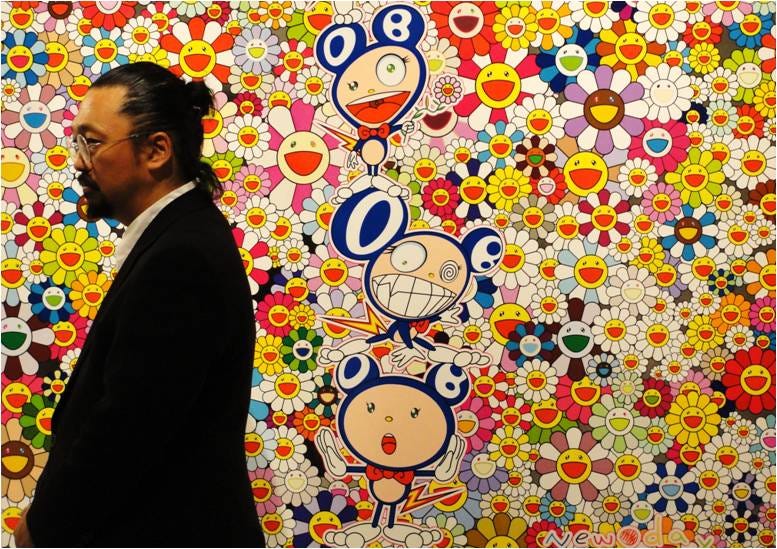
The same thing happened to Murakami, whose Superflat manifesto was a sustained argument about postwar Japanese consumerism and got received in New York galleries as a fun new aesthetic for tote bags. It happened to a lot of late-90s and early-2000s Japanese cultural exports.
The argument got mistaken for the costume.
What I think makes Katamari particularly poignant is that the game is doing the thing it’s critiquing in real time. You cannot play it without consuming. The mechanic and the meaning are the same gesture.
Takahashi couldn’t even make a game about the sadness of accumulation without accumulating, and the catalogue of objects in the menu screen is the receipt. Every playthrough generates its own little archive of what you’ve taken.
The PS2 was the right console for this.
The whole generation was built on storage, on bigger discs and more content and the implicit promise that scale was an end in itself. Sony’s marketing during the PS2 era kept returning to bigness, to the idea that this console could contain more, do more, hold more.
Katamari arrived in the middle of that while asking what all the accumulation was for. The answer the game offers is bleak. You roll up the world, and then a celestial figure who barely registers your existence flings it into the sky as decoration.
Takahashi himself has spent the years since trying to escape what Katamari became. He has spoken openly about Namco Bandai turning the property into a steamrolling brand, about his discomfort with sequels, about feeling unsuited to the games industry.
He has tried to build playgrounds. He has made small strange projects with tiny audiences.
The thing he’s most famous for is the thing he most wanted to make once and never repeat, and the industry’s response to that wish has been to ask him, repeatedly and with increasing volume, whether he might consider making another one.
You finish a playthrough and the King congratulates you on your work, and the credits roll over a montage of everything you’ve taken, and you sit there with a controller in your hand wondering why the cheerful little song feels so heavy at the end.
You get it now.
No posts
Comments
Nothing yet. Say the first thing.
Sign in to join the conversation.