
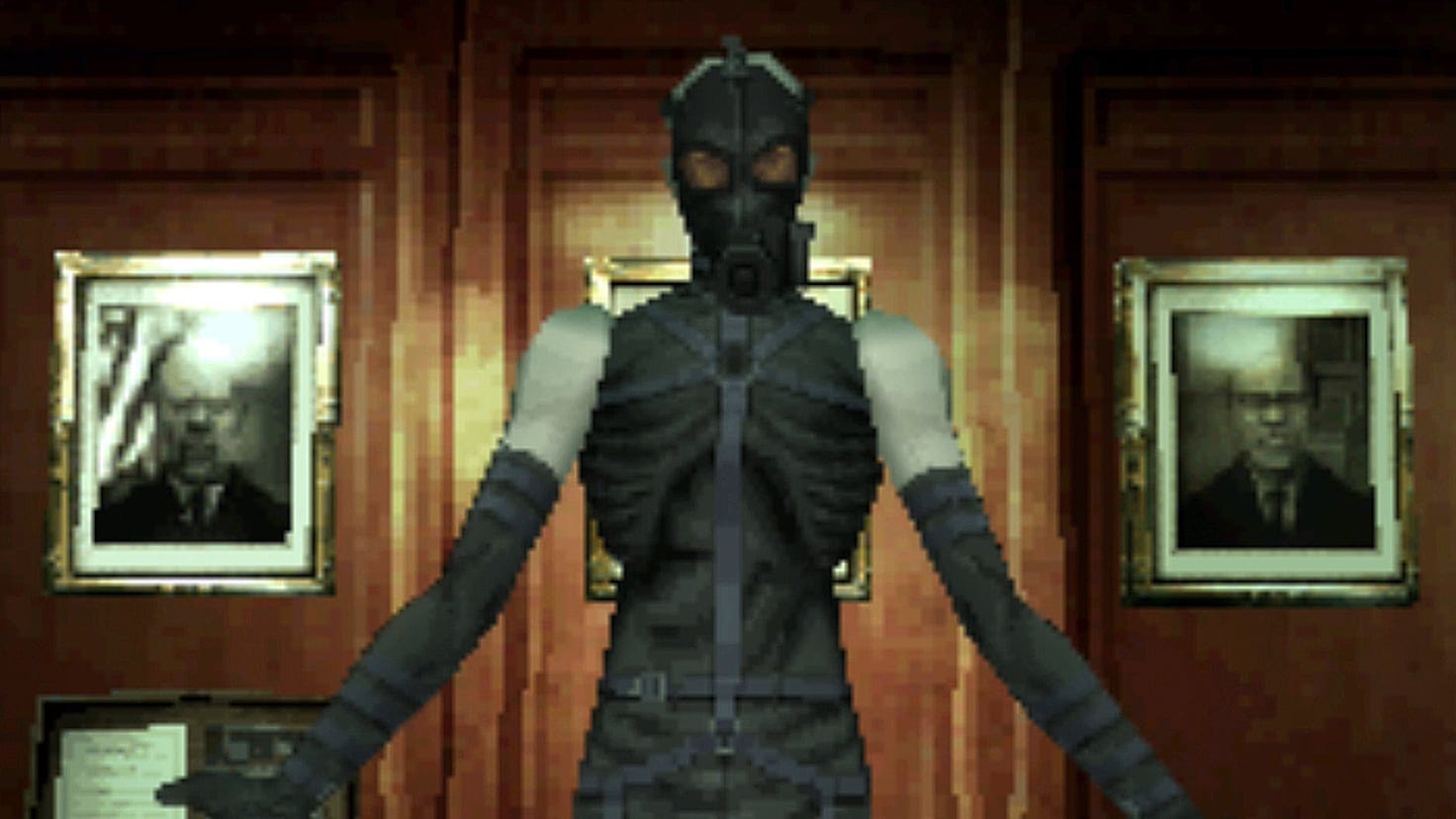
We all remember where we were when the game first reached out of the screen and into our own realm. Colonel Campbell tells the player to call Meryl on the codec, then admits he doesn't have her frequency.
His advice is to check the back of the CD case.
Not a menu within the game, not a file buried in an options screen, not a location somewhere on Shadow Moses. The actual plastic case the game shipped in. The number, 140.15, is printed there within an inconspicuous screenshot.
"Huh, that can't be it, can it?" I said to myself, as I typed the frequency into the game. But it was. Meryl shows up in her balaclava, and we finally talk over the codec for the first time.
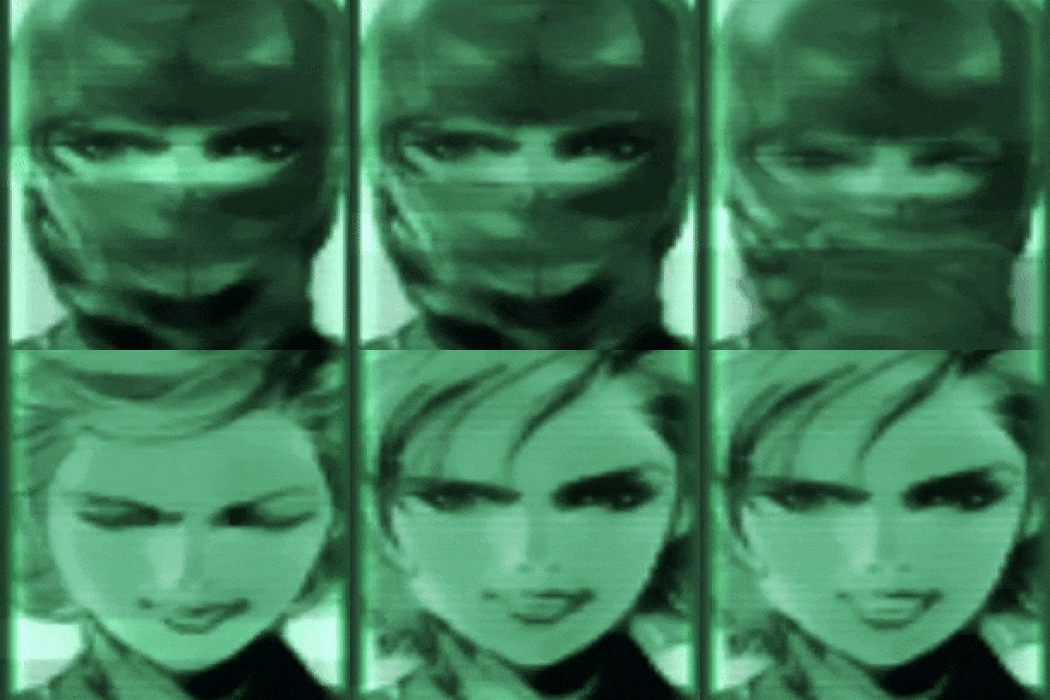
If "movie magic" is the go-to term for cinema, what's the gaming equivalent? Because this tapped into something that felt, well, magical.
It’s a small thing. Something you can imagine being jokingly shared around corridors and in the meeting rooms of Konami. But it establishes the conceit that runs through the whole game, the idea that this fictional world somehow knows about the world outside the screen.
I think it really shows how Kojima loves messing with players in ways that go beyond what traditional hardware was supposed to allow, something that culminates on a much grander and more involved scale later with the Psycho Mantis boss fight.
Psycho Mantis is a psychic, a telepath, and the game makes a real meal of it.
By the time you reach him, he's already established as someone who reads minds and bends the physical world, so the fight is built around the idea that he knows things he has no business knowing.
What makes it land is that Kojima doesn't keep that power contained to Snake and the world on screen. He points it outward, at you. Just as he did with Meryl’s codec frequency.
Before the fight begins, Mantis reads the console’s memory card, as a demonstration of sorts. He goes through whatever else has been played and names the saves back, Castlevania, Suikoden, any other Konami titles.
Spooky.
Then he goes further, and profiles the player from the save data. Frequent saves mark someone cautious, anxious. Sparse saves mark someone reckless.
Spookier.
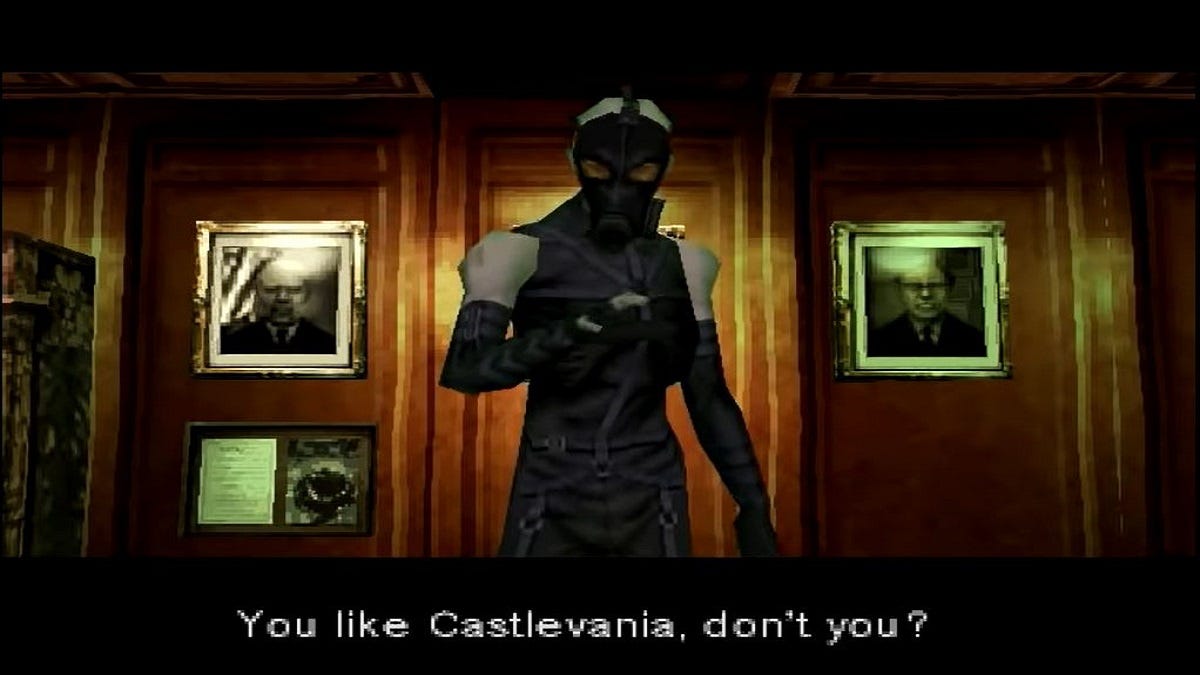
It’s difficult to articulate just how novel a concept this was.
A character inside the television reaches into the slot on the front of the machine, reads a person’s habits off a memory card, and passes judgement on them. That felt like he’d stopped addressing Snake. He was addressing the human holding the controller, and he’s going through your stuff.
Maybe this seems quaint by today’s standards, but back then, in those pre-internet-ish days, it felt positively paranormal.
But Mantis wasn’t done. As a final flourish of the dark arts, he instructs the player to set the controller down so he can unleash his full power.
And so you set the controller down.
And you wait.
Then, the controller judders and vibrates across the table.
It coincides with Mantis giving it his all, pushing and bending both the game world and real world to his will.
It works.
Oh boy does it work, because by this point, the game has made it genuinely clear (or unclear) where the fiction stops and the hardware begins.
Fun fact: At one point the game tells you to hold the PlayStation Dual Shock against your arm after a particularly torturous button-mashing scene, to "heal" your sore arm. Cute!
Then there’s the fight itself which cannot be won by conventional means.
Mantis ducks, dives and dodges every attack you send his way. “What on earth? Why can’t I beat him? This is too difficult,” I remember saying begrudgingly. But little did I know he was being particularly deceptive.
He is psychic after all, so it shouldn’t have been surprising that he was able to read controller inputs before they resolved. There was no pattern to “learn” here. No matter how hard I charge at him with everything I’ve got, I won’t bring him down.
The only solution is to pause, unplug the controller, and move it to the console’s second port. Unconventional to say the least.
Mantis then goes quiet and concedes he can no longer read the player’s thoughts. The boss is beaten not in the fiction but in the living room, by physically rearranging the hardware.

On paper this reads a little like a set of gimmicks, a magician explaining his own tricks. Like I said, quaint.
But in reality, the effect depended entirely on context, on a person sitting close to a machine that suddenly behaved as though it was cognizant.
It worked precisely because you had no idea how it would play out, and there was no whipping out your phone to see how everyone else felt about it or how they'd gone about beating it.
In Metal Gear Solid 4, released years later on the PlayStation 3, Mantis returns as a ghost and attempts the same routine. He reaches for the memory card and finds nothing.
A neat nod to a past that was long gone, even by 2008.
The thing that made him frightening was tied to a specific arrangement of silicon, a card that could be held, ports that were visible, a box that had been kept, and that arrangement had been engineered out of existence.
Kojima has always been particularly good at designing within constraints and finding the creative angle. The original PlayStation was a physical object full of openings, and he was one of the few designers who understood that the openings were exactly where the unease could get in.
He treated the case, the card and the cable as places a story could hide. A technique that has effectively died out, because there is nothing left to reach into.
The machine is sealed, the saves live in the cloud, the box is often a download. The controller is still there, broadly the same shape it has always been.
The difference is that nothing inside it is going to reach back out.
No posts
Comments
Nothing yet. Say the first thing.
Sign in to join the conversation.