
Hi Team PR@ctical.
I just got back from NYC Tech Week and one thing the forward-thinking leaders were talking about is the detriment of brands who say, “we’re going to focus on AI perception in the next six months.” That sentence is expensive.
Google just shipped new Search Generative AI performance reports inside Search Console. As it roles out, you will be able to see how often your pages show up inside AI Overviews and AI Mode, broken out by page, country, and date. (Google Search Central)
The thing you were going to “get to later” is now a number and baseline waiting to be owned by comms.
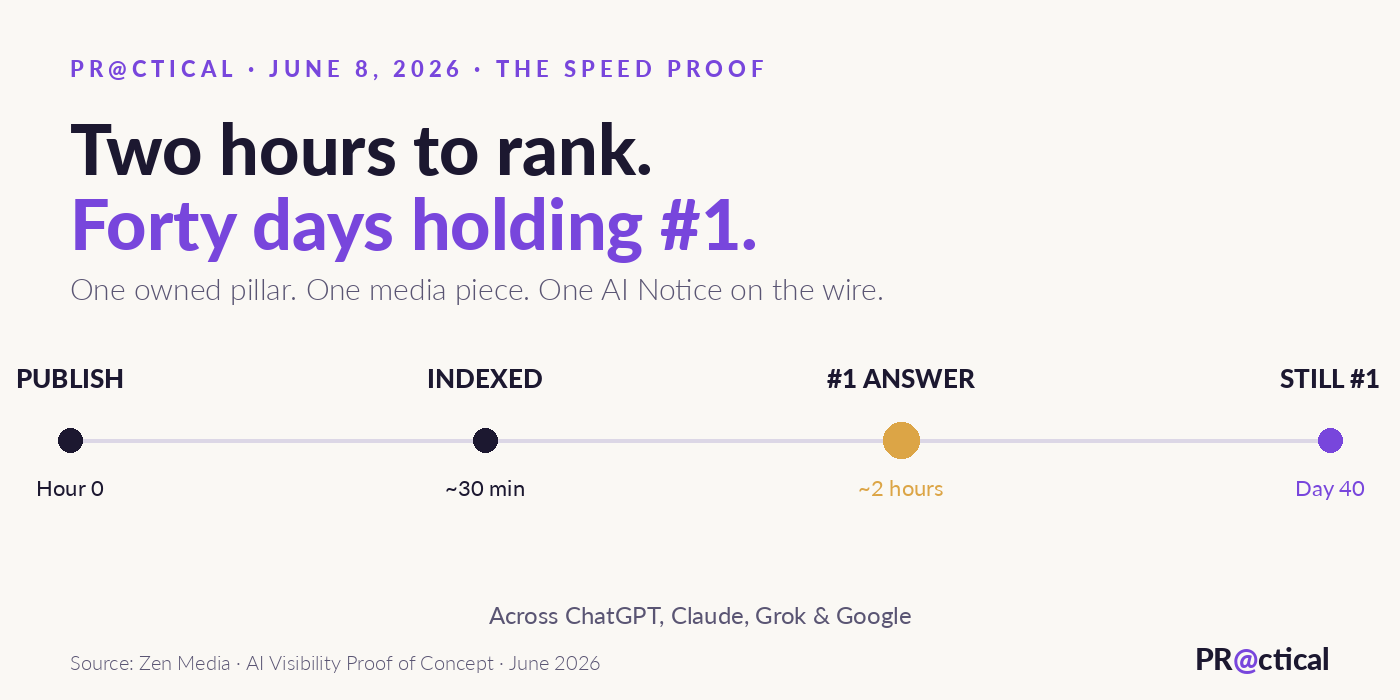
I will show you my own receipt. We picked a category we had zero authority in and ran one owned pillar, one media piece, and one AI Notice on the wire. Time from publish to the number one answer across ChatGPT, Claude, Grok, and Google was about two hours. We have held that top spot for 40 days and counting.
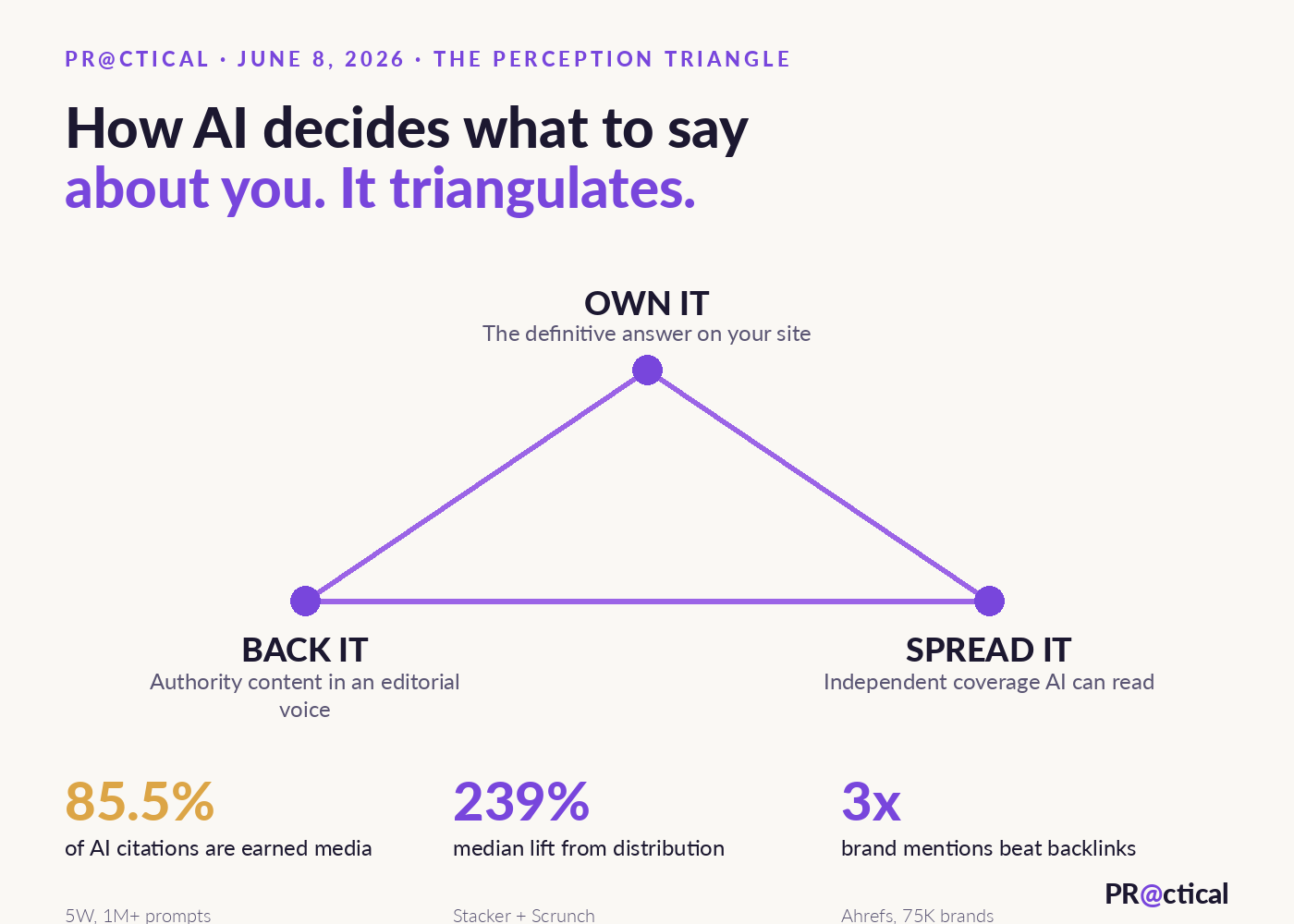
So how do you actually show up? I keep coming back to one framework I use with every brand: the Perception Triangle. Own it (the definitive answer on your site), Back it (authority content that says the same thing in an editorial voice), Spread it (independent coverage AI can read). When all three corners tell the machine the same story, it reads as consensus, and consensus is what gets cited. More on that below, with the third-party data that proves it.
One human note before the news. This week reminded me why I love events. I got real time with founders and reporters at Founder Brew, bumped into people I have known for years, and made a stack of new connections that would not have happened over email. The deeper AI takes us into automating the work, the more the in-person stuff appreciates in value. So go to the thing. Sit in the room. Shake the hand.

NEW: The AI Slop Reduction Addendum for LLMs
I went back and forth on whether to give this away. My business coach said I should charge $600 for it because of how much time, resource and IP went into it. I launched over the weekend at $59 and said, “I’ll keep upping the price each week.”
Today it’s at $109. Next week, $159.
Use this three ways:
Add it to every instruction or project as a resource
Keep it on your desktop and attach it AGAIN when asking something to be reviewed
Create your own skill and attach this to it.
It is a Universal Editorial Standard addendum with 35 banned phrases that instantly flag AI writing, and an 11-item audit your model runs before it hands you anything.
Editing time drops about 60%. Works with ChatGPT, Claude, Gemini, anything you already use.
Guide of the week: AI and Communications: The Practitioner’s Guide (20 min)
If you are the one being asked “what is our AI plan” in the next leadership meeting, start here. It is the plain-language walk-through of where comms actually owns the AI perception layer.
🔗 Read it at asksarah.ai/learn
1. Google turned AI visibility into a report line. The waiting period is over.
What happened: On June 3, Google added Search Generative AI performance reports to Search Console, showing impressions inside AI Overviews and AI Mode by page, country, and date. It is impressions only for now (no clicks, no position, no query data). Important caveat: Google is rolling it out to a subset of sites first, UK-first, to test before going wide, so you may not have it in your property yet. Google also added a toggle to pull your content from AI features without hurting organic rank. (Search Engine Land)
What to do: Check whether the report has reached your property. If it has, export your AI Overviews and AI Mode impressions by page and screenshot it as your baseline. If it has not, do not wait for Google. Build your baseline now with the Perception Triangle so you walk into the budget conversation with a number either way.
Why it matters: The day a thing becomes measurable is the day it stops being optional. Even in limited rollout, the signal is set. AI visibility is now something Google reports on, which means it is something your leadership will ask about.
2. 85.5% of what AI says about you comes from outside your website. The Perception Triangle is how you get cited.
What happened: The data on AI citations keeps landing in the same place. 85.5% of AI citations come from earned media, not brand-owned sites, across an analysis of more than one million prompts. (5W) Brand mentions across the web correlate roughly 3x more strongly with AI visibility than backlinks. (Ahrefs) And distributing one story through third-party outlets produced a 239% median lift in AI citations versus the brand site alone. (Stacker and Scrunch)
What to do: Run the Triangle on one buyer question you must own. Own it (the definitive answer on your site), Back it (an authority piece in an editorial voice), Spread it (independent coverage AI can read). One corner is not enough. AI reads agreement across all three as consensus.
Why it matters: Single-source visibility plays underperform because the model is looking for corroboration, not for your homepage. The brands getting cited are the ones whose story shows up in three places at once.
3. AI search is no longer a one-engine game. Optimizing for ChatGPT alone leaves you invisible everywhere else.
What happened: ChatGPT’s share of AI chatbot traffic fell to 54.7%, down from 76.5% early last year, while Gemini climbed to 27.4% and Claude grew 306% in a single quarter. (Momentic, built on Similarweb)
What to do: Take your buyers’ top three questions and ask them in Gemini and Claude, not just ChatGPT. See where you are named and where you vanish. The answer is usually different on each engine.
Why it matters: A single-engine strategy now misses nearly half the market. This is exactly why the Triangle matters.
4. AI is now the first stop, not the second. If you are not in the answer, you are not on the list.
What happened: 37% of consumers now start their search with an AI tool instead of Google or Bing, and 44% of AI-search users treat AI as their primary source of insight, versus 31% who still lean on traditional search. (Eight Oh Two 2026 AI + Search Behavior Study)
What to do: Stop treating AI answers as a downstream SEO concern. Map the three or four questions a buyer asks before they ever reach a sales conversation, then check whether your brand is named in the AI answer to each one.
Why it matters: When AI is the first stop, the shortlist is built before a human visits your site. Miss the answer and you miss the consideration set, no matter how good your pipeline looks after that point.
Increase your brand’s AI visibility in 7 days, guaranteed.
We are not a consultative agency anymore. We have become a combined industry partner and a standalone tech, strategy, and execution layer for any brand ready to move now. You bring the brand. We bring the build. The AI Accelerator is the proof-of-concept version: 7 days, money-back guarantee, real results.
This is for the ones leaping into AI right now, the ones who get that this is the window to own how you are perceived before everyone else catches up. DM me if you book. I have an extra gift waiting. 🔗 offer.zenmedia.com
Need your AI baseline and don’t want to wait on Google’s rollout? We will pull it for you. 🔗 ai.zenmedia.com
I just walked off the Ragan Communications and PR Daily stage in Brooklyn, and the line people kept repeating back to me: stop treating AI like your boss, start treating it like your employee. Most of us hand AI a task, take whatever comes back, then spend an hour fixing something we already knew how to make. Flip it. If you know the end result, build the example first, then ask AI how to get there and better.
For daily reps on this, 6MOA (6 Months Out, Already) runs every weekday on LinkedIn Live with Duran. Same theme as this whole edition: the companies that move now are six months ahead of the ones still scheduling it.
📊 This week’s RECEIPTS, REPORT DROP, PLATFORM MOVES, and THE CROSSOVER are below the fold for paid subscribers →
Comments
Nothing yet. Say the first thing.
Sign in to join the conversation.