
Hi Team PR@ctical.
I don’t think I could have predicted this is where I’d be right now. After running a traditional agency for almost 16 years, I now have a team with 9 AI developers and an AI scientist. That’s a new layer into our ecosystem. They are the key to the rest of the team learning to think like architects and is the evolution of all of our roles.
Here’s what it means:
A communicator gets a task and does it.
An architect gets a task and asks “how do I build this once so it runs every time without me starting over and keeps improving over time?” You stop being the person who does the work and become the person who builds the thing that does the work.
The Architect Stack: Prompt → Skill → Project → Scheduled Task → Iterate → Improve
You don’t have to become a developer to do this. I’m not one. You spot the thing you do over and over, and you build it once. That is the entry-level “architect” point and it gets more exciting the deeper you go.
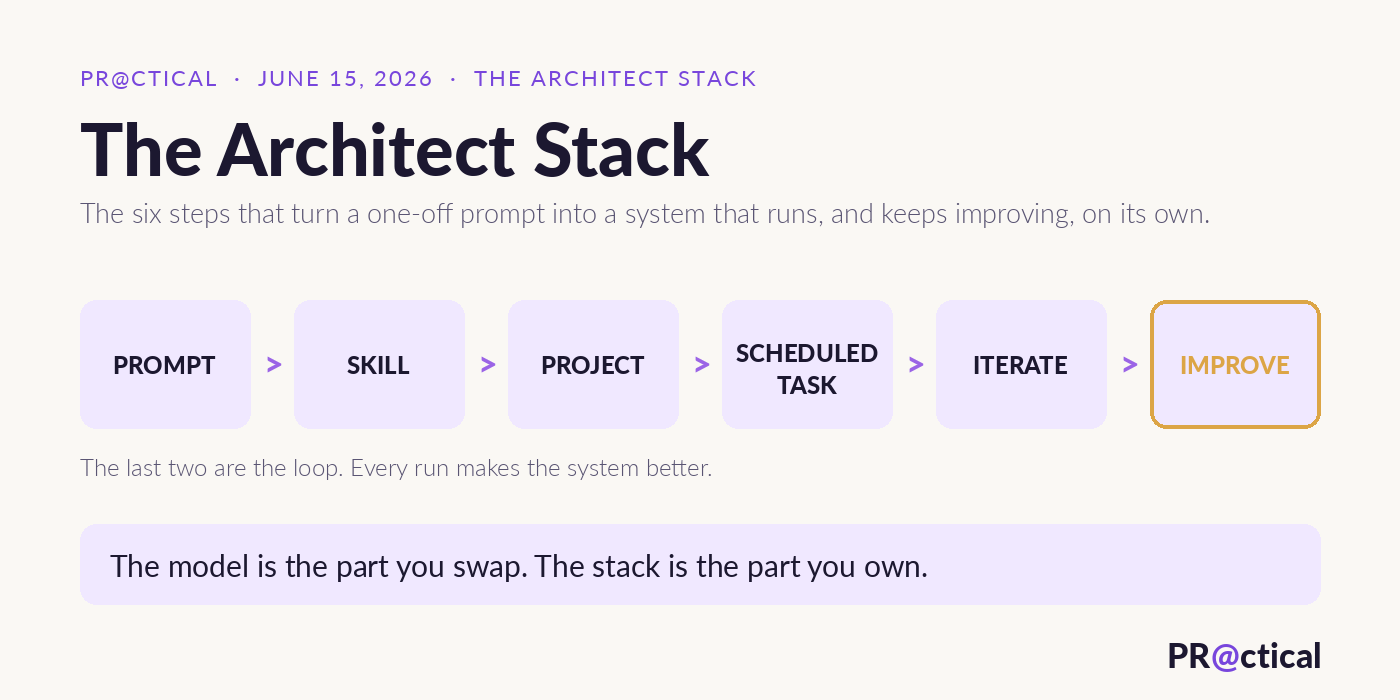
Here’s one I built that I use every single day.
It started with a problem I was sick of. Every AI content draft… SLOP! I was spending too much time editing until I realized I never “showed” AI what great looks like. So instead of fixing drafts by hand forever, I built the fix once. I went back through more than 500 hours of my own editing decisions, pulled every phrase I always cut and every pattern that screams “a machine wrote this,” and turned it into one standard I attach to anything. Any model. Any skill. Any project. The output changes the second you add it.
I aptly call it the AI Slop Reduction Guide, and it’s exactly what thinking like an architect produces: find the problem once, build the system once, own it forever, and keep sharpening it.
And the same way of working is what gets our clients cited. We traced one piece of content we call an AI Notice and found the actual impact from it. ONE PIECE! It triggered 154 non-branded citations to start. 154 different prompts where this now shows up as an answer. PR reporting will never be the same.

P.S. Because of all the IP in the slop guide, I am increasing the price by $50 every Monday. You have an hour to get it at $109 before I raise it to $159.
The AI Slop Reduction Guide (the one from up top). 35 banned phrases, an 11-item audit, and a copy-paste briefing prompt you attach to any model, skill, or project. More than 70 people are using it and reporting 40 to 60% less editing time. Get it here before tonight’s bump.
The Learning Curve Destroyer (free, open source). A viral Instagram prompt turned Claude into a teacher with a time budget. I rebuilt it as a Skill so your AI keeps the instructions forever. You tell it what you want to be able to do and how much time you have. It builds the plan, tells you what to skip, and teaches you hands-on. Install once and it’s yours. If you can attach a file to an email, you can install it. Download it from my GitHub.
⚡ THE BRIEF
1. Communicator vs architect: the actual difference.
A communicator gets handed a task and does it. An architect gets handed a task and asks “how do I build this so it runs every time without me starting over.” What to do this week: take the next thing that lands on your desk and, before you do it, write down the steps you’d take. That list is the blueprint for a skill. Why it matters: doing the task scales to one. Building the system scales to everything you do after.
2. AI is your employee, not your boss.
The work comes out average when you let it file unsupervised. What to do: after you get an output you actually like, paste the final version back in and say “this is the standard, learn from it.” Close the loop. And give it a standard up front instead of a blank prompt. Why it matters: a blank prompt gets you a generic draft. A briefed one gets you something you can almost send.
3. Build it once. Then never do it by hand again.
Pick the one task you hate most (a media brief, a coverage tally, a recurring report) and turn it into a skill this week. What to do: open Claude, describe the task, and say “interview me on everything you need to build this as a skill.” Answer its questions. Save the result. Why it matters: that’s five hours of setup one time, then twenty minutes forever. Junior-level grunt work, senior-level output.
4. Two questions before you write anything.
What does this client want to be known for? What are you writing to compete against? What to do: if you can’t answer the second one, stop and go look at what already owns that answer before you write a word. Why it matters: writing blind is how you produce content that disappears. Knowing what you’re up against is how you produce content that beats it.
🎙️ ON AIR
My new session with PRNEWS is live on demand: “AI’s Role in PR Strategy,” part of the PRNEWS Learning Collective. It’s built for senior comms and marketing leaders deciding right now where AI fits in their strategy. Watch on your schedule. Session here.
📊 This week's DELIVERY INSIDER, AGENTIC WORKFLOW #02, plus THE RECEIPTS, REPORT DROP, PLATFORM MOVES, THE CROSSOVER, and THE MOVE are below for paid subscribers →
Comments
Nothing yet. Say the first thing.
Sign in to join the conversation.