
Hi Team PR@ctical,
I know, I know… I’m a broken record. Agentic commerce is where we pivoted our own agency PR focus, and we couldn’t have been more on point.
Two payment networks moved within hours of each other this month. Visa and OpenAI announced that a tokenized Visa card can now complete a purchase inside ChatGPT. Mastercard shipped its own version, Agent Pay for Machines, the same day (American Banker).
The agent does the buying.
That is agentic commerce: an AI does the shopping and the checkout on a person’s behalf. It shortlists. It decides. It pays.
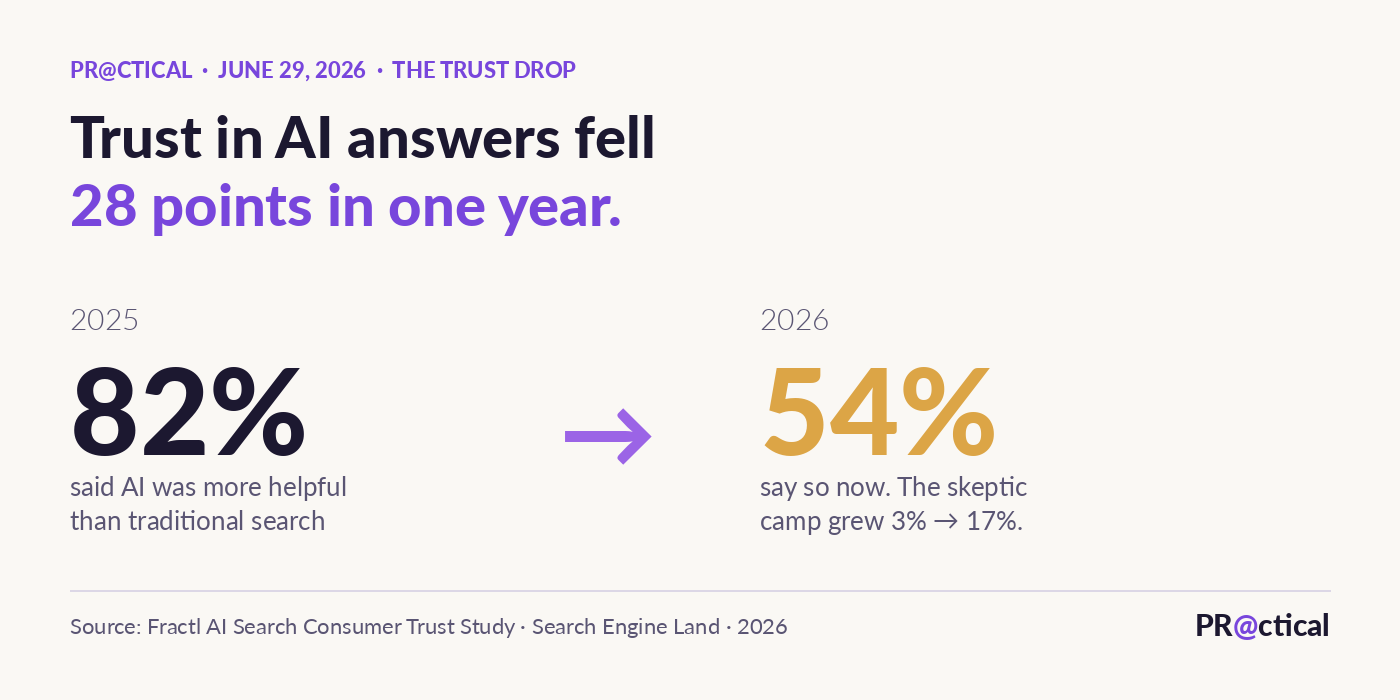
This is new. There will be bumps and bruises, but we still have to learn alongside the pace of technology. Consumers are going to ebb and flow with the trust of AI answers. A year ago, 82% of consumers said AI was more helpful than traditional search. Today it’s 54%. That is a 28-point drop in twelve months, and the skeptic camp grew nearly six times larger (Search Engine Land, 2026).
Call it AI Slop, call it a gold rush, things will start to even out.
So we have a machine that is increasingly making the purchase, and a public that increasingly does not trust what the machine says. Both things at once.
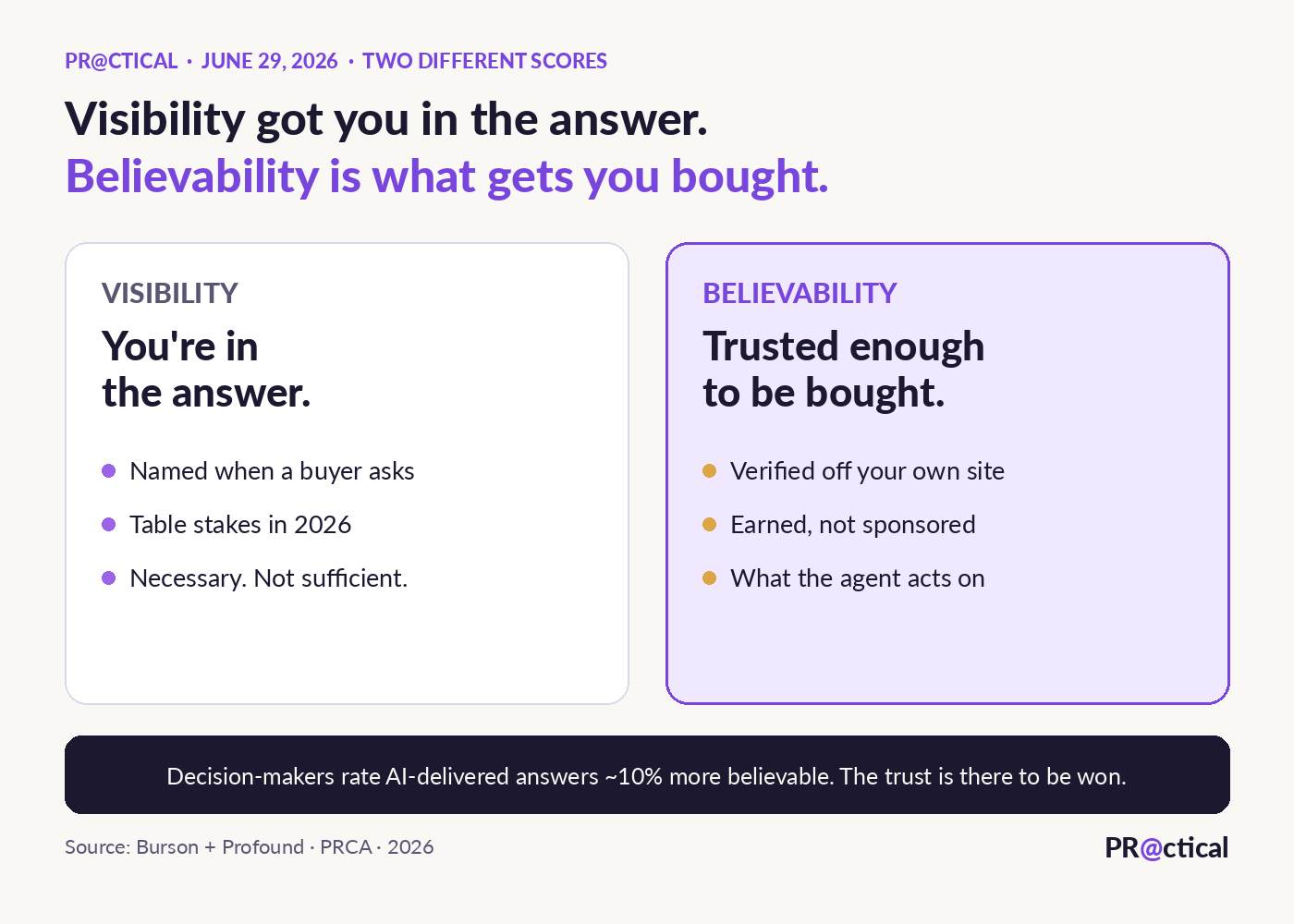
This is the whole reason I keep saying visibility was always step one, never the finish line. Getting named in the AI answer means you are building the infrastructure, the schema and the content.
The next fight is believability: whether the AI, and the human reading it actually trust you enough to act.
Being visible and being believed are two different scores, and business decision-makers rate AI-delivered answers about 10% more believable than the same claim elsewhere (PRCA, 2026).
That is why I’m running the first AI Visibility Certification Day, and as of this morning there are 12 spots left (grab one here). This is step one: the language, how AI decides which brands to surface, what your team needs internally to start building, and how to lead that conversation where you work. If you’re at an agency, this is a great use of your learning and development budget. Take what you learn back to your team.
One more thing, and this one is big. I spent two and a half hours this weekend with one of the top tech editors and columnists working today.
Best training data I’ve gotten in years. He essentially told me“I’m sick of meeting with agencies, telling them our preferences, only to get the same exact pitch over and over, and it’s not even a pitch.” So I’ve been a busy builder and am creating a new tool, shaped by what a real journalist actually wants. The theory: the 1% of pitches he actually covers should move up for people who use what his brain helped build. Coming soon. You’ll see it here first.
Let’s get into it.
Coming soon: the journalist-built pitch tool. Built from a 2.5-hour download with a top tech editor on what makes him open, read, and actually cover a pitch. Not an agency’s guess. The reporter’s real preferences, turned into a tool. Teased above. Watch this space.
AI Slop Addendum for LLMs. This tool has 500 hours of best practices you attach to any project or prompt where you’re writing content. It spits out an exceptionally better first draft so you can spend time on quality, not AI slop detection. (https://stan.store/asksarahevans/p/ai-slop-reduction-addendum-for-chatgpt-and-claude)
Guide: AI Visibility for Business Leaders (20 min, asksarah.ai/learn). Written for the person who has to defend the budget, not run the tactics. Start here if you’re the one walking into the board meeting.
⚡ THE BRIEF
1. Trust in AI answers fell 28 points in a year. That’s your opening, not your obituary.
A year ago, 82% of consumers said AI was more helpful than traditional search. Today, 54%. The skeptic group went from 3% to 17%, and the share of people who say heavy AI use would lower their trust in a brand jumped from 20% to 39% (Fractl, 2026; Search Engine Land, 2026).
What to do: Stop measuring only whether you appear. Start measuring whether what’s said about you is accurate. 27% of brands have already been misrepresented in an AI answer, and 14% say an AI inaccuracy has hit a sale, a customer relationship, or a PR situation (Fractl, 2026).
Why it matters: When trust is falling, the brands that read as credible win a bigger share of a more skeptical market. Falling trust is a sorting event. Some brands sort up.
2. The agent is becoming the buyer, and it picks vendors by checking sources you don’t control.
Visa and OpenAI turned on agent-initiated checkout inside ChatGPT on June 10, with Mastercard launching its machine-payment framework the same day (American Banker, 2026). Bain’s read: agentic commerce lives or dies on consumer trust (Bain, 2026). And here’s the mechanism that should reorganize your week: an agent doesn’t trust the claims on your own website. It cross-references you against the sources it can verify independently, earned coverage, reviews, credible third parties, before it shortlists.
What to do: Audit what the agent can verify about you off your own site. If your believability lives only on pages you own, the agent discounts it.
Why it matters: In agentic commerce, the trust signal shifts from social proof you create to citation networks the agent checks for itself. (Shameless plug: this is exactly what the Published Monthly system at Zen Media is built to feed.)
3. The fastest way to lose the agent’s buyer is to look bought.
75% of Americans say they’d trust AI shopping less if the results were sponsored, and the same 75% would trust a brand less if it paid to influence an AI agent (Quad + The Harris Poll, 2026). A 2026 Gartner survey found half of US consumers would rather buy from brands that don’t use generative AI in their customer-facing content at all.
What to do: Win the answer with earned credibility, not paid placement. The thing that looks like a shortcut is the thing that erodes the trust you’re trying to build.
Why it matters: The agentic economy rewards brands that read as independently credible and penalizes the ones that read as purchased. Earned is not the slow option anymore. It’s the durable one.
🔗 PR Newswire / Quad + Harris Poll
🏠 HOUSE OF ZEN
Becoming the brand AI recommends is a system, not a campaign. The AI Accelerator is the 7-day version: we increase your brand’s AI visibility in seven days, guaranteed, and build the earned, verifiable footprint that the buying agents actually check before they shortlist. It’s white-label, so agencies can run it under their own banner for clients.
If your visibility is fine but your believability is thin, this is the gap to close before agentic checkout becomes your customer’s default.
→ Start at offer.zenmedia.com
🎙️ ON AIR
The Visibility Equation is back in the chair soon, and the through-line for the next run is exactly this: visibility versus believability, and what changes when the agent does the buying.
→ Replays at asksarah.ai/shows
📊 Below the fold for paid subscribers: THE RECEIPTS, the REPORT DROP on what journalists actually want, PLATFORM MOVES, THE CROSSOVER, and THE MOVE. →
Comments
Nothing yet. Say the first thing.
Sign in to join the conversation.