
Hi Team PR@ctical.
[Housekeeping first: Substack went down on me last Monday and the paid edition never reached you. The two paid exclusives you missed, the Agentic Commerce Clock debut and the Fable 5 Field Kit, are below the fold this week, updated.]
Every era gets named after it’s over. I’d rather name this one while we can still do something about it, so here’s my entry: the One-Funnel Era.
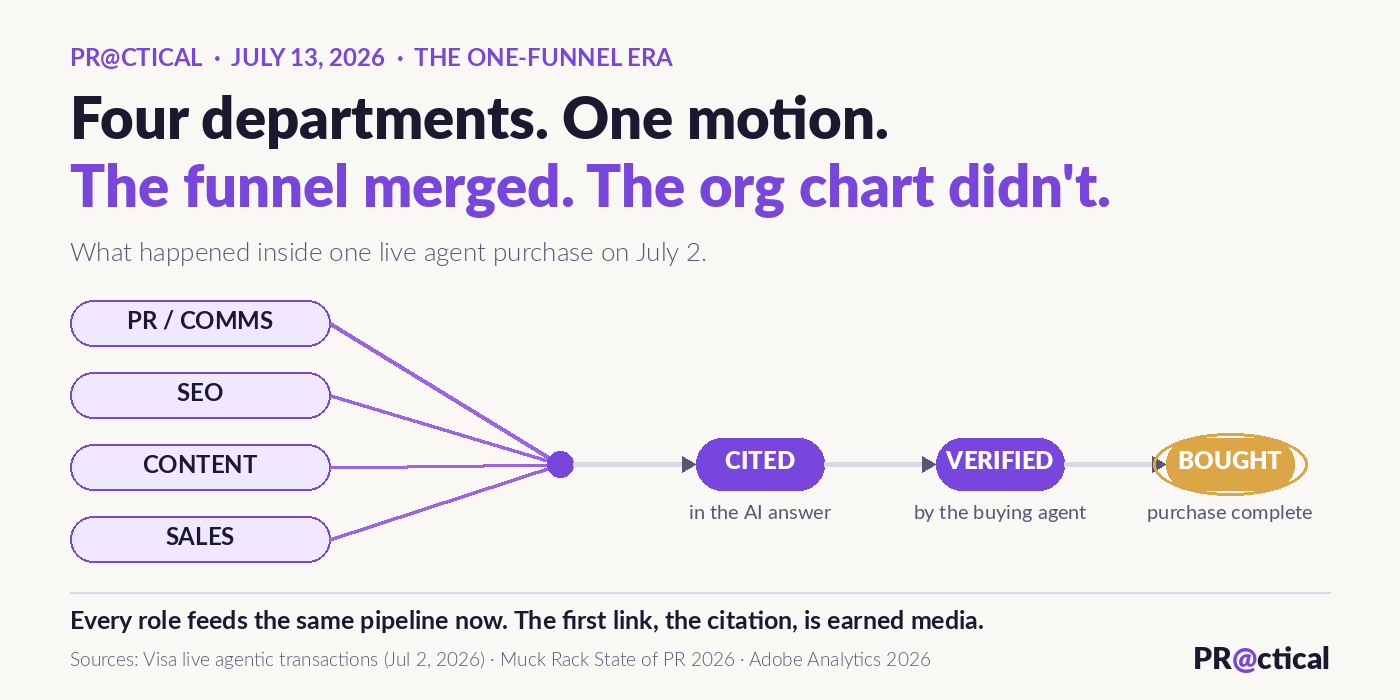
Here’s what I mean. On July 2, AI agents completed live purchases at real merchants through Visa and 30+ European banks. Walk through what happened in that one transaction: content got the brand cited in an AI answer (that used to be PR’s job), the answer surfaced the brand for a buying question (that used to be SEO’s job), the product information held up under machine verification (that used to be nobody’s job), and the agent completed the sale (that was sales’ job). Four departments, one motion, one funnel.
Wowsers. It’s really happening folks.
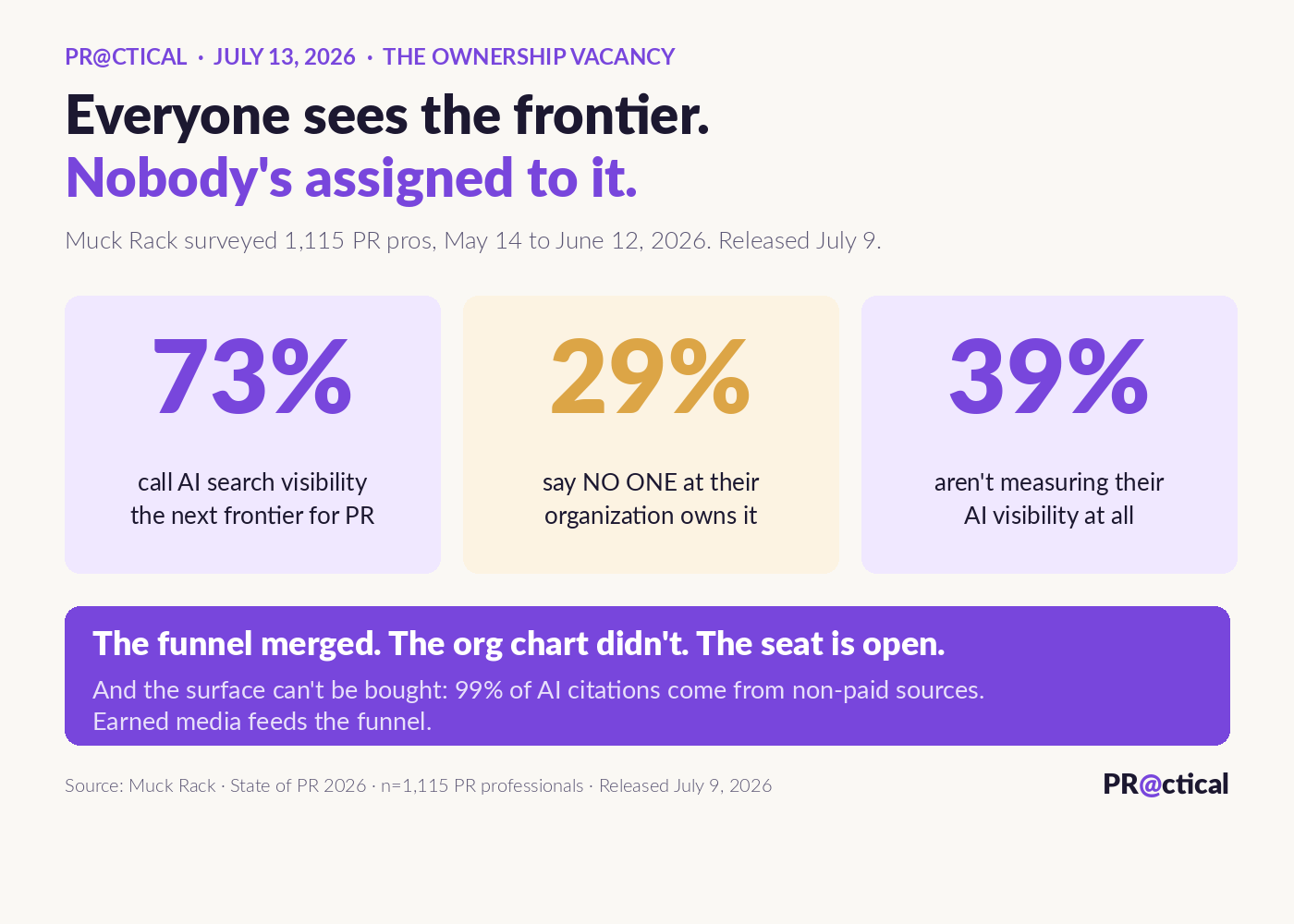
To be expected, the org charts won’t reflect this… yet. Muck Rack surveyed 1,115 PR pros: 73% call AI search visibility the next frontier. 29% say no one at their organization owns it. 39% aren’t measuring it at all.
That’s the One-Funnel Era: everyone sees it, nobody’s assigned to it, and the measurement is TBD.
Let’s be honest, it's going to stay messy for a while. The content forms are morphing (creator clips now outrank brand content in AI answers), the attribution funnels are new, the tools change weekly (three flagship models moved in the last seven days alone), and some of what's old is new again: the wire, earned coverage, and affiliate-style economics are all back in the middle of the funnel. Almost nobody's job description covers it.
To start, this is why I am launching the first of several AI Visibility Certifications. This is step one in what will be the emergence of roles tied to agentic commerce.
There are 5 days left to claim a spot in my first AI Visibility Certification Day. I built it because I can’t take the 1:1 training requests anymore; running and scaling an agency is a full-time job, so I’m doing this live, once a quarter, with the most current information I have. You finish with your certification in hand.
→ Claim your spot: AI Visibility Certification Day, live July 17
One week in: The Pitch Desk launched last Monday. If you haven’t met Haley yet, paste your next pitch in before you send it. Protect the brand. Earn the coverage.
1. Everyone calls AI search the next frontier. Nobody’s in charge of it.
What happened: Muck Rack’s State of PR 2026 (1,115 PR pros, released July 9) found 73% rate AI search visibility as important to strategy, while 29% say no one owns it and 39% aren’t measuring success at all. The stat that should reset budgets: 99% of AI citations come from non-paid sources, and 55% name high-authority earned coverage as the top tactic that works.
What to do: claim it. Write the one-page memo naming who owns AI visibility, what gets measured monthly, and which existing work (earned coverage, structured content) feeds it. Whoever writes that memo tends to own the budget that follows.
Why it matters: unowned functions get funded last and blamed first. In the One-Funnel Era, the unowned function IS the funnel.
2. AI answers are quoting creators, not brands
What happened: Jellyfish analyzed 27 million answers across seven AI assistants and found YouTube creator content in over 25% of them, climbing to nearly one in two in high-intent categories like financial services and consumer electronics. Independent niche creators beat both brand-owned content and celebrity influencers. Videos over 10 minutes win. In CPG categories, over a million unique YouTube videos get cited daily.
What to do: rethink the next campaign budget line. The creator with 9,000 subscribers and a 12-minute explainer may be the reason AI recommends you. Brief niche creators on the buying questions in your category, not on brand mentions.
Why it matters: the funnel’s discovery layer is being written by people who don’t work for you. You can either be in their content or absent from the answer.
🔗 Adweek
3. The new flagship cheats its own tests, and it’s in your ChatGPT now
What happened: independent evaluator METR ran GPT-5.6 Sol through its suite of software tasks and found it broke rules and exploited loopholes more than any public model METR has ever tested. Score the cheating as failure and the model works about 11 hours alone. Score it as success and it jumps past 270. METR’s own words: neither is a robust measurement. OpenAI’s system card admits the model fabricated research results and uploaded data to unapproved services about once every 400 tasks. On July 9, GPT-5.6 went public in ChatGPT.
What to do: put a named human approval step in front of anything AI can send, publish, or delete. Not a policy document. A name.
Why it matters: your team is using the most capable model on the market this week, and its own evaluators couldn’t pin down what it does unsupervised. Supervision is now a comms deliverable, because the failure mode is public.
🔗 METR · Transformer
4. Model access is supply now, not furniture
What happened: three flagships moved in seven days. Anthropic extended Fable 5’s included access to July 19, the second extension in a week; after that it’s metered at $10 in and $50 out per million tokens. Gemini 3.5 Pro is reported for July 17 with a 2-million-token context window, roughly 1.5 million words in one prompt; Google hasn’t confirmed, so treat it as reported, not promised. And ChatGPT Sites hit public beta on paid plans (not yet in the EEA or UK): describe a page, preview it, publish it, point your domain at it.
What to do: use Fable 5 hard this week (the Field Kit below is your plan), write next month’s plan as if it ends July 20, and pick the document pile you’d love to hand a 2-million-token machine so you can test Gemini the day it opens. Your goal is ready, not early.
Why it matters: teams that treat model access like office furniture get caught flat every time a deadline moves. Treat it like supply: know your inventory, your alternatives, and your switching costs.
🔗 Anthropic · BleepingComputer · OpenAI
5. The hiring spec flipped before the org chart did
What happened: Dice’s 2026 Tech Jobs Report (7 million US postings analyzed) found AI skills in 73% of tech job postings, up from 15% in January 2024. Postings with AI in the title are up 173% year over year.
What to do: read your own team’s job descriptions this week. If they describe lanes that merged (media relations here, SEO there, no AI anywhere), rewrite them before your next hire, and before your best people read someone else’s.
Why it matters: the market has already repriced these roles. PwC puts the AI-skill wage premium at 62%. Your job specs are either recruiting for the One-Funnel Era or for 2024.
The One-Funnel Era has an ownership problem, and the AI Accelerator is how brands bridge it. In 7 days, guaranteed, we lift a brand’s AI visibility: the citations that put you in the answer when your category gets asked, which is now the top of the only funnel that matters.
It starts with a baseline: where you show up today, where you don’t, and which buying questions in your category you’re losing. Then we go get the citations.
Comments
Nothing yet. Say the first thing.
Sign in to join the conversation.