
Over the past few months we have been publishing analysis of undercover footage obtained on so-called ‘game farms’ across England. We began by looking at the sheer scale of the shooting industry, and how the adult birds (not every bird, but far too many) are sometimes treated. We’ve also looked briefly at how enormous numbers of eggs are collected and washed - and in some cases dumped unlawfully in open-air trailers, where - as we explained - wild birds including Magpies were visiting those dumped eggs.
We pointed out at the time that Magpies are routinely targeted by the shooting industry as a species that must be “controlled” because they are supposedly too numerous and too great a threat to ‘ground-nesting birds (ie pheasants and grouse) and other wildlife.
Here is one way this awful, cruel industry carries out that ‘control’, and how it gets around laws that were meant to protect wild birds…
Behind the language of “predator control” and “conservation,” the shooting industry relies on a largely unobserved - and at the moment, lawful - practice: using live wild birds as bait to lure and kill other wild birds.
That ‘control’ extends to all parts of the shooting industry. Undercover footage we were forwarded recently came from a so-called ‘game farm’ (not a shooting estate, the farm where birds are produced for the gun) and was filmed earlier this year. It gives a rare, unfiltered look at what ‘control’ can actually look like on the ground - and it is a long way from the tightly regulated, welfare-conscious system the industry likes to describe.
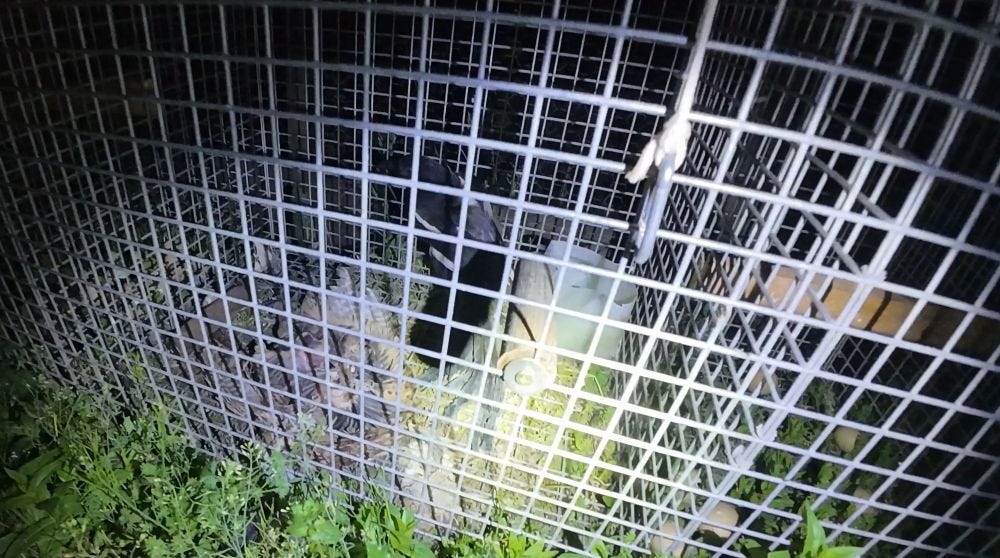
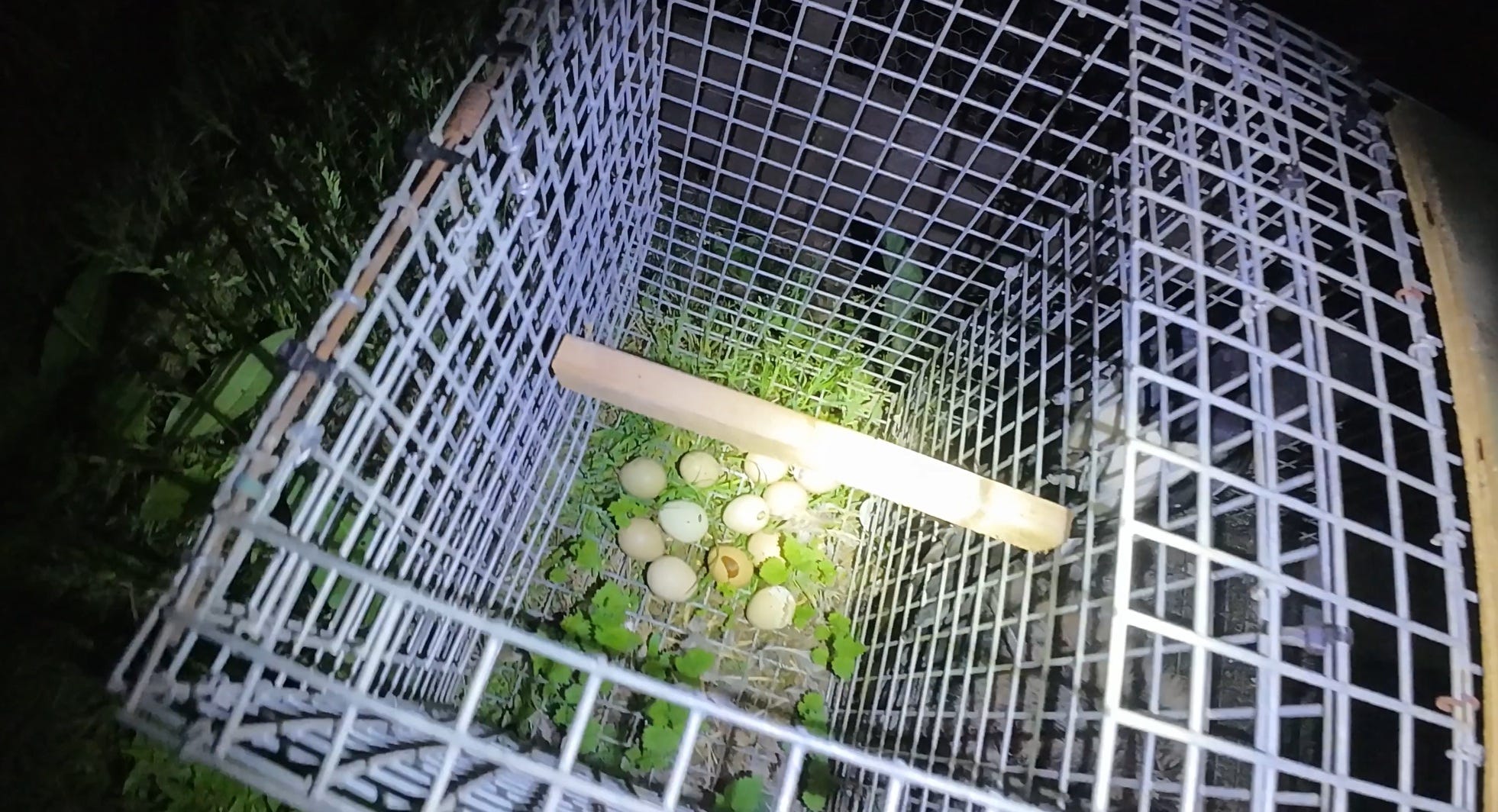
The footage passed to us shows a Larsen trap. This is a small cage with two compartments, one typically holding a live decoy bird and the other set to snap shut around any corvid (or raptor) coming to investigate the decoy. This trap was baited with pheasant eggs. (On a side note, the Game & Wildlife Conservation Trust (GWCT) originally championed the introduction of Larsen traps from Denmark in 1988, a claim repeated on their website which states these awful things were “pioneered in the UK by the GWCT and its regional advisory team”.)
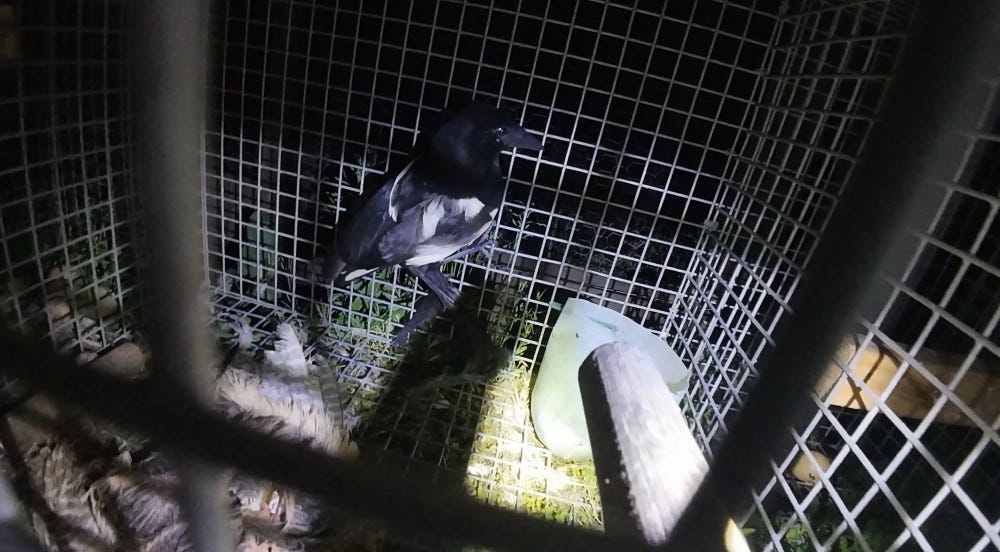
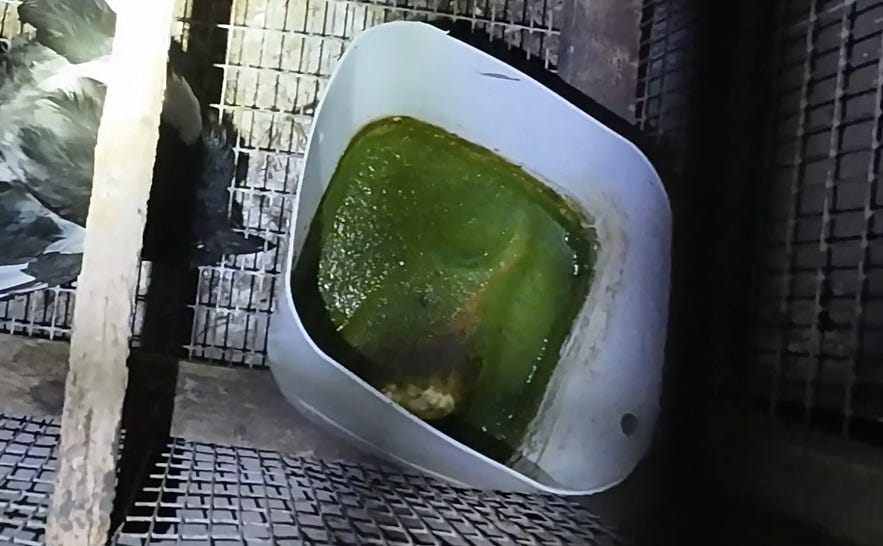
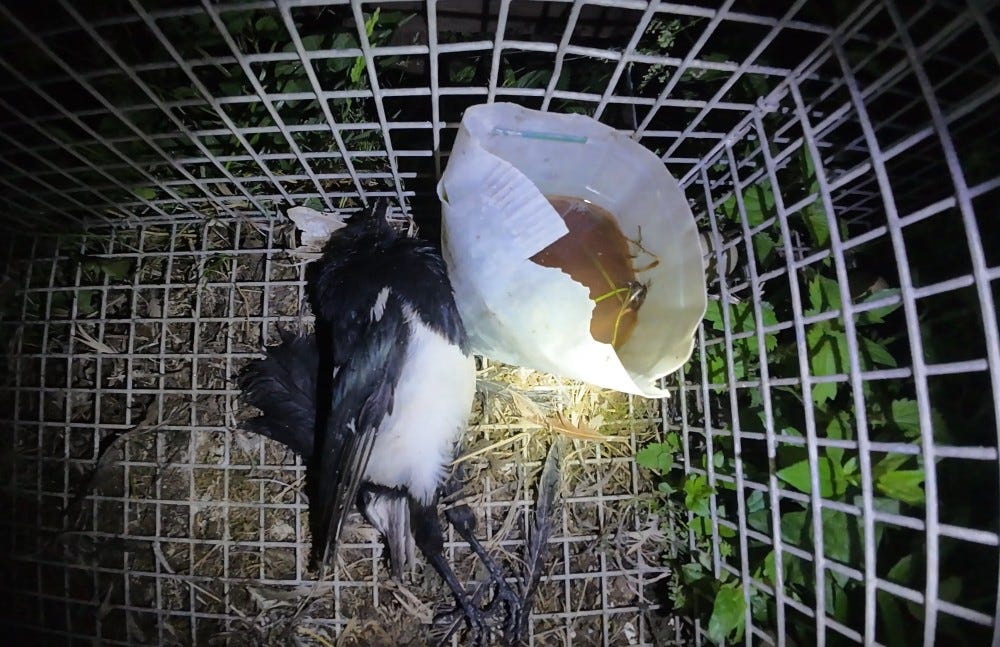
Inside the trap sat a Magpie, a wild bird, kept alive as a lure. Food provided was a dried-out pheasant carcass (not a permitted food source under the rules that are meant to govern this practice). A water container held algae sludge.
Return visits told the rest of the story. Days later, the pheasant remains had been picked to the bone and not replenished. The water had not been changed. The Magpie’s tail feathers were gone - whether through deliberate clipping or through the bird battering itself against the mesh in distress we cannot say for certain, but neither explanation reflects well on whoever was meant to be checking that cage.
By the final visit, there was no food left at all and the same foul water. The Magpie had been abandoned to starve and dehydrate inside a trap from which there was no escape.
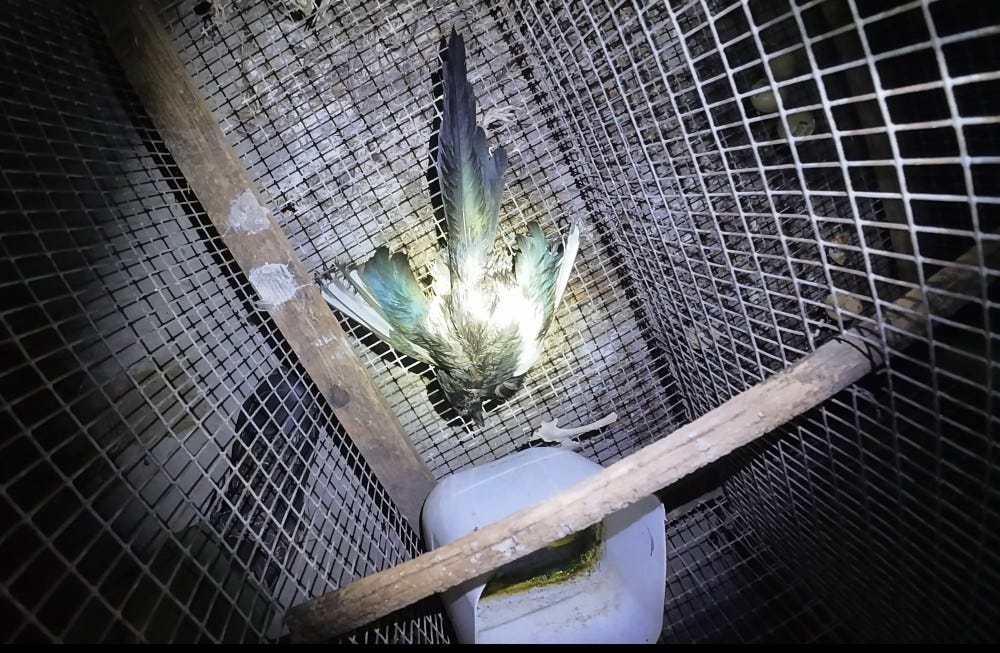
A second Larsen trap, found separately, told a similar story. The only food was a scraped-clean set of old bones and the provided water was thick and green with algae. In this cage, the decoy Magpie was already dead.
Ironically, both traps had a perch fitted - a ‘welfare provision’ that cannot possibly stop a bird from dying of thirst.
Larsen traps are not illegal. Lobbying by the shooting industry has made sure of that. In England (where this pheasant farm is located) they are operated under General Licences issued by Natural England, which exist as exemptions from the Wildlife and Countryside Act 1981’s protection of wild birds.
Shooting lobbyists have whipped up a storm of hatred aimed at Magpies. Traps like these litter the countryside. If they had bothered to read what the General Licences say, a pheasant farm using one to trap Magpies would probably claim it is to protect pheasant eggs and poults. It would (if they had bothered etc etc) be relying on a purpose-specific licence, most likely GL42 (a licence to control birds ‘to prevent serious damage to livestock’ - which includes “gamebirds kept in an enclosure or which are free-roaming but remain significantly dependent on the provision of food, water, or shelter (by and within the release pen) by a keeper for their survival” - the same ‘gamebirds’ which will be sold to be ‘damaged’ by shooters of course) or perhaps GL40 which allows the killing or taking of Magpies to conserve “wild birds of conservation concern” - which clearly doesn’t include non-native pheasants (or Red-legged Partridges).
It’s also worth noting that if relying on GL40 there is a “reasonable endeavour to use alternative lawful methods” requirement which applies specifically when acting against Carrion Crows, Jays and Magpies…
Whichever purpose-licence applies, its use of traps and decoys is only lawful if it also complies with a second document that sits underneath all of them: GL33, “Trapping wild birds: standard licence conditions.”
GL33 sets out what “adequate” provision actually means in practice. GL33 is not optional extra guidance - it is a binding condition of the licence itself:
Food must be sufficient, palatable, and of a type suited to the decoy species. There must be enough to sustain the bird between an operator’s visits, and if carrion is used for a corvid decoy it must be fresh, with enough meat left on it to meet the bird’s needs. Dried-out pheasant remains picked to the bone do not meet that standard.
Water must be available at all times: drinkable, free of contamination, and changed regularly to stay clean - a description that algae-choked sludge plainly fails.
GL33 also requires decoy birds to have appropriate shelter and a suitable perch, and requires traps to be checked at least once every 25 hours - a rule that these two examples clearly suggest was not being followed with anything like that regularity, if at all.
This matters legally as well as morally, because while General Licences don’t need to be applied for (which in our opinion is a clear loophole for their exploitation) they come with conditions. Where GL33’s welfare conditions are NOT being met, the exemption to the Wildlife & Countryside Act that the purpose-licence provides DOES NOT hold for that instance of trapping.
In other words, the conditions filmed here change what should have been abhorrent but lawful, licensed control into abhorrent unlawful taking and possession of a wild bird contrary to the Wildlife and Countryside Act 1981 - a criminal offence sitting alongside, not instead of, any welfare offence.
The conditions found here also bring in the Animal Welfare Act 2006 (AWA). The AWA sits entirely independently of the wildlife licensing framework we described above. It applies to any “protected animal” (in legal terms that means ‘under the control of a person’, which includes a captive decoy bird) regardless of which general licence, if any, was being relied on at the time.
Two sections of the AWA are directly relevant here.
Section 4 makes it an offence to cause a protected animal unnecessary suffering, or to fail to take reasonable steps to prevent it, where a person knew or ought reasonably to have known that an act or omission would have that effect. A bird left to starve over a period of days, watching its food disappear without replacement, sits squarely within what this section was written to capture.
Section 9 goes further, creating a positive duty of care: anyone responsible for an animal must take reasonable steps to ensure its welfare needs are met, including a suitable environment, a suitable diet, the ability to exhibit normal behaviour patterns, appropriate housing with or apart from other animals as needed, and protection from pain, suffering, injury and disease. A single perch in an otherwise barren cage, with fouled water and no fresh food, does not come close to satisfying that duty regardless of what the General Licence’s minimum conditions technically require.
Supporters of the shooting industry - whom for good reason we routinely describe as ‘wilfully blind’ to the horrors surrounding their chosen hobby - will undoubtedly claim that most trap operators are not behaving like this. The usual ‘rotten apple’ script they like to wave around, in other words. Unlike us, though, they are not providing evidence to prove that assertion, and, given the litany of abuses that anyone who looks into this blood-soaked industry will be aware of, why should we believe them?
They might also claim that ‘operator errors’ like these are breaches of a set of rules rather than anything that can be challenged on legal grounds. They would be wrong. The Wildlife and Countryside Act and the Animal Welfare Act are laws, not guidelines. And anyway, that argument simply blasts wide open the weakest point of the whole system: General Licence trapping in England is a weak system that is essentially self-policed by the same industry that stands to benefit most from abusing it.
There is no routine inspection regime,
no independent verification that decoy birds are fed, watered and checked daily,
and enforcement depends almost entirely on chance discoveries like this one - usually made by investigators, hunt saboteurs or members of the public, rather than by any statutory body checking traps in the field.
Magpies starving in cages while being used to bait other wild birds so they can be killed too is a disgrace. These poor birds are a strong argument for getting rid of General Licences and for asking why the hell the self-serving shooting industry should be allowed to regulate itself at all…
Video and images recorded by our undercover investigator in 2026.
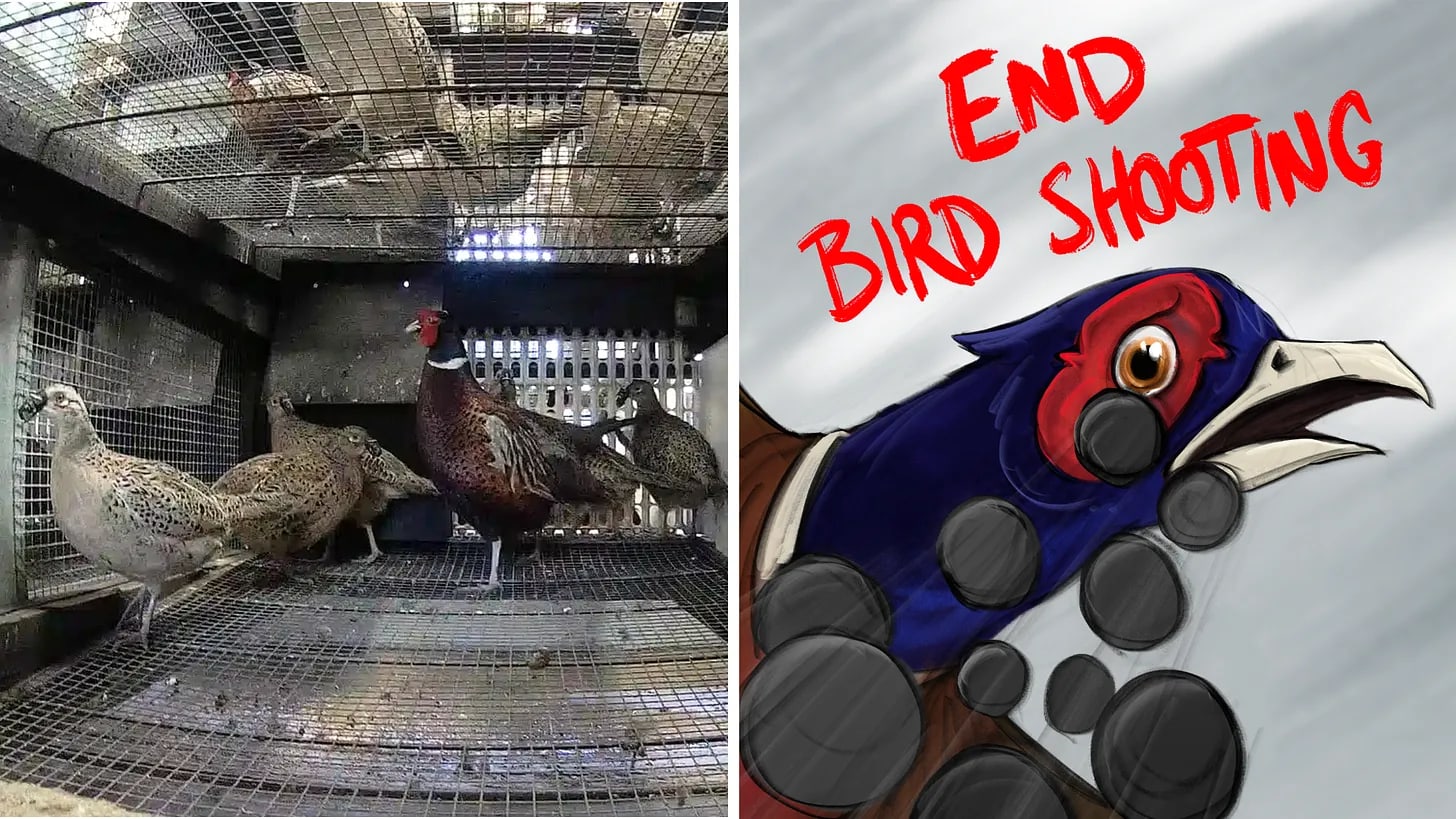
We are working to END BIRD SHOOTING. This suffering has to stop. Please share this article. Share our socials. Follow us for updates.
Over the coming months our campaign will look at the shooting industry at every level. We will highlight the suppliers — the farms, hatcheries, importers and breeders producing tens of millions of birds under conditions that would provoke public outcry if applied to any other animal. We will expose the providers — the estates and syndicates that take those factory-farmed birds and sell the experience of killing them as leisure. And we will look at the clients — the paying guns who are fully aware of the wildlife crime, the trapping of native predators, and the mass suffering involved, and who have decided that none of it is reason enough to stay away.
This industry survives because suppliers supply, providers provide, and clients pay. We intend to examine them all.
We are at the beginning of something. Months of undercover work. Hundreds of hours of footage. Farms across the UK exposed. And we are only just getting started.
But investigations alone do not end industries. People do.
Many of you have already responded and we are extremely grateful, but we are repeating our ask for you to become a Game Changer. We need to make people care. Please stand with us as we take this fight forward, week by week, piece by piece, until the public, the media and the politicians can no longer look away.
The first 500 people to sign up will receive a limited edition pin badge.
This is the beginning. Be part of it.
Comments
Nothing yet. Say the first thing.
Sign in to join the conversation.