
If you know anything about astrology, you have heard about Daddy Saturn, the strict teacher. Put in the years, the discipline, do the work, and eventually it rewards you.
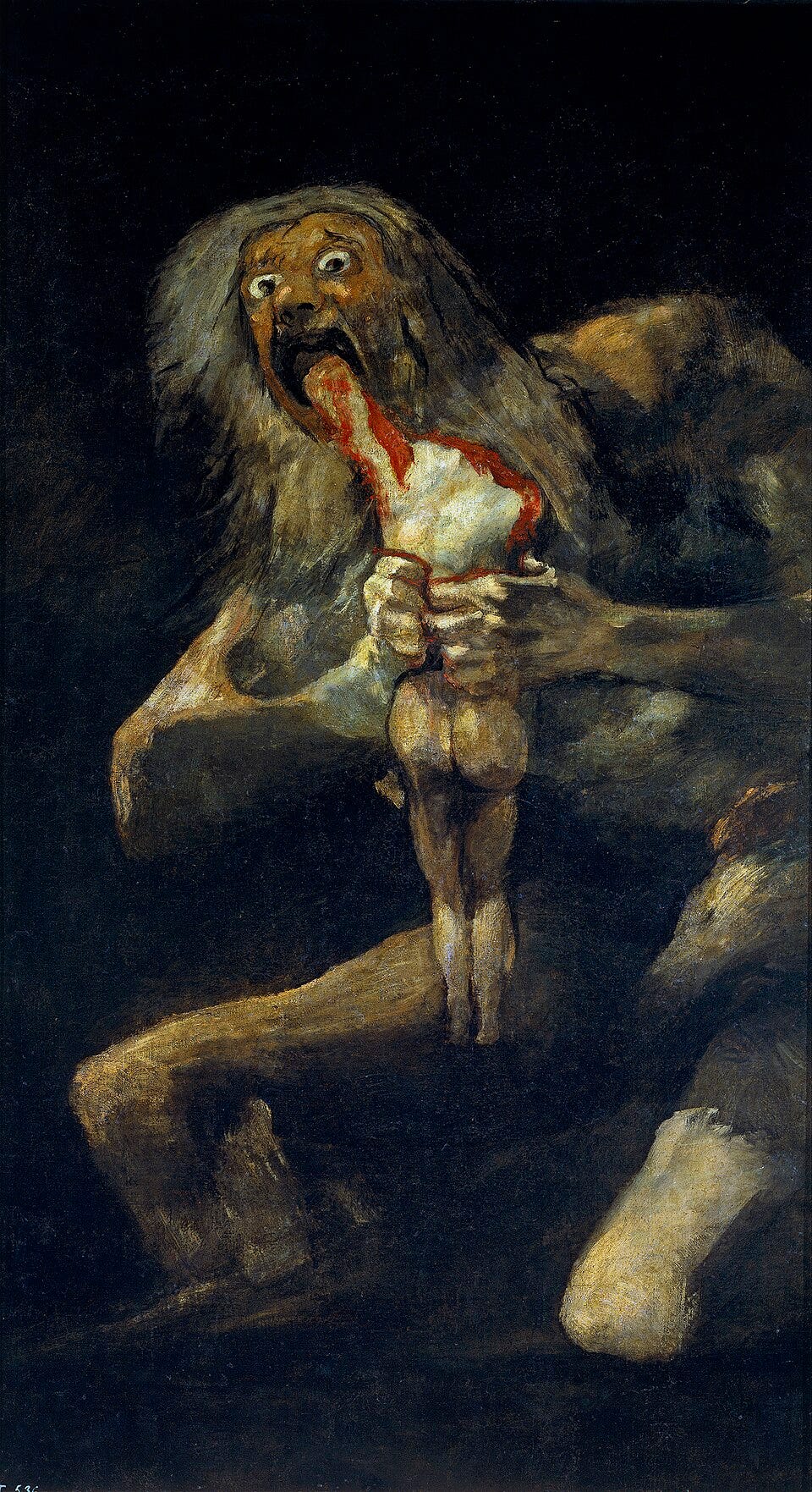
That is the simplified version of a cruel god who ate his own children.
I am not going to take the promise of a reward away from you entirely. Something does come, and we will get to it. First, you need to know who you are dealing with, because Saturn is the part of your chart that rarely lets you forget it, and most people spend an entire life negotiating with it without ever learning its true purpose.
Kronos, the Greek counterpart to Saturn, was the youngest of the Titans. His father Ouranos, the Sky, lay on top of his mother Gaia, the Earth, and pressed down so hard that their children could not be born. He stuffed them back inside her body as they came. Gaia, in agony, made a sickle out of adamant and asked her sons to use it.
Only Kronos took it. He castrated his father and separated the sky from the earth forever.
That is Saturn’s first act in the world — a cosmogonic separation, and everything that follows exists because it was separated from something else. Saturn’s original function is not punishment. It is the boundary that lets a thing be a thing.
Then there was the prophecy: Kronos would be overthrown by his own son, exactly as he had overthrown his father. So he ate them. Each child, as it was born, he swallowed whole. Rhea hid the last one, gave Kronos a stone wrapped in swaddling clothes, and he ate that too without noticing. The child was Zeus. He came back, forced his father to vomit up the others, and threw him down.
Until 1781, Saturn was the last planet.
Beyond Saturn were the fixed stars, which never changed. They were eternal and therefore considered divine. Saturn was the boundary between the world that changes and the world that does not. It was the last thing before God.
So when astrology says Saturn signifies limitation, that is not a metaphor some astrologer invented to make a difficult planet seem more meaningful. Saturn was the limit. For most of the history of astrology, it marked the outer edge of the visible universe.
Your Saturn is not a punishment applied to an otherwise unlimited life. Limitation is the price of having a life at all. You cannot be a specific person without also being a restricted one. The wall is what makes the room.
Saturn is where you stop being infinite and start being someone.
Three more things I want to mention before we get to Saturn in your chart.
In Alchemy, Saturn’s metal is lead. The heaviest, dullest, cheapest thing in the alchemist’s cabinet. It is, however, the beginning of everything. The Great Work starts with lead, and its first stage is the nigredo, the blackening. Rot. Putrefaction. The material breaking down completely into a black mass with nothing recognizable left in it. You cannot skip this stage. The alchemists knew that matter has to be destroyed before it can be made into anything else.
Saturn’s day is Saturday, and Saturday is the day you are commanded to stop. In the Jewish tradition it is Shabbat, and Shabbat is not framed as rest you have earned. It is a prohibition. You are literally forbidden to work. Saturn imposes rest on you as a law, which anyone unable to stop working might recognize as a mercy wearing an unfriendly face.
And the Greeks associated Saturn with the melancholic temperament, ruled by black bile, the heaviest of the four humors. It made you heavy and solitary. Then Aristotle’s school asked: why is it that every outstanding philosopher and poet and artist turns out to be melancholic? Marsilio Ficino, a Saturnine melancholic himself, wrote that the same weight dragging the scholar down is precisely what gives him his intellectual depth. The Saturn that makes you heavy is what lets you go where lighter people cannot follow.
Modern astrology talks about Saturn almost entirely as an event. The Saturn return at twenty-nine. The squares at seven, fourteen, twenty-one, and so on. The opposition in your forties. All of it is useful, of course, but it is obscuring the more important fact underneath.
Your natal Saturn is not an event. It is a permanent condition you have to live with.
It was in your chart the day you were born and it will be there on the day you die. It does not pass over. It does not lift. Whichever house it occupies is where effort, fear, delay, responsibility, and consequence tend to gather. That does not disappear at thirty, or sixty, or ever.
Transits are weather. Your natal Saturn is the ground you are standing on.
Which means the Saturn return is not the moment Saturn “happens” to you. It is the moment you finally notice what has been there the entire time, because the planet comes back to the exact degree it occupied at your birth and puts the whole account in front of you at once.
So the real question was never “when will this transit be over.” It is this: what are you going to do about the one part of your life that is permanently harder than it should be?
Answering that takes three things. Knowing whether Saturn is working for you or against you. Knowing what it is made of, which is the sign. And knowing where it lives, which is the house. The aspects are important, too, but even understanding these three things will put you ahead of everyone else.
Here they are.
Comments
Nothing yet. Say the first thing.
Sign in to join the conversation.