
The Democrats are having an identity crisis. They lack a clear message and strong messengers. Their opposition to Trump and the Republican Congress has been ineffectual to the point of invisible. Their traditional constituencies are vanishing or defecting. They’re blaming each other, not looking for solutions.
What’s a Democrat to do?! The New York Times is busily running a series on the “battle for control” of the party. (Is that the right frame? Is there something that Zohran Mamdani and Dan Osborn are battling to control?) Ezra Klein says they’d better figure it out. (Unfortunately, some of the ruminations sound like a Monday-morning football panel on Morning Edition rather than a hard-nosed strategy session.)
With that as an introduction, here is a clipping from my archives:
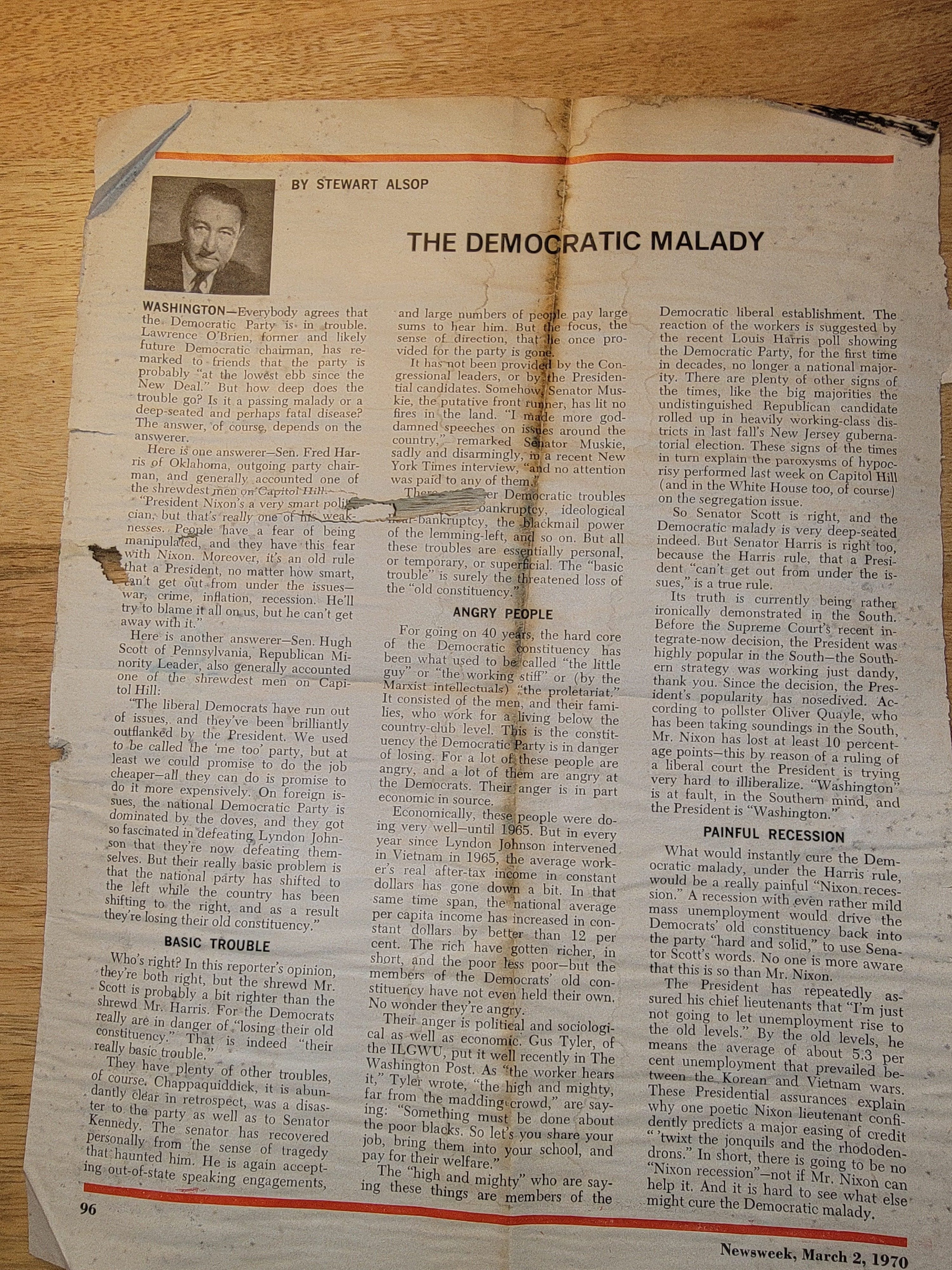
Newsweek columnist Stewart Alsop quotes the Senate Republican Leader:
“The liberal Democrats have run out of issues, and they’ve been brilliantly outflanked by the President. We used to be called the ‘me too’ party, but at least we could promise to do the job cheaper—all they can do is promise to do it more expensively. On foreign issues, the national Democratic Party is dominated by the doves, and they got so fascinated in defeating Lyndon Johnson that they’re now defeating themselves. Their really basic problem is that the national party has shifted to the left while the country has been shifting to the right, and as a result they’re losing their old constituency.”
That was in 1970.
The description does not perfectly fit our moment, but the point is that Democrats have been here before. Repeatedly. Why do they fail to recognize its recurrence? Each time, they wring hands as if they had never been there before. But you don’t have to look far to find comparable moments for the party (2010, 1994, 1984, 1972, 1952…), much less the political violence, the polarization, the disintegration and reorientation. And yet we seem to treat each time as novel, and impossible.
We’d like to see the arc of the 20th century bending in a progressive direction, but maybe it would be better to look at the past 125 years as a perpetually divided time during which leaders were often elected based on narrow or unpredictable circumstances. We’d like to attribute positive change to the election of Democratic presidents, but look again: Woodrow Wilson came in only after Theodore Roosevelt split the Republicans in 1912. FDR won during a crisis by running against the establishment. Truman took up his legacy but had to drop out after New Hampshire in 1952.
Barack Obama, Bill Clinton and John F. Kennedy start to look like singular figures attuned to a moment, interspersed with national losers like Stevenson, McGovern and Mondale, rather than peaks on an upward graph.
On a similar note. In that recent podcast, Klein described “the work of politics” as “bridging over a lot of profound, fundamental, moral disagreements.” Sure, that is one way you could practice politics. It’s a nice idea. But it’s not the way most politicians go about it. It’s not how machine politics1 or corporate politics or global diplomacy works. It’s like saying, “Make America great again.” When did it work that way, exactly? (When reformers get power, they’re just like everybody else: they want to keep it.)
How did we get here, condemned to repeat the past we can’t remember?2 Dashka Slater has one theory, stemming from the death of Charlie Kirk: “As I tried to understand what was happening, it occurred to me that the chattering class, fearful of what the uptick in political violence might presage for the future, had decided that the best way to prevent it from continuing was to downplay the stakes of our national disagreements.” She compares it to post-Franco Spain, where forgetting the past was essential for moving forward democratically.
Maybe the right kind of amnesia would be helpful. Rather than finding their way back to an ambiguous moral calling, maybe Democrats should just figure out how to win the next election.
According to Daniel Okrent in his book Last Call, historian Daniel Boorstin wrote that the difference between a political machine and a political party was that the former is about its own survival, while the latter focuses on some goal or cause beyond itself. What have we here?
One other example from my archives: A UPI article from Ronald Reagan’s time as governor of California (1967-1975). A group of professors at UC San Diego known as the “Committee to Save the Universities” called for an end to the “intrusion of political matters” into the classroom. The leader criticized “radical” professors and appealed to a “moderate middle” to oppose them. The group got a welcome hearing from Reagan, who had been elected in 1966 in part by criticizing the Democratic incumbent’s allegedly lax response to the Free Speech Movement at UC Berkeley.
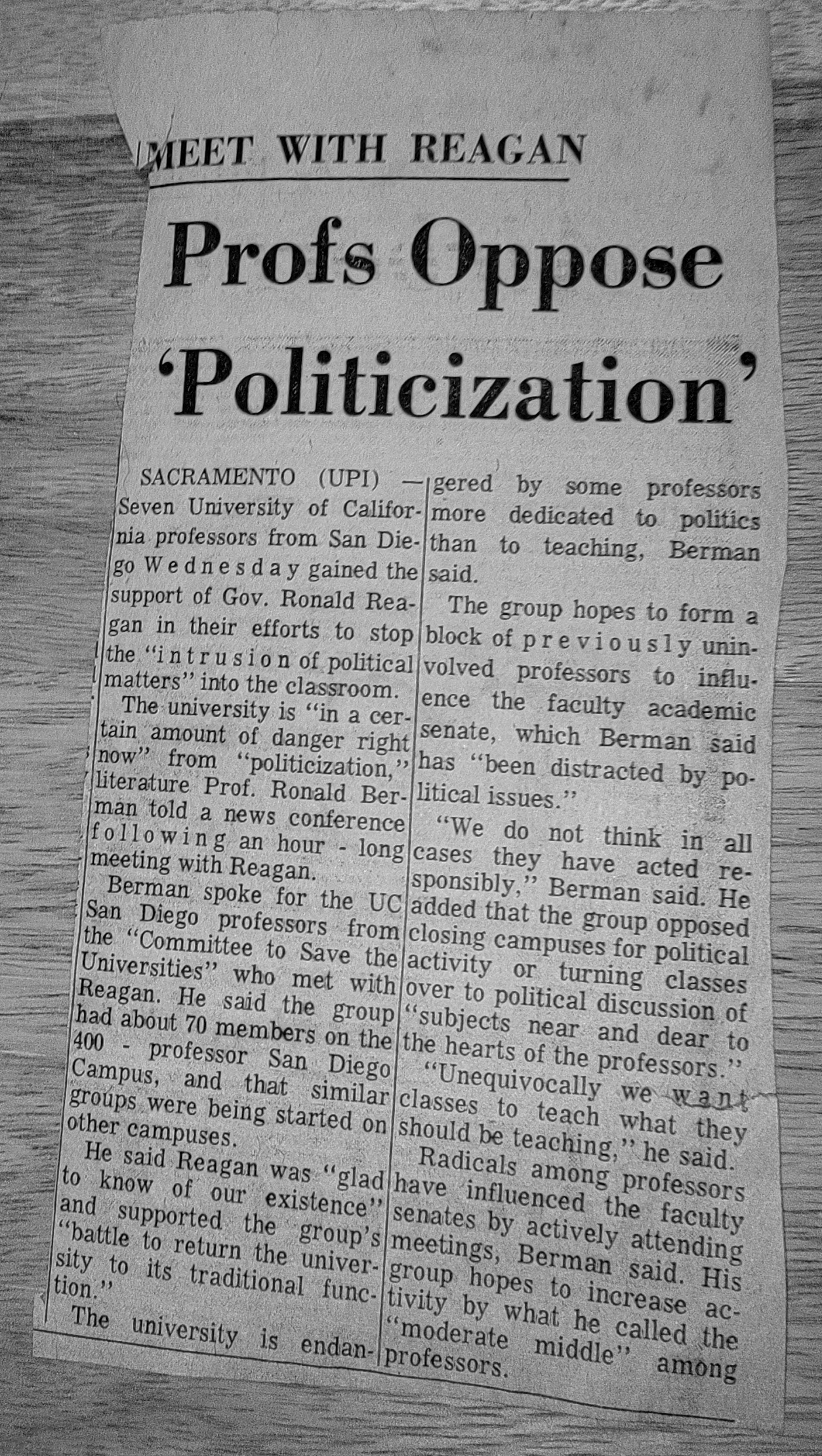
Why are these items among Walter Quigley’s papers, given that they happened after his death? Most likely, his daughter Kate clipped them because she shared his interest in the direction of our country.
Comments
Nothing yet. Say the first thing.
Sign in to join the conversation.